


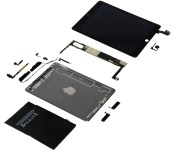
iPad Air 2 Material Costs Hold Steady Starting at $275, but New Storage Tiers Erode Profit Margin
As it always does with Apple’s major new iOS devices, research firm IHS iSuppli has torn down the new iPad Air 2 in an attempt to estimate Apple’s component costs for the device (via Re/code). According to IHS iSuppli’s estimates, the 16 GB iPad Air 2 costs Apple roughly $275 to build, just one dollar more than last year’s iPad Air.

The report unsurprisingly points out that Apple benefits from stronger profit margins as users move to higher capacity models, with Apple paying only about $50 more for 128 GB of storage compared to the base 16 GB configuration while charging users $200 for the upgrade. Still, Apple’s move to eliminate the 32 GB option and slide the 64 GB and 128 GB models down $100 has slightly eroded Apple’s profit margins at the top end.
The latest report from the research firm IHS, due later today and shared exclusively with Re/code, shows that the base model of the iPad Air 2, the 16-GB Wi-Fi version, which sells for a price of $499, costs $275 to build, exactly one dollar higher than the previous base model. The top-end model, the 128-GB LTE version costs which sells for $829 costs $358.
Apple’s implied profit margin on the iPad Air 2 has dropped slightly to a range for 45 percent to 57 percent depending on the device, compared with the original at 45 percent to 61 percent.
Many of the components have remained the same between the iPad Air and the iPad Air 2, with Apple’s use of essentially the same display unit allowing the company to reduce costs of that component from $90 to $77. But with Apple’s move to bond the display to the device’s cover glass and the addition of a new antireflective coating, the same display offers a significantly better user experience.
Other changes include the move to a powerful new A8X chip currently unique to the iPad Air 2, and improved cameras that have resulted in slightly higher component costs.
As always, it is important to note the estimates from IHS iSuppli cover only the cost of the individual components that make up the device and do not include other costs involved in product development, manufacturing, and sales, such as research and development, software, patent licenses, marketing, and distribution expenditures. All of these costs contribute to significantly reduce Apple’s true profit margin from the levels cited by IHS, but the basic component cost remains an interesting glimpse at how Apple brings everything together to consistently hit its retail pricing goals.
Watch this App: Minimal & Elegant
You not only get the ability with this app with change the colors of this sleek, minimal watch face, but you get to schedule when they change as well! You can set multiple times throughout the day when your smartwatch will change colors, which is very personable. Custom text is available to you that you… Read more »
The post Watch this App: Minimal & Elegant appeared first on SmarterWatching.
Read the rest at SmarterWatching.com!
The post Watch this App: Minimal & Elegant appeared first on AndroidGuys.

YouTube’s music streaming service almost ready for launch, according to CEO

YouTube CEO Susan Wojcicki spoke about YouTube’s upcoming music streaming service and stated that the service will offer offline playback and other functionality with competitors.
Whilst no additional granular details were offered about the service, Wojcicki is optimistic that the service will be launching in the near future.
YouTube is also reportedly looking at ways of offering paid subscriptions to remove advertising from videos.
Will you be purchasing a subscription to YouTube if one was offered?
The post YouTube’s music streaming service almost ready for launch, according to CEO appeared first on AndroidGuys.
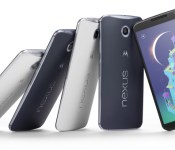
Google talks screen size of Nexus 6, thinks people want giant phones
 When Google announced the Nexus 6, there were two details that raised eyebrows. The biggest shock was definitely the pricing, since most of us have gotten used to the incredibly cheap phones and tablets in Google’s Nexus lineup. However, the size of the phone has also become a hot topic for debate.
The Nexus 6 sports a 5.9-inch screen, which is considerably bigger than the 5-inch screen offered on the Nexus 5 from last year and still slightly bigger than even the largest phablets on the markets today. It’s clear that Google wanted an absolute top-of-the-line device with the Nexus 6, but there are still questions about whether or not customers will want something that big. Google thinks they do.
When asked about the size of the screen, Google’s VP of Engineering for Android David Burke said that if most people tried out a phablet device, they would eventually like it and wouldn’t be able to go back to a smaller screen device. It’s a bold claim, but it has a lot of merit. There are fewer and fewer smaller devices, and consumers seem to gravitate towards phones with massive screens.
If you just refuse to get a phone with a giant screen, Burke pointed out that there are still options. Google is still selling the extremely capable Nexus 5 alongside the Nexus 6, and there will always be options from other manufacturers. If you need a cutting edge flagship phone, though, it looks like Google and everyone else is pushing for tablet-replacement devices.
source: Cnet
Come comment on this article: Google talks screen size of Nexus 6, thinks people want giant phones

PS4 Remote Play app now live on Google Play with support for Xperia Z3 devices

Sony has today launched its much-anticipated, eagerly-awaited PS4 Remote Play application, which is, for those unaware, a revolutionary new feature that gives users the ability to stream games from their PS4 console to an Xperia Z3 smartphone or tablet.
The app is now available to download through the Play Store for free and is compatible with the Xperia Z3, Xperia Z3 Compact and Xperia Z3 Tablet Compact. To make playing games on your mobile device more manageable, Sony intends to introduce a new GCM10 GAME Control Mount for its official DualShock 4 wireless controller, which looks much like a suction mount on a Sat-Nav.
Configuring Remote Play is simple. All you have to do is update your PlayStation 4 to the latest software version 2.0 which is scheduled to roll out later today and download the application on your Xperia device, and then you’re good to go.
To see PS4 Remote Play in action — be sure to check out the demonstration video below:
Click here to view the embedded video.
Come comment on this article: PS4 Remote Play app now live on Google Play with support for Xperia Z3 devices

Watch the trippiest virtual trip through the Large Hadron Collider

We’ll bet you didn’t wake up this morning wanting to experience what a particle goes through as it zooms along the massive tunnels of the Large Hadron Collider. Oh, wait — you did? Well, game development studio Funktronic Labs is waaay ahead of everyone. The firm has already created a trippy first-person virtual reality journey through the LHC, as an homage to the Higgs boson-like particle it found back in 2012. You can interact with the kaleidoscopic world and control your virtual trek by waving your hands (and using pinch-and-pull motions) over a Leap Motion detector, which triggers visual changes on screen. But, if you’re lucky enough to have an Oculus Rift at this point in time, you can use one for a more immersive (and very, very trippy — because this needs to be said more than once) experience. Don’t have either? Don’t worry: head after the break and watch a preview video to at least get a glimpse of the psychedelic experience.
Filed under: Science
Via: Wired
Source: Funktronic Labs (1), (2), Leap Motion App Store

Algoriddim’s Djay 2 app heads to Android with Spotify integration

Algoriddim’s Djay app has come a long way since its Mac-only beginnings in 2006, but after years of Apple exclusivity, Android users are finally welcome to join the party. Djay 2, the current version of the award-winning mobile mixing platform, has finally been ported over to Android (for phones and tablets runing 4.1 or higher) and is available today on Google Play and Amazon’s Appstore for $2.99. Those familiar with the iOS version will find that little has changed after making the jump across the aisle. The app still gives you hands-on scratching and cueing, HD waveforms, Automix, in-app recording, pitch adjustment and on-the-fly effects for the full DJ experience. Spotify integration, which launched last May, is included to give premium account users instant access to its cloud-based library of tunes. And with Spotify’s Match feature, DJs can get intelligent recommendations on what to play next. The app also dips directly into Play Music to let you select from your own locally stored audio files. We took the app for a quick test drive and found that it’s a solid interface, but DJs looking to use MIDI controllers like the Reloop Beatpad for Djay will need a few more cables than their iOS counterparts to get the job done. Join us in the gallery below for a quick look at this new Android version of Djay 2.

Tidal brings pristine streaming music to nearly every device you own

You can already check out Deezer Elite if you want high-quality streaming music, but it’s only available on Sonos devices. That’s not very useful when you’re away from home, is it? Thankfully, Aspiro has stepped in to fill that void with a far more accessible service, Tidal. The offering brings lossless internet tunes to Android, iOS, the web and seemingly every networked media player on the planet; the company has deals to support gear from 34 home audio companies, including Sonos and Denon. Tidal also has a few incentives to come back besides new albums, including articles, music videos and a Shazam-style song recognition feature. You can give Tidal a spin today, but be prepared to cough up some cash for that no-compromise sound. It costs $20 per month in the US (£20 in the UK), or about twice as much as many run-of-the-mill services.
Filed under: Home Entertainment, Internet, HD
Source: Tidal
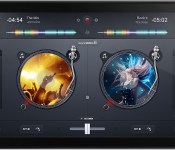
Longtime Apple-Exclusive Studio Algoriddim Brings ‘Djay’ to Android [iOS Blog]
Longtime Apple-exclusive developer Algoriddim has made a name for itself with its popular djay app that first found success on the Mac before moving to iPad and eventually iPhone. The app has been featured prominently by Apple over the years, winning an Apple Design Award in 2011 for the original iPad version, and just this month it was featured as a key music app in promotional materials for the new iPad Air 2.
So after such a long tenure and significant success on OS X and iOS, we were interested to learn that Algoriddim is announcing today an expansion to Android, bringing the full djay experience to that platform. While Algoriddim is by no means the first iOS developer to branch out to Android, it is a high-profile, award-winning one and so we chatted a bit with Algoriddim CEO Karim Morsy to find out more about the how and why of the company’s move, a perspective not frequently shared at MacRumors.
Morsy pointed out that with, or perhaps despite, 15 million downloads on iOS, the number one request from djay users has long been an Android version of the app. With a strong presence on the Mac platform as well, Algoriddim found plenty of Mac and/or iPad users who use Android phones and have been asking Algoriddim in large numbers to bring the app to their phones.

Rather than a simple port of the iOS version of djay, Algoriddim built the Android version of the app from the ground up, replicating the look and feel of the iOS version wherever possible while bringing feature and performance parity, something that was not always a given considering the pace with which proper tools and frameworks for Android were becoming available. But with the release of Android 4.0 three years ago, Algoriddim finally felt the tools were in place to pursue bringing djay to Android.
Morsy expected development to be challenging, and indeed it was, particularly ensuring that djay worked well across the variety of devices running Android, with the diversity of screen sizes and performance-related specs requiring significant amounts of work to optimize for.
We also asked Morsy whether Algoriddim is expecting any backlash from Apple with the expansion of djay to Android, given that Apple likes to tout apps and other content that is exclusive to its own platforms. But Morsy noted that Apple regularly features apps available across multiple platforms and that the history and continued popularity of djay on Mac and iOS is likely to remain a strong factor as Apple weighs future feature opportunities for the music segment.
As was added to djay 2 for iOS earlier this year, djay 2 for Android brings full integration with Spotify’s premium music subscription service, including auto-matching of tracks using technology from The Echo Nest, which was acquired by Spotify in March of this year. The Android version of djay 2 launches today at a limited-time introductory price of $2.99, and users will also receive a free one-week trial of Spotify Premium to test out the service with djay.

Apple Adds ‘Fyi’ and ‘Feeln’ Channels to Apple TV [iOS Blog]
In yet another addition to the growing stable of channels available on the Apple TV, A&E’s Fyi network and Hallmark’s streaming family movie channel Feeln have been added to the set-top box today.

As with many other channels, Fyi offers some free content, but complete access to streaming on-demand episodes requires authentication with a participating cable provider. The television, which launched as a rebranding of The Biography Channel earlier this year, focuses on “contemporary lifestyle” topics.

Feeln’s subscription service is priced at $4.99 per month with a one-week free trial or $47.99 per year with a one-month free trial. The service offers reasonable library of family-friend movies for streaming, including some box office hits, Hallmark originals, and original shorts.


 AIVAnet