



Samsung Galaxy A7 makes appearance on benchmark site

We have seen a few leaks surface for the Samsung Galaxy A7, but the latest appearance on the GFXBench benchmark site may provide some of the best information yet regarding the device. Unfortunately, one datapoint throws some confusion into the mix. Previous leaks showed the Galaxy A7 having a 5.5-inch screen. However, the entry in the GFXBench database lists the device as having a 5.2-inch display. We will have to wait to see what the final size it. Despite that bit of uncertainty, the rest of the specs look to be solid.
The display, whatever size it ultimately ends up being, is listed with a resolution of 1920 x 1080 which is consistent with a previous report that the device would have a full HD display. Powering the device is a new octa-core processor, the Snapdragon 615. This is a step up from the Snapdragon 410 processor that is becoming common in non-flagship devices as well as the Galaxy A3 and the Galaxy A5.
The new database entry with GFXBench also reveals the Galaxy A7 will come with 2GB of RAM, 16GB of internal storage, and will be running Android 4.4.4 KitKat.
We still don’t have pricing or availability information for the forthcoming A-series phones from Samsung.
source: GFXBench
via: SamMobile
Come comment on this article: Samsung Galaxy A7 makes appearance on benchmark site

New contender for world’s thinnest smartphone surfaces from Vivo

Industry watchers who pay attention to super-thin smartphones, and notably the record for world’s thinnest smartphone, know that Gionee has managed to hold the title for a while now. The current record holder is the Gionee Elfie S5.5 that measures only 5.5mm thick. A couple months ago rumors surfaced that Gionee was working on a successor, the G9005, that would bring the thickness down to only 4.9mm. Some new images posted to Weibo suggest Gionee may have some competition from Vivo in the near future.
The images that have surfaced show a device from Vivo that measures a mere 3.8mm in thickness. To help put that in perspective, that is half the size of an iPhone 5/5S which comes in at 7.6mm. Even the new iPhone 6 is still a whopping 3.1mm thicker than this new device, if Vivo manages to bring it to market.


source: Weibo
via: G for Games
Come comment on this article: New contender for world’s thinnest smartphone surfaces from Vivo

What you need to know about the world of online dating

If a smoky, beer-soaked pub is the last place you’d go to find Mr. or Mrs. Right, online dating is a godsend. Ideally, it brings together like-minded couples in a non-threatening virtual space, so they can get to know each other before committing to a physical date. On top of the countless mainstream sites, there are specialized ones to help you find someone with the same religion, interests and sexual preferences — whether you’re seeking a friendly relationship, life partner or a one-night stand. There are serious pitfalls to avoid, of course: dodgy sites, “catfishing” and, worst of all, online predators. But despite the risks, online dating works. Most of us know at least one person who’s met their partner online — if you don’t, I’m one of them. Nice to meet you! All it takes is some common sense and a pinch of savoir-faire.
WHAT IS IT?

Online dating sites are databases that can match you to a partner with the qualities you prefer. The concept of meeting in cyberspace predates the World Wide Web. The oldest dating site that’s still around is Matchmaker, which started as a dial-up BBS in 1985 and ran on a RadioShack TRS-80 with six modems (above). At first, it was a crude listing of mostly computer nerds within the same area code, but it grew to include email exchanges and became one of the largest pre-web email networks.
Eventually that site and others joined the internet, and today, dating sites in the US draw nearly 30 million unique visitors per month. Some of those, including Match.com, offer free trials or crippled features, but require a subscription to make contact. Others, like OKCupid.com let you browse potential mates for free (supported by ads), while offering a paid premium option with more features — advanced searches, message read receipts and so on. Another well-known, mobile-only site is Tinder, which lets you quickly like or reject suitors in your area. There are also specialty sites like Adam4Adam for gay men, or JDate (below) and ChristianMingle, aimed at Jewish and Christian singles, respectively.
Then there are the more controversial sites like Ashley Madison, targeted at people seeking extramarital affairs, or SeekingArrangement.com for “sugar daddies” willing to set up younger women in exchange for sex or companionship. At the bottom rung are risky sites like AdultFriendFinder, aimed mostly at people looking purely for sex.
WHO’S WHO IN ONLINE DATING?
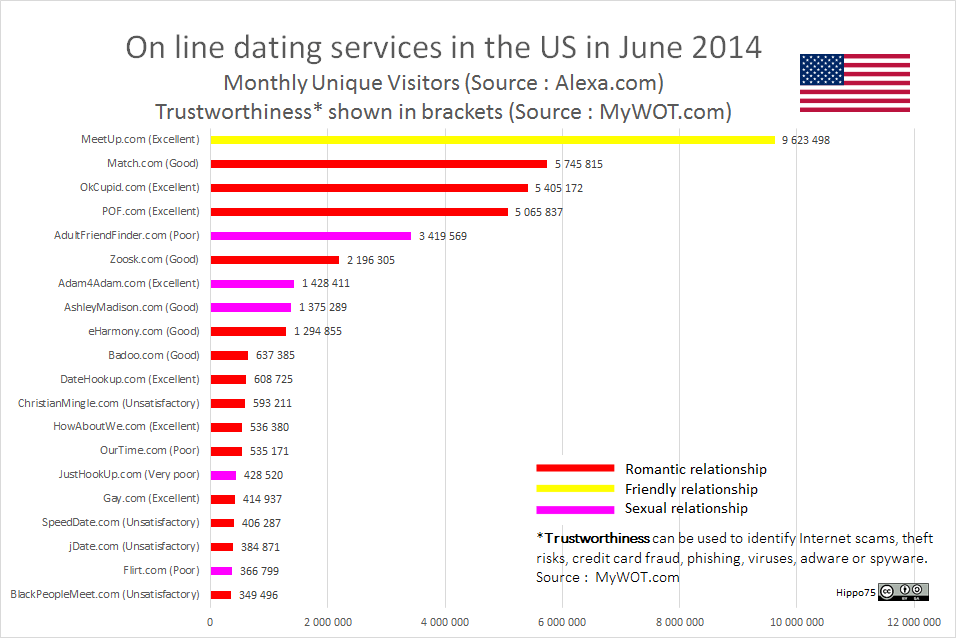
There’s no reason why you can’t play the field with dating sites, but they vary widely in reputation. The top 20 in terms of unique visitors (according to Alexa) are shown above. They’re ranked not only by size and type (romantic, friendly and sexual) but also reputation, as determined by MyWOT.com. The most popular subscription site is Match.com, which carries a “good” rating, while “freemium” sites OKCupid and PlentyOfFish (POF) each have “excellent” user ratings (Meetup.com is mostly targeted at folks looking to join clubs). The main specialty sites aimed at Jewish, Christian and black singles have garnered “unsatisfactory” ratings, while gay sites GayDar.net, Adam4Adam and Gay.com scored “excellent.”
As you might expect, pure hookup sites are fraught with hazard: AdultFriendFinder.com and JustHookUp.com rate “poor” and “very poor” in reputation, respectively. Such sites have been accused of billing customers after they’ve canceled, inflating user figures with numerous fake profiles and rampant prostitution.
WHICH TO PICK?

Though rating individual sites is beyond our scope, we’ve compiled recent rankings from several sites like Marie Claire, PC Mag, Wikipedia, Lifehacker, Mashable and more. Here are the top four, along with the cost for a single month and the typical user.
Match.com, $43, leads in sheer numbers of users. On top of more choice, PC Magazine pointed out that the site has “far more search options than we found in any other dating site,” including physical appearance, exercise frequency and occupation, to name a few. The downsides are the high price and constant requests for more cash to see who visited your page, for example.
POF.com, free, is popular, but it sure ain’t pretty. The site will make design purists go cross-eyed, and it often serves up skeevy banner ads. Given the large number of user profiles, however, it might be a good place for a newbie to start before taking the subscription leap.
eHarmony.com, $20-$40/month, quizzes each of its users exhaustively and employs custom algorithms to make a match. As you’d expect, that scientific approach is best for users looking for a long-term relationship. And it does work: According to eHarmony, 90 of its members get married every day (you can read some of the touching testimonials here). On the downside, the site — which started as a Christian network — targets primarily heterosexual couples. It only started allowing gay and lesbian users in 2010 after it was forced to by a lawsuit.
OKCupid.com, free, is the anti-eHarmony. According to PC Mag, it’s better at filtering out unsuitable partners than making proactive matches. However, it sports 30 million or more active users, with a million logging in every day. That gives you a good chance of finding a date, but according to the Telegraph, also makes it “an absolute hive of polyamorous kinksters, furries and others… at the odd end of the dating pool.”
Our resident dating expert Tim Seppala prefers OKCupid, as do several other Engadget editors. Why? “Well, it’s free, and it doesn’t feel gross — unlike POF.com.” The large number of users and messages is a plus, though Tim added that “the overall user population isn’t the best in my area, and there are a lot of people who are ‘very hesitant’ to meet someone in person.”
WHAT’S THE STRATEGY?

Instead of making a long-term subscription commitment and regretting it, why not start with a free site? That way you can test the waters, figure out what does and doesn’t work and get a nice, tight profile before paying anything. Some sites will give you a free trial with a credit card, but automatically start billing unless you cancel the subscription — which is often difficult to do. If you do decide to go onto a pay site, take a long, hard look at the cancellation policy. One pro tip for trials: Many credit card companies will give you a virtual account number to use, which you can limit in time and value.
Next is that all-important profile. You need clear photos that accurately represent how you look now. Avoid selfies, and if possible, have a friend take a full body shot, preferably outdoors. According to Marie Claire, action photos that show you playing sports or the guitar get the most messages. Meanwhile, your self-description should be free of “long walks on the beach” tropes, and focus concisely on specific things you love, fun facts about yourself and sociable hobbies — not activities you do alone. Avoid negative comments, especially about previous relationships. Finally, ask friends to read your profile, since they might know certain things about you better than you do.

Once you’re ready to contact someone, GQ adds that it’s best to keep messages cool and casual. Coming on too strong, while occasionally amusing, is off-putting. Try to focus on the other person and not talk about yourself too much. Our Managing Editor Dana Wollman recalls meeting several nerdy dates online who, upon learning her job, proceeded to talk all evening about gadgets. Guess what! When you work in tech all day, it’s the last thing you want to discuss. If you actually pay attention to the other person and read the signals, you’ll avoid such faux pas.
Finally, be patient and picky. You might get lucky and meet Mr. or Ms. Charming right off the bat. But more likely? You’ll have to give a lot of frogs the ol’ cheek turn. Here’s an example of a date gone wrong from our own Tim: “I went out with a really cute girl for three weeks, and then she suddenly tried passing me off to her (much less cute) roommate. It was a ploy, and they were both in on it.” Ouch.
DANGER!

The bad news: Online dating (or any dating) has a seamy side, and women especially need to beware. As recounted by Jezebel, certain dates can go sideways, but at least you can laugh about them later. However, there are plenty of deranged individuals out there who look at dating sites and see a trove of potential victims. In some cases, the results can turn out tragically.
The good news: There are steps you can take to ward off such problems. Here are some tips from JDate, Reader’s Digest and others.
Choose sites wisely. It’s best to stick with reputable sites that have at least a “good” trust rating. The Dating Gurus and others can help with full-encounter site reviews. Beware of signing up long-term (even if the price is tempting) and make sure it’s easy to cancel your subscription.
Never give out your private contact information. This should go without saying, but criminals can be very persuasive. If anybody insists on having your phone number or other private info, it’s a strong red flag.
Never send money. Scams abound on dating sites, and con men or women will often string marks along for months before swooping in for the score. A typical scam might be similar to a Nigerian con: Somebody needs money to, say, import a large inheritance, and if you can just help them out, they’ll pay you back, double. Sure.
Speak by telephone a lot. Though it’s tempting to just IM and message all day, you’ll generally get a much better sense of someone over the phone.
Meet in public and tell a friend where you’re going. A restaurant, mall or other public place is great for a first date, but a hotel room or private home is definitely not. Make sure to touch base with a friend or relative to let them know when and where you’ll be for a date. Confirm when you’re back home safely.
Arrange your own ride. Never accept a lift from someone you just met in person, no matter how nice they seem. Have a plan for getting home.
Go with your gut. If a situation doesn’t feel right, back out. A potential partner that seems too good to be true probably is.
WANT EVEN MORE?

On top of the many links you’ve seen so far, there’s more! They say the best education comes from your own mistakes, but do you know what’s even better? Other people’s mistakes! The Awl has a compendium of dating horror stories; read them and weep — and learn. For a deeper dive into the sociology of online dating, check out Vice’s chat with New York Magazine columnist Maureen O’Connor. Meanwhile, check out PCMag’s comprehensive reviews, along with The Dating Gurus (which also has general dating advice) and Wikipedia (which shows traffic, trustworthiness and more). Mashable has a list of the hottest new dating sites; Marie Claire compiled a top list for UK denizens; and LifeHacker has a recent list of the best sites. It’s a very, very deep topic and we’ve left out huge swaths like speed dating, virtual dating, dating assistants and others we haven’t even thought of. Heck, if you’re at a loss for words, you can even hire a ghostwriter.
(Image credits: Getty/AFP [Lede photo]; Wikimedia Commons [Matchmaker.com]; Hippo75/Wikimedia [Online dating chart]; JDate [JDate YouTube ad]; FRED DUFOUR/AFP/GettyImages [Adopteunmec]; AP [Laptop image]; Getty Images [Speed dating]; AFP/Getty Images [Danger image]; Kelley Boone/Wikimedia Commons [Couple])
Filed under: Internet
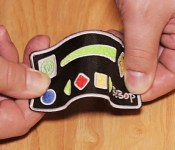
BeBop’s smart fabric puts sensors in everything you wear

Wearable sensors don’t tend to do much; they’re usually limited to health data like EKG readings or your heart rate. If BeBop Sensors has its way, though, they’ll be useful for just about anything that comes in contact with your body. Its new smart fabric sensor tracks virtually every aspect of physical presence, including bending, location, movement and pressure. As you might imagine, that opens the door to… well, quite a lot. You could have smart insoles that track both your pace and your running style, or baseball gloves that help perfect your swing; BeBop also sees uses in everything from wearable controllers to smart yoga mats that improve your poses. The company is only providing the basic technology, not finished products, so it’ll be a while before you see this smart cloth in something you can buy. Even so, it’s clear that there’s a lot of potential — you may always have a way to measure your activities without resorting to wristbands or other conspicuous gear.
Filed under: Wearables
Source: BeBop Sensors, Thomas PR

Tiny tethered drone gives soldiers a view of the dangers ahead

Drones already give troops valuable data about enemies and devastated areas, but the existing vehicles have their limits; big aerial drones can’t see inside buildings, and their ground-based counterparts can’t get over rough terrain. Well, CyPhy Works might just have a reached a happy balance between those two extremes. It recently signed a deal with the US Air Force to produce the Extreme Access Pocket Flyer, a very tiny UAV (it weighs just 2.8oz) that sends HD video to soldiers for up to two hours. The key to its portability is a 250-foot microfilament tether that delivers both power and data — bulkier gear like batteries will stay with the soldier. This has the upshot of adding reliability and security, since there’s no wireless signal subject to interference or jamming.
The military may be calling dibs on the Pocket Flyer, but combat recon (such as special forces and tunnel surveillance) is only part of the story. CyPhy notes that the focus will be on search and rescue; the drone should help find people in collapsed buildings and other situations where it’d be too dangerous to go in blind. While there’s no firm timetable for when this pint-sized machine will be ready, it’s far enough into development that you could see it enter service relatively quickly.
Filed under: Robots
Via: IEEE Spectrum, Geek
Source: CyPhy Works

LG G Pad 10.1 shows up at FCC with LTE connection for Verizon

In time for the holiday season, Verizon is bolstering its tablet lineup. The G Pad 10.1 recently appeared at the FCC seeking approval. It just is not a WiFi-only variant of the LG tablet, though. This is a version of the G Pad 10.1 that has an LTE connection. Verizon and LG have not said anything about this device at this time.
Even with an LTE connection, the G Pad 10.1 is expected to be affordable. The specifications are not cutting edge; however, they are perfectly suitable for many consumers. The display’s resolution is 1280×800. The processor is a Snapdragon 400 with 1GB of RAM. The camera on the back is 5MP and up front is a 1.3MP camera. Nothing too crazy on this device.
Come comment on this article: LG G Pad 10.1 shows up at FCC with LTE connection for Verizon
ASUS MeMO Pad 10 officially released

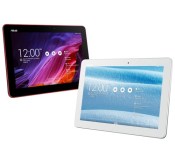
ASUS has officially launched a new 10-inch tablet device carrying a $199 price tag. The ASUS MeMO Pad 10 is on the lower end of the spectrum when it comes to hardware. The device has a 10.1-inch display running at 1280 x 800 resolution, yielding 149ppi. Powering that display is a Snapdragon S4 Pro quad-core processor with a 1.5GHz gpu and 1GB of RAM.
The MeMO Pad 10 will come equipped with 8GB of internal memory, but this can be expanded via a microSD slot. One bright spot in the otherwise modest specs are the speakers. ASUS decided to put in dual stereo speakers. The cameras include a 5MP rear-facing unit and a 0.3MP front-facing camera. The battery is expected to provide 9.5 hours of use. ASUS is shipping the MeMO Pad 10 with Android 4.4 KitKat loaded on the device. On top of that is the company’s ZenUI interface.
When the MeMO Pad 10 shows up in retail outlets it will be available in either black or white.
Click here to view the embedded video.


Come comment on this article: ASUS MeMO Pad 10 officially released

iPad Air 2 Display Praised for Antireflective Coating, but iPad Mini 3 Display Still Lags
 With the iPad Air 2, one of Apple’s main selling points has been the improved display, which includes a new bonded construction that eliminates the air gap between the display and the cover glass, as well as a new antireflective coating to reduce glare in situations with high ambient light.
Ray Soneira of DisplayMate Technologies has now put the new display to the test, finding that the antireflective coating is indeed a significant improvement for the iPad and a major step above competing tablets, but in overall performance competitors are still doing better than the iPad. Apple receives only minimal credit for the bonded display, as it is mainly catching up with competitors on that aspect.
A major innovation for the iPad Air 2 (that is not fully appreciated) is an anti-reflection coating on the cover glass that reduces ambient light reflections by about 3:1 over most other Tablets and Smartphones (including the previous iPads), and about 2:1 over all of the very best competing Tablets and Smartphones (including the new iPhone 6). […]
However, other than the new anti-reflection coating and bonded cover glass, the display on the iPad Air 2 is essentially unchanged and identical in performance to the iPad 4 introduced in 2012, and is actually slightly lower in performance than the original iPad Air (for example 8% lower Brightness and 16% lower display Power Efficiency) – most likely the result of an obsession with producing a thinner Tablet forcing compromises in the LCD backlight.
With competitors such as Samsung, Amazon, and Microsoft offering better color accuracy, viewing angles, and power efficiency, Soneira finds the improvements in the iPad Air 2 insufficient to move the device to the top of his tablet display rankings, and the Samsung Galaxy Tab S retains its number one position.
Moving on to the iPad mini 3, Soneira unsurprisingly finds that the display is unchanged from the one used in the previous generation, unsurprising given that Apple kept the specs of the iPad mini identical with the exception of the Touch ID home button and a gold color option. Soneira notes the unchanged display is a “major disappointment”, as the iPad mini 2’s display has been rated poorly for color gamut and accuracy.
In 2013 the mini was given a Retina display, but remained with a reduced 62 percent Color Gamut – the only current iPad or iPhone without a full Color Gamut. Now, in 2014 the new iPad mini 3 still only has a 62 percent Color Gamut, plus it was denied the new enhanced anti-reflection coating and bonded cover glass of the iPad Air 2.
Soneira again points to competitors offering higher-quality displays on their tablets, concluding that the iPad mini 3 is “embarrassingly mediocre and way overpriced” considering its $399 starting price tag and significantly poorer display performance compared to both competitors and the iPad Air 2.
Full details on Soneira’s testing of the new displays are available in his extensive report.
Apple Pay Competitor CurrentC Detailed as Convoluted System With Minimal Consumer Benefit
With recent moves by pharmacy chains CVS and Rite Aid to disable Apple Pay or even NFC payments entirely at their stores, a separate mobile payments initiative backed by these and other major retailers is gaining significant attention. This consortium of merchants, which includes Best Buy, Walmart, Lowe’s, and many more, is known as Merchant Customer Exchange (MCX) and is developing a mobile payments solution known as CurrentC.
Though it is supported by major retailers attempting to work around the credit card swipe fees charged by banks and card issuers, CurrentC may be hindered by a complicated user interface and security concerns as detailed in a report by TechCrunch.

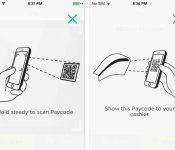
Unlike Apple Pay, which uses NFC to process payment wirelessly, the CurrentC system uses a dedicated app and relies on QR code scanning to process a consumer’s payment. The app stores receipts as well as provide access to loyalty accounts, which can be used to apply discounts at participating retailers.
To use CurrentC, consumers must have an active account that requires them to set up a bank account as a payment source and confirm their identity by providing their driver’s license and social security number. This sensitive information is stored in the cloud and not on the phone.
When you sign up for CurrentC, you’re supposed to add your bank account. This lets CurrentC process payments for you without retailers having to pay the steep credit card processing fee. You can also add retailers’ loyalty credit cards or gift cards as payment methods.
Payments are pulled automatically from the bank account linked to the user’s account via Automated Clearing House (ACH) transactions, a system adopted as a way to help merchants avoid paying the approximately 2-3 percent fee levied by credit card companies. MCX also provides retailers with consumer intelligence information, allowing them to send targeted ads and discount offers to consumers based on their purchase history.

CurrentC notes it may share info with your device maker, app store, or developer tool makers. Oddly, it will collect health data. Precise location information is used to verify you’re at the retailer where you’re making a transaction, and if you opt in it can be used for marketing or advertising. CurrentC notes that you can opt in to be able to capture and store photos in the app for a hypothetical visual shopping list or other features down the road.
In 2012, MCX reportedly ramped up its efforts to entice retailers to join its mobile payments system., asking participating merchants for an upfront fee of up to $500,000 and requiring them to sign three-year exclusivity deals. These deals appear to be the reason Rite Aid and CVS disabled unofficial access to Apple Pay in their stores, although it is unclear why they waited until after the service went live and customers were using it before disabling their systems.
CurrentC is currently in beta testing and on target for a 2015 launch, which positions it behind Apple’s already existing Apple Pay system. It is reportedly being pilot tested in Minnesota at select retailers before rolling out nationwide next year. Because the payments do not require NFC or Bluetooth LE, the system will be compatible with a variety of Android and older model iPhones.
Adoption may be slow as retailers must modify their point of sales systems to accept these payments. Consumers may also balk at a system that requires the cloud storage of sensitive information and a cumbersome checkout process that relies on QR codes accessed through a separate app and tied to direct bank withdrawals. To compensate for these detractors, MCX reportedly will push retailer discounts and loyalty purchases to entice consumers to adopt this upcoming mobile payments system.

Making chiptune music is as easy as gaming with this player

Chiptune music is one the many phenomena that ’80s era gaming nostalgia spawned — but to get into it you need to mod a working 30-year-old NES into an instrument. Now, a company called Assorted Wires has launched a hackable 8-bit chiptunes instrument on Kickstarter to make it way easier. The pitch is pretty simple: if you’re good at video games, you can make music with no practice. That’s why they’re calling it the Lo-Fi SES, for Sound Entertainment System. It’s shaped exactly like a game controller, with the control buttons used to trigger samples, change tempo, and play, record or delete tracks, to name a few functions.

The Lo-Fi SES is designed around the Arduino platform with an Atmega processor. As a result, you can replace the samples with actual sounds from an NES or other console. You can remap the buttons, do sophisticated open-source signal processing and even use it as a… game controller. The team says that no coding experience is needed, but if you like hacking, “it’s the perfect platform for audio projects, budding bands or skilled instrumentalists.” Finally there’s a slot to add three cartridges: a second sound pack, a USB cartridge for custom tweaking and a “Smasher” cartridge that lets you dirty up the music.
So how much does this chiptune fun cost? For $50, you can get an early bird cartridge only, while $110 will grab you the early bird Lo-Fi SES with all three cartridges. Early bird backers should receive their devices by the end of the year, while other buyers will have to wait until April 2015. The campaign has just kicked off with a $5,000 goal.
Source: Kickstarter
 AIVAnet