


iHeartRadio for iOS Updated with Support for CarPlay [iOS Blog]
Radio streaming service iHeartRadio has updated its official iOS app to include support for Apple’s CarPlay iOS vehicle integration feature. Users can now search and play any live or favorited radio station through their CarPlay-compatible in-dash car system, and can also listen to archived on-demand episodes from multiple categories like News, Sports, and Comedy.

This newest update also brings a new Today Widget for the Notification Center which allows users to access recently played stations quickly. Apple announced in June that iHeartRadio would be getting CarPlay support along with other popular apps like Beats Music, MLB At Bat, and Spotify, which received its CarPlay update earlier this month.
iHeartRadio is a free app for iOS devices and can be downloaded through the App Store. [Direct Link]

Malicious ads on major websites held users’ files to ransom

A widespread attack has exposed millions to malware that holds files to ransom. The campaign, which was first detected a month ago, placed fake adverts on websites such as Yahoo, AOL and The Atlantic that installed so-called “ransomware” onto a victim’s computer. The attackers stole assets from the likes of Case Logic, Bing and Fancy in order to make the malicious ads appear real, but once a computer becomes infected, things get very bad, very fast, for victims.
The ransomware — named CryptoWall 2.0 — uses Adobe Flash to exploit browser vulnerabilities, installing itself on the affected computer. It then sets about encrypting files on the users’ hard drive, refusing access to said files until the victim pays for a decryption key. The fee, said to be equivalent to $500, is requested in Bitcoin, and security firm Proofpoint, which first noticed the attack, estimates that the attackers’ are currently raking in $25,000 from victims. As Bitcoin wallets are public, Proofpoint is able to analyze the incoming payments to each of the attackers’ accounts. One of the Bitcoin wallets was in use for just 5 days and managed to pull in the equivalent of $9,350.
This latest breach highlights the dangers of malware online. Earlier this year a similar attack targeted Synology storage servers, ransoming mostly small business data for around $350. How do you stay safe? There’s no way to ensure a computer is 100 percent secure, but keeping all your software up-to-date with the latest security patches is a good start. Most modern browsers can also be setup to only open plugins such as Flash when content is clicked on, which would eliminate the risk of being infected by this particular attack.
Via: IBTimes
Source: Proofpoint

Root in Android Lollipop may be a little more difficult to get, says Chainfire
 Android Lollipop is currently the toast of the Android community – its overhauled UI and expansive improvements already have many of us salivating. However, while it looks sweet, literally and figuratively, it might not be the best for developers after renowned Android developer, Chainfire, said that root in Android Lollipop could possibly become a rarity due to increased security measures that Google has implemented this time around. In fact, Chainfire has been warning about this day for a long time, and it appears, unfortunately, that he is absolutely correct. In a nutshell, Android Lollipop “breaks” root, and not in the conventional way that can be overcome – for more specifics about the new changes, read Chainfire’s explanation here.
Chainfire’s own root solution requires a custom kernel in order to gain root, however often you require root before being able to flash a custom recovery, and that in itself can only be done with an unlocked bootloader. In the event that a manufacturer locks the bootloader, this will essentially mean the device is rendered a stock device until someone figures out how to circumvent this scenario and enable root. Of course, this fate will never befall the Nexus line with their unlocked bootloaders, but it presents the situation where developers may have to become a little choosier with which manufacturer they buy from.
What do you think about root in Android Lollipop potentially being harder to come by? Let us know your thoughts in the comments.
Source: +Chainfire via XDA, Phone Arena
//<![CDATA[
ord = window.ord || Math.floor(Math.random()*1E16);
document.write('‘);
//]]>
The post Root in Android Lollipop may be a little more difficult to get, says Chainfire appeared first on AndroidSPIN.
Microsoft is finally dropping the ‘Nokia’ from Lumia

Over a year after the acquisition was first announced, Microsoft is officially replacing the Nokia Lumia brand. In a blog post today, the software giant revealed its upcoming smartphones will now be known as Microsoft Lumia. The new Microsoft branding will appear on future phones from the company, with a plain black version of the company’s four-squared logo also set to make an appearance.
Tuula Rytilä, Microsoft’s SVP of Marketing for Phones, says the company is looking to unveil its first own-brand Lumia phone “soon.” Rytilä is also keen to note that the change in nomenclature will not affect the support of current Nokia devices. Although the Nokia name will no longer be used for smartphones, low-end phones — the company calls out the Nokia 130 — will still be sold under the banner. Nokia still has brand cachet in Europe and developing markets, and it’s likely that Microsoft will continue to exploit that fact for years to come.
Filed under: Cellphones, Mobile, Microsoft, Nokia
Source: Microsoft (Nokia Conversations)
You can soon watch a doc about virtual reality on Oculus Rift

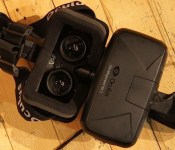
If you’d rather that your non-game Oculus Rift experiences be nonfiction, it looks like that wish is coming your way rather soon. Next week, Zero Point hits Steam and it offers full 360 degree views of a Department of Defense military training camp, a beach scene and even the extremely crowded LA Convention Center during E3 2013. The rub of the video is that it’s the first of its kind — a documentary about virtual reality, filmed in VR and made for the platform. It’s very meta. Each scene is explorable, with either head tracking, a game controller or a mouse running the action. It’s apparently compatible with all past-and-future Oculus dev kits, and will cost $15 come its October 28th release. However, IGN notes that if you purchase before November 4th it’ll only run you $12. Want a preview before you buy? Of course you do; just head past the break for that.
Filed under: Gaming, Home Entertainment, HD
Via: IGN
Source: Steam

Record everything with this dive-friendly 360-degree action cam

Remember 360fly? The panoramic camera from the company from EyeSee360, which built the panoramic GoPano iPhone lens, has been on the scene since early this year at NAB. Now, the WiFi- and Bluetooth-equipped 360fly camera has been given the nod by the FCC, and an attached review manual gives us a better idea how it works. As the company showed earlier, it’s a single-lens 360 degree horizontal and 240 degree vertical fisheye lens that has “the widest field of view on the market.” It uses an iOS 8 or Android 4.3+ app that turns your Bluetooth LE-equipped smartphone into a 360 degree video viewfinder with full remote control.

Using a single lens and sensor eliminates the need to “stitch” video and photos — instead, you can swipe across the video to pick the angle you want, then edit it together using the 360fly app. As for the rest of the specs: according to the FCC guide, it’s waterproof to a whopping 164 feet (5 atm) with 16GB of memory, a 360 degree horizontal and 240 degree vertical f/2.5 lens, a mic and a 1,504 x 1,504 1/2.3-inch CMOS sensor. It can hold a charge for 2 hours, weighs 138g (0.3 pounds) and comes with a tilt mount, power cradle and USB port. You may have noticed that I didn’t mention an SD card — it looks like it’ll make do with 16GB of internally memory only, with large transfers to your mobile device by WiFi.
Rather than tackling sports cam stalwarts like GoPro directly, the 360fly is trying to carve its own niche by capturing video from all around the photographer without the complexity of multiple lenses. EyeSee360 must have a convincing case, because it raised $17.8 million from bullish investors. Though the company promised it for this summer, it looks like its ready to at least take a step towards the market now that it’s cleared the FCC. Some of the specs might be revised in the interim, but for now, the manual is marked “Reviewer’s Guide,” so hopefully we’ll get our mitts on it soon.
Filed under: Cameras
iHeartRadio and Rdio are ready for CarPlay, but your car isn’t

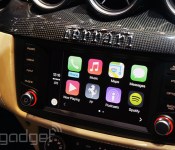
Online radio streaming app iHeartRadio has just made good on its promise to add support for CarPlay, Apple’s new car infotainment system. But, it’s not the only app joining Spotify on CarPlay today — Rdio, a free music streaming service with offline playback, is tagging along. By introducing optimized apps for Cupertino’s car platform, both online services make it easier for users to navigate their interfaces on an onboard screen. Sadly, there are very few people who can actually enjoy the updates right now, as CarPlay’s only available on Ferrari FFs and select Pioneer in-dash systems, though most automakers promise to load it on their vehicles’ entertainment systems in the future. Other web services also vow to eventually introduce optimized apps for the platform, including CBS News Radio and, of course, Beats Music.
Filed under: Transportation, Apple
Via: Apple Insider
Source: Rdio (iTunes), iHeartRadio (iTunes)

Somehow the internet hasn’t killed off ‘America’s Funniest Home Videos’

The internet’s been blamed for making a lot of things redundant, and you’d be justified in assuming that that extended to America’s Funniest Home Videos too. Except, surprisingly, the wealth of cat videos and stripper-pole-fail clips online hasn’t had a fatal effect on the long-running show, according to Bloomberg. How the series has managed to survive is apparently been by embracing the internet and creating a trio of YouTube channels, a Facebook page that, according to AFV‘s Vin Di Bona, gets an average 5,000 to 10,000 shares per post and a partnership with online video giant Maker Studios. Di Bona also says that the wealth of AFV digital content is driving viewers back to its traditional broadcasts too.
Bloomberg reports that, according to Nielsen numbers, this month’s season premiere actually increased in ratings by five percent compared to 2013’s. Perhaps even more impressive? That 93 percent of the show’s audience is watching live on a given Sunday night. Somewhere, we’re imagining Bob Saget has a smile on his incredibly dirty mouth.
Filed under: Home Entertainment, HD
Source: Bloomberg Businessweek

Honda’s pedestrian-detecting technology is coming to cars this year

Loyal Honda fans, crisis averted. You don’t have to switch to Subaru, Volvo or Ford if you want their anti-collision technology, now that the Japanese automaker has officially announced its own. The company has just launched a new and enhanced driver-assistive system called “Sensing,” which, true to its name, can sense vehicles and pedestrians that might be blocking your way. Using a radar hidden in the front grille coupled with a camera on the windshield, the system can detect whether you’re in danger of colliding with another vehicle or a person crossing the street. It then gives you both audio and visual warnings if so, gently applies the break if you still haven’t after a while, and then brakes hard in your stead if you’re thisclose to running somebody over or smashing against another car.
Other than that, the system can also make sure you’re driving in the middle of the lane, as well as recognize traffic signs and show them on the infotainment display. Honda’s Sensing technology will launch alongside the newest Legend luxury sedan (known in the US as the Acura) before the year ends, though the company promises to load it onto more models in the future.

Source: Honda
LG announces the LG G3 Screen and new in-house NUCLUN octa-core Processor
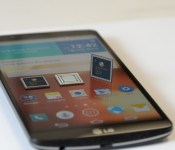
Looks like LG had another announcement up their sleeves today. You might remember earlier in the day LG announced global availability of the LG G Watch R. Now they have announced a new phone that will follow in the G3 branding. To make things even a little more interesting, they also announced their own in-house processor packed inside too. First, the device. Meet the LG G3 Screen. Cause, it has a big screen?

The LG G3 Screen packs in the following specs:
- 5.9-inch Full HD IPS display
- 2GB of RAM
- 32GB of internal storage
- 13MP rear camera
- 2.1MP front camera
- 3,000 mAh battery
- Android 4.4

I left the processor off the list because it needs to be explained a little. The processor in the G3 Screen is an in-house creation by LG. THat just means that it is chip that LG has made instead of using a Qualcomm, Intel or what have you. The processor carries the name NUCLUN, pronounced NOO-klun. The NUCLUN is designed based on the ARM big.LITTLE technology. Odd sounding and looking, right? That is how it is though. The processor is an octa-core chipset that carries four 1.5GHz ARM Cortex A15 processors for high-performance and four 1.2GHz ARM Cortex-A7’s for less intense processing.

“NUCLUN opens up a new chapter in LG’s history of innovation in the mobile industry,” said Dr. Jong-seok Park, president and CEO of LG Electronics Mobile Communications Company. “With this in-house solution, we will be able to achieve better vertical integration and further diversity our product strategy against stronger competition. NUCLUN will give us greater flexibility in our mobile strategy going forward.”
The LG G3 Screen will carry along a lot of the same UX features of the current G3 devices on the market. As an added bounus to the news though, the G3 Screen is the largest smartphone designed for LTE-A Cat. 6 networks. That will deliver download speeds three times faster than regular 4G LTE. All capable, but theoretical, speeds of 225Mbps. That is all well and good, but now we are intrigued to see when and where this device ends up and just how well those processors perform in the real world.
Source: LG
//<![CDATA[
ord = window.ord || Math.floor(Math.random()*1E16);
document.write('‘);
//]]>
The post LG announces the LG G3 Screen and new in-house NUCLUN octa-core Processor appeared first on AndroidSPIN.
 AIVAnet