


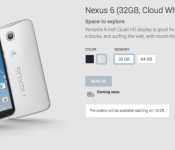
Nexus 6 pre-ordering starts October 29 on Google Play

Head over to your calendar and make a note for October 29. While the Nexus 9 is already available in the Play Store, the Nexus 6 and Nexus Player have remained on hold. The Nexus 6, though, will be ready to go in the Play Store next week. The pricing is steep even with the base 32GB storage option at $649. Relying upon Google for excellent pricing is not an option. This year, it seems that going with a carrier to get a Nexus device is the way to go.
Here is a breakdown of the choices:
- Nexus 6 (32GB, Midnight Blue) — $649
- Nexus 6 (32GB, Cloud White) — $649
- Nexus 6 (64GB, Midnight Blue) — $699
- Nexus 6 (64GB, Cloud White) — $699
Come comment on this article: Nexus 6 pre-ordering starts October 29 on Google Play

TalkAndroid Daily Dose for October 20, 2014

With hectic schedules, it can be hard to keep track of everything in your news feed. That’s why we created the TalkAndroid Daily Dose. This is where we recap the day’s hottest stories so you can get yourself up to speed in quick fashion. Happy reading!!
Guides
Copying apps from your old phone or tablet to your new phone or tablet with Android Lollipop
How to make sure your Android phone or tablet is backed up on Google’s servers
Android TV
Nexus Player now available on the Play Store for $99
Android Wear
[New Android Wear App] Tempo-Motion is another great option for watch faces
Google Fit app gets exposed prior to official launch
Apps
Spotify announces new family plans starting at $14.99 a month
Play Music gets a Material Design makeover in Nexus 4 port
Gmail 5.0 update will support Outlook and Yahoo accounts
Lollipop’s keyboard can now be installed on any Android device without root
Carriers
AT&T to launch Samsung Galaxy Mega 2 October 24th
Sprint now rolling out LG G2 stability update
EYE Experience for HTC One (M8) on T-Mobile to start rolling out tomorrow
Collectibles
‘Lucky Lucy’ special edition Halloween Android figurine on sale tomorow
Were OEMs to blame for Android Silver never coming to fruition?
You can now filter apps in the Play Store by ratings
Phones
HTC’s Android 5.0 update roadmap leaks
EYE Experience for HTC One (M8) on T-Mobile to start rolling out tomorrow
LG teases a new concept phone that has mood swings
Sprint now rolling out LG G2 stability update
“Ambient display” appears to be Nexus 6 spin on Moto Display
Google’s Nexus 6 gets compared to Samsung’s Galaxy Note 4
OnePlus pre-order system will go live for 24 hours on October 27th
AT&T to launch Samsung Galaxy Mega 2 October 24th
Updates
HTC’s Android 5.0 update roadmap leaks
EYE Experience for HTC One (M8) on T-Mobile to start rolling out tomorrow
Sprint now rolling out LG G2 stability update
Miscellaneous
Come comment on this article: TalkAndroid Daily Dose for October 20, 2014

Galaxy Note Edge to be Launched Thursday in Japan

Samsung’s funky and clever upcoming device is eagerly awaited by techies everywhere. (Or at least right-handed techies everywhere.) We’ve been waiting patiently to get a launch date for the phablet, and today we learned some new information. Japan will be receiving the device on its largest mobile carrier (NTT DoCoMo). The device will be black only until November, when a white version will be released as well.
The special device and its curved screen will eventually be available stateside sometime this year on all four big carriers, but as of right now, no one but Samsung knows when.
Source: NTT Docomo
Via: Phone Arena
Come comment on this article: Galaxy Note Edge to be Launched Thursday in Japan

T-Mobile’s 10GB/$100 Deal Set to End on the 29th
 T-Mobile’s neat plan that offers 10GB of data to share among 4 lines for $100 is drawing to a close. The special offer will be grandfathered until January 2016, so if you act fast, you can seize the extra cheap, overage-free data and keep it for a little over a year. If you want to snag the deal, swing on over to T-Mobile’s website by next Wednesday and sign your family up for a family plan.
Source: TmoNews
Come comment on this article: T-Mobile’s 10GB/$100 Deal Set to End on the 29th

Audi RS 7 proves it needs no driver to go racing

Audi’s execs must have toasted to their autonomous car’s success this weekend, because the self-driving RS 7 has successfully conquered the Hockenheimring racing circuit in Germany. While the company’s announcement doesn’t get into specifics, it says the modified sedan finished each lap in just over two minutes, close to the original two minutes and 10 seconds estimate. It doesn’t confirm a top speed either, but the commentator in the video after the break says the car reached 137mph, driving the optimal trajectory you’d expect a top racer to take. As we’ve mentioned before, the automated RS 7 is completely driverless and uses GPS and photos taken by a 3D imaging camera to track its position down to 1 to 2 centimeters — something it’s obviously executed well during the Hockenheimring stunt.
The car that drove around the circuit, though, is just one of Audi’s self-driving prototypes named Bobby after race car driver Bobby Unser. There’s another one called AJ (named after AJ Foyt), which raced against Slashgear’s editor-in-chief before the event. According to Slashgear, engineers can dial down the car’s performance, depending on weather or track conditions. At 86 percent performance driving on a wet race track, the car finished a lap in two minutes and 10 seconds, while at 93 percent on a dry track, it was done in merely two minutes and a second. Audi hasn’t revealed if it plans to develop models people can buy just yet, but says piloted driving is “one of [its] most important development fields.”
Filed under: Transportation

We rode a $10,000 hoverboard, and you can too

It’s impossible to talk about hoverboards without invoking a particular movie title, so we’re not even going to try: remember that awesome scene from Back to the Future Part II? It’s one step closer to reality: a California startup just built a real, working hoverboard. Arx Pax is attempting to crowdfund the Hendo Hoverboard as a proof of concept for its hover engine technology — it’s not quite the floating skateboard Marty McFly rode through Hill Valley (and the Wild West), but it’s an obvious precursor to the imagined ridable: a self-powered, levitating platform with enough power to lift a fully grown adult.
I initially approached the floating pallet with caution, expecting it to dip and bob under my weight like a piece of driftwood. It didn’t. The levitating board wiggled slightly under my 200-pound frame, but maintained its altitude (a mere inch or so) without visible strain. Arx Pax tells me that the current prototype can easily support 300 pounds and future versions will be able to hold up to 500 pounds without issue. Either way, you’ll need to hover over a very specific kind of surface to get it to hold anything: the Hendo uses the same kind of electromagnetic field technology that floats MagLev trains — meaning it will only levitate over non-ferrous metals like copper or aluminum.
http://www.engadget.com/embed-5min/?sid=577&playList=518473552&responsive=false
Riding the contraption was a lot fun, but also quite the challenge: the Hendo hoverboard doesn’t ride at all like McFly’s flying skateboard. In fact, without a propulsion system, it tends to drift aimlessly. Arx Pax founder and Hendo inventor Greg Henderson says its something the company is working on. “We can impart a bias,” he tells me, pointing out pressure sensitive pads on the hoverboard’s deck that manipulate the engines. “We can turn on or off different axis’ of movement.” Sure enough, leaning on one side of the board convinces it to rotate and drift in the desired direction. Without feeling the friction of the ground, however, I had trouble knowing how much pressure to exert — Henderson’s staff had to jump in and save me from spinning out of control. Clearly, this might take some practice.
As fun as its current form is, Henderson didn’t necessarily set out to reinvent transportation. The Hendo engine’s original inspiration came from architecture. “It came from the idea of hovering a building out of harms way,” he says. “If you can levitate a train that weighs 50,000 kilograms, why not a house?” After some prodding he clarifies the idea as a sort of emergency lifting system that could theoretically rise a building off of its foundation during an earthquake, essentially rendering the natural disaster’s tremors harmless. The idea sounds as fictional as, well, a hoverboard — but he already built one of those. Henderson says that floating a building is a long term goal. Right now, the technology is in its early stages, and he’s just trying to get it in the hands of engineers with big ideas.

That’s where the Hendo “white box” comes in. Backers who contribute to the company’s Kickstarter at the $299 level will receive a complete, working Hendo hover engine and enough hover surface to play around with. It’s a developer kit, Henderson says, and he wants makers to use it to build their own hover projects. If they have an idea they want to take to market, Arx Pax will work with them to make it a reality. “The most important piece of it all for me is the idea of taking away the limitations of how we think about problems in general. Not just thinking outside the box, but off the page,” he says, explaining how Hover technology could be used to solve old problems in new ways. “When you do that — when you approach problems that were seemingly impossible in different ways — you’ll never cease to be amazed by the solutions you can come up with.”
While long-term goals go far beyond that of the not-so-humble hoverboard, there are plenty of Kickstarter goals focused on scratching that itch exclusively. 250 backers at the $100 level will be eligible for a five minute ride on one of the company’s prototype boards, and $1,000 buys a privately coached hour-long ride. Not content with merely renting hover-time? Okay, okay: the first ten backers to contribute $10,000 will get a hoverboard to keep. The delivery date? 10/21/2015 — the date Marty McFly arrives in the future.
Filed under: Misc, Transportation
Source: Hendo Hover
OnePlus One pre-orders will go live on October 27th. For one hour.
 One of the most widely criticized parts of OnePlus‘ campaign to sell its maiden smartphone, the OnePlus One, has been its handling of device distribution and its use of the maddeningly exclusive invite system. Stopping short of admitting the invite system was a mistake, OnePlus went on the record about a month ago to say that they would instead be using a pre-order system starting in October. OnePlus has finally announced that these OnePlus One pre-orders are going to start on October 27th, but with one teeny, tiny, big detail: the pre-orders are only going to be open for an hour.
Yes, you read that correctly. According to OnePlus’ blog post, on October 27th 15:00 GMT, people can pre-order the OnePlus One for one solitary hour. It would seem that the pre-order system isn’t actually what we thought it was going to be, and in fact, OnePlus says at the bottom of the post:
“While the pre-order system won’t completely replace the current invites method, it is certainly a huge step towards expanding the reach of OnePlus.”
While the OnePlus One is still fantastic value for flagship level hardware specifications, and OnePlus did give away 50,000 invites a few weeks ago, the combination of the pre-order and invites system still clearly lacks the flexibility that some people actually want when purchasing their smartphones.
What do you think about the OnePlus One pre-orders system? Let us know your thoughts in the comments.
Source: OnePlus via Phone Arena
//<![CDATA[
ord = window.ord || Math.floor(Math.random()*1E16);
document.write('‘);
//]]>
The post OnePlus One pre-orders will go live on October 27th. For one hour. appeared first on AndroidSPIN.

Xbox One’s next update adds custom backgrounds, Twitter for TV and game clips

Microsoft only just unleashed its October update for the Xbox One, and now it’s talking about what to expect next month. The update will hit consoles for those in the preview test group soon, and adds many features Major Nelson and crew say the community has been asking for, including custom backgrounds (with the PS4 getting themes soon, it’s Blu-ray 3D all over again), and extra details for profiles. The custom backgrounds will launch with a selection of pictures and the ability to post based on achievements, and after a media player update later in the month, gamers will be able to import any image they want. A returning feature from the Xbox 360 will put details like your location and custom bio back on the profile page, plus a self-curated selection of game clips and achievements. Oh, and those game clips? You’ll be able to share them with the masses easily, because the update adds the ability to share any of your favorites directly to Twitter. Check after the break for a video demo and more details on what’s coming.
The Twitter integration won’t stop there either, as the OneGuide adds trending lists for what users are watching on live TV, what people are tweeting about, or what Xbox One owners specifically are watching the most. There is even space to see what people are tweeting about a show in the MiniGuide itself. The integrated Internet Explorer browser can switch from full screen to Snap with a button on the address bar now, and a number icon to let users know when “Featured Sites” have updates. The second screen SmartGlass app has more support to see what’s going on in the Store and what your friends are playing, while the Preview dashboard app for testers has some new gamified features.
Here’s what to expect in Xbox One’s November system update (Spoiler: Customizable Backgrounds) http://t.co/ryXfkGrJWp
– Larry Hryb (@majornelson) October 21, 2014
More fan-requested features coming to Xbox One in November: http://t.co/roFbnnJf8m
– Jeff Rubenstein (@jeffrubenstein) October 21, 2014
Filed under: Gaming, HD, Microsoft
Source: Xbox Wire

Google’s Nexus 6 gets compared to Samsung’s Galaxy Note 4

This fall, two massive devices will be on the market and consumers will have a very difficult choice to make. Should they go with Google and the Nexus 6 or Samsung and its Galaxy Note 4? Fortunately, you can take a look at a video comparing the two. Carphone Warehouse has both devices on hand for a really good breakdown. Unsurprisgly, the Nexus 6 is a lot bigger than the Galaxy Note 4. After all, the Google device does have a 5.96-inch display compared to its foe’s 5.7 inches.
There is a common ground for the two. The resolution of the displays both equal 2560×1440 and are AMOLED. Inside, Google and Samsung opted for a Snapdragon 805 processor with 3GB of RAM and 3220mAh batteries. They also have 32GB of internal storage; however, Samsung follows its tradition by including a microSD card slot.
Hit the break for the video.
Click here to view the embedded video.
Source: TechnoBuffalo
Come comment on this article: Google’s Nexus 6 gets compared to Samsung’s Galaxy Note 4
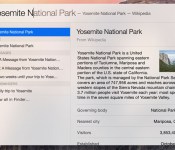
Spotlight Suggestions Sends Minimum Amount of Data to Apple, Exact Location and IP Addresses Not Collected
Following the release of OS X Yosemite with new Spotlight Suggestions, some users noted that Apple’s Spotlight privacy policy began offering a warning letting users know that search terms were being uploaded to Apple’s servers, with some of the info being forwarded to Microsoft’s Bing search engine.
The search terms were being shared with Apple in order to enable Spotlight’s new capabilities, which include searching sources like the Mac App Store, Wikipedia, and the web.

When you use Spotlight, your search queries, the Spotlight Suggestions you select, and related usage data will be sent to Apple. Search results found on your Mac will not be sent. If you have Location Services on your Mac turned on, when you make a search query to Spotlight the location of your Mac at that time will be sent to Apple. Searches for common words and phrases will be forwarded from Apple to Microsoft’s Bing search engine.
While Apple noted directly within Yosemite’s Spotlight preferences that the search terms were collected only to improve Spotlight Searches and directed users to turn off Spotlight Suggestions and Bing Web searches in System Preferences if they didn’t want their data uploaded, the issue still received quite a bit of attention over the course of the weekend, with one developer even uploading a Python script to prevent Apple from collecting data.
Apple has now given a statement on Spotlight Suggestions to iMore, stating that the company is “absolutely committed” to protecting user privacy and that Spotlight Suggestions minimizes the information that’s sent to Apple.
“We are absolutely committed to protecting our users’ privacy and have built privacy right into our products,” Apple told iMore. “For Spotlight Suggestions we minimize the amount of information sent to Apple. Apple doesn’t retain IP addresses from users’ devices. Spotlight blurs the location on the device so it never sends an exact location to Apple. Spotlight doesn’t use a persistent identifier, so a user’s search history can’t be created by Apple or anyone else. Apple devices only use a temporary anonymous session ID for a 15-minute period before the ID is discarded.
“We also worked closely with Microsoft to protect our users’ privacy. Apple forwards only commonly searched terms and only city-level location information to Bing. Microsoft does not store search queries or receive users’ IP addresses.
“You can also easily opt out of Spotlight Suggestions, Bing or Location Services for Spotlight.”
As Apple says in the statement that it gave to iMore, users that are concerned about their data being uploaded to Apple’s servers can easily disable the new features by going to System Preferences –> Spotlight and unchecking both the boxes for “Spotlight Suggestions” and “Bing Web Searches.”
Along with offering users its privacy policy directly in the System Preferences app under “About Spotlight Suggestions & Privacy,” Apple has also updated its iOS 8 Privacy website to make it clear that limited user data is collected and that the data the company does acquire is obscured by an anonymous identifier.
Introduced with iOS 8 and OS X Yosemite, Spotlight Suggestions allow Apple’s Spotlight feature to give users search suggestions from sources like Wikipedia, the iTunes Store, and Maps. For example, it’s now possible to search for an app in the Mac App Store using Spotlight, or look for a specific term on Wikipedia without needing to access Safari or another web browser.
 AIVAnet