


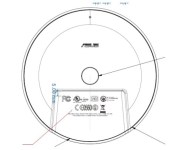
Nexus Player passes through FCC, may go on sale again soon

On Friday, Google pulled the ability order the new Android TV device, the Nexus Player, as fast as it was put up. While some assumed that Google had a limited stock and quickly went through it, Google shed some light showing that it was something else. A message later in the day popped up on the Nexus Player order page saying, “This device has not been approved by the Federal Communications Commission. It is not for sale until approval of the FCC has been obtained.” Well it looks like FCC approval has been obtained.
The Asus made device passed through the other day and it confirmed everything that Google mentioned for the device. It comes with a 1.8GHz Quad-core Intel Atom processor with the Imagination PowerVR Series 6 Graphics 2D/3D Engine, 1GB of Ram, 8GB of internal storage, and the remote. The unit goes for $99, well, when it finally ships as it’s still showing out of inventory.

When the device is in stock again, it will be available in the US and Canada. There’s really no telling when that will be but when it does, will you be picking one up?
source: FCC
via: Gadgetz Arena
Come comment on this article: Nexus Player passes through FCC, may go on sale again soon

Google’s Nexus Player gets FCC approval, right on cue

Well, that didn’t take long. Just a couple of days after Google stopped pre-orders of the Nexus Player while it waited for the FCC’s all-clear, its Android TV puck has received approval. There aren’t any surprises in the regulatory filing, but it should let you both pre-order the WiFi media hub soon and (hopefully) get it around that originally promised November 3rd release date. If you were worried that you’d have to make do with a Chromecast for a little while longer, you can relax.
Filed under: Home Entertainment, HD, ASUS, Google
Source: FCC

Watch Jony Ive and Elon Musk talk design and sci-fi transportation

Tired of hearing little more than soundbites from tech luminaries such as Apple’s Jony Ive and Tesla’s Elon Musk? Today’s your lucky day. Vanity Fair has posted its full video interviews with both Ive and Musk, giving you an insight into how the two executives work. Not surprisingly, Ive’s chat focuses on his design philosophies and processes, including what he thinks of Xiaomi’s eerily familiar-looking products (spoiler: he doesn’t see them as “flattery”). Musk, meanwhile, drops both hints about Tesla’s semi-automated Model S P85D and discusses the motivations behind the science fiction-inspired transport from SpaceX and Tesla, including why it’s important for humanity to go to Mars. The two discussions are lengthy at about half an hour each, but they’re definitely worthwhile if you want to see what makes key industry figures tick.
[Image credit: Kimberly White/Getty Images for Vanity Fair]
Filed under: Cellphones, Desktops, Laptops, Tablets, Transportation, Wearables, Apple
Source: YouTube (Jony Ive), Elon Musk

Google Play Games 2.1.10 also gets a Material Design upgrade [APK Download]
 We reported that Google Play Movies & TV got its Material Design update earlier today and now we can say that we have the APK for Google Play Games 2.1.10 which does the same thing. It’s from the same source as the Movies & TV APK – found after digging around in an Android TV device. As such, while it is signed by Google and we have tried on our own devices, installing the APK on your device is your own choice. With that said, you can download the new Play Games from the link provided below:
Google Play Games 2.1.10 APK download
As you might expect, the new Play Games UI is all glammed up, adopting the slightly darker green that we have already seen in the new Google Play Store and flattens everything out. Other UI changes include giving games much bigger graphics in the menus and game description pages are much prettier now too. Naturally, the Play Games icon has been updated as well and has been flattened out. If you manage to spot something else that is different, feel free to drop us a line in the comments below.
Source: Gapps Early
//<![CDATA[
ord = window.ord || Math.floor(Math.random()*1E16);
document.write('‘);
//]]>
The post Google Play Games 2.1.10 also gets a Material Design upgrade [APK Download] appeared first on AndroidSPIN.

Scientists want to fight the Ebola outbreak using robots

Outbreaks of lethal viruses like Ebola are bad enough by themselves, but they’re made worse by having to send in aid workers — these people can quickly become victims, no matter how careful they are. To eliminate that risk, both the White House and a trio of educational institutions are holding workshops on November 7th where scientists will discuss using robots to tackle the current Ebola crisis. The goal is to minimize physical contact whenever possible while keeping patients and families in touch. At a basic level, they’d like machines to disinfect areas and deliver supplies. Telepresence robots, meanwhile, could both let people visit patients without putting themselves in danger.
As you might imagine, scientists have to walk a fine line between moving quickly and handling outbreaks with sensitivity. Rather than build robots from scratch, the teams want to modify existing machines; they’d also like to keep humans involved wherever possible, and respect local customs for burial and grief. There’s no telling how much these sessions will help, but the focus is on rolling out practical health care tools rather than high-minded concepts. If all goes well, the researchers will have robots providing safer care within a matter of weeks or months.
[Image credit: Zoom Dosso/AFP/Getty Images]
Source: Computerworld
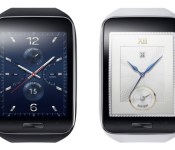
Samsung Gear S will have own Plan on Sprint
 Samsung’s Gear S is going to be the first popular SmartWatch with a 3G connection, so there are a lot of questions to be answered about how the device will be used practically as a separate device on a wireless plan.
It seems that as far as Sprint goes, your Gear S can be used on one of two plans: as a standalone device, and as a Family Share Pack device. Both options cost the same at $10 per month. The Standalone device includes 1000 minutes, 1000 text messages, and 100 MB of data, with a 40 cents/min and 20 cents/msg overage charge. The Family share pack gives unlimited talk and text and shares whatever data package you have.
If you’re connected to your phone via Bluetooth, you won’t be using your messaging or minutes for handling calls or texts. You can also connect to Wi-Fi to avoid using up your data package when you’re somewhere with the option available.
The other main carriers should follow suit soon and announce plans designed for the Gear S and other standalone smartwatches since Samsung is unlikely to be the only one working on this type of device. Stay tuned for more information about the Gear S, including release date, carrier availability, and pricing.
Source: Phandroid
Come comment on this article: Samsung Gear S will have own Plan on Sprint
You can’t upgrade the new Mac mini’s RAM

If you’re planning to snag the new Mac mini and load it up with aftermarket memory, you may want to reconsider your strategy. Macminicolo owner Brian Stucki (among others) has discovered that the RAM in Apple’s latest tiny desktop isn’t upgradable, much as you’d expect with the company’s laptops and the 21-inch iMac. The move isn’t completely surprising given that the Mac mini is basically a MacBook in different clothing, but it’s a step backward given how relatively easy it was to upgrade the previous generation. All that you can do now is replace the hard drive, provided you’re willing to void your warranty. You’ll have to consider buying either a higher-end model or a custom order to get more RAM, and both of those options are typically more expensive than adding RAM yourself. This limitation isn’t necessarily a deal breaker, but it’s unfortunate if you like the idea of upgrading a Mac on your own terms.
Confirmed: RAM in the new Mac mini is not user accessible. Hard drive can be replaced/upgraded, though not keeping warranty.
– Brian Stucki (@brianstucki) October 17, 2014
Via: MacRumors
Source: Brian Stucki (Twitter)
Nice try Apple: Apple says 54% of Android devices running a 2-year-old OS
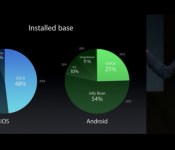
 It’s not like we would have expected anything else, but I’m not entirely sure why anybody believes them anymore. Earlier this week, Apple launched some new devices (or something) during which the above slide was shown to compare Apple’s iOS status compared to Android’s. Apple VP of Software Engineering, Craig Federighi, then felt the need to say that only 25% of Android devices are using the latest Android operating system, Android KitKat, and that 54% of users are using a “more than 2-year-old” operating system in Android Jelly Bean.
While the objective facts are correct, let’s put a little perspective into this argument – Android owns a 80% global smartphone market share whereas Apple owns less than 20%, and anyone good at maths will tell you 25% of that 80% is just about equal to all of Apple’s smartphone install base. Similarly, the comment about Jelly Bean being 2 years old is correct, however this enables many more devices, some which cost only a fraction of the iPhones and iPads, access to an operating system which is pretty fluid – compare this to installing iOS 7 or iOS 8 onto an iPhone 4 or iPhone 4S and rendering it almost useless. Federighi also mentions that iOS 8 has achieved 48% install rates on their devices since its launch, but neglected to cite the statistic that 46% of iOS owners had already installed iOS 8 five days after launch, meaning that the install base has only increased by 2% over the last three weeks.
Now, I don’t mean to bash on Apple, but arguing moot points like install rates and comparing it to Android, an operating system that is known for fragmentation (but arguably has a good reason for it), seems more than a little desperate. But enough of what I think, what do you think of what Apple has said? Let us know your thoughts in the comments below.
Source: Phone Arena
//<![CDATA[
ord = window.ord || Math.floor(Math.random()*1E16);
document.write('‘);
//]]>
The post Nice try Apple: Apple says 54% of Android devices running a 2-year-old OS appeared first on AndroidSPIN.

Air Force’s mysterious space drone returns after two years in orbit

Following its longest-ever mission by far, the 11,000 pound X-37B unmanned spacecraft has returned to Earth bearing… well, we don’t actually know. You see, after NASA and Boeing developed the craft (about a fifth the size of the Space Shuttle), it bounced over to the Air Force, which is using it for top-secret missions. The X-37B’s longest previous flight lasted about 15 months, and this time, it stayed in orbit just shy of two years. As for what it was doing up there, exactly, cue the speculation. Some experts think it was launching spy gear from the pickup-bed-sized payload bay, while others believe it was designed to capture or impair enemy satellites. The Air Force denies all that, saying it was just testing space tech like advanced guidance, robotic systems and autonomous orbital flight. It certainly nailed the latter — with no human at the controls, the X-37B made a perfect touchdown following a 218 mile-high descent. To see it, check the all-too-brief video below.
[Image credit: Boeing]
Filed under: Science
Via: Slate
Source: Boeing
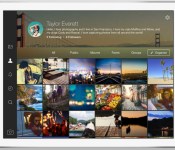
Flickr Launches Updated iOS App with Full iPad Optimization [iOS Blog]
Yahoo-owned photo sharing service Flickr today updated its iOS app to Version 3.2, bringing full optimization for the iPad along with other new features. Flickr for iPad allows users to browse images on their feeds in high resolution and contains a full camera interface and editing suite for shooting and editing photos. In addition to a new interface, Flickr also now comes with its own iOS 8 share extension that allows photos to be shared through social media services like Tumblr, Facebook, and Twitter.

This version of the Flickr iOS app is optimized to take full advantage of the larger screen on iPad, while delivering the gorgeous design you expect of Flickr, our powerful camera, and the versatility you need to manage your photos while on the go. On iPad, Flickr can now display images in high resolution by pushing up to 3,000,000 pixels per photo.
Flickr launched a redesigned app for the iPhone earlier this year, which brought new features like live filters and HD video recording. The service was acquired by Yahoo in May 2013, which led to a major overhaul and 1TB of free photo storage space for all users.

Flickr is a free app for the iPhone and iPad and can be downloaded through the App Store. [Direct Link]
 AIVAnet