


Ghostbusters-themed Fruit Ninja update hits the Play Store just in time for Halloween
One of the most popular (and enduring) games on the Play Store is the blissfully-simple Fruit Ninja. Earlier this month, Fruit Ninja developers Half Brick gave the game a complete overhaul adding new game modes and updated graphics. Yesterday the developers updated the app again for Halloween with a bunch of Ghostbusters-themed features. Hit the break for a full feature list and a trailer for the special update.
Click here to view the embedded video.
From the Fruit Ninja Google Play download page:
- NEW BLADE – Cross the streams to annihilate fruit. There’s a very slim chance we’ll survive!
- NEW DOJO – Slice ghost traps to release spooky clusters of fruit!
- NEW THEME – The Fruit Ninja crew has been kitted out from head to toe!
Come comment on this article: Ghostbusters-themed Fruit Ninja update hits the Play Store just in time for Halloween

Twitter adding suggested Tweets to the timeline based on user interest

Twitter has been updating and adding features like crazy, and usually before they roll out new features they experiment by rolling them out to select users and observing the outcome. One such experiment involved inserting “suggested” tweets into the timeline to make Twitter more relevant to users. While this may distress long-time users of the service, the social media site claims that most people seemed to enjoy the extra tweets during initial experiments and is now rolling the feature out to all subscribers. Could this help the service grow at the rate they hope or could this ruin the experience? Let us know what you think in the comments below!
Source: Twitter
Come comment on this article: Twitter adding suggested Tweets to the timeline based on user interest

Lockheed Martin thinks it can give the world unlimited clean energy in 20 years

Remember back in the ’50s, when official-sounding newsreels promised that we’d have new-kew-lur-powered cars by the ’70s and no-one would ever be unhappy? Probably not, since we’ve probably gotten that skewed sense of history from watching too many episodes of Futurama. Still, several decades behind schedule, the promise of clean and unlimited energy might finally be looming upon the horizon, thanks to Lockheed Martin. The defense behemoth believes that it might have a working prototype of its Compact Fusion Reactor in a decade, which might just save the world as we know it.
For those not in the know, nuclear power is great, but there are many reasons why we’ve never ditched coal and gas in favor of it. For one, there’s a risk of a meltdown, the process produces hard-to-dispose-of nuclear waste and throws out highly lethal radiation at all times. Fusion by comparison is a lot less dangerous, and could theoretically be shrunk down to the point where it could power an airplane that never needs to land in order to refuel.
A team at the company’s skunk works, lead by Dr. Thomas McGuire, has cherry-picked elements from previous fusion experiments to build a magnetic containment chamber that’s 90 percent smaller than previous devices. The reactor’s small size means that it’s possible to turn prototypes around in under a year, and McGuire believes that Lockheed Martin will be able to demonstrate true fusion energy by 2020. The system also promises to be able to plug into the existing gas turbine power infrastructure, which would instantly eliminate carbon emissions in the sector, and, even better, enhances “energy security,” which is a euphemism for not buying coal and gas from your political enemies.
[Image Credit: Eric Schulzinger / Lockheed Martin]
Filed under: Science
Via: The Washington Post, Aviation Week
Source: Lockheed Martin

Samsung revamps its lower-end Chromebook with faux leather

It’s taken a while, but people finally seem to be embracing Chromebooks as the low-cost laptops that they were designed to be. Samsung’s already earned our plaudits for this year’s Chromebook 2, but what if you just don’t have $400 to spend on a new piece of hardware? Never fear, for the company has also refreshed the lower-end model from 2012 with better specs, but the same $249.99 price-tag. The low cost doesn’t mean that this new (old) Chromebook can’t be stylish, however, as Samsung has coated the top lid in the same faux-leather backing that we’ve seen on plenty of the company’s other gadgets.
Speaking of the hardware, the Exynos 5 that ran the show in the 2012 model has been ditched in favor of a 2.58GHz Intel Bay Trail CPU (Celeron N2840) paired with 2GB RAM. You’ll also find 16GB storage, Intel HD graphics and an Intel-made 802.11ac WiFi chip lurking beneath the keyboard. Display-wise, there’s a 1,366 x 768 TN screen nestled beneath a 720p webcam, and we’d imagine both have been carried over from the original in order to keep the costs down. In addition to the battery rated for nine hours of life, owners will be some of the first to be able to use Google Help, the company’s Mayday-esque tech support service. Available between 10am – 7pm (ET), all a user needs to do is type Chrome:help into their address bar and, if an agent is available, you’ll be given the option to call them for assistance. If that’s all the information you need before slapping cash on the counter, you’ll be able to pre-order the Chromebook from right now, with shipping commencing at some point next week. If not, then you’ll just have to wait for our review
Dana Wollman contributed to this report.
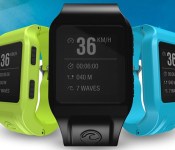
Glassy Pro One wants to be the FuelBand for beachbums

Sportsbands or smartwatches try to be all things to all people, but are you going to pit a pricey smartwatch against 20-foot waves? Of course not, and that’s where purpose-built devices come in like the Glassy Pro One sportsband for surfers. While far less versatile than a general sportsband, the new device will certainly give you the pertinent info: the number of waves, swell height, your surf speed and the duration of a ride. It can also tell you the weather in about 6,000 spots, help set goals, and of course let you brag about an epic session through the social functions. It’s now up for pre-order at $279 in the US, joining Rip Curl’s SearchGPS in a suddenly burgeoning surf watch market.
Filed under: Wearables
Via: Wareable
Source: Glass Pro
castAR bets big on its augmented reality hardware with move to Silicon Valley

Jeri Ellsworth is moving.
Though she was born in Georgia, the former Valve engineer and all-around hardware guru was raised in Oregon and has always called the Pacific Northwest her home. Even during the seven or so years when she would travel regularly to Silicon Valley as a computer chip consultant, her base of operations never deviated. Now, however, it will. Technical Illusions, the company that she founded with fellow former Valve co-worker Rick Johnson to create a projected augmented reality system called castAR, is uprooting from Seattle and moving to Mountain View, California. And she — along with the rest of the company’s 10 or so employees — is following suit.
No, the company wasn’t bought out by Google or anything like that. It is, however, about to take the next steps in growing castAR, which has raised over $1 million on Kickstarter and is currently ramping up efforts to meet production demands. And in order to do that, it needs more people. Specifically, it needs more hardware people.
“The idea for moving down here is to raise more money and to get more hardware engineers,” said David Henkel-Wallace, Technical Illusion’s newly appointed CEO. Henkel-Wallace is based in California, and has been helping Ellsworth and her crew raise capital for the past few months. “Seattle is great for software folks; not so much hardware.”
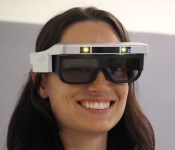
Henkel-Wallace introduced himself to me in the company’s new makeshift headquarters, tucked inside a rented office suite in downtown Mountain View. The space is small and a touch claustrophobic, with narrow hallways, stark empty walls and harsh fluorescent lighting. The only employees on-hand to greet me were Henkel-Wallace, a couple of engineers and Christina Engel, Technical Illusion’s communications manager, who’s pictured in the photo above. The office, Henkel-Wallace told me, is temporary. They’re still looking for a more permanent solution, but they wanted a space to interview applicants, talk to investors and, of course, demonstrate castAR.

Which also happens to be the reason I was there in the first place. The team had finally finished building the first few castAR units that it hopes to ship out to its early Kickstarter backers, and I was there to see how it looked. Before I get into that, however, here’s a brief recap on how castAR works. It consists of a pair of active shutter glasses that are equipped with a couple of tiny projectors and a camera module perched above the frame. When hooked up to a computer, the projectors cast 3D images onto a retroreflective surface, while the camera module scans for infrared LEDs to track the location and movement of your head. Unlike pure VR systems like the Oculus Rift, castAR touts augmented reality — the fact that you can play 3D games and still look at the people and things around you — as its strength. We should note here that castAR also comes with an optional clip-on attachment that can transform the glasses into a VR headset if you so desire.
While it’s not quite close to production-quality just yet, the early developer glasses Henkel-Wallace showed me are far and away cleaner and more refined compared to the units I saw seven months ago at GDC 2014. The projectors, camera modules and surrounding circuitry are now encased in a slim plastic enclosure that wraps around the top and sides of the frames, with none of the hot glue and exposed wires that plagued the earlier prototypes. Among the reasons for the streamlined look are new projectors, which have been custom-designed for castAR by a Japanese company that specializes in optics. “They’re very similar to low-power pico projectors,” said Henkel-Wallace.
“Before, I was building the projectors myself, and putting my fingers all over the lenses, so it was so blurry,” explained Ellsworth, who joined us over Skype. She was still in the process of making the rest of the hundred or so pre-ordered glasses, and won’t make the trip down south until that’s squared away. “I’m not an optical engineer, so we hired a company to build and design the optics for us. Now they’re so much better.”

And they certainly were. From just a brief hands-on with the new hardware, I could tell the images were brighter and crisper. I saw a demo of a fantasy chess game, and I could make out the cracks on the armor of one of the pieces. The clearest example for the sharper resolution was in a new Marble Madness-type game that Johnson and his team designed using the Unity engine. With a resolution of 2,560 by 720, the text for the scores looked nice and sharp, and as the ball rolled around collecting coins, I could easily make out the number of points hovering above it. A retroreflective surface blanketed almost the entire table as well as a couple of the walls in the room, and since it acted as the game’s “display,” the game terrain was much wider than I anticipated. I found it fascinating that I could look around objects by just walking around the table. Henkel-Wallace mentioned a potential for a holodeck application by blanketing a room with that retroreflective material, and I could certainly see a use case for that.
Early Kickstarter backers will get a copy of the new glasses, a set of retroreflective material, the aforementioned marble game (named mARbles) and an SDK that developers can use to make their own apps and games.
The glasses are also overall much lighter, weighing in at around 135 grams, which Ellsworth hopes to reduce to about 80 grams in the final production. Indeed, the team accidentally made their plastic enclosures much bigger than the internal components — they didn’t know the new projectors and cameras would be so much smaller — so slimming down the glasses won’t be a problem.

And that’s not all. Backers who also chipped in for peripherals like wands will get them as soon as they’re available. The wands, just like the glasses, need a camera to find their way around, and the team is still iterating the design on it. “We’re not happy with the buttons just yet,” said Henkel-Wallace. “We’re trying to put in a more traditional one with a joystick and a button.” He added that since it’s augmented reality, the wand can be anything you like, say a sword or a gun. If you pair that with retroreflective clothing, Henkel-Wallace said that could lead to all kinds of interesting gameplay. “Imagine slicing someone with a virtual sword and seeing their ‘guts’ spill out, or maybe shooting someone in a game of laser tag.” Ellsworth and Johnson also mentioned they’ll be sending out RFID mats so that you could play tabletop games like Dungeons & Dragons with “living” character pieces that can do things like breathe fire or swing an axe.
Henkel-Wallace added that castAR is not just for gaming either. Indeed, one of the reasons the team committed to moving down to Mountain View is that they see its potential far beyond the video game realm. He said that someone from the movie industry has approached him about doing that aforementioned holodeck application, for example, and you could also use it for CAD drawings or work presentations. “One of my objectives is to get rid of this thing,” he said, while tapping on the whiteboard behind him. “We can have a three-dimensional experience for projects and presentations.”
http://www.engadget.com/embed-5min/?sid=577&playList=518170689
As for future plans, well, Henkel-Wallace eventually wants a retail space for castAR. “We want people to come and get demos, buy glasses if they want to,” he said. “I think we’re going to sell a lot of these.”
“I’m so excited making the move down there, although it’s going to be a tremendous amount of work,” said Ellsworth. The biggest logistical problem? Moving down her collection of 80-plus pinball machines. “I’m trying to encourage David to do a big fundraising round so that we can put most of my machines in the office,” she said jokingly. “We’ll have a pinball parlor.”
“An augmented reality pinball parlor,” Henkel-Wallace added, laughing. “That’s what we’ll have.”
Filed under: Gaming
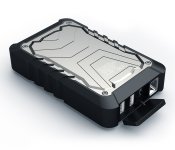
Accessory of the Day: Photive BOLT water resistant battery charger $39.95

For folks needing a heavier-duty solution to portable charging, the Photive BOLT is calling your name. Packing 9000mAh in a rough and rugged housing, this bad boy can handle the worst of weather and environments while providing a powerful and reliable charge. Fantastic reviews and a price of just $39.95 (Prime eligible) make this a deal you shouldn’t pass up.
 |
The post Accessory of the Day: Photive BOLT water resistant battery charger $39.95 appeared first on AndroidGuys.

Apple Store Down Ahead of iPad Air 2 and iPad Mini 3 Pre-Orders
Apple has taken its online store down to prepare for the launch of iPad Air 2 and iPad mini 3 pre-orders. When Apple announced the two new tablets, it said pre-orders would be available starting on October 17, although the company did not specify a time pre-orders would start.
Given the short amount of time between the announcement of the iPad Air 2 and the iPad mini 3 and the start of pre-orders, it is unclear whether other retailers and carriers will be prepared to offer iPad pre-orders.

Apple’s iPad Air 2, which includes several upgrades like Touch ID, an A8X chip, an improved camera, 802.11ac Wi-Fi, and an anti-reflective screen, is available in 16, 64, and 128GB capacities. Pricing in the United States starts at $499 for the entry-level 16GB Wi-Fi only model and goes as high as $849 for the Wi-Fi + Cellular 128GB model.
The iPad mini 3, which has been updated with Touch ID and a new gold color option, is also available in 16, 64, and 128GB configurations. Pricing for the iPad mini 3 begins at $399 for the Wi-Fi only 16GB model and goes as high as $729 for the Wi-Fi + Cellular 128GB model.
Apple has not announced when the iPad Air 2 and the iPad mini 3 will be in stores or when the two tablets will begin shipping out to customers, giving only an availability date of “later next week.”

Nexus 9 available for pre-order on Amazon

Despite the Nexus 9 being available for pre-order today officially through the Google Play Store, Amazon have pulled the trigger early and the Nexus 9 has been available to order since yesterday.
With the Nexus 9 still not actually available for pre-order through the Google Play Store, it seems Amazon is the only place you can put your order in for the new tablet.
The pre-orders from Amazon are showing as a shipping date of 3rd November, which is consistant of that we’d expect from the Google Play Store, so if you want to secure your device you may want to take the plunge with Amazon.
It seems only the US, French, and German stores have the Nexus 9 up for pre-order, but we expect more countries to be added to the list as the day progresses.
|
The post Nexus 9 available for pre-order on Amazon appeared first on AndroidGuys.

The FBI wants access to your encrypted phone data

The FBI isn’t happy with recent decisions by Apple and Google to secure communications by default, saying it could lead to “a very dark place.” That was the gist of a recent talk by director James Comey, who expressed frustration at the inability of law enforcement to keep up with technology. Both tech giants recently said they’d encrypt devices by default, meaning even the companies themselves can’t access photos, emails or other data on your device — let alone law enforcement. Comey also complained that there are now too many message and calling tools for the FBI to keep up with, and many companies are unable or unwilling to give backdoor access. He cited several cases in which phone data helped law enforcement crack cases, but during a Q&A, couldn’t cite a single example of how encrypted data hindered it.
As such, Comey called on Congress to update the 20-year-old Communications Assistance for Law Enforcement Act (CALEA) to reflect modern times. So far, the White House has declined recent requests to revise CALEA, and many privacy advocates have called the FBI’s latest plea disingenuous. The American Civil Liberties Union (ACLU) said “federal law explicitly protects the rights of companies to add encryption with no backdoors,” adding that such access makes devices more vulnerable to hackers. It gave kudos to Apple and Google for their latest encryption initiatives, saying “others in the tech industry (should) follow their lead.” For a deeper dive, check out a video of the talk below.
Filed under: Cellphones, Misc
Source: Brookings Institute
 AIVAnet