



Apple is now the fifth-largest PC maker in the world, if you ask IDC

Apple is historically a small player in the PC world compared to many of its peers, but it may have just entered the big leagues. IDC estimates that the company jumped to 6.3 percent market share in the third quarter of the year, making it the fifth-largest PC builder worldwide — a feat it hasn’t managed in decades. It’s still no major threat to heavy-hitters such as Lenovo (20 percent), HP (18.8 percent) and Dell (13.3 percent), but IDC believes that a combination of slight price cuts and improved demand in “mature” markets like North America have helped it grow in a computer market that’s still shrinking.
With that said, the crew in Cupertino probably isn’t breaking out the party streamers right away. Gartner contends that ASUS claimed the fifth-place spot with 7.3 percent, and that Apple only sits in the top five in its native US. So what gives? In short, it’s a difference in methodology; Gartner and IDC don’t have official shipping numbers from everyone, and there’s enough wiggle room in their estimates that it wouldn’t take much for the rankings to change. As precise as these figures may be, you’ll get a better sense of how Apple fared when it posts its fiscal results (and real shipping numbers) in a couple of weeks.


Filed under: Desktops, Laptops, Apple, ASUS, HP, Dell, Acer, Lenovo
.CPlase_panel display:none;

Apple Ranked as Fifth Largest Global PC Vendor Due to Price Cuts, Improved Demand
Apple saw its worldwide PC marketshare climb to 6.3 percent in the third quarter of 2014, launching it into the top five worldwide vendors, according to new data released from IDC. While Apple has long held a position as one of the top PC vendors in the U.S., it has not made it into the list of top five worldwide vendors in quite some time.
With nearly 5 million shipments during the quarter compared to 4.5 million in the year ago quarter, Apple saw overall growth of 8.9 percent year over year, allowing it to edge out ASUS as the number five vendor. Lenovo, HP, Dell, and Acer, meanwhile, held their top four positions. Lenovo, as usual, was the top worldwide PC vendor, with more than 15 million shipments and 20 percent marketshare.
 IDC’s Preliminary Global PC Vendor Unit Shipment Estimates for 3Q14 (In Thousands)
Apple moved into the number 5 position on a worldwide basis, slightly overtaking ASUS. The company’s steady growth, along with recent price cuts and improved demand in mature markets, has helped it to consistently outgrow the market.
As for U.S. shipments, Apple retained its number three vendor position with more than 2.2 million shipments and 13 percent marketshare, up 9.3 percent year over year. HP and Dell held their positions as the top two vendors in the U.S., with 27.7 and 24 percent marketshare, respectively.
 IDC’s Preliminary U.S. PC Vendor Unit Shipment Estimates for 3Q14 (In Thousands)
Overall, worldwide PC shipments totaled 78.5 million units and saw a year over year decline of -1.7 percent, while PC shipments in the United States totaled 17.4 million units and saw a 4.3 percent year over year growth.
Gartner has also released its shipment estimates for the third quarter of 2014, but its numbers rank ASUS as the number five worldwide PC vendor with 5.7 million shipments. On the U.S. front, Gartner’s estimates also place Apple as the third U.S. vendor with 2.4 million shipments and 14.3 percent marketshare.
It is important to note, as always, that the global and U.S. PC shipment estimates from both IDC and Gartner are based on preliminary data, which explains the discrepancies between the two separate shipment estimates.
Apple’s move into the number five worldwide vendor comes as the company prepares to launch new iMacs and possibly other Mac upgrades at an event on October 16. Apple has also launched minor updates to its Retina MacBook Pro, MacBook Air, and iMac lineup throughout 2014, and has introduced price drops on the two latter products.
.CPlase_panel display:none;

Snowball wants to be your Android phone’s universal inbox

These days, all of the messages we get on our phones live in separate little boxes, destined never to mingle… unless some crafty developers and entrepreneurs force them to. As it turns out, that’s exactly what a Google Ventures-backed startup called Snowball just did — its creators made an Android app that pulls all your disparate missives into a single, simple inbox that you can scan at a glance. Facebook messages? Fine. Whatsapp texts? No worries. Snapchats? You get where we’re going. Co-founder Anish Acharya says the aggregating app works with the 10 most popular messaging services out there right now (including good ol’ SMS, Line, Hangouts and Slack just because they like it), which means there’s a very good chance it’ll be right up your alley. Sounds a lot like the universal inbox we’ve been clamoring for, doesn’t it?
Well, it’s close.
To the team’s credit, the setup process is dead simple — all you really have to do is wade through some splash screens and give the app access to your notifications (more on that later). Once that’s all done, Snowball will exist in form of a cutesy ever-present icon, sort of like a persisting Facebook chat head that hides when there’s nothing new to see. A quick swipe on the icon will open up your inbox to reveal all the textual treasures within, but alas, you can’t actually respond from there — tapping one of them launches the associated app from whence you can do the deed. That’s perhaps the only real bummer about the (currently beta) app: it does a fine job of rounding up your messages, but by virtue of the way these messaging apps are designed and created it isn’t going to be a truly one-stop shop.
Acharya says it won’t be too difficult to add support for buzzy new messaging apps down the road, but that’s essentially because Snowball works by capturing and rendering your message notifications within the app. Alas, it’s a pretty neat little trick that, as you might imagine, doesn’t exactly work on iOS. Don’t count an iPhone-friendly version out completely, though: it’ll take more concerted work with the developers of those apps, which could lead to benefits for users on both sides of the smartphone OS divide.
.CPlase_panel display:none;

Drone racing in the woods evokes more than a few Star Wars memories

Ever wanted to recreate the speeder chase in Return of the Jedi, or pod racing in The Phantom Menace? There’s apparently an easy way to do it that doesn’t involve sci-fi technology. France’s Airgonay club recently raced flying drones through a forest using a combination of cameras and wearable displays to immerse pilots in the action. As you’ll see in the highlight video below, it’s both thrilling and more than a little challenging — racers have to both dodge around trees and other drones that could come from virtually any direction. At least a few competitors had to retreat to a repair area to fix broken rotor blades and other damage.
This isn’t really a spectator sport yet, but the Airgonay team is hopeful. There’s a global tournament coming in about a year, and the club would like to see events stream online so that you can get that first-person experience from afar. The group’s Herve Pellarin even predicts that drones will get virtual lasers to “shoot down” opponents Wipeout-style. FAA regulations may prevent this remote-controlled racing from getting started in the US for a while, but it’s good to know that the framework for it already exists.
Filed under: Robots, Wearables
Via: GigaOM
Source: Herve Pellarin (YouTube)
.CPlase_panel display:none;
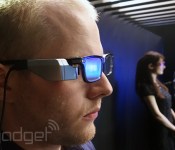
Toshiba’s new prototype is a simpler, lighter Google Glass rival… with a catch

Nearly every tech company wants in on the wearables game, but they can’t all be Google Glass or Apple Watches — not that they have to be. But hey, here’s Toshiba — and it’s got a Toshiba Glass prototype to show off. We’ll say this right at the start: this remains a reference product that the company’s showing off at CEATEC in Japan this week. And yes, technical specifics (let alone a price) aren’t being discussed yet, but the vision for Toshiba’s eye-based wearable prototype is a gentle, predictable one. The hardware is the combination of a tiny projector, attached to admittedly normal-looking frames. However, there’s actually a special kind of one-sided reflective glass to catch the projection. The projection module itself is kind of bulky, but actually lightweight… which is great, until you realize that this prototype requires a constant wired connection to work.
According to Toshiba, there’s no computational component in the arm, which primarily consists of a tiny projector and not much else. There’s no camera, rather Toshiba’s concept would act primarily as a notification system. The concept teaser (and accompanying projected images) offered glimpses of fitness tracker notifications, call reminders and a handful of business-based applications point towards security and warehouse use. Toshiba’s New Business Development Division’s Yuki Kaneko told us that’s a device headed for B2B first: it’s for other companies that also want Toshiba’s system support and other business-type stuff… that we leave to other dustier tech publications.
When we brought up the inevitable Google Glass comparison, Kaneko-san was (surprisingly!) positive about the ever-present wire, citing that it kept the weight down by offloading not only computing (and other frills like cameras), but also the battery. Battery life is thus dependent on whatever device it’s connected to, leaving the wearable lighter and more, well, wearable. The real device will appear next year, but consumer models for us mere muggles will likely be a while after that — for now, this is a business-centered wearable — which probably explains the “goggle edition.” (Our words, not theirs.)

Filed under: Wearables
.CPlase_panel display:none;

HTC makes the Desire EYE official with 13MP front camera with flash and waterproof
Prior to the announcement of the HTC RE camera, the company announced the new Desire EYE. Which was a follow-up announcement to the EYE software that we will get into a bit later. The Desire EYE though is a new phone that has a lot going for itself. It is plastic, but it is a unibody dual color molded plastic. No back covers here. The real kicker to the device aren’t the internal specs, while they are still very nice, or some 4k screen. Nope, the Desire EYE’s main attraction is the 13MP wide-angle front facing camera with color LED flashes. Yes, a front facing camera with some oomph and a set of LED flashes. I might not be a selfie taker, but I certainly do get tired of seeing super dark selies from the bar show up on social feeds.

Beyond the front camera and flash, the Desire EYE brings you a 5.2-inch 1920 x 1080 display, quad-core Qualcomm 801 processor clocked at 2.3 GHz, 2GB of RAM, 16GB internal storage with SD card slot, BoomSound, and an embedded 2400 mAh battery. The device is also IPX7 waterproof rated as well.
Beyond the hardware you have a feature set of software that takes full advantage of the dual cameras. It is called the Eye Experience. The same software will be finding its way to the HTC One M8, possibly the M7, with an update over the next month or so. The Eye Experience lets you take front and rear photos/videos at the same time. You can also do some double exposure work and take your image and place it on the scene, or in someones pocket, whatever. You will be able to crop and scale to your heart’s content. There is also, what they call, the Auto Selfie. Near as I could tell, a timer for selfies that is set for 2 seconds. It does over voice commands like “Say Cheese.” for photos and “Action” to start a video. There is a bit more in the Eye Experience that we will cover in a separate post since it will be making its way to other HTC devices soon.
The HTC Desire Eye is set for launch exclusively with AT&T. Colors, dates and pricing aren’t available yet. At least none that I found or heard.We will keep you posted on those. You can signup for more information about the Desire Eye through HTC’s website at your leisure.
//<![CDATA[
ord = window.ord || Math.floor(Math.random()*1E16);
document.write('‘);
//]]>
The post HTC makes the Desire EYE official with 13MP front camera with flash and waterproof appeared first on AndroidSPIN.
.CPlase_panel display:none;

HTC’s next midrange smartphone is destined for selfie fans

Selfies are exploding in popularity, so naturally manufacturers are stepping up to offer phones that match that rapidly expanding trend. In reality, there are already several that specifically cater to those who can’t resist a good picture of themselves, and HTC is hopping on the bandwagon with a “selfie phone” known as the Desire Eye. The device is among the first wave of phones that bear a 13MP camera on the front, which matches the resolution on the rear camera. It also comes with a new set of imaging tricks and the usual Sense experience, so it’s appealing even if you don’t want to broadcast your beautiful face all over Facebook and Instagram (among others). It’s time to take a closer look at HTC’s next big thing.
The Desire Eye is not the first smartphone that bears dual 13MP cameras; a KIRF called the THL W11 Monkey King holds that title. Still, it’s the first from a major brand that is due to roll out worldwide — it’ll come to AT&T in October as an exclusive in the US and then make its way to Asia and Europe shortly after — and is being positioned as one of HTC’s flagship devices.
The device itself comes in two colors, coral reef (white with orangish red trim) and blue lagoon (dark blue with light blue trim), is 8.5mm thick, weighs 154 grams (5.43 ounces) and has a 5.2-inch 1080p display. It features slightly bubbled out sides and a flat back, but its thickness still allows plenty of room for my fingers, which makes it easy to grip. It uses HTC’s new “double shot” design housing, which is a two-tone polycarbonate unibody design method that’s also featured on the Desire 820; it looks and feels well-built and completely robust. It also comes with a waterproof rating of IPX7, which means that it’s supposed to handle up to one meter of water for up to 30 minutes. It’s great to see more devices like this land in the US, which has admittedly been late to the waterproof game.

The Desire Eye will be the first device to offer a new bundle of camera tricks called the Eye Experience, which will become available on a large number of HTC devices soon. Most of the new features listed aren’t groundbreaking nor essential, but can help you get a little more creative with your shots. One of the coolest features is a clever new face tracking technique for video conference calls that can find up to four faces and display each of them on their very own frame; if someone is video chatting with you on Skype, for instance, they’d see four frames of each individual, rather than all four standing next to each other. Again, not essential, but it could make conference calls a little less intimidating.
On top of this, there’s also a crop-me-in mode that lets you take a selfie picture and paste it into a rear camera shot. Face Fusion can merge two faces together; Split Capture lets you take a rear picture and selfie and put both in a split-pane view; Live Makeup is exactly what it sounds like, and it doesn’t make me look any prettier (mileage could vary); Photo Booth takes four pictures and puts them into a photo booth-style set of frames. HTC is also adding voice capture for front-facing shots, so you just have to say “cheese” to take stills (“rolling” for video).
The Eye Experience will come to several other phones, such as the M7, M8, E8, Butterfly 2, One mini and mini 2, One max, Desire 816 and 820. HTC says that the feature list will be available when the update rolls out to these models, which suggests that some phones may not get all of the features.

I won’t make any final judgments on the camera experience until the firmware is completely final (these units come installed with pre-production firmware), but my first impressions are more mediocre than I was hoping — especially in the area of lowlight performance. Sure, it’s not as noisy as some other phones, but I had to retake several shots that turned out blurry and most of them were too dark, a travesty when you’re hoping to get a well-lit selfie. To that point, HTC has graciously added a dual-LED flash to the front for this kind of situation, but it’s almost too bright; your face will be sufficiently lit, but you also won’t be able to see anything for an hour. Colors aren’t accurate in daylight shots either, but again, improvements may be made between now and the final release.
The new hardware, which runs Sense 6, features specs that are more indicative of the One lineup than the Desire brand, as it offers a 2.3GHz quad-core Snapdragon 801 chipset, 2GB of RAM, IPX7 waterproof rating, a 5.2-inch 1080p display, BoomSound and a 2,400mAh battery (which is just a tad too low for our taste). The 16GB internal storage is Thus, it’s no surprise that HTC is planning to price it in between its two lineups: The company says the Eye will be priced somewhere between the Desire 820 — the 64-bit smartphone unveiled last month — and the E8, which is a plastic version of the M8.
Filed under: Cellphones, Wireless, Mobile, HTC
.CPlase_panel display:none;
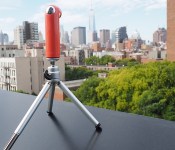
HTC’s RE camera is a GoPro for NoPros

Periscope. Asthma inhaler. PVC pipe. These are just a few items that came to mind the first time I saw HTC’s first standalone camera, which the company is simply — and oddly — calling the RE. Even though nothing about this device is normal, it’s catered to the interests of the average Joe. “If you’re going whitewater rafting down rapids, use a GoPro,” an HTC marketing executive said, pointing out that the RE isn’t supposed to compete with the popular action cam. No, HTC’s brand new emerging device, which should retail for around $200 when it hits US retail outlets like Best Buy later this month, is in a completely different category. But the biggest challenge HTC faces is in convincing buyers that this is better, faster and easier than simply pulling your phone out of your pocket when you need a quick shot.
The RE is a small and light device, at 96.7 x 26.5mm and 65.5 grams (2.31 ounces). This makes it easy to securely handle it one-handed, and that’s exactly the point: It’s supposed to be petite enough for you to quickly draw it out of your pocket or purse and start taking pictures or video footage of anything at a moment’s notice. HTC continually mentioned family scenarios, such as anytime the kids or pets are doing something cute; I’d love to use it at Disneyland, both when wandering around the park and when going on rides. In theory, the camera will be perfectly ideal for such situations — it takes 16MP images, 1080p 30fps video, 4x slow-motion 720p video and time-lapse recording, and features a 1 /2.3-inch CMOS sensor and 146-degree wide-angle lens.
There are only two buttons on the device: A shutter button on the outside, which you press once to take a picture and long-press for a couple seconds to take video, and a slow-motion capture toggle that you have to hold down to activate before starting the video. Notice that I didn’t mention a power button, because HTC wants the device to be always-on, and thus, always ready and waiting for you to use it. Sensors embedded within the RE can tell when you grab it, so in theory it shouldn’t take pictures when it’s buried deep within your pants. You’ll also find a mic on top, as well as an LED indicator and speaker just below the slow-mo button. A microSD slot sits on the bottom underneath a watertight tab; the RE comes with an 8GB card pre-installed, but you can switch it out for any card up to 128GB. There’s also a micro-USB charging/data port and a quarter-inch tripod mount for a wide variety of accessories.

Although it’s built using glossy plastic, rather than a matte finish, I didn’t seem to mind very much. It certainly is a fingerprint magnet, depending on the color — white, dark blue, teal and orange are available at launch — but since my hand is already wrapped around it, those prints typically only show up in one place where my fingers routinely sit. And while glossy materials are often too slippery, I never felt like I was going to drop it.
With the RE, HTC wants to extend its reach to consumers who may not actually use an HTC phone; it’s compatible with both Android 4.3 (or better) and iOS 7 (or better). Here’s how it works: After downloading the app and using it to connect the RE with your phone, you can then use it to back up your pics and vids, change settings (like wide-angle versus standard angle, device updates, backup settings and more) and use the app’s remote viewfinder and shutter. The RE app is also the only way you can take video in time-lapse mode; here, you can dictate how often it takes shots and the duration of the footage. Additionally, HTC says that developers will be able to access an API to open the RE up to third-party options — Tencent and Instagram were specifically mentioned.
One of the most intriguing features on the RE is live broadcasting, but it won’t be ready at launch but should be coming out shortly afterward. This is a fantastic use case for any aspiring (or already successful) YouTubers who want to record and upload events as they happen — conventions, concerts, sporting events, perhaps even city hall meetings. I didn’t get the opportunity to test out this feature, so I’m curious to see how reliable it’ll be when it comes out; will there be significant latency issues, or is it capable of maintaining a consistent connection?

Fortunately, you can switch between a standard photo and wide-angle. The latter setting definitely captures a wide panorama as advertised, but the resulting images look like they were taken by a fisheye lens. Unless I needed to capture a breathtaking skyline or other majestic scenery, I preferred to stick with the normal angle; the wide-angle shots look too distorted to use for regular shots, but it’s good to have the option and switch back and forth whenever necessary.
The unit I used was running pre-production firmware, so I will refrain from making final judgments on how it performs until I get my hands on a review unit. You can take a look at the samples to get a general idea of what to expect, but keep in mind that there are many parts of the experience that should improve before the device launches. I’m very hopeful for this, because my initial impressions weren’t very good. My unit couldn’t focus on close objects, although it focused on distant objects in the same image; I had to pull back a foot or so for the RE to focus on the correct target. The f/2.8 aperture isn’t good enough to handle lowlight shots very well; most of them were blurry and noisy, and sometimes there was such little light that the device refused to even take a picture. The video stabilization wasn’t able to compensate for the shakiness of my hand and smooth out my footage, which is crucial when using a device that’s specifically designed to work for one-handed operation. (I’ve uploaded my full-res samples to my Flickr page.)

In terms of connections, the RE uses Bluetooth LE to initially pair with your phone, but the rest of the process is facilitated by WiFi Direct — transferring files, the remote shutter and everything else.
The RE comes with an IPx7 water-resistance and dust-resistance rating, but you can buy a waterproof cap that boosts it to IPx8. It’s also armed with an 840mAh battery, which HTC says is large enough to handle up to an hour and 40 minutes of continuous 1080p filming or 1,200 16 MP photos. (As an aside, the 16MP images are shot in 4:3, but you can bump down the camera resolution to 12MP if you prefer 16:9 pictures.) I was barely able to get through a full day of testing, as my unit was in the red when I was finally ready to go to bed and charge it up.
HTC recognizes that debuting a new category of standalone cameras comes with a lot of challenges. The pricing is one of the biggest concerns; at $200, it’s going to be a difficult sell for confused shoppers who don’t know why they’d use it instead of whipping out their phone to take pictures. People will also become frustrated at the lack of an on-device viewfinder, which means users will be taking pictures with an aim-and-pray approach. Retail representatives may also find it hard to sell the device if they don’t understand the point of the product, or potential use cases for it. HTC will also have to work on distancing RE from its spiritual predecessor, the GoPro.
Another point of confusion is the name. HTC chose RE for a few reasons: First, through this and other products (the Zoe app, for instance), the company wants to distance the device so it’s not associated with HTC phones, especially since the app and service will be cross-platform; HTC also believes that the RE name aligns with some of the camera’s attributes — it’s simple, easy to say, and “you smile when you say it,” the marketing team claims.
HTC’s RE camera reminds you of…
Filed under: Cameras, Misc, HTC
.CPlase_panel display:none;

HTC’s Zoe app arrives for Android, heads to iOS later this year

HTC revealed its plan to turn Sense feature Zoe into a full-on social network a couple months back. Today, the company announced that the photo and video-sharing app is exiting its open beta, and is available for compatible Android devices (4.3 and above). If you’re in need of a refresher, Zoe lets you turn snapshots and video clips into highlight reels (Zoes) with music included. It also allows your pals to “remix” photos and videos with yours for collaborative efforts that can now be 7, 15 or 30 seconds in length. And as you might expect, Zoe works with footage from the company’s newfangled RE action cam to produce the final product, should the need arise. So what about the iOS app? While the Android faithful can nab the software today, HTC says that the version for Apple’s gadgets will arrive “later this year.” For now, the curious can take a closer look at the iOS app in the gallery down below.
Filed under: Software, Mobile, HTC
.CPlase_panel display:none;

Tour one of Earth’s grandest deserts in Google Street View

Visiting a large desert in person can be difficult. Roads will only take you so far, and you probably aren’t used to navigating gigantic sand dunes. Thankfully, you no longer have to plan a whole adventure just to see this austere beauty at ground level. Google has used camel-mounted Trekker cameras to bring Street View to Liwa, an oasis-laden desert in the southern end of the United Arab Emirates. The move gives you 360-degree panoramas of everything from massive dunes (up to 131 feet high) to date farms. This won’t compare to making the trip yourself, but it’ll probably be much more comfortable.
Via: Google Maps
Source: Google Views
.CPlase_panel display:none;
 AIVAnet