


Nokia’s Here Auto tries to predict your driving needs (hands-on)
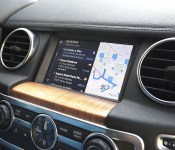

Okay, let’s get this out of the way: it’s not Nokia Here anymore, just plain old “Here.” Nokia’s VP of Connected Driving, Floris van de Klashorst, told me that Here no longer uses the Nokia name and is fully independent (though it’s still 100 percent owned by Nokia). That settled, Here Auto was launched last year as Nokia’s connected car solution for automakers, competing with Apple’s CarPlay and Android Auto. Nokia beat both of those giants to the punch, however, and it definitely shows. The latest version of Here Auto, launched at the Paris Auto Show, has fewer rough edges than its competitors. It’s also designed to think ahead of you, learn your habits, work with other devices and present information and options in the least distracting way possible. That’s the goal, anyway — to see if it succeeded, I took a tour around Paris in the company’s Range Rover demonstrator.
Before jumping in the car, I had a look at the latest version of Here Auto and talked to Mr. van de Kashorst about the features. First off, the engineers took me through a typical trip planning session. After entering the destination — which can be done from the vehicle’s console or a tablet (more on that later) — the system queued up several route choices. Thanks to the vehicle’s fuel sensor input, part of the route showed up as red, meaning you wouldn’t make the whole trip with the amount of gas in your car. From there, a sidebar menu appeared, showing filling stations in the area, and even the price of fuel (the availability of prices depends on your location). You could then add the pit stop to your itinerary, and the whole trip is replotted.

The system also works with your tablet or smartphone, allowing you (or a passenger) to preselect your destination. The destination will then be added to your favorites list on the console display, where it’ll stay until you delete it. On top of eliminating the cumbersome console entry chore, the tablet also lets drivers change destinations or add pits stops on the fly.

That done, we launched in the company’s demonstrator for a quick trip around the convention center. The system immediately brings up street level imagery to let you picture the destination before you arrive. It’ll then bring up several, traffic-optimized route options, since most manufacturers will likely include traffic data for free with the nav systems. Once navigating, the system allows touchscreen control, but also indirect control via a dial/joystick to the right of the driver (if included). In addition, the route can be displayed on the car’s dash so that you just have to glance down to see if you’re still on track. Nokia said together, those are key safety features that let you “focus on the task at hand, which is driving the car.”
In the event you need input a new destination mid-drive, the maps will still work offline — a feature also available on the apps. You’ll also get tourism information from Lonely Planet, Trip Adviser or local sources, if available.
Once you near your endpoint, the system kicks into approach mode. It brings up the street level view again, and also brings up a mode called “one-touch parking nearby.” It then lets you send an SMS or email with one touch to inform your party that you’ve arrived. Meanwhile, the companion app located on your tablet has kept up with the program, and can walk you back to your car if you forget where you parked it.

Mr. van de Klashorst told me that on of the main goals of the new update was to make it easier to improvise and adjust on the fly during a trip. By opening up the interface to external devices (iOS, Android and, of course, Windows) passengers can also join in the fun by finding interesting spots to explore.
With a new SDK, Nokia is giving car manufacturers access to all its features, while letting them custom design the look of interface to suit their own vehicle styles. The company also has its tendrils into self-driving vehicles, helping manufacturers make self-driving vehicles more friendly. For instance, Here has recently started providing lidar-generated 3D mapping data for better efficiency and trip planning.
Despite a few tablet syncing glitches, the whole demo was incredibly smooth — and all the Nokia-less work seems to be paying off. Here said yesterday that it was used as the primary mapping service in 50 out of 62 new vehicles that just launched at the Paris Auto Show.
Filed under: Transportation, Nokia
.CPlase_panel display:none;
 AIVAnet