



China Telecom Launches Preorder Page With Fictional iPhone 6 Claims, Rendered Images
Following in the footsteps of China Mobile, Chinese carrier China Telecom has also begun taking preorders for the iPhone 6 ahead of the device’s official launch in order to drum up interest with customers. As noted by TechCrunch, the site has a preorder page that sports rendered images of the iPhone 6, along with several suspect specifics about the device that have undoubtedly come from unconfirmed rumors.
The preorder page depicts the 4.7-inch iPhone, which China Telecom suggests has a pixel density of 416, which would be in line with a 1704 x 960 resolution. While that resolution has been rumored for the iPhone 6, recent images of a supposedly functional device have leaned towards a 1334 x 750 resolution with a 326 ppi first proposed by Apple pundit John Gruber.
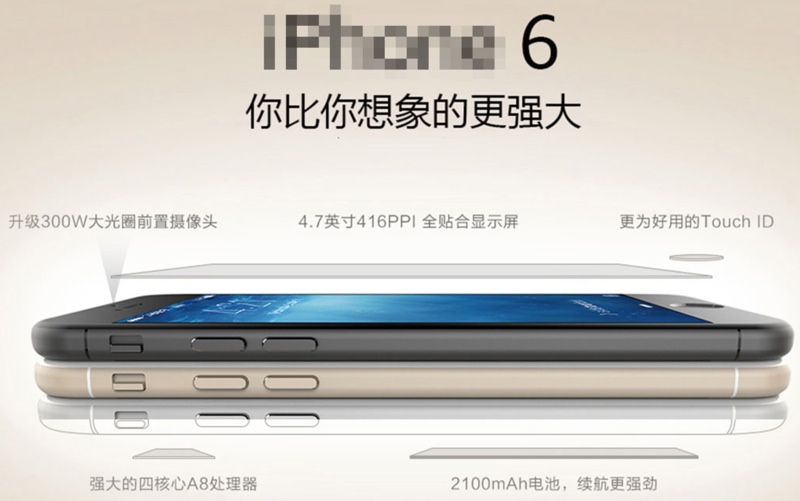
An A8 processor and a Touch ID fingerprint sensor are highlighted in the image, which are two likely inclusions for the iPhone 6, but the image also points towards a 2,100 mAh battery. While that capacity has been rumored, there have also been several photos of an 1,810 mAh battery bearing an Apple logo and regulatory text. Finally, China Telecom’s image suggest a 3-megapixel front-facing camera, another unsubstantiated rumor.
According to TechCrunch, the graphic originally included a non-blurred version of the word “iPhone”, but it was later updated by China Telecom, likely at Apple’s request.
Earlier this week, China Mobile began accepting preorders for the iPhone 6 and garnered more than 33,000 orders in just hours, pointing towards strong interest in the iPhone 6. Analyst predictions have suggested the iPhone 6 launch could bring a in more upgraders and Android switchers than normal, due to its larger display and redesigned body.
Apple is expected to introduce the iPhone 6 at a September 9 media event, which is now just under four days away. Rumors and part leaks have suggested the device will have an A8 processor, NFC support, and an upgraded camera. It’s expected in two sizes — 4.7 and 5.5 inches — but it is unknown if both versions of the phone will ship to consumers at the same time due to production difficulties with the larger model.
.CPlase_panel display:none;
Apple Seeds OS X Mavericks 10.9.5 Build 13F31 to Developers [Mac Blog]
Apple today seeded Mavericks 10.9.5 build 13F31 to developers, just over a week after seeding the fifth OS X 10.9.5 beta, build 13F24, and more than a month after releasing OS X 10.9.4 to the public.
The beta is available through the Software Update mechanism in the Mac App Store and through the Mac Developer Center.

It is unclear what improvements the 10.9.5 update will bring to Mavericks, but it is likely to include bug fixes and stability enhancements. Apple is asking developers to focus on USB, USB Smart Cards, Graphics, Safari, and Thunderbolt.
Along with working on improvements to Mavericks, Apple is also beta testing OS X Yosemite, which is due to be released in the fall. The last Mavericks update, 10.9.4, added several Wi-Fi fixes and improved wake from sleep reliability.
.CPlase_panel display:none;

Intel’s Core M chips will boost PC battery life by nearly two hours

Indisputably, the star of this year’s IFA show is going to be wearables: round ones, flashy ones, head-covering ones. After that, though, you’re also going to see a lot of super-thin tablets and 2-in-1 PCs, many of them made possible by Intel’s new low-power Core M chips. Intel first teased these processors earlier in the summer, in the form of a 7.2mm-thick tablet that was even thinner than the iPad Air. Now many such systems are about to go on sale, which means it’s time for Intel to fully explain what these new chips are capable of.

To be clear, although these CPUs fall into the “Broadwell” family — the one that comes after the current Haswell line — these are not the replacements for Intel’s fourth-generation Core processors, the ones inside most new high-end laptops. Those won’t come until sometime next year. Rather, Core M is the follow-on to the current “Y series” of Haswell processors, which are already used in some 2-in-1 PCs, like this one. Indeed, Core M is also meant for 2-in-1’s (plus super-thin notebooks); it just promises faster performance and longer battery life. You know, like you’d expect on a new chip.
Because Intel moved from a 22-nanometer process with Haswell to a 14-nanometer one with Broadwell, this new crop of PCs will be both thinner and lighter than was previously possible for a full-fledged PC. In particular, Intel says some of these devices will measure as little as 7mm thick, though the company has warned from the beginning that not every Core M device will be as thin as that iPad Air-like tablet we mentioned earlier. Again, all this is possible thanks to some significantly shrunken components. The motherboard alone is 25 percent smaller and is now about as wide as a dime and slightly taller than a quarter. In total, the die size is now 37 percent smaller.

As for power consumption, the power draw can go up to 6W, though Intel says the typical TDP for systems on the market will be 4.5W. As a result, the company claims you can expect up to 1.7 hours more battery life versus Haswell-Y depending on the use case, with the biggest gains coming from local 1080p video playback. These systems should run cool enough, too, that just about all of them will be fanless. (You could technically do this with a 4.5W-TDP Haswell CPU, though most PC makers chose not to.) Additionally, Intel says CPU performance is up to 50 percent faster, with Intel’s integrated HD 5300 graphics notching a 40 percent performance improvement.
Other features of these processors include Wireless Display 5.0; Intel’s Smart Sound technology, which allows the device to wake on voice; and native support for PCIe storage disks. Core M chips will eventually support the WiGig wireless docking standard as well — just not at launch, according to Intel. That last bit is important, as it’s a key step in Intel’s plan to one day enable PCs with zero cables or ports.
All told, more than 20 models with Core M are on the way, according to Intel. For now, Intel is shipping three different processor skus, the specs of which you can find in the table below. More CPU options will follow early next year, including some vPro-enabled chips for corporate-issued machines. Eventually, too, Intel still says prices will drop as low as $599 — just don’t count on seeing anything that cheap right away. Everything you’ll see here at IFA is likely to be a bit more pricey.

Filed under: Laptops, Tablets, Intel
Source: Intel
.CPlase_panel display:none;

Back to School 2014: The 7 best gaming gadgets

Everyone needs a study break at some point, and there are plenty of consoles ready and waiting to entertain you. We’ve also included our top gaming laptops for those who need serious graphics. Once you’ve checked out our top picks, head to the back-to-school guide home page for more gadget goodness.
.CPlase_panel display:none;

Pinterest Chrome extension brings inspiration to freshly-opened tabs

When you open a new tab in Google’s Chrome browser, you’re greeted with a search box, rows of recently-visited sites and a tucked-in menu for individual apps. It’s really not very inspiring, is it? Pinterest doesn’t think so, and thanks to an internal make-a-thon, there’s a new Chrome extension that aims to remedy the gray box blues. Once you’ve installed the add-on, you’ll be prompted to select what you’re interested in for the day amongst sports, food, photography and several others. When you open a new tab, you’ll be greeted with a full-bleed image populated from Artsy, 500px or National Geographic. I’m told these are the libraries for now due to the “good spectrum” of options they house, but more could be on the way later. On top of the visual stimulus, Google Calendar info is situated at the bottom left while weather details for your current location is pulled in from Yahoo. And of course, info for the displayed photo and the ability to pin it is down on the right. The digital repository already has an extension for adding to boards from websites, and that’s included here too, but the original will still be available for those who don’t want to spice up their tabs.
Filed under: Internet, Software
Source: Pinterest, Chrome Web Store
.CPlase_panel display:none;

New 27-Inch 5K Display From Dell Rekindles Thoughts of Retina iMacs
Dell yesterday unveiled its new $2500 27-inch 5K monitor (UP2715K) that boasts an impressive 5120 x 2880 resolution at 218 pixels per inch. This ultra-high resolution places the monitor on par with Apple’s Retina MacBook Pro, which has a pixel density of 220 pixels per inch, and would be the equivalent of a Retina 27-inch iMac or Apple Thunderbolt Display.

Dell does not detail the technology powering the monitor, but AnandTech believes the company is using Multi-Stream Transport (MST) to stitch together two 2560 x 2880 panels in order to provide 5120 pixels horizontally. Dell demoed the monitor to Maximum PC using a 5K H.265 video streamed from a workstation-class NVIDIA Quadro K5000 video card.
As outlined in our display roundup, customers have been looking toward a higher-resolution large display from Apple for some time, whether it be a true Retina version of the existing display or a somewhat lower resolution 4K display, particularly since Apple has been touting the 4K capabilities of the new Mac Pro. Rumors of Retina iMacs date back to 2012, but the machines have yet to appear, likely due to both cost and technological constraints.
With Dell listing its display at $2500, it is clear pricing remains a challenge for Apple’s ambitions to launch Retina iMacs and standalone displays. Standalone displays may stand a better chance, as Apple has historically been willing to develop expensive large-screen displays priced in the thousands of dollars for its pro-level customers. An iMac almost certainly priced well north of $3000 could be a difficult proposition, however, so Apple may yet need more time for prices to come down before such a machine becomes commercially feasible.
Besides its impressive resolution, Dell’s monitor ships with Dell’s PremierColor technology and an edge-to-edge glass that includes both anti-smudge and anti-reflective properties. Also included in the display is an integrated media reader, six USB ports and 16W Harmon Kardon speakers. Video out support includes dual DisplayPort 1.2 ports for 5K video and a miniDisplayPort for 4K operation.
Dell’s UltraSharp 27 Ultra HD 5K monitor will be available in the fourth quarter of this year.
.CPlase_panel display:none;

Rear Camera of 5.5-Inch iPhone 6 With Optical Stabilization and Other Parts Shown in New Photos
A number of parts from Apple’s upcoming iPhone 6 models have leaked in recent months, but a new photo set from Feld & Volk [Instagram page] offers some fresh details on the new devices.
At the top of the list is the rear camera from the 5.5-inch iPhone 6. As shown in comparison photos, the module is thinner and otherwise larger than the one from the iPhone 5s, but with Apple shaving down the iPhone’s thickness, previous leaks have indicated the company has needed to create a slight protrusion on the rear of the device to accommodate the camera.
 Rear cameras from 5.5-inch iPhone 6 (left) and iPhone 5s (right)
Feld & Volk says the rear camera does indeed appear to include optical image stabilization (OIS), as the camera assembly has some freedom to float within its module. Rumors have differed on whether the iPhone 6 will include OIS and if so, whether both the 4.7-inch and 5.5-inch models will support it.
 Rear cameras from 5.5-inch iPhone 6 (left) and iPhone 5s (right)
Feld & Volk indicates the 5.5-inch camera module does not fit in the 4.7-inch rear shell the firm has on hand, suggesting the two iPhone 6 models will use different camera modules. Supply chain analysts have indeed predicted that OIS will be a differentiating factor for the larger iPhone 6 model.
 Inside rear camera module from 5.5-inch iPhone 6
Along with the rear camera, Feld & Volk also draws attention to several other parts, including protective mesh for the speaker and microphone holes, color-matched to the various iPhone color options.
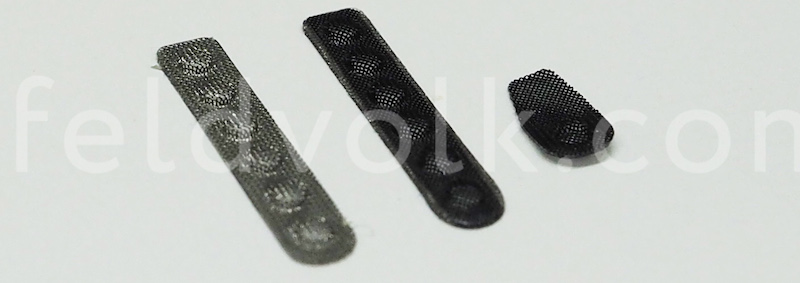 Speaker and microphone mesh for iPhone 6
While the iPhone 6 power button has been seen previously, Feld & Volk has highlighted the presence of a rubber seal around it, which is a new addition for the iPhone line. The seals would help increase dust and moisture resistance for the iPhone 6.
 iPhone 6 power button with rubber seal
The photos are the latest in a long line of recent leaks from Feld & Volk, which has been working to acquire iPhone 6 parts in an effort to quickly release its own version of the device. The company specializes in luxury modified versions of the iPhone selling for thousands of dollars, and is planning to launch its iPhone 6 models as soon as possible after Apple’s official announcement next Tuesday.
.CPlase_panel display:none;

At least ten U.S. wireless providers in line to carry the Moto X

Now that the new Moto X is official and no longer rumor it’s time to look at which carriers are in line to offer the device. We swung by the Motorola website this morning to see who might be listed as having the phone on its radar. We expected to find most, if not all, of the top five providers but were pleased to see even more.
As of today there are at least carriers listed under the registration page. Suffice it to say, you should be able to get the Moto X with your provider of choice. It’s just a matter of how long it takes for some of them.
- AT&T
- Boost Mobile
- Cricket Wireless
- MetroPC
- Net10/Tracfone
- Sprint
- T-Mobile
- U.S. Cellular
- Verizon
- Virgin Mobile
If you’re looking to add your name to the list, be sure to swing by Motorola’s website to learn more about the Moto X availability.
The post At least ten U.S. wireless providers in line to carry the Moto X appeared first on AndroidGuys.
.CPlase_panel display:none;

Huawei’s Ascend P7 Sapphire Edition is elegantly tough

Huawei’s a smartphone manufacturer that likes to stay very much on trend. At IFA this year, it unveiled the latest device in its large-screen Ascend Mate series, which includes a fingerprint sensor akin to that of the HTC One Max and iPhone 5s. While that handset was very much the star of the show, Huawei also brought the new Ascend P7 Sapphire Edition along for the world’s press to check out, and it’s the first time we’ve seen it in the flesh since hearing about it late last month. Sapphire glass looks set to become the new buzzwordy feature of next-generation phones, and Huawei’s making sure it’s quick out of the gate. We know full well what’s inside the new P7 edition and how it’s likely to perform, which left us plenty of time to drool over the new premium look that’ll turn heads and take a serious beating.
Huawei’s given the Sapphire Edition almost a complete makeover. For starters, the glass on the front (if you haven’t cottoned on by now) is made from super-strong sapphire. We already know how much punishment sapphire glass can laugh off with no visible damage, but we gave the P7 a brief thrashing regardless. Luckily, Huawei had tethered a few small penknives to the demo area for just this purpose (they were also handy for keeping other rabid journalists from getting snatchy). The glass shrugged off every attack easily, though we didn’t expect much else — you wouldn’t exactly include knives in the demo area if you weren’t 100 percent sure your device could handle them.
It’s not just the front that’s been toughened up, either, as the back panel is no longer bog-standard glass, but ceramic. Not only is the material more durable, but its bubble-like patterning adds some extra, pleasing detail. The aluminum band that runs around the top and sides of the device has also been re-skinned in a soft rose gold color. It’s almost too decadent given the phone would be just as happy in a toolbox as a jean pocket, but it looks great against the deep black of the rest of the handset.

So, not only has the P7 been treated to more premium materials on the front and back, but the whole package looks like a much superior version of the original. The only thing that gives away the smartphone’s roots is the bare, curved plastic on the bottom edge of the handset. It doesn’t do much to taint its overall appeal, however. Huawei’s releasing a limited quantity of Sapphire Edition devices in China later this month, and while the exact price remains a mystery, it’ll definitely be more expensive than standard P7 (duh!). The firm’s CEO Richard Yu told us discussions with global distribution partners are ongoing, so it is possible we could see a wider rollout in the future, but that scenario is still far from a lock.
Filed under: Cellphones, Mobile
.CPlase_panel display:none;

Wuaki.tv to join Netflix and Amazon with 4K streaming

In the competitive UK streaming market, pricing might be important, but many services live and die on the features they offer. With juggernauts like Netflix and Amazon already committing to bumping up the quality of their streams, Wuaki.tv is moving quickly to match its competition by adding 4K content to its service. The company has worked with LG and Samsung to develop a new app capable of streaming 4K movies direct to compatible TVs in the UK and Spain by the end of the year. Like Amazon and Tesco’s Blinkbox, Wuaki.tv offers a mixture of subscription or pay-as-you-go movies and TV shows, letting you stream its 4K content any way you want it.
Filed under: Home Entertainment, HD
.CPlase_panel display:none;
 AIVAnet