


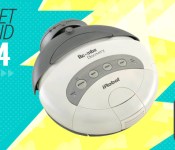
Gadget Rewind 2004: iRobot Roomba Discovery

Little robot helpers found a place in our hearts and homes in 2002 when iRobot introduced the Roomba. This house-cleaning ‘bot definitely made for an odd addition to the company’s existing lineup of space exploration, minesweeping and tactical support devices. But beyond the novelty factor, the first Roomba model wasn’t an immediate success for the company.
After heading back to the drawing board, iRobot released a vastly improved model in 2004 called the Roomba Discovery. It had enhanced cleaning powers, longer battery life and was significantly smarter. The Discovery may not have been a true replacement to traditional vacuuming, but it definitely justified its cost and earned a solid customer base. It was also affordable, costing only a couple hundred dollars compared to competitor products like the 2004 Electrolux Trilobite, which shot well past the $1,000 mark.
Whereas the first iteration of the Roomba spent most of its time traversing in ever-growing spirals and occasionally hugging walls and furniture edges, the Discovery had a better grasp of its environment. Its underbelly featured independently controlled wheels and a brushing mechanism for clearing away muck and mess that it stowed in an onboard, bagless bin. Sensors informed the Discovery when it had given most of a room enough of a cleaning, and even helped it return to the charging dock when it was finished. The Discovery was even smart about battery management: If its two-hour battery life was waning, it would head to the dock early to charge up.
Although the Discovery was better equipped to sense its surroundings, it wasn’t foolproof. On many occasions, owners would find their confused robovac repeatedly seeking an escape from a wall corner, caught between table legs, or held up by wires or various other household items. And while it was a fairly successful solution for light housekeeping, the Discovery wasn’t meant to thoroughly clean an entire house. It was designed merely to do a dry sweep of rooms, not mop floors. To cover that functionality gap, iRobot expanded the line in 2005 to include the Scooba, a model made specifically for washing and scrubbing floors.
iRobot’s success with its Roomba and Scooba lines eventually led to a variety of spin-offs with dedicated functions. In the late aughts alone, the company released the Looj for gutters, the Verro for pools, the Dirt Dog for industrial workspace messes and the Roomba Pet Series. The Roomba line may have splintered off over the years to service different cleaning needs, but one thing has remained consistent: its ability to entertain pets.
Filed under: Household

The Big Picture: Beijing’s urban e-waste economy

Head out of Beijing in a north-westerly direction, and you might pass Dongxiaokou village. Perched on the outskirts of town, the Dongxiaokou is where a lot of Beijing’s electrical waste goes to be forgotten about. Not by everyone, though. The village has become a hub for immigrant workers that make a living plundering the e-waste for scrap materials or repairable items. Despite the tough living conditions and low income they receive, residents are concerned that plans to urbanize the area could mean an end to their livelihood.
[Image credit: Kim Kyung-Hoon/Reuters]
Filed under: Misc
Source: Reuters

Google considers $15M Songza purchase

With streaming services booming, Google is apparently looking to supercharge its services, now in talks to acquire Songza, according to the New York Post.
Songza, a music curation and streaming service, creates playlists based on time, date, mood, activity, etc., which are all things missing from Google Play Music All Access.
Some examples of playlists from the Songza website homepage include “Waking Up Happy,” “Drinking Gourmet Coffee,” “Working Out,” “Recovering From Last Night,” and “Brand New Music.”
Songza, which has about 5.5 million active users, is a free service that has been dabbling with advertising as of late, creating playlists co-branded with products such as Febreze’s “Sleep Serenity,” the Post said.
Rumor has it that Google is offering Songza around $15 million to help it better compete with services like Spotify with 24 million active users and Pandora with 77 million active users.
If the deal goes through, it could just push the search giant to become an even bigger player in the music streaming industry, and they may need it too to compete against Apple and Beats.
Source: New York Post

The post Google considers $15M Songza purchase appeared first on AndroidGuys.

Inhabitat’s Week in Green: Terrafugia, Urban Skyfarm and a motorized ‘home in a box’
Each week our friends at Inhabitat recap the week’s most interesting green developments and clean tech news for us — it’s the Week in Green.

Hurricane Sandy slammed into the East Coast in the fall of 2012, causing widespread devastation and billions of dollars in damages — and future superstorms will likely be worse. But the US government is doing something about it, providing nearly $1 billion in federal funding for projects that will make the coast more resilient in the face of climate change. HUD announced six winning proposals this week, and they include some of the world’s top design firms. OMA, the firm founded by Rem Koolhaas, received $230 million to rebuild the damaged areas of Jersey City, Hoboken and Weehawken and protect them from future superstorms. Bjarke Ingels’ BIG Architects was awarded $335 million to create a series of protective planted berms and flood walls in lower Manhattan’s flood zones to make them more resilient to storm surges. SCAPE/Landscape Architecture won funding for its Living Breakwaters project, which will provide a buffer against wave damage on Staten Island. A team from MIT also won funding for its plan to transform and protect the Meadowlands basin in New Jersey and expand current marshland restoration efforts. And Walter Meyer has developed a proposal for creating a 50-acre nature park with sunken forest that could protect the Rockaways from future storms.
Continuing with the theme of disaster preparedness and resilience, this week Inhabitat took a look at Intershelters, prefab dome homes that can be assembled in less than a day, providing instant shelter for up to five people. In other green design news, MIT Media Lab has created a motorized and compact “home in a box” that can make a 200-square-foot space feel like a room three times larger. Best of all? The room expands and contracts with a wave of your hand or the sound of your voice. Aprilli Design Studio has drawn up plans for Urban Skyfarm, a massive tree-like vertical farm that provides food and renewable energy for urban dwellers. At this year’s Venice Biennial of Architecture, Zaha Hadid and several other leading architects unveiled Titled Antarctopia, a pavilion that explores man’s relationship with Antarctica by showcasing present and future models of living in the polar continent.
Could airplanes of the future be powered by nothing more than the sun? A pair of Swiss aviators thinks so. Bertrand Piccard and André Borschberg, the men behind the Solar Impulse airplane, recently completed a successful maiden flight of the Solar Impulse 2. Next year, the two men plan to fly the solar-powered plane around the world. In other exciting aviation news, Terrafugia is seeking $30 million in funding so it can begin to produce its flying cars by as soon as 2016. But the most practical (and greenest) mode of transportation is still the trusty bicycle, and France recently rolled out a plan to pay people to ride their bikes to work. In the US, eight states just formed an alliance to drastically cut emissions by boosting the number of zero-emission vehicles on the road to 3.3 million by 2025. And electric carmaker Tesla announced this week that it will tweak the Model X crossover vehicle to make it look better (and make it more appealing to the ladies).
Ocean plastic is a major problem, but we’re only beginning to understand the full extent of it. Canadian scientists have announced the discovery of a new type of rock made from the scraps of melted plastic waste and ocean debris. The best way to limit plastic waste is to stop using the stuff. In Germany, a pair of entrepreneurs is preparing to launch the country’s very first zero-waste supermarket. In 3D printing news, the team at AKEMAKE has just unveiled Spirula, the world’s first 3D-printed speaker that’s made entirely from wood. Can you imagine a world in which you could forgo baggage fees, and email your luggage to yourself? Finnish designer Janne Kyttanen suggests that in the future we could use 3D printers to produce our clothes and other necessities at travel destinations. On the green design front, Inhabitat got a window makeover with the help of window-covering company Decorview. In Lego news, a group of schoolchildren and workers in Hungary teamed up to create the world’s tallest Lego tower, shattering the previous record set by a group of high school students in Delaware. Lego has also announced plans to expand its collection of female minifigs by creating a set of female scientists. And if you’re looking for a way to use your smartphone more productively, Inhabitots recently gave the (free) group text-messaging service GroupMe a test drive.
Filed under: Misc, Transportation, Internet

Scientists use lasers to imitate an exploding star here on Earth

It could be centuries (if ever) before humans can observe the behavior of a supernova first-hand, but scientists at the University of Oxford may have delivered the next best thing. They’ve recently simulated an exploding star by zapping an extremely thin carbon rod with a powerful laser; the resulting extra-hot blast (1.8 million degrees Fahrenheit) ripped through a chamber much like the real thing, as you can see pictured here. To add an extra dose of realism, the team added a plastic grid that replicated interference from dust and gases.
The ensuing swirls supported theories behind not just the behavior of supernovas, but the universe at large; turbulence in the test chamber amplified magnetic fields, suggesting that the earliest magnetism was created through similar chaos. Whether or not there’s an opportunity to prove this in the future, it’s clear that researchers are at least on the right track.
[Image credit: University of Oxford]
Via: Space.com
Source: Nature Physics

San Francisco takes the pain out of joining secure public WiFi

Security on public WiFi tends to be either non-existent or a bit of a hassle; it’s not fun to track down passwords just so that you can get online from the street corner. If you frequently visit downtown San Francisco, though, it’s now a relative breeze. The city has launched a new version of its public WiFi that uses the Hotspot 2.0 standard to give you an encrypted connection with a minimum of fuss. So long as you’re using a recent platform (newer Android devices as well as iOS 7, OS X Mavericks and Windows 8), you only have to install a simple profile to get going instead of putting in some credentials.
The service is still limited to the same footprint as San Francisco’s recent WiFi network, which runs along Market Street between Castro Street and the Embarcadero. However, it’s potentially significant as one of the first city-scale uses of simple-yet-secure WiFi. Typically, you won’t see Hotspot 2.0 unless you visit specific places (think airports), and you may still need to subscribe to an internet service like Boingo or Time Warner Cable. San Francisco’s deployment takes the guesswork out of it — you can stay online throughout a large urban area knowing that others can’t easily snoop on your activity.
[Image credit: Scott Loftesness, Flickr]
Filed under: Cellphones, Wireless, Networking, Mobile
Via: CIO of San Francisco (Twitter)
Source: City of San Francisco
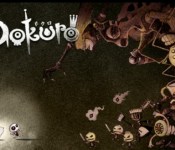
Whatcha Playing?: Dokuro by GungHo Online Entertainment

Welcome back to another edition of “Whatcha Playin”, an article about me playing a game exclusively for one week and I tell you my deepest thoughts on it. For this week I got to enjoy a true gem, Dokuro by Gungho Online Entertainment.

What the game is about
Dokuro is a 2d action platform puzzle game. A Dark Lord captures a lovely princess, and takes her back to his castle to make her his new bride. You play as a Dark Lord’s minion tasked to look over a captured princess. However after a change of heart you become her hero and try to escort her safely out of the Dark Lord’s castle.

Who is this game for
This game is for those who enjoy puzzles that often include a quick response. The puzzles are often pick up and go, none that I encountered required too much time to solve. However this does not mean the game is not difficult. Many of time I made a fool of myself getting mad at myself and displayed a quite tantrum. The game has golden coins to collect in each stage to add to the difficulty of the game. This game also includes Boss battles that adds both action and puzzle solving to beat them.

Final thoughts
I enjoyed playing this game, and at a later time will continue to enjoy it. The game feels as if you are playing an old silent movie that was drawn in chalk. It is a cute and whimsical game that won me over without trying. One of my main reasons why i enjoyed this game is of the story it tells. The story shows that it is not what we are but who we are that is all that matters. Another main reason why I like this game is it’s solid control, even though I personally hate touch buttons, the game still played great.

Outro
In conclusion, if you want a game to fill in that waiting time on a line or at a doctors appointment this game is great for that and then some. Just remember when you’re in public places not to make a fool of youself.
//<![CDATA[
ord = window.ord || Math.floor(Math.random()*1E16);
document.write('’);
//]]>

Moto 360 Spotted on the Tonight Show with Jimmy Fallon

The Moto 360, I feel, is going to take the tech community by storm, the question on all our minds is: when will it be made available? If last night’s Tonight Show with Jimmy Fallon can tell us anything, is that it might be out pretty soon.
Joshua Topolsky, Editor Chief for The Verge, was a guest on Jimmy Fallon to show him the latest in technology goodies. Apparently Topolsky is a regular on Fallon, and last night, he showed off the Lytro camera and Sony’s new VR headset. Those were pretty spiffy pieces of technology, but a lot of us focused on what was wrapped around his wrist. Without even mentioned it, Topolsky was wearing the apparent Moto 360. It looks absolutely beautiful, and of course Topolsky couldn’t say anything about it, because he is obviously a tester. Check out the full video segment below, and let us know your thoughts about the Moto 360.
Source: Android Authority
//<![CDATA[
ord = window.ord || Math.floor(Math.random()*1E16);
document.write('’);
//]]>

International Space Station beams a video back to Earth using lasers (video)

In April, NASA sent special equipment to the ISS that’ll be able to test if laser beams can effectively transmit large amounts of data from space. Sounds like the project (called Optical Payload for Lasercomm Science) is going well thus far, because it successfully beamed a 27-second “Hello, World!” video back to Earth for the first time. The entire transmission lasted 148 seconds, but it took the system only 3.5 seconds to send each copy of the video clip to the project’s ground station at the Table Mountain Observatory in California. It would’ve taken the ISS’ radio waves-based technologies 10 minutes to do what OPALS did for less than two; the connection even reached a peak of 50 megabits per second.
To make that happen, the hardware on the ISS had to detect a beacon fired by the ground station before it can send signals over the laser beam back to the ground. That’s extremely difficult to do, as the ISS orbits the planet at 260 miles above ground, with a speed of 17,500mph — in fact, NASA compares the feat to shining a laser pointer to the tip of someone’s hair 30 feet away and keeping it at that point while they go around moving. The agency’s doing all these not just to provide the ISS a faster connection, though. OPALS is actually part of NASA’s efforts to find a better means of communication for future spacecraft right out of sci-fi flicks meant for real-life deep space exploration.
[Image credit: NASA]
Source: NASA Jet Propulsion Laboratory
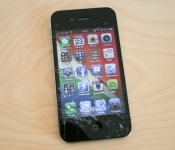
New film makes shatterproof phone screens a practical possibility

Sure, the screen on your smartphone is likely scratch-resistant, but it still won’t survive a drop to the sidewalk. However, that could all change if University of Akron scientists get their shatterproof touchscreen film into shipping hardware. They’ve developed transparent electrodes that, when layered on polymer surfaces, are just as transparent as current technology (indium tin oxide) but much more durable. You can bend them over 1,000 times without breaking, and they also hold up against peeling.
More importantly, the technology is cheap. In fact, the university believes that it should be less expensive to make this film than the touchscreen tech in use today; you can simply mass-produce it in rolls. While there’s no firm production timetable, scientists fully expect their technology to hit stores in the future. Eventually, you won’t have to worry quite so much that your phone might slip out of your hands.
[Image credit: William Hook, Flickr]
Filed under: Cellphones, Displays, Science, Mobile
Via: MD Connects
Source: University of Akron, ACS Nano
 AIVAnet