



Tech’s biggest misfires of 2013

You can’t win ‘em all. The adage certainly holds in the fast-paced world of technology, where one small slip can put a damper on your entire year. Every year, among all of the celebrations of top gadgets and big news stories, we like to take a moment to acknowledge the other side of things. This time out, it’s a pretty diverse list, from flubbed Kickstarter launches to massive governmental privacy breaches and yet another really lousy year for one smartphone manufacturer. But don’t worry everyone; the year 2013 is nearly over.
Microsoft gets DRM-happy with the Xbox One

After nearly a decade between consoles, Microsoft’s Xbox One got off to a bit of an inauspicious start. What should have been a celebratory time for the gaming powerhouse was preceded by something of a muddled mess, thanks to a jumble of confusion surrounding the admittedly obtuse digital strategy put forth by Redmond. One thing was for sure: Gamers were pissed about the console’s DRM, most notably the 24-hour physical disc check-in for used games. The plan was even more problematic for those without access to a stable internet connection. Anyone who’s ever spouted that tired cliche about there not being any such thing as bad press has clearly never been on the wrong side of a video game flame war, and with its chief competition, the PlayStation 4, launching at virtually the same time, Microsoft saw fit to make a change.
Xbox head Don Mattrick took to the console’s official site to confirm that the gamers had won, thanking them for their “assistance in helping us to reshape the future of Xbox One.” It was a pretty sweeping reversal on a policy for which the company had seemingly been unwilling to budge. It’s tough to say how much of an impact such a policy would have ultimately had on the next-gen console’s sales, but with a price $100 greater than Sony’s offering already working against it, the added negative publicity certainly couldn’t have helped. In the end, plenty of zombies were shotgunned via the Xbox One — and isn’t that what really counts?
The NSA gets caught reading everyone’s email

Granted, it’s not as if all this went down in the 2013 calendar year, but given the sorts of revelations that were uncovered, we’d be remiss if we didn’t include it this time out. The question, then, is where precisely to start with the government agency’s laundry list of civil liberties violations? After all, while it’s likely that few were genuinely surprised that the government’s been doing this manner of snooping, the information revealed by Edward Snowden was shocking in precisely how deep, thorough and extreme the NSA’s collection methods were.
Given the nature of this here site, PRISM seems as good a place to start as any. One particularly incriminating slide highlighted the NSA’s information-skimming from the servers of technology’s biggest names, including Apple, Microsoft, Google, Yahoo and Facebook. After denying foreknowledge of such spying, a number of often adversarial companies teamed up for an open letter to the US government. As the saying goes, clandestine mass-electronic surveillance programs make strange bedfellows.
DMCA phone-unlocking ban is back in action

Remember that great exemption by the Library of Congress that made it legal to unlock your phone? Remember how it sounded too good to be true? Remember how unsurprised you were when the three-month window ended and the Copyright Office wasn’t exactly jumping to renew it. And while the legality of unlocking is still pretty murky, the situation raised alarms for pretty much everyone from the ever-vigilant Electronic Frontier Foundation to President Barack Obama. In fact, in September, the White House petitioned the FCC to require carriers to let consumers unlock their handsets.
Pretty Much Everything BlackBerry

Listen; we’re as sick of including BlackBerry on this last as you are reading about it — the company’s managed to make its way onto this list in some form or another since we started compiling it back in 2011. And while we’ve been holding out hope that the Canadian smartphone manufacturer would have turned things around by now, each new piece of news out of Waterloo seemingly confirms that it hasn’t quite found the bottom yet. By all accounts, it should have been a banner year for the company, wrapping up January by launching the long-awaited BlackBerry 10 with a bang. The release arrived with two new handsets — the Q10 and Z10 — and a complete rebranding for the company, finally shedding the stuffy Research in Motion moniker for the more familiar BlackBerry. Shortly after the announcement, the company’s newly named creative director (and sometime singer-songwriter) Alicia Keys tweeted from her iPhone. It wasn’t a make-or-break moment for the smartphone wars, but it was hard not to read the gaffe as symbolic of the company’s larger struggles.
In March, new CEO Thorsten Heins announced that the company wasn’t interested in targeting the developing world, and the following week, BlackBerry’s tone-deaf band was at it again with an Etta James parody announcing that the OS was finally ready to ship. When we got our hands on the new phones, it was pretty clear that they weren’t the game-changers BlackBerry was clearly gunning for. Revenue proved disappointing, as well, as the smartphone maker continued hemorrhaging jobs again and again. And as for the “budget” Q5, well, if you can’t say anything nice… In September, it was announced that the company had lost a billion dollars in a three-month period. Later that month, amidst much speculation, an Ontario-based financial holdings company was set to take over, only to have the deal fall through, instead opting for an investment, while ousting Heins, who joined the CMO, CFO and COO in the long line of Blackberry job losses. Just last week, it was revealed that the company’s continued financial woes put the kibosh on plans for two budget handsets.
New CEO John Chen has, naturally, remained bullish (if, understandably, grounded), projecting profitability by 2016. In the meantime, don’t be too shocked if BlackBerry winds up on another of these lists before it’s all over.
Ouya’s lukewarm launch

This one kind of hurts. Like many of you, pretty much everything about OUYA excited us, not the least of which was the prospect of a small hardware startup disrupting a gaming industry dominated by three giants. And heck, the company deserves some points for delivering a product at all, in an age when Kickstarted hardware projects feel like a crapshoot, at best. When the Android console finally launched, however, it was pretty clear that the first-generation console wasn’t ready to take on the heavy hitters.
By most accounts, the device still felt like a beta unit. The controller was a bit crummy and the game selection wasn’t quite there — hardly the sort of launch it needed to compete with the Nintendos, Sonys and Microsofts of the world. Since then, however, the team has been hard at work on improving the console’s overall experience, adding games, improving the controller, expanding storage (see above image) and even taking a break to mess around at E3.
Illustration by Greg Grabowy; Photos: National Security Agency (NSA) Director Gen. Keith Alexander (AP Photo/Manuel Balce Ceneta); Thorsten Heins, president and CEO of Research In Motion (AP Photo/Reinhold Matay)
Filed under: Cellphones, Gaming, Peripherals, Software, Mobile, Microsoft, Blackberry

FAA selects six sites for drone testing because flying robots are our future

One day, drones will be flying overhead… and it will be normal. But, right now, concern over the safety of allowing unmanned aircraft to roam freely in our airspace outweighs their groovy future potential. Which is why the FAA today, following a mandate by Congress, has selected six test sites around the US for the purpose of studying UAS (unmanned aircraft) and eventually integrating them safely into our heavily trafficked skies. Research on UAS will now be carried out at facilities operated by The University of Alaska, Texas A&M University, the state of Nevada (an obvious choice, really), North Dakota’s Department of Commerce, New York’s Griffiss International Airport and Virginia Tech — all chosen for their geographical and climatic diversity.
Each partner will carry out testing in key research areas highlighted by the FAA: sense and avoid, command and control, ground control station standards and human factors, airworthiness, lost link procedures and interface with air traffic control. The results of which will go towards developing regulations for “commercial and civil use” (yes, you will one day own and operate a drone). But just because the FAA’s given a greenlight to further UAS testing, that doesn’t mean you’ll see drones whizzing about in our skies anytime soon. The agency’s stressed that this is just a test and not an invitation to tempt fate in our national airspace system.
Filed under: Robots
Samsung intros 8Gb LPDDR4 Mobile DRAM for next-gen smartphones
Samsung on Monday announced a new form of memory chip for smartphones, tablets, and other mobile devices. In specific terms, the module is an 8Gb, low power double data rate 4 (LPDDR4) DRAM chip on a single 1GB die. In general terms, it’s a much faster memory module than what we’re dealing with today.
With the new chip, Samsung will focus on the premium mobile market including large screen UHD smartphones, tablets and ultra-slim notebooks that offer four times the resolution of full-HD imaging, and also on high-performance network systems.
These chips offer “50 percent higher performance” while using “approximately 40 percent less energy” than the current stuff. According to Samsung, four of these can be combined to create a single 4GB RAM module and that volume production is expected in early 2014.
Sounds like we might look forward to 4GB RAM in the Samsung Galaxy S5, no?
The post Samsung intros 8Gb LPDDR4 Mobile DRAM for next-gen smartphones appeared first on AndroidGuys.
Samsung Galaxy Gear 2 rumored for Mobile World Congress
A Galaxy Band is also expected in the new year
That Samsung is already working on a successor to the Galaxy Gear smartwatch shouldn’t come as much of a surprise. We actually heard a few months back that such an animal was already in the works. But, as to when it’s going to be released has not been made clear. According to the Korea Herald, the next-gen wearable should debut at Mobile World Congress.
Another device expected from Samsung for the MWC is the Galaxy Band, which is reportedly a health and fitness wristband with which can monitor physical conditions such as pulse and blood pressure.
In addition to the Galaxy Gear 2, we are advised to look for a Galaxy Band fitness tracker in the new year. As you might expect, the device would track and sync your workouts, steps, and other health-related details.
Samsung has historically held an Unpacked event around the annual February event so we expect that for 2014. With rumors suggesting that Samsung has a bunch of smartphones, tablets, and other devices due in the first half of the year we should look for a big introduction at one, maybe two, events.
The post Samsung Galaxy Gear 2 rumored for Mobile World Congress appeared first on AndroidGuys.

Purported Original iPhone Prototype Sells on eBay for $1499
An alleged prototype version of Apple’s original iPhone has sold on eBay for $1499, with the device appearing to be in excellent condition and containing signal strength measurements etched on the rear casing. The device is also shown running Apple’s internal diagnostic software.
I am selling a very rare original iPhone engineering prototype. These were used to test the iPhone’s various features. To do so, a special test software was installed, which is still running on the device perfectly.
This is device is especially rare, as it shows the initial iOS version installed and the signal strength values etched on the back. This was done by Apple internally and is guaranteed genuine.

The authenticity of the device has not been confirmed, and similar signal strength etchings do not appear to have been seen on other prototypes, but the device does lack the standard regulatory text on the rear casing that would be present on a non-prototype unit. A reddit user claims to be the buyer of the device, but it has not yet been delivered to allow for further testing of its authenticity.

It is not unusual for prototype Apple devices to appear on eBay, and many of these auctions are quickly removed, presumably at Apple’s request. This auction was able to be completed, perhaps due to having been posted for only two days and having ended through a “Buy It Now” purchase well ahead of the scheduled ending time.
     |

Apple and Samsung Said to Resume Settlement Talks Over Patent Dispute [iOS Blog]
Apple and Samsung have reportedly resumed settlement negotiations over their ongoing patent-infringement dispute, according to The Korea Times. A source from the Korean Fair Trade Commission (FTC) told the newspaper that the two companies are in “working level discussion” about a potential deal, adding that Apple and Samsung are attempting to narrow differences over royalty payments.

Samsung still prefers to sign a comprehensive “cross-licensing” deal, allowing the world’s biggest smartphone manufacturer to access all Apple’s design-related, some standard-essential and commercial patents; while Apple is asking Samsung to pay over $30 per device for Samsung’s patent violations, which Samsung thinks is “too much,” said another Samsung official who is familiar with the issue.
The report also states that Samsung Mobile CEO Shin Jong-Kyun may fly to the United States to discuss patent issues with Apple CEO Tim Cook early next year. Last year, Cook met with Samsung CEO Choi Gee-Sung to discuss the subject, however, those talks reportedly failed because Samsung would not accept Apple’s demand for patent royalties. Both companies also met face-to-face in Seoul earlier this year, but there was said to be “no indication” of an imminent agreement as the discussions failed to progress.
Apple and Samsung have been in a long, ongoing legal battle that started in 2011, with the first U.S. trial awarding $1 billion to Apple in 2012. However, a judge voided nearly half of that amount in March, with a jury in the damages retrial last month ruling that Samsung is to pay Apple $290 million for willfully violating multiple patents. A second infringement lawsuit between the two companies will also be held on March 31, 2014, with a separate injunction trial centering around Apple’s call for a U.S. ban on Samsung products potentially preceding it.
| |

‘New York Times Magazine’ Design Director Arem Duplessis Joining Apple’s Marketing Team [Mac Blog]
 Longtime New York Times Magazine design director Arem Duplessis is leaving the publication to take a position with Apple’s internal marketing team, according to Mediabistro. Duplessis answered a few questions for Mediabistro, but did not address what his exact role at Apple will be.
I’ve been at The New York Times Magazine for almost ten years. I have worked with some of the smartest people on the planet and it’s been one of the most rewarding experiences of my life. I feel very fortunate to have been able to experience such a great gig. With that said, it’s time for a new chapter and a new challenge.
The New York Times Magazine is a Sunday supplement for the venerable newspaper, offering a range of content including feature-length pieces from well-known contributors, highly regarded photography features, and a puzzle page with the newspaper’s famous Sunday crossword.
Prior to joining The New York Times Magazine in 2004, Duplessis had spent time as design director at Spin and GQ magazines.
Apple’s marketing team, which is drawn from both internal staff and agency TBWA/Media Arts Lab, recently lost one of its high-profile members for the second time when Scott Trattner joined Facebook earlier this month. Trattner had spent nearly a decade as Executive Creative Director at TBWA\Media Arts Lab before leaving in August 2012 to join Samsung’s ad agency 72andSunny. That appointment lasted just seven months, however, with Trattner rejoining TBWA\Media Arts Lab in February of this year.
| |

The man behind NYT Magazine’s gorgeous covers is headed to Apple

You may not know the name Arem Duplessis, but you’ve no doubt seen his work on the cover of The New York Times Magazine in the past 10 years. As design director at NYT Mag, he crafted some of the most stunning work in the publication’s history — examples seen above — and he’s just been hired away from his decade-long post. And that’s what’s especially interesting: he’s heading to Apple as a creative director.
In a brief interview with Mediabistro, Duplessis says part of what he’ll do at Apple is assist the internal marketing team (the folks responsible for evangelizing to Apple employees on the company’s own products). No doubt those internal memos will have extra attention to alignment and contrasting colors! The ambiguity of his title means he’ll also have other responsibilities, and we’re gonna go all the way crazy and wager that Apple wouldn’t waste Duplessis’ eye for design solely on internal marketing.
[Image credit: Cover Junkie]
Filed under: Apple
Source: Mediabistro
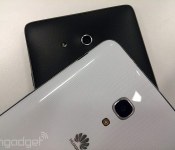
Huawei Ascend Mate 2 snapped with its predecessor, said to keep 720p panel

While there’s been no reason to doubt whispers of a follow-up to Huawei’s Ascend Mate, pictures of the super-sized device have so far been unflattering. Today, however, a Mate 2-toting source has sent some snaps to our friends at Engadget Chinese, including a few family photos with the original Mate. Barring a few aesthetic changes and a slightly thinner profile, the Mate 2 bears a similar square form factor to its older brother. Aside from learning of its 13-megapixel main camera, the source reiterates specs we’ve heard already: a 1.6GHz quad-core processor, 16GB of internal storage, 2 gigs of RAM and Android 4.2.2 with a coating of Emotion UI. It is claimed, however, that the next-gen Mate’s display has not been upgraded as previously thought, so we’re in for the same 6.1-inch 720p panel as before. That could make for an anticlimactic first impression, and if Huawei’s going to make its Mate family announcements a CES tradition, then disappointment is just around the corner.
Filed under: Cellphones, Mobile
Source: Engadget Chinese

French Uber users face 15-minute delay starting next year

To the surprise of virtually everyone in France, the government has just passed a law requiring car services like Uber to wait 15 minutes before picking up passengers. The bill is designed to help regular taxi drivers, who feel threatened by recently-introduced companies like Uber, SnapCar and LeCab. Cabbies in the Gallic nation require formidable time and expense to get their permits and see the new services — which lack such onerous requirements — as direct competitors. The legislation managed to pass through parliament despite reservations from the French competition authority, which deemed it ill-thought-out. Meanwhile, a spokesman for the private services called the new law “absurd, unjust and incomprehensible” and vowed to attack it. One SnapCar rep even told TechCrunch it would never leave a customer on a rainy street, and pointing to the French Minister responsible, said “what would Manuel Valls want for his mother?”
Filed under: Transportation, Internet
Via: TechCrunch
Source: Liberation
 AIVAnet