


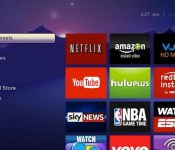
Roku 3 finally snags an official YouTube app, support for additional models is on the way

The lack of a YouTube app has been a massive hole in the content lineup of Roku’s otherwise well-rounded media streamers, but no more. YouTube just announced that Roku 3 players in the US, Canada, UK and Republic of Ireland all have access to its video streams starting today. Unfortunately, that means it doesn’t apply to earlier players, but the Roku blog says additional models will get access next year — we’re checking to see if that applies only to the new 2013 lineup or older hardware also. Unofficial — and frequently blocked — channels to access YouTube and ways to pipe content through other apps like Plex have existed before, but the official app brings HD video, “Send to TV” pairing with your phone or tablet and the ability to sign in and access your subscribed channels directly. The app is in the channel store right now; add it to your player by clicking here.
.@RokuPlayer Awesome videos and #Roku3? Time for a dance party: http://t.co/sPHAzBqDKB Let’s break it down: http://t.co/hbS1vYq9ld
– YouTube (@YouTube) December 17, 2013
Filed under: Home Entertainment, HD, Google
Source: YouTube Blog, Roku Blog, Roku Channel Store

Samsung is reshaping its identity one note at a time

A car barrels across a highway, accompanied by a gently stirring orchestral movement. Wait, it speeds away in silence. Actually, it’s careering along to a rapid drumbeat and a brutal string arrangement, suggesting there’s trouble ahead. That’s how Samsung’s Joong-Sam Yun prefaced our meeting at the company’s Sound Lab in Korea, overlapping different backing tracks to a TV show opening and highlighting the drastic effect audio can have and warming up to how his team is trying to bring a similar aural clout to the company’s devices.
Samsung’s Galaxy S series has become known as the iPhone rival, no doubt magnified by the ongoing legal tussles between Samsung and Apple, and its own ads for the Galaxy S III. Becoming arguably the most visible (and successful) Android smartphone maker has made it a magnet for criticism, fair or otherwise. Despite multiple critically and commercially well-received smartphones, dominating the TV market and spending $10.8 billion a year on R&D, it seems the Korean company hasn’t quite achieved the identity it wants. Now, with an eye on changing consumer perception, the company has turned to sound design to make Samsung distinctly recognizable to your ears.
Aside from shifting to studio recording and increasingly sophisticated methods aimed at making its ringtones and start-up melodies unique, Samsung’s Sound Lab is also tasked with testing and creating new uses for haptic technology — another effort that the company hopes will ensure its future mobile products maintain that smartphone market share.
The department has existed for decades, but its output was previously dedicated to more by-the-book digital audio work, pulling from a huge catalog of generic Foley sounds (everyday sounds, reproduced in a studio) when needed. However, two years ago, when it came to developing the audio for the Galaxy S III, the Sound Lab needed to deliver a more natural, less “cold” sound to go alongside new hardware “inspired by nature.” It had to deliver something different that would make its new smartphone undeniably Samsung-made.
Early feedback said that recordings “sounded like they came from the toilet.”
Foley recording techniques suddenly came back to the fore, because the sound bank Samsung used wasn’t unique. So, the engineers and designers at the lab got out the glassware, some mics and varying quantities of liquid in an effort to make their very own nature-inspired sound library. The splash notification sound you heard on the Galaxy S III isn’t actually water. It’s not milk or yogurt either (though these were both tested); but orange juice. Samsung’s explained this before, but the sound team admitted that the eventual sounds took some revising: Early feedback suggested that recordings “sounded like they came from the toilet.”
“We fell into a panic,” Yun admits.
The team returned to the studio and tweaked both the Foley recording and how it sounded on the device. The resulting natural soundtrack that peppered the Galaxy S III might still have a slight ring of domestic plumbing, but it remained a statement of intent as the company offered more resources to its sound design arm.
“[The company] wanted to add emotional value; that was why they hired sound designers,” Yun said. “Recording sounds via orchestra? Ten years ago, this would have been impossible, but we can [now] present a high-quality … emotional sound.”

The practice of sonic branding (as it’s referred to at its most insipid level) is familiar territory for other Top 10 Global Brands, where the likes of McDonald’s and Microsoft have their own unmistakable audio identity. Samsung wants the same and the de facto ringtone melody on Galaxy phones reappears on other devices, is repurposed for backing music in its own retail stores and is even put to work at the company’s big press launches.
We’re not sold on the notion that a lone notification or ringtone can ever bring a tear to our eyes, but it’s hard to argue with the fact that Samsung’s seven-note ear worm and those nature-inspired notifications are creeping into the public consciousness — a watery swipe-to-unlock at Starbucks, a splash sound in the middle of a crowded train. It helps that the rest of the built-in ringtones are simply higher quality than what’s come before.
2011
2013
Under Yun’s supervision, Samsung’s signature melody, “Over The Horizon,” (embedded above) has made its way into most of the company’s smartphones since the Galaxy S. Yun previously penned music arrangements for commercial films and brought that experience with him to Samsung. The team now makes its compositions with real musicians, rather than using digital sounds, as it did in years past. It doesn’t matter how rich or lilting a composition sounds on a digital piano; transform those into a live performance and you immediately elevate whatever sentiment or emotional reaction that was being aimed for.
The team reaffirms that its new identity is focused on consistency across Samsung Electronics’ myriad products — a sound that says, “This is a Samsung product.” It’s something the company reckons will only increase in importance as it continues to expand and push smart appliances and home systems.
There’s huge potential in haptic tech, although anything groundbreaking might be a ways off.
But making products “sound” Samsung (in a traditional sense of the word) is only a portion of the lab’s goal. It’s also heavily involved with the development of “non-visual sound,” like haptic and vibrational technology. Along those lines, it’s currently readying an entire UX aimed at users with disabilities in addition to rolling out further haptic features and enhancements on its smart devices. The efforts here mark another attempt to separate Samsung’s consumer tech from its rivals, to offer something that users won’t get elsewhere. However, the Sound Lab will have to push deeper than what we’ve seen so far.

Samsung’s Galaxy Note 3 offers unique vibrational feedback to the stylus for different (digital) pens, which is meant to bring the writing experience closer to paper, but it’s hardly a killer feature. Development is treading carefully, and we’re told that any expansion will require “in-depth study” with regard to the strength and frequency of haptic notifications. The haptics found in the Galaxy Gear prove a good example. Because the wearable attaches directly to your wrist, it meant halving both the ringing volume and haptic feedback for the company’s first smartwatch. According to its research, the average distance between the wrist and the ear is 50cm, while your smartphone (in your pocket or on the desk) is about a meter away.
There’s huge potential in haptic tech, although anything groundbreaking might be a ways off. “Our homework is to work out to what extent haptic notifications and feedback can be improved. As hardware evolves … haptics will too,” Yun explains. If Samsung gets it right, it might not be all that disparate from what it’s trying to achieve with its ever-adapting anthem: something that could define the company and its future.
Richard Lai contributed to this report.
Filed under: Cellphones, Tablets, Software, Mobile, Samsung

Now iOS users can control Google Glass remotely with MyGlass companion app

For a while there, Google’s Glass was only for the Android population since the eyewear required compatible devices running the MyGlass app for activation. Not so anymore as the company’s just released that companion app to Apple’s App Store, making it possible for iOS users to set up, manage contacts and Glassware apps, as well as remotely navigate (or screencast) Glass right from their smartphones. You’ll need to be running iOS 7 in order to run the app and take advantage of the screencasting possibilities. And before your itchy trigger finger hits hits download, heed Google’s oft-repeated advice: “If you don’t have Glass, then downloading this will be a waste of time.” That’s right from the mouth of Mountain View itself. Consider yourself warned.
Filed under: Wearables, Software, Mobile, Apple, Google
Via: 9to5 Mac
Source: iTunes App Store
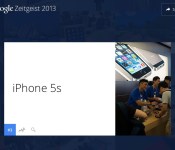
iPhone 5s and iOS 7 Rank Highly in Top Google Searches of 2013
Google has released its annual Google Zeitgeist feature highlighting popular and trending searches for 2013 in various categories. As usual, several Apple-related terms rank highly among most popular searches for the year, led by “iPhone 5s” at #3 and “iOS 7″ at #11.

Rounding out the list of Apple products included in the main list was “iPad Air”, which took the 68th spot among most popular searches. Other popular tech products included Samsung’s Galaxy S4 in eighth place, PlayStation 4 in ninth, and Xbox One in 19th.
Google also includes a number of rankings broken down by category and geography. In the United States, for example, the trending tech gadgets category was led by the PlayStation 4 and Samsung Galaxy S4, but Apple took the next four spots with iPhone 5s, iPhone 5c, iPad Air, and iPad mini. Even the iPhone 6 made an appearance in tenth place among trending tech gadget searches for 2011.
     |
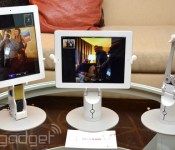
KUBI telepresence robot arm for tablets now shipping, starting from $399

It was almost a year ago when we checked out Revolve Robotics’ KUBI, a motorized tablet cradle that lets you remotely pan and tilt your device — via an iOS app (Android version coming soon) or web portal — during video calls. After missing its summer launch window, this US-made telepresence robot is finally shipping to its Indiegogo backers starting this week. Those who want in now can also order one through the company’s website, albeit at much higher price points: the KUBI Hacker Edition for developers costs $399, whereas the prettier but otherwise identical KUBI Classic (pictured above) is asking for a steep $499 — almost twice as much as the original intended price due to a change in tooling, for the sake of speeding up production.
If you’re really desperate for a Bluetooth LE robot arm for your tablet, order soon — delivery is expected within three to four weeks. For now, you can get a glimpse of the first few KUBIs off the production line in the short clip after the break.
Filed under: Robots
Source: Revolve Robotics
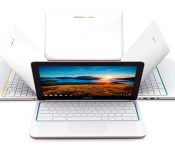
Google and HP recall overheating Chromebook 11 chargers

Google and HP may have already put the brakes on Chromebook 11 sales due to overheating chargers, but there are many Americans who still own the risky equipment. Accordingly, the two companies have just issued an official recall for all 145,000 adapters in the US; owners now have to contact Google for a free replacement and stop using the flawed gear. There’s still no word on just when Chromebook 11 sales will resume, although the existence of a fixed charger suggests that the 11-inch system will return to shelves in the near future.
Filed under: Laptops, Google, HP
Source: CPSC
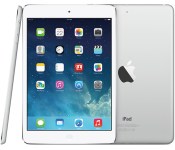
Engadget Giveaway: win an iPad mini courtesy of Numbridge!

The holidays are upon us and the New Year is rapidly approaching, so it’s probably time to ditch the cryptic text messages and get on the horn for a proper chat with friends and family. The folks at Numbridge are offering some incentive for those who choose nice over naughty by giving away a svelte new iPad mini with Retina display to one lucky reader. Numbridge is the iPhone and Android app that’s “redefining proximity” by making all international calls into local ones and freeing you from WiFi and broadband dependence. The rates are said to be some of the lowest on offer, with access to 50 countries around the globe, smart caller ID and even local callback numbers. So while you’re listening to that distant relative tell the “longest story ever,” you could also be enjoying a session of Plants vs. Zombies 2 on one of Apple’s latest slates — just don’t forget to turn the sound off! All you need to do is head to the Rafflecopter widget below and enter for your chance to win.
The Rules:
- Entries are handled through the Rafflecopter widget above. Comments are no longer accepted as valid methods of entry. You may enter without any obligation to social media accounts, though we may offer them as opportunities for extra entries. Your email address is required so we can get in touch with you if you win, but it will not be given to third parties.
- Contest is open to all residents of the 50 States, the District of Columbia, and Canada (excluding Quebec), 18 or older! Sorry, we don’t make this rule (we hate excluding anyone), so direct your anger at our lawyers and contest laws if you have to be mad.
- Winners will be chosen randomly. One (1) winner will each receive one (1) iPad mini with Retina display – WiFi, 64GB, Black (ME278LL/A)
- If you are chosen, you will be notified by email. Winners must respond within three days of being contacted. If you do not respond within that period, another winner will be chosen. Make sure that the account you use to enter the contest includes your real name and a contact email or Facebook login. We do not track any of this information for marketing or third-party purposes.
- This unit is purely for promotional giveaway. Apple, Numbridge and Engadget / AOL are not held liable to honor warranties, exchanges or customer service.
- The full list of rules, in all its legalese glory, can be found here.
- Entries can be submitted until December 18th at 11:59PM ET. Good luck!
Filed under: Announcements, HD, Mobile, Alt, Apple
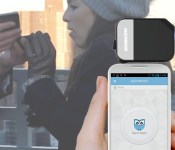
Alcohoot smartphone breathalyzer shipping now for $119

It’s no match for knocking back a few Diet Cokes in lieu of libations before getting behind the wheel, but if you can’t avoid having a beer or two before driving home, getting a read on your blood alcohol content is an absolute must. Alcohoot, a smartphone-powered breathalyzer, will help you gauge your BAC and put a stop to further consumption before things get out of control. The $119 device, which boasts “police-grade accuracy” and plugs into your handset’s headphone jack, is shipping now.
Alcohoot is significantly pricier than competing products, such as the $49 Breathometer, but co-founder Ben Biron promises professional accuracy, assuming you keep up with the requisite annual calibration (to speed things up, you’ll get a new device each year with a shipping label to return the old gear, for a $30 fee). The bundled Android and iOS apps will show you open restaurants within walking distance so you can soak up that booze with some greasy grub, a link to Uber and even a tool to track your consumption throughout the night — though nothing quite spoils the mood like whipping out a breathalyzer after every drink.
Filed under: Cellphones, Household, Mobile

The original Tomb Raider is now available on iOS for $1

Perhaps you saw the lush TressFX in the latest Tomb Raider game and thought, “Man, I’d sure like to go back to the way things were, back when Lara Croft’s hair was little more than a brown object affixed to her polygonal face!” Well you’re in luck, as Square Enix today re-released the original 1996 version of Tomb Raider, rough edges and all, on the iOS App Store. Better still? It’s just $1 — about the maximum we could see ourselves paying for a near 20 year old game.
As for how easy you’ll find guiding Lara through the tombs she’s known to raid, that’s another question altogether: screenshots show a mess of contextual on-screen virtual buttons as the means of control (or perhaps as an attempt at control). Even if it’s unplayable, the most money you could waste is a single bank note — not exactly what we’d call a risky proposition.
Filed under: Gaming, Handhelds, Software, Mobile
Via: Joystiq
Source: iTunes
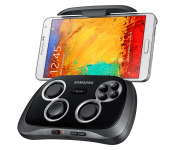
Samsung debuts redesigned GamePad controller for smartphones
Samsung has introduced a new version of its GamePad game controller for Galaxy and other smartphones. Things look strikingly different than the first generation and now feel considerably less like an XBOX 360 controller. Color has switched from white to black and the analog sticks are now concave instead of convex. What’s more, the buttons have gone from the traditional ABXY layout to dots numbering 1-4.
The GamePad can work with any Android smartphone ranging in sizes of 4-inches to 6.3-inches. You will need Android 4.1 Jelly Bean or newer; NFC-ready Galaxy handsets with Android 4.3 can pair automatically.
Samsung is also introducing a new Mobile Console app which curates a list of compatible games to browse and/or purchase. At launch there are 35 games but Samsung says there’s “much more to come in 2014.” Samsung is selling the GamePad in some European markets and will be available in additional regions in the coming weeks. Pricing is not immediately clear.


The post Samsung debuts redesigned GamePad controller for smartphones appeared first on AndroidGuys.
 AIVAnet