



Alt-week 12.21.13: Rainbow sun, edible batteries and the world’s toughest encryption cracked by a microphone
Alt-week takes a look at the best science and alternative tech stories from the last seven days.

When constructing a feature whose very reason for being is to explore the most far out aspects of our universe, it’s fair to say that we’re leaning towards the red pill. But that doesn’t mean there’s nothing here for those of the blue persuasion. We think you’ll love the rainbow sun, for example — until you realize, technically that’s very real too. This is alt-week.
Everyone knows what the sun looks like, right? Most kids would be able to paint it from memory before reaching first grade — big, bright and probably yellow. And that image is largely correct, for us Earth-bound pedestrian humans. Less so, if you’re one of the team at the Solar Dynamics Observatory, which has just released a video of our star, comprising footage of 10 different wavelengths of light (and therefore colors). Most of what the video shows is invisible to the human eye, or is blended in with what we do see. When separated, the different light frequencies show off different elements, or features of the sun — for example, ultraviolet shows a sweltering 11 million degrees F, where you’ll find solar flares hanging out. So, while the school kids aren’t getting their artwork wrong, there’s definitely scope for them to go a little more abstract.

To us, the term “edible batteries” either sounds like something discarded from a cereal-maker’s product brainstorming session, or a spirit-crushing fact of life from a not-so-far off dystopian future (though maybe the former is, too?). If you hang around at Carnegie Mellon University, however, you’re more likely referring to a prototype power source, that could be used to fuel innovative (ingestible) medical devices. The “batteries” are based on melanin — found in cuttlefish ink — as the anode, and manganese oxide as the cathode. Everything in the battery can harmlessly dissolves in the body — unlike conventional lithium-based cells, that need to be safely encased, and physically removed. With further development, the edible batteries could be used to power “smart pills” that only release their active components once they are past the stomach. It’s this part of the journey which can destroy many medicines before they reach the intestine — usually calling for intravenous administration instead. Perhaps we can add NFC, too, and then the interactive app possibilities are endless.

We guess we knew this day was coming, but the comfort of denial was too seductive. A team of acoustic cryptanalysts has broken 4096-bit RSA encryption using little more than a microphone. We say little more, but that’s just in terms of hardware, you’ll still need some high-grade smarts. By recording high-pitched sounds (in the region of 10- to 150 KHz) produced by a laptop’s CPU as it decrypted data, the team — which includes RSA co-inventor Adi Shamir — was able to unlock its secrets. With a recording made, the experts were able to pin-point parts that related to decrypting of data. Once this part has been established, you can filter out the rest, and focus on figuring out the decryption key. Worrying as it may be that we’re thoughtlessly sending this information out into the ether every time we use our computers, know that there’s a bunch of variables in the chain that would make almost all scenarios individual. Different computers, CPUs, and not to mention encryption software would likely require their own fresh attempt. That said, the same team was able to break algorithims from as far away as 13 feet, and even managed it using just a phone (from 1 foot away). In theory, all you need is the recording, and the rest can be done back at the lab/studio, but if there’s ever been a case for cracking up your jams when working with sensitive info, this is it.
Seen any other far-out articles that you’d like considered for Alt-week? Working on a project or research that’s too cool to keep to yourself? Drop us a line at alt [at] engadget [dot] com.

Behind the Scenes: CES 2014 Planning and Organizing, Not as Easy as You Think
Every year there is this event. The International CES. Some of you might have heard of it. It is the single largest tech event in the world. It kicks off every year in January in Las Vegas. The show covers all aspects of technology from next years TV’s, Cars, Connected Homes, Start Ups, Tablets, Phones, Accessories and everything else in between. New products get announced, new concepts get shown off and upcoming technology makes the headlines across the globe. It spans 1.9 million net square feet, and that just covers the Las Vegas Convention Center, the Las Vegas Hilton and The Venetian. That number doesn’t take into account the numerous suites and meetings held at the Bellagio, The Pallazo and countless other hotels up and down the strip.
How does a site, like ours, plan for such a massive event? Very carefully. Seriously though, it is nothing short of a tedious task. So I thought that it might be interesting for us to share a little bit of what goes into attending this show.
 In past years there have only been two of us on the floor. Most of the time was spent moving from meeting to meeting for 7 days straight. All in an attempt to see as much as we could see to report back to you guys about later. One sad fact and truth about an event this massive, is the overwhelming amount of people sucking the life out of data connections everywhere. Sure, there is a press room for us to visit and get things out, but they too are crowded. This year however, we are fortunate enough to have 6 guys on the ground. Bonus for us and for you guys. I thought planning with a crew would be a lot simpler of a task than it has turned out to be. We have managed to fill up the entire week with quite a few meetings for everyone.
Negotiating 1.9 million+ square feet is pretty insane when you think about it, but it is nothing compared to when you first step onto the show floor. The first task at hand was navigating the 75 to 100 daily emails for meeting requests. Filtering out what is most relevant to AndroidSPIN and our readers, and what is just too cool to miss regardless. Then there is the limit of time. Crossing from North Hall to South Hall isn’t just a 5 minute walk. Booking our meetings based on their location was imperative. Keeping walking time to a minimum so that there would be more time to talk, video, photograph and learn about anything we are looking at. The good news though is that the first few weeks of December is when you get bombarded with requests and then they slowly taper off around Christmas until opening day.
There are only so many hours in a day and only so much a small crew can see. We have about 70 meetings scheduled over 6 days on the floor. We will see plenty more though. Having been multiple times myself, I know we will have shorter meetings than expected and less time moving to the next than planned. That is where the next phase of planning come in. I call it “The List”.
The list is an organized list of companies and their booth numbers organized by their locations and in numerical order. Many are ones that requested we come meet them and don’t have the time to schedule a formal meeting, others are companies I know we should visit or have visited in the past. Currently our list has another 50 booths to attempt to make it to also. Mathematically, if we make all the meetings and hit all the booths on the list and nothing else, we will have visited roughly 120 various companies. I have no doubt in my mind that we won’t probably hit the 200+ number though. Especially considering events like CES Unveiled, Showstoppers and Pepcom Digital Experience housing multiple companies at small tables.
None of what I have mentioned above is a secret. Anyone can visit cesweb.org and take a look around. See a list of companies, find their locations on the various how floors and check out a photo gallery of last years show.
We are definitely excited to make the trip this year and have a number of plans to bring more to you guys then we have been able to in the past. Next week I think I might clue you into the packing stage of the prep work. If anyone is interested I mean.
I am sure there are a number of my fellow bloggers and news sources out there that will be in attendance as well. How is your planning and booking phase going? Are you overwhelmed, overbooked and ready to go?

Swiss researchers created a cube that can sit, jump and walk (video)

Swiss researchers have created a metallic cube that can “walk” across a surface. Staff at the Federal Institute of Technology Zurich crammed a series of inertia sensors and constantly-spinning rotors (called reaction wheels) into a 15-centimeter cube, dubbed Cubli, that enable the contraption to move around on its own. When one or more of the weighted rotors abruptly stops spinning, the machine sort of jumps on its edge — all thanks to centrifugal force. Once upended, the rotors act like a gyroscope to maintain Cubli’s position. Halt another wheel and things get really crazy: the device defies gravity, tipping up and balancing on one of its eight corners. By repeating these motions in succession, the gizmo uses a series of controlled falls to slowly hop across a surface. In terms of practical applications, the Swiss researchers said this tech could aid in remote planetary exploration, possibly giving the Curiosity rover and its ilk some company. All noble goals, but for now the lab says that Cubli is just a high-tech toy. And that? That’s perfectly fine.
Filed under: Robots, Science, Alt
Via: Huffington Post UK

Divoom Bluetune-Bean, the perfect pocket sized Bluetooth Speaker [Review]
If you are still looking for the perfect stocking stuffer for the pre-teen in the family, or maybe just something for mom in the garden, then the Bluetune-Bean from Divoom might be one that could fit the bill.
 The Specs:
- 3 watts of speaker power, max 6 watts
- 50 mm micro driver
- 100 – 20000Hz frequency range
- Bluetooth v3.0 +EDR
- 10 m range / 360 degree sound
- 6 hours of playback time
- 68 x 45 x 92 mm
- In the box – USB Charging cable, Bluetune-Bean, manual (no wall plug)
 The Bluetune is a small portable bluetooth speaker that offers a lot for its price and its size. The outer casing is a nice soft rubber that gives it a great feel and look. On the bottom you have your micro USB port for charging. It is under a rubber stopper that is a bit of a pain to get open.

 On the left side is a power/sync button. Like any other Bluetooth device, press and hold it to put it in pairing mode. Just below that is a phone button. Yes, the Bluetune-Bean is more than just a speaker, it is also a speaker phone. The mic is located between the two buttons. The phone button also doubles as a play/pause button for your tunes.
Sound quality of the Bluetune-Bean
For its size I was quite surprised by the volume level of the speaker. My wife has been using it on a hook on the shower door while streaming music to get ready for work. It fills the bathroom and floods into our room. We have a two story townhouse and I can even hear it downstairs in the living room.
It isn’t going to ‘bump’ and rattle the walls, but you can’t expect it to. Heck, it really doesn’t have much, if any, bass. The audio quality is clear and unlike many other smaller speakers that I have seen and used, it doesn’t seem to have and pops or cracks. Probably due to the lack of bass.

Overall thoughts on the Bluetune-Bean
The Bean comes in various colors as you see above. Giving them a little flare and personality for the user. It doesn’t have any volume or track controls directly on the speaker, but I don’t think it needs them. There is room on the right side of the speaker for them, but it would increase the price of the Bean, which would make it more expensive then it is actually worth.
The anodized metal hoop at the top is a pretty useful addition. You can hang it on a hook, or use the carabiner clip to connect it to a belt loop or backpack.

 As with nearly every single Bluetooth speaker I have ever used or seen, using it as a speaker phone is a painful experience. I can’t blame Divoom for this drawback. It has been a struggle for every speaker I have ever used. Don’t look to this to be the speaker phone accessory.
It fits the bill as a good stocking stuffer for pre-teens or the less needy high audio and deep bass loving individual. Its small size makes it good for travel when you might want a little more sound than what your phone or tablet can put out without breaking the bank.
On a personal level, the Bluetune-Bean is super easy to use. My non-techy wife can connect her phone and listen to music easily. I have clipped it to my belt loop for walks with my son so we had some good walking music. I plan to take it camping this summer and hanging it from the middle of the tent for a little extra sound boost. For the sound and the price point, it is a great little speaker to have handy.
Cost wise, you are looking at $30 from Divoom themselves for a Bluetune-Bean in any color choice available. You can pick them up on Amazon for $24 and $30
Are You Really Surprised?: CyanogenMod Reaches 10,000,000 Installs
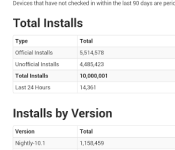
 As if the Android community needed any further confirmation that CyanogenMod is one of the best and most trusted ROMs out there at the moment, it’s been confirmed anyway as CyanogenMod has now clocked in 10,000,000 installs according to CMStats. It’s an impressive feat to have seen its acceptance grow over the years to become the trusted ROM on Android, one which has recently become CTS-certified in a landmark moment, allowing the ROM to be shipped on the Oppo N1 out of the box and use the Google Play Store to install apps.
It’s almost surprising that the news that CyanogenMod reaches 10,000,000 installs hasn’t come earlier, but in reality, the number may actually be a lot higher than 10,000,000 as CMStats is only able to count devices that have CMStats enabled and have checked in within 90 days. Regardless, it is still a great feat. If you were interested in what devices CyanogenMod is most used on, these stats were posted on XDA:
Installs by Device
Device Total galaxysmtd 509,743 i9100 492,575 i9300 456,696 cooper 220,659 pyramid 200,491 mb526 193,650 bravo 192,112 mako 187,057 maguro 176,778 blade 175,284
The top 3 devices are made up by the Galaxy S, Galaxy S2 and Galaxy S3, which isn’t really surprising seeing how many more devices there are of these than anything else (you might also say it is because of TouchWiz, but that’s another discussion entirely).
Who’s using CyanogenMod right now? Who’s thinking of changing over? Let us know what you think about this news.
Source: XDA
 AIVAnet