


3D systems buys a piece of Xerox to expand 3D printing empire

We’re a mere weeks from 2014, and here’s a sign of the times: a 3D printing company has just picked up a piece of Xerox, a name that’s still a bit hard for many to divorce from images of office printers and industrial copiers. Of course, 3D Systems isn’t exactly a new kid on the block. The company may not possess the relative name recognition of a MakerBot, but it’s been in the game for almost 30 years, founded by the inventor of the rapid prototyping technology that would give birth to the world of 3D printing. The $32.5 million acquisition announced this morning involves a chunk of Xerox’s solid ink product design, engineering and chemistry team in Oregon with more than 100 or so employees joining 3D Systems. The team, labs and IP involved will likely have its biggest impact on 3D Systems’ booming industrial wing, with the two companies having already collaborated on the Star Trekifying Projet line, which has become something of an industry standard for rapid prototyping.
Source: 3D Systems

Single-charger standard proposed for laptops to reduce e-waste, frustration

The group that successfully pushed for a common smartphone charging-connection (in Europe) now has its sights on a bigger target: laptops. The International Electrotechnical Commission (IEC) recently proposed mandating power supply compatibility across manufacturers and models as a way to reduce e-waste. While the idea of one charger to rule them all sounds rad, the IEC is quick to temper our excitement, saying that due to technical realities, this initiative is still likely a long way from being achievable. Sadly, it looks like the days of replacing entire computers because the power brick was discontinued aren’t over just yet.
[Image credit: Ian Sane/Flickr]
Filed under: Laptops
Via: IT Pro Portal

Apple’s new Mac Pro will finally go on sale December 19th

We knew it was coming, now it’s almost here. Apple has confirmed that the new Mac Pro will go on sale from tomorrow, starting at $3,000. For that, you’ll get a 3.7GHz quad-core Xeon CPU (“with Turbo Boost speeds up to 3.9 GHz”), 12GB DRAM, two AMD FirePro D300 GPUs, and a 256GB SSD. As usual, you’ll be able to order online via Apple’s online store, through various resellers and, perhaps most importantly, Apple’s retail stores. While there’s no word on whether you’ll be able to walk out of an Apple Store with a Mac Pro tomorrow, the fact that it’s assembled in the US suggests that could be the case, at least in the States. We’ve contacted Apple for clarification and will update you when we know more.
Source: Apple (Businesswire)

Glyph is a high-res wearable display headed to Kickstarter for $499

We were sold on Avegant’s retinal head-mounted display even when it looked like this, but the company’s latest reveal has us throwing balls of cash at the screen. The consumer version will be branded as Glyph, and it’s set to debut January 22nd on Kickstarter with a pre-order price of $499. Avegant had its previous-gen prototype on hand last month at Engadget Expand, and the refreshed version (pictured above) will be on display at CES — it looks quite nice in the render, but this is a product you’ll really need to see to believe.
The device will sport integrated noise-canceling headphones with a flip-down display, enabling the unit to double as a standard set of cans when you’re not in the mood to consume super-sharp video content projected from the built-in virtual retinal display. We spent a few minutes with the final headphone design this week, and audio sounded great, but you’ll have to hang tight until CES for a full hands-on with the refreshed version. For now, click through for our hands-on demo with the previous prototype, narrated by Avegant CEO Ed Tang.


‘NES Remix’ takes classic NES games and…remixes them for Wii U, available today for $15

NES Remix is a new game collection from Nintendo for the Wii U that takes 16 classic Nintendo games — from Super Mario Bros. to The Legend of Zelda — and picks specific pieces of them for remixing. For instance, an Excitebike level is shown as if the driver had a headlight in a dark arena, and a famous Mario level is shown entirely backwards. In so many words, NES Remix is a series of classic game vignettes remastered and re-released in a new package for the Wii U, which sounds…fantastic? We’re gonna call it fantastic.
Beyond sharing specific accomplishments in each piece of NES Remix, you can also share level clear times to compete with friends and the larger community — the first real addition we’ve seen to MiiVerse sharing since it was introduced last year. The games on Nintendo’s game page include Donkey Kong (featuring Link!), Excitebike, Super Mario Bros., The Legend of Zelda, Clu Clu Land, Baseball, Tennis, Ice Climbers, Golf and Balloon Fight. We’re told there are 16 games represented in total, though a list of all 16 is nowhere to be found. We’ve dropped a trailer for it just beyond the break. It’s available now on the Wii U eShop for a whopping $16.32 (w/ tax). Woof.
Filed under: Gaming, Software, HD, Nintendo
Source: Nintendo

Vivo Xplay 3S unveiled with a 6-inch 2K display, powerful audio amp and fingerprint reader

We came away rather impressed with the Vivo Xplay from China, so today’s launch of its successor, the Xplay 3S (which is a bit odd as there was never an “Xplay 2″), is something that we’ve been looking forward to since the teaser way back in October. As mentioned before, this new Android phone is still the first to pack a 2K (2,560 x 1,440) display, which works out to be a ridiculously high 490ppi density on the 6-inch panel.
Like other recent Vivo phones, you’ll find a pair of dedicated audio chips on the Xplay 3S — here you have ESS Technology’s ES9018 DAC and Texas Instruments’ OPA2604 amplifier, both of which are said to be the crème de la crème in their respective categories. This should go nicely with the built-in DTS Headphone:X feature that brings 7.1 or even 11.1 surround sound effect to your stereo headphones; plus Vivo’s video streaming service already hosts about 200 Headphone:X-capable movies (along with over 400 movies in 1080p and over 1,000 movies in 720p), with more to be added each month.
Other specs include a 2.3GHz quad-core Snapdragon 800, 3GB of RAM, 32GB of storage, a 3,200mAh battery plus support for both TD-LTE and FDD-LTE. This is all inside a 172g body with a 4.5mm-thick metallic bezel, though the phone is just a tad thicker towards the middle due to its curvature. The actual new bit this time round is the fingerprint reader on the back, which lets you unlock the device and sensitive documents.
Our only worry is that the f/1.8 13-megapixel camera — which should be of decent quality — is positioned rather close to the fingerprint scanner, meaning it’s prone to smudges. On a related note, like many Chinese phones these days, the 5-megapixel front imager should keep the girls busy with its various beautification features. What’s more, these settings can also be toggled by voice command now, but only if you don’t mind shouting “make my face thinner” or “make my eyes bigger” in front of other people.
There are some nice goodies in the latest version of Vivo’s Android ROM, which is now awkwardly dubbed Funtouch OS. The most notable one is Photo+, a video sharing app that takes advantage of augmented reality (as demonstrated in the above clip). Once your video is uploaded to the cloud, you can pick a video frame for printing or sharing digitally; and then using the same app, point the camera at the still to “animate” it with its assigned video clip.
In addition to the OS’ gentle facelift, other cool new features include gesture assignment for contacts, mood-based music playlist, “air wake” gesture input to toggle apps, location-based reminders, City Show AR app (like Layar) to browse nearby offers, and a “timeline desktop” app that lists your photos and interaction with friends chronologically. One unfortunate thing here is that Vivo’s new camera app looks all too similar to Nokia’s offering, but it’ll be interesting to see if the latter company can do anything about this in China.
Sadly, there’s no info on when the Xplay 3S will be available for purchase. All we know is Chinese online store Tmall will be taking pre-orders soon, and there’s no doubt that Vivo is pushing for a full launch before Chinese New Year (January 31st for 2014). The price is CN¥3,498 or about $580, and the company told us that it has big plans for the overseas market next year, so we shall keep an eye out for the Xplay 3S’ next move.
Filed under: Cellphones, Mobile
Source: Sina Weibo
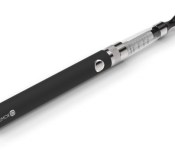
Smokio electronic cigarette may be the first time ‘smart’ and ‘smoking’ have been used in the same sentence

Well, you had to see this coming right? Someone was bound to connect an electronic cigarette sooner or later. Smokio’s bring its e-cigarette to market along with apps for iOS and Android, so you can track smoking, check the battery and regulate the amount of vapor you’re getting with each puff. Heck, you can even map all the places you’ve been smoking with the thing, and if you need some positive reinforcement, the app’ll show you the equivalent number of analog cigarettes you’d have smoked, had you not switched. Smokio is currently listed as “coming soon” on the company’s site, with no word on pricing. Apparently it’ll start shipping next month, after the completion of an upcoming Kickstarter campaign. There’s also a video below, if you can stand to hear someone use the term “vape” over and over again in a short period of time. Now if only would could figure out how bad those smartphones are.
Filed under: Misc
Source: Smokio

You may be able to make in-flight calls next year, but not on Delta

In a company-wide memo sent to 80,000 Delta employees this morning, CEO Richard Anderson put his foot down on the issue of in-flight passenger calls. His definitive statement, “Delta will not allow cellular calls or internet-based voice communications onboard Delta or Delta Connection flights,” will apply regardless of updated regulations from the FCC. That agency is considering lifting the ban on in-flight calls come 2014, but the Department of Transportation may follow up with its own ruling to maintain the phone-free environment many of us have come to enjoy at 30,000 feet.
Meanwhile, powerful in-flight internet services, like JetBlue’s recently launched Fly-Fi, take communications a step further, enabling VoIP and video chat services with performance that makes using these tools more than a novelty. Delta, for its part, will support non-voice cell services pending FCC and FAA approval: “if the FCC lifts its ban on cellular use in flight, Delta will move quickly to enable customers to use text, email and other silent data transmission services gate to gate.”
(AP Photo/Reed Saxon)
Filed under: Transportation, Wireless
Source: Delta
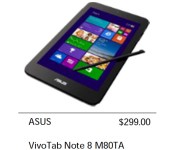
ASUS VivoTab Note 8 leak hints at a cheap, pen-toting Windows 8.1 tablet

Dell’s Venue 8 Pro may soon get some fresh competition. Mobile Geeks has discovered some imagery (albeit of the heavily pixellated variety) and full specs for ASUS’ VivoTab Note 8, an entry-level Windows 8.1 slate with pen input and a worryingly Samsung-esque name. It looks like the VivoTab should closely match Dell’s hardware, with an 8-inch 1,280 x 800 IPS display, a 1.33GHz Bay Trail-based Atom chip, 2GB of RAM and either 32GB or 64GB of expandable flash storage. ASUS may also reuse a few parts from the MeMo Pad HD 7, including the 5-megapixel rear camera, 1.2-megapixel front camera and a 3,950mAh battery. Take the launch details with a grain of salt, however. The image leak has the VivoTab Note 8 arriving during the holidays for $299, but time is running out and a release may not happen until the new year.
Source: Mobile Geeks (translated), SlideShare

Samsung and TSMC to Share Production of Apple’s 14-nm A9 Chips in 2015
 Samsung has signed a contract to produce 30% to 40% of Apple’s 14-nm A9 chip family in 2015, with the remainder of the production load being handled by other Apple supplier Taiwan Semiconductor Manufacturing Company (TSMC), reports Digitimes.
The news comes after a report back in July stating that Apple had signed a deal with Samsung to cooperate in producing A9 processors based on a 14-nanometer process node, though it was not known then whether Samsung would be the sole supplier of the chips. The claim also came weeks after TSMC confirmed a deal with Apple to begin producing A-series chips in 2014, but was also followed up by a report in September stating that Samsung would also be helping out with A8 chip orders as well.
Apple has apparently been seeking to reduce its reliance on Samsung as a component supplier as the two companies have become fierce rivals in both the mobile marketplace and in the courtroom. The two companies have, however, continued working together in several areas, particularly where Samsung’s competitors in the component market are unable to match its technology, production capacity, or pricing.
Furthermore, a look into the A7 processor in September revealed that Samsung was indeed the manufacturer for the chip, with the chip produced at a smaller 28-nm node compared to the 32-nm A6. Currently, the A7 chip is used in the iPhone 5s, the iPad mini with Retina Display, and the iPad Air. Teardowns of all three devices revealed that the iPad Air includes a slightly faster variant of the A7 chip clocked at 1.4 GHz compared to the iPhone 5s and Retina iPad Mini which both include an A7 chip clocked at 1.3 GHz.
     |
 AIVAnet