



Federal court ruling against NSA phone surveillance isn’t quite what it seems

A federal district court judge in Washington DC issued a preliminary injunction today in a case regarding the NSA’s practice of collecting phone call metadata. In doing so, Judge Richard Leon essentially prohibited the NSA from recording the metadata of the folks who filed the lawsuit, holding that the NSA’s actions likely violate the fourth amendment of the US Constitution — the right to be free from unreasonable searches and seizures. The case was originally filed in June by five people who are customers of either Verizon, AT&T or Sprint in the wake of Edward Snowden’s NSA spying revelations. And today’s ruling has been hailed by some as a huge blow against the NSA in its fight to continue the surveillance practices it claims are authorized under the Foreign Intelligence Surveillance Act (FISA).
There’s a problem with that narrative, however. It’s misleading, and the ruling’s importance has been overstated. In reality, the ruling just tells us Judge Leon’s view of the case given the information he currently has. (A view that is, admittedly, overwhelmingly skeptical of the legality of the NSA’s practices and current case law regarding fourth amendment violations.) It does not change the law, the ruling is not final in nature. In fact, in issuing the ruling, Judge Leon removed any immediate legal force of his decision when he stayed the injunction (meaning that the NSA can go about its business as usual if it so chooses) pending appeal. So, not only does the injunction not yet take effect, it might not ever take effect if the appellate court disagrees with Judge Leon’s reasoning. Furthermore, the effect of a preliminary injunction only lasts as long as the case does — so should the trial result in a verdict that the NSA did not violate the constitution, any reasoning given to the contrary in a preliminary injunction ruling is essentially rendered moot.
So, while it seems clear that Judge Leon will be looking upon the NSA’s data collection policies with great interest and some scorn, his decision is not a major blow against the government. That blow may be coming, and Judge Leon may be the among those to deal it. He just didn’t do so today.
Filed under: Cellphones, Mobile
Source: The Guardian (Court ruling PDF)

Photo: New Mac Pro Arriving at Apple Retail Stores [Fake] [Mac Blog]
With Apple’s new Mac Pro scheduled to launch this month but no exact availability date having been disclosed by Apple, many customers have been anxiously awaiting word on when the machines will be available for ordering. It now appears, however, that units are starting to make their way to Apple’s retail stores, suggesting that a launch may be imminent.

One Twitter user has posted a photo of the new Mac Pro on display today at the Bromley store in the United Kingdom. The Tweet has apparently since been deleted, but has remained viewable to some users due to caching.
A follow-up Tweet indicates the store has received just three units so far, with more due later this week.
Apple frequently releases new products on Tuesdays, and thus the delivery of new Mac Pro units to Apple’s retail stores could point to a release tomorrow, although there have been no specific claims of a Tuesday launch.
Update: It appears that this image may be from Apple’s October 22 event that gave press a chance to look at the Mac Pro.
     |

Mac Pro Build-to-Order Upgrade Pricing Revealed
 Late last week, we noted that Apple’s business sales staff have been offering customers price quotes for build-to-order configurations of the new Mac Pro, providing the first glimpse at what these machines will cost beyond the $2999/$3999 base configurations shown on Apple’s site.
Since our initial report, we’ve heard from a few other business customers who received price quotes, and that information has helped us to piece together what we expect retail pricing to be for the various upgrades. Due to varying discounts for business customers included in the quotes and in some cases currency conversions that we have attempted to take into account, we consider our listed prices to be estimates, but they should be very close to Apple’s retail pricing for U.S. customers.
For upgrades beyond the $3999 high-end stock configuration, here is our estimated pricing (all prices relative to the stock model):
CPU (Stock: 3.5GHz 6-Core Intel Xeon E5)
– 3.0GHz 8-core: +$1500
– 2.7GHz 12-core: +$3000
Graphics (Stock: Dual AMD FirePro D500 with 3GB GDDR5)
– Dual AMD FirePro D700 with 6 GB GDDR5: +$600
RAM (Stock: 16GB 1866MHz DDR3 ECC – 4x4GB)
– 32GB (4x8GB): +$400
– 64GB (4x16GB): +$1600
Flash Storage (Stock: 256GB PCIe-based)
– 512GB: +$300
– 1TB: +$800
As an example, for a customer looking to buy an 8-core Mac Pro with 32GB of RAM and 512GB of storage, the machine would cost $3999 base + $1500 processor upgrade + $400 RAM upgrade + $300 storage upgrade, yielding a total price of $6199.
At the lower end, Apple’s $2999 base Mac Pro model carries a quad-core Intel Xeon processor, 12 GB of RAM, and dual AMD FireCore D300 graphics, compared to the $3999 high-end stock configuration with 6-core processor, 16 GB of RAM, and D500 graphics.
We have not seen any exact breakdowns of how much each of those changes contributes to the overall $1000 price difference between stock configurations, but expect roughly half of the price difference to be represented by the processor upgrade, a somewhat smaller amount for the graphics upgrade, and a relatively nominal amount in the range of $100 for the bump in RAM.
The new Mac Pro remains scheduled to launch sometime this month, but Apple has yet to announce an exact date for either initial orders or availability.
| |
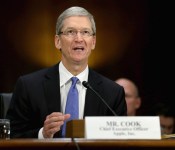
Tim Cook and Other Tech Executive to Meet With President Obama Again to Discuss NSA Surveillance and Health Care Website
Tim Cook and other tech executives will meet with President Obama tomorrow to discuss the Healthcare.gov website, as well as “national security and the economic impacts of unauthorized intelligence disclosures”. In addition, the group will discuss ways the Obama administration can partner with the tech sector to grow the economy and create new jobs.
According to a report from Time:
“Tomorrow, President Obama will meet with executives from leading tech companies to discuss progress made in addressing performance and capacity issues with HealthCare.Gov and how government can better deliver IT to maximize innovation, efficiency and customer service,” a White House official said. “The meeting will also address national security and the economic impacts of unauthorized intelligence disclosures. Finally, the President will discuss ways his Administration can partner with the tech sector to further grow the economy, create jobs and address issues around income inequality and social mobility.”

According to the report, the following executives will attend:
– Tim Cook, CEO, Apple
– Dick Costolo, CEO, Twitter
– Chad Dickerson, CEO, Etsy
– Reed Hastings, Co-Founder & CEO, Netflix
– Drew Houston, Founder & CEO, Dropbox
– Marissa Mayer, President and CEO, Yahoo!
– Burke Norton, Chief Legal Officer, Salesforce
– Mark Pincus, Founder, Chief Product Officer & Chairman, Zynga
– Shervin Pishevar, Co-Founder & Co-CEO, Sherpa Global
– Brian Roberts, Chairman & CEO, Comcast
– Erika Rottenberg, Vice President, General Counsel and Secretary, LinkedIn
– Sheryl Sandberg, COO, Facebook
– Eric Schmidt, Executive Chairman, Google
– Brad Smith, Executive Vice President and General Counsel, Microsoft
– Randall Stephenson, Chairman & CEO, AT&T
Earlier this month, Apple, Google and a number of other tech companies urged the President and Congress to reform government surveillance tactics.
Concerns about government use of user data collecting ramped up in June, when a U.S. government program named PRISM was revealed to be giving the U.S. National Security Agency direct access to user data on corporate servers across a wide spectrum of Internet companies including Microsoft, Yahoo, Google, Facebook, PalTalk, AOL, Skype, YouTube, and Apple.
In response, Apple published a statement of “Commitment to Customer Privacy” denying its participation in the NSA’s program and teamed up with a number of tech companies to request greater NSA surveillance transparency, allowing it to provide customers with regular reports on security related requests. Last month, Apple published a report outlining statistics on government and law enforcement requests it received from January to the end of June.
Apple and other companies also met with President Obama in August to discuss privacy issues and government surveillance. Recently, Apple and 30 other technology corporations signed a letter urging the U.S. Congress to pass the Surveillance Order Reporting Act of 2013 and the Surveillance Transparency Act of 2013, which would result in increased surveillance disclosures and would give technology companies the right to publish detailed statistics on demands for user data.
Note: Due to the political nature of the discussion regarding this topic, the comment thread is located in our Politics, Religion, Social Issues forum. All MacRumors forum members and site visitors are welcome to read and follow the thread, but posting is limited to forum members with at least 100 posts.
| |

Free Fold N’ Play speaker from OrigAudio, 48 hours Only
 OrgiAudio’s small foldable speaker, the Fold N’ Play, is up for FREE for the next 48 hours. The little speakers are made from 70% post consumer recycled material and works with anything that has a headphone jack. It offers up a set of 1 watt speaker for some mobile tunage. For FREE it isn’t a bad deal. Check em out in this little video.
You do need to pay for shipping, but thats a small price to pay for a cool little stocking stuffer for someone. Hit the link to go get your FREE Fold N’ Play + shipping now before the freebie offer is over.
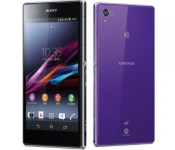
Sony Xperia Z1 comes to China Mobile with more memory and minor hardware changes

Three months after the launch of the Sony Xperia Z1, the flagship smartphone is coming to China Mobile — but the handset as we currently know it isn’t making the trip. This particular device (shown above) boasts nearly all of the same features and specs — 5-inch 1080p Triluminous display, 2.2GHz quad-core Snapdragon 800, 2GB RAM, 20MP camera and 3,000mAh battery, for starters — but the new model, also referred to as the L39t, has been bumped up to 32GB internal storage (up from 16GB in the international model) and now offers TD-LTE and TD-SCDMA/GSM support for carrier compatibility. Additionally, the sides are now reportedly made of plastic instead of metal and the headphone jack is centered. These are minor differences, but the new Z1 looks very similar to the T-Mobile version first leaked by @evleaks in October, which means it’s quite possible we’ll see more of this design in Vegas next month. If the T39t is right up your alley, get ready to pay up: it’s 4,499 yuan ($724).
Filed under: Cellphones, Wireless, Mobile, Sony, Google
Via: AndroidCentral
Source: ePrice, XperiaBlog
Nielsen: users embracing smartphone apps while ditching traditional web services

‘Tis the season for year-end lists and summaries galore, and Nielsen is no exception to this rule. The company has just released its list of the top 10 web brands, online video brands and smartphone apps, and its findings reveal a growing trend that may not come as a surprise to anyone: more people are using smartphones, and they’re using them to access the most popular services out there, instead of their web-based counterparts. In these aforementioned lists, Nielsen also discusses how each brand has changed year-over-year; web brands have all decreased, online video brands are relatively flat and smartphone apps are skyrocketing in overall usage.
Let’s take a look at a few services in particular. Google was the top web brand for 2013, yet it saw a decrease in unique visitors by six percent from last year (and YouTube dropped by 14 percent). That said, these two brands represented five of the top 10 smartphone apps, with growth ranging from 14 percent to as high as 29 percent. Perhaps unsurprisingly, Facebook experienced a very similar trend, with a 16 percent decrease in web traffic versus a 27 percent increase in its smartphone app numbers, making it the most-used service of the year. In addition, social networks like Instagram and Twitter grew by leaps and bounds, earning each of them a spot among the top 10 apps; Instagram, in particular, was the fastest growing app on the list. (Also, here’s a shameless plug for our parent company as the seventh most popular web brand.)
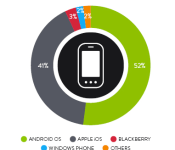
Finally, Nielsen also reported that nearly two-thirds of US phone subscribers — 65 percent, to be specific — are now using smartphones instead of featurephones, which is a solid jump up from 56 percent at the end of 2012. Of those subscribers, 52 percent are now using Android devices, while 41 percent use iOS and seven percent use other platforms (BlackBerry is at three percent, while Windows Phone is at two). Head below the break to see all of the fine details for yourself.


Filed under: Cellphones, Wireless, Mobile, Apple, Microsoft, Google, Blackberry, Facebook
Source: Nielsen
 AIVAnet