



Lomography’s Petzval lens ships to Kickstarter backers, pre-order it now for $599

If you ordered one of Lomography’s Petzval lenses on Kickstarter for as little as $300, you’d be forgiven for feeling a bit smug right now. First off, you may get it soon since the first five hundred have now shipped, and secondly, it’s put the brassy glass up for pre-order to new buyers for a considerably higher price of $599. The starter package does include extras on top of the lens and cap, though: a Petzval Art Lens book, seven standard aperture plates, four experimental plates and a leather pouch. If you’ve got a Canon EF or Nikon F camera, that’ll let you take artsy shots with whirly bokeh and vignetting like the 1840 original but with the sharpness of modern optics. Lomography said that pre-orders won’t ship until May due to limited Russian production and a backlog of Kickstarter orders. If that and the new price doesn’t dissuade you, however, you can grab one here.
Filed under: Cameras
Via: DP Review
Source: Lomography
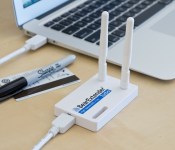
BearExtender Turbo Adds 802.11ac Wi-Fi to Older Macs [Mac Blog]
BearExtender today announced the launch of BearExtender Turbo, a new USB-based solution for adding faster 802.11ac Wi-Fi connectivity to older Macs. Regularly priced at $80 but available through Amazon for $70, BearExtender Turbo can boost Wi-Fi speeds by up to 2-3x for Macs supporting USB 3.0 but not 802.11ac natively.

Using AJA System Test on Mac OS X 10.9 Mavericks, a 2GB file was transferred between a Mid-2012 802.11n MacBook Air and a 2013 Apple Time Capsule at a rate of 10.66 Megabytes per second (MB/s not megabits). The same test with BearExtender Turbo connected to the MacBook Air’s USB 3.0 port had a rate of 23.84 MB/s, more than twice the Macbook Air’s internal Wi-Fi card.
While speed bottlenecks for most users will continue to be their actual ISP connections when connecting to the Internet, 802.11ac is particularly useful for transferring large amounts of data between machines within a network.
BearExtender Turbo supports maximum throughput of 867 Mbps and includes dual-band connectivity at 2.4 GHz and 5 GHz for maximum speed and compatibility. The device’s two antennas can also be removed for portability.
     |
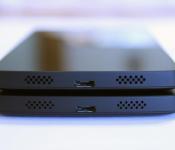
Nexus 5 now shipping with slightly altered physical appearance
Over at XDA Developers forum, some new owners of the Nexus 5, and those that returned theirs for defects, are reporting that their devices are slightly different from those that originally shipped at launch.
According to XDA member shinral, some devices had noisy buttons, a protruding SIM card tray and a “cutting edge” or sharp display frame.
With the recent long shipping times for the Nexus 5 to come back in stock, Google and LG must have been busy making slight tweaks to the production line.
All of these imperfections are reported to have been fixed and one of the other differences noted between the original and new Nexus 5 are larger microphone and speaker holes.
Have you had any issues with your Nexus 5 or noticed any of these changes?

via XDA Developers
The post Nexus 5 now shipping with slightly altered physical appearance appeared first on AndroidGuys.

Cover exits closed beta for Google Play Store
In the last year, there have been many launcher and lockscreen replacements for Android popping up and one of the most recent and popular is Cover.
Cover, which for the last few months has an invite-only beta, is now out of closed beta and available for free in the Play Store.
It’s an interesting app since it lets you set different locations whether you’re at home, work, in the car or out on the town and different apps shortcuts will be displayed on your lockscreen. For each setting, you have a different wallpaper as well. Cover learns what apps you use most and displays them on your lockscreen so you can access them quickly.
All that being said, the only downside to using this replacement is that if you use lockscreen widgets, you can’t use them anymore and you technically can’t set the apps yourself that appear on the lockscreen.
WIth Cover now in the Play Store, the company announced some changes to the app. Apparently over the last six weeks, they’ve “made 100+ improvements” that include optimized battery usage, improved car detection, compatibility with Android 4.4 KitKat, the Nexus 5 and new ART runtime for Android, when peeking and switching between apps, Cover now maintains the state within each app, tutorials on fast app-switching, how to set custom wallpapers/ring volume and how to use it with either a PIN/Pattern security code, more customization options such as those to configure the size and location of app tray target and the ability to share your Cover setup on Facebook, Twitter or Google+.
via Cover
The post Cover exits closed beta for Google Play Store appeared first on AndroidGuys.
Gmail improves security while rolling out image display changes
According to the Gmail Blog, there has been a change in the way the Gmail app handles images. You may have noticed that, a lot of the time, an email with images will have the “Images are not displayed” message, with options on how to show them. Now, however, Google has changed how images display, saying that “ thanks to new improvements in how Gmail handles images, you’ll soon see all images displayed in your messages automatically across desktop, iOS and Android. Instead of serving images directly from their original external host servers, Gmail will now serve all images through Google’s own secure proxy servers.”
Google also says that this makes messages “more safe and secure”, as images are now scanned for known malware and viruses.
You can still turn off the option to auto-display images by going to the General tab under Settings in Gmail, and choose “Ask before displaying external images”. The changes apply to desktops (currently rolling out), as well as the mobile app in early 2014.
via gmailblog
The post Gmail improves security while rolling out image display changes appeared first on AndroidGuys.

Isis Mobile Wallet now supports Wells Fargo Visa credit cards

Isis — a joint mobile payment venture between AT&T, T-Mobile and Verizon — has partnered up with banking juggernaut Wells Fargo, shortly after it rolled out nationwide. In addition to Chase, American Express, J.P. Morgan, and random loyalty cards, users can now load their mobile wallets with Wells Fargo’s Visa consumer credit cards. This allows them to purchase from participating merchants (there are “hundreds of thousands,” according to the bank) that accept NFC payments without having to bring their plastic to the store. Want to use the system but don’t know where to begin? First things first, make sure you have an Isis-ready Android smartphone from any of the three aforementioned carriers. Once you’ve received the special SIM and have activated the service, you can start going on nighttime trips to McD’s or doing emergency CVS runs with only a phone in hand.
Filed under: Cellphones, Mobile, Verizon, AT&T, T-Mobile
Source: Wells Fargo

BT has a surprise for new subscribers: adult content is blocked by default

The UK government’s been pushing ISPs to enable adult content filters by default for quite some time, and today BT has fulfilled its commitments, joining other major providers like TalkTalk and Sky. A new tool from the telecoms outfit, cleverly named “BT Parental Controls,” blocks unwelcome traffic at the router level — BT has provided similar services before now, but this improved effort will be more conspicuous, especially for new broadband subscribers. When setting up their connection, customers will have the option to turn off filters that are otherwise switched on by default, just like Cameron wanted. Existing customers will be notified of the new controls next year, and if they’re on board, will have three preset levels to choose from. Other features include a user-defined blacklist and timed filter periods, but as yet there’s no “ignore Miley Cyrus” setting. Please BT, for the children.
Filed under: Internet
Source: BT
Apple’s ‘iWatch’ Said to Arrive in October 2014 with Wireless Charging
According to Chinese site C Technology [Google Translate, via GForGames], Apple is planning to release its long-rumored iWatch alongside the next iPhone in October 2014, with the company having tested two iWatch prototypes. However, the report also states that Apple has not decided on the final screen size of the device, with the prototype units being powered by a 100 mAh battery. The iWatch is also said to include wireless charging capabilities which will allow the device to charge from up to a meter away.
The report questions the reported inclusion of a 100 mAh battery, noting that it seems far too small to allow for significant battery life. Samsung’s Galaxy Gear watch contains a 315 mAh battery and has received criticism over poor battery life.
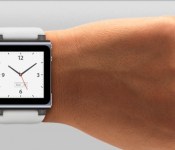
 Sixth-generation iPod nano with watch face
Battery life has previously been reported as being an issue for Apple, with iWatch prototypes lasting only 1-2 days on a charge and the company hoping to find ways to extend that to 4-5 days. C Technology notes that wireless charging would be one way to reduce the burden of frequent charges, but it is unclear exactly how it would be implemented by Apple. A 100 mAh battery in the iWatch would roughly match the 105 mAh battery seen in the sixth-generation iPod nano that was designed in part to be able to be used as a watch.
In contrast, a report last month from Digitimes stated that the iWatch would be released in Q2 2014, with component makers having started pilot production for the device. The report also stated that low part yields have pushed back mass production of the device from an internal target date of Q1 2014 to Q2 2014, with Apple suppliers Quanta, Inventec, and Foxconn said to be competing for iWatch production orders.
iWatch reports have surfaced throughout the past few months, with Apple rumored to be releasing both 1.7 and 1.3-inch display sizes of the watch for men and women. NPD DisplaySearch analyst Paul Gagnon also noted that Apple appears to have put its major television product plans on hold for the time being in order to focus on wearables such as the iWatch.
C Technology‘s rumor track record is mixed, with the site being a frequent source of accurate iPhone 5s and 5c photo leaks leading up to the launch of those devices but also sharing several inaccurate pictures claimed to be of iPads in gold and/or with Touch ID prior to the introduction of the new tablets.
| |

RealPlayer Cloud streams local and cloud video to Chromecast
 It seems that when we announced about the 10 new apps with the ability to cast to Chromecast on Tuesday, we missed that one can also stream locally and cloud stored content to your TV.
RealPlayer Cloud, which launched in September, now lets users watch their local and cloud videos on their TV through Chromecast. The company says that with its SurePlayTM technology, RealPlayer Cloud ensures videos cast from the app are automatically formatted to give viewers the highest quality experience possible.
Once sent to the TV, users can control playback of the video via the RealPlayer Cloud app on their mobile device or PC.
RealPlayer Cloud is free to download and gives users in the U.S. and Canada 2 GB of cloud storage for free, but requires you to sign up for a free account. Subscription plans with more storage are also available starting at $4.99 per month.
via RealNetworks
The post RealPlayer Cloud streams local and cloud video to Chromecast appeared first on AndroidGuys.

Recon’s extreme sports gear will now stream your death-defying stats straight to Facebook

Much has been written of the loneliness of the long-distance runner, but has anything been done to combat the solitude of the slopes? Recon Instruments is doing its part to bring extreme types closer to their social network by adding Facebook integration to the Snow2 heads-up display. The hardware will shortly be able to stream stats like speed, vertical descent and distance covered straight to your supportive friends back home. The feature is the primary component of the ReconOS 3.2 update, which daredevil users can download from December 18th, with the company promising that more social networks will be connected in the future. Personally, we’re waiting for the moment when the Snow2 can live-tweet the profanities we utter as we hurtle to our icy doom.
Filed under: Cellphones, Wearables, Facebook
Source: Recon
 AIVAnet