


Sony suspends player who found a sex organ in ‘Watch Dogs 2’
Ubisoft might pride itself on Watch Dogs 2’s plausible game world, but it looks like the open world title might be a little too realistic… and one player is paying the price for it. Sony suspended NeoGAF forum member Goron2000 from the Sony Entertainment Network (including PSN) after he discovered that at least one of the female character models in the game has a fully rendered vagina. It’s not exactly necessary in a hacking-themed action title where intentional nudity is very rare, is it?
Unlike the “Hot Coffee” scandal that surrounded Grand Theft Auto: San Andreas years ago, this gaffe isn’t inaccessible bits of code buried deep within the title’s back-end, it’s art assets within the final game that seemingly any player could happen upon. According to Sony, the player’s decision to share his discovery online (using the PS4’s built-in sharing and streaming features, no less) violated SEN guidelines forbidding players from sharing “adult or sexual” content.
Ubisoft has promised to patch the sex organ out of the game, and it’s important to note that the temporary ban will last until December 15th. However, the very fact that either happened has left Goron2000 and others scratching their heads. How did this make it past Ubisoft’s certification team? And is Sony right to boot a player who was sharing material the publisher/developer inadvertently approved, leaving a black mark on his account?
Sony hasn’t responded to our request for comment, but the player at the center of the ordeal tweeted that his PSN privileges have been reinstated as of 7:33pm Eastern.
Sony have undone the suspension. We won! I think? They never admitted fault of course. I want to thank everyone for their support today.
— Swizzasaur (@Swizzasaur) November 16, 2016
However, the incident highlights the problems with bending over backwards to include sharing features on consoles. If you’re going to make it easy to livestream or share photos on Twitter, you shouldn’t be surprised if users draw attention to the naughtier material.
Via: The Next Web, Polygon
Source: NeoGAF, Swizzasaur (Twitter)
Sony Pictures will stream live VR with Nokia’s Ozo camera
Nokia made some great smartphone cameras back in the day, but we certainly didn’t expect that to lead to the Ozo, a $60,000, 360-degree 3D virtual reality camera. Now, the Finnish company will provide expertise and Ozo cameras to Sony Pictures, which will use them to create VR content. The studio will also take advantage of the Ozo Live VR broadcast capability “to transport fans to Sony Pictures events that they couldn’t otherwise attend,” the company wrote.
There are other VR rigs out there that can take higher-quality images. And it seems odd that a camera manufacturer with Sony’s professional experience would turn to Nokia, of all companies, for equipment and advice. However, Ozo does offer live VR broadcasting, real-time on-set Oculus Rift VR playback and rapid stitching from the eight cameras. With other systems, it can take ages to patch together multiple videos, meaning producers often have no idea what they shot until much later.

You can also do live 4K VR output, provided you have a powerful Mac or PC. In fact, it produces a signal that broadcasters can send through standard UHD equipment, which end-users can decode with an HTC Vive, Oculus Rift or Gear VR headset. That helps it fit in with Sony’s “established production processes and workflows, and enable the real time capture and broadcast of VR content,” Sony Pictures VP Scot Barbour said in a statement.
Sony will also bundle Nokia’s Ozo player into its Privilege Plus app to “bring unique content straight to fans.” (As a reminder, that’s the streaming video player for Xperia Lounge, which is Sony’s answer to Google Play on Android.) If Sony Pictures can produce some decent content on Ozo, that might finally give users of that not-very-popular app a reason to try it.
First official ‘Infinite Warfare’ tournament happens December 3rd
With Call of Duty: Infinite Warfare just now landing and Modern Warfare: Remastered reminding FPS fans of the franchise’s glory days, Sony is ready to celebrate the Call of Duty New Year. It’s that time of year when CoD players get their hands on a new game, start leveling up their weapon kits again and getting ready for the next round of Call of Duty World League. As they did with last year’s release of Black Ops III, PlayStation will be kicking off the new season with an invitational tournament and some big announcements about what’s in store for one of the biggest games in eSports.
The invitational tournament takes place on December 3rd and 4th at the PlayStation Experience in Anaheim, CA, where eight teams will square off in Infinite Warfare’s first official LAN broadcast. Before the first virtual rounds are fired, the conference keynote will include some some official news and possibly some PSVR announcements. The tournament livestream will also be introduced with more details about the season structure, game updates and key events coming to Infinite Warfare and CoD: World League. Of course, if you can’t be in Anaheim, the whole thing will be streamed on MLG.tv and the Call of Duty Twitch Channel.
Source: PlayStation Blog
What ‘The Last Guardian’ creator learned from ‘No Man’s Sky’
The video game world is vastly different now than it was in 2007, when Fumito Ueda and his team began working on The Last Guardian. Nintendo dominated the hardware market with the 3DS and Wii, while the Xbox 360 and PlayStation 3 trailed by millions in console sales. Assassin’s Creed, BioShock and Mass Effect debuted, kicking off a fresh round of long-running AAA franchises.
Today, we have the Xbox One, PlayStation 4 and PS4 Pro, and Nintendo is attempting to rebound from slow sales of the Wii U. Day-one patches are normal, pre-order DLC bundles are standard practice, we’re on the ninth Assassin’s Creed and, sometimes, indie games are indistinguishable from AAA titles.
This is the brave new world that Ueda will release The Last Guardian into on December 6th. Over the past nine years, he’s kept an eye on the video game industry and he knows that the market is volatile. He knows that the industry has changed. Fans are used to a constant barrage of information, trailers, screenshots and interviews about upcoming, high-profile games. Sometimes this marketing strategy works out just fine. And sometimes, No Man’s Sky happens.
At least Ueda has been down this road before. He’s the creator of Ico and Shadow of the Colossus, two cult classics that captured the hearts of players in the early 2000s. However, his experience fuels a potential issue that looms heavy over The Last Guardian: After nine years of development, fans of Ueda’s work have had time to build up the game in their minds. They’ve had the space to imagine a million perfect, uncompromising experiences, each one different and attuned to a specific person’s taste. When these fans finally sit down to play The Last Guardian, they might expect impossible things.
“Obviously there’s a level of expectation, and it’s really down to each and every person’s level of expectation and imagination that they’ve created based on what they’ve seen,” Ueda says.

That’s what happened recently with No Man’s Sky, an independent game that received massive amounts of attention from the moment its first trailer went live in 2013. Sony immediately seized the momentum and ran with it, featuring No Man’s Sky in its largest convention speeches and press tours. The game was pitched as a sprawling AAA experience, even though it came from Hello Games, a small team in the UK known for creating the quirky side-scroller series Joe Danger.
It took three years and one delay for No Man’s Sky to go gold, giving a flood of hungry fans plenty of time to envision the perfect space-exploration game. And then, when No Man’s Sky landed in August, it didn’t meet many fans’ expectations. Backlash was swift. Livid players gathered on Reddit and Steam demanding refunds, and the game’s ratings plummeted. It’s now being investigated in the UK over charges of false advertising.
Ueda is aware of the potential pitfalls that come when a game finally goes public after years of anticipation. However, instead of dissuading him from development, he says the weight of fans’ expectations actually fuels his team.
“I try not to think about the pressure that has been added or is probably assumed to be added to this title,” he says. “But, having said that, I don’t think all pressure is always negative. It’s actually kept us motivated because of the expectations that people put on our next game. What that does is it creates this weird cycle, in a good way, where the pressure that we feel is then turned into motivation, and then that in turn helps Sony and our partners and our team to have even a stronger belief in the product.”

Ueda has already proven he knows how to make moving video games that touch millions of people, but he refuses to settle for average with The Last Guardian. He says he wants as many people to play the game as possible — and this isn’t just the dream of a legendary developer yearning for another slice of glory. Instead, it’s the foundation of Ueda’s approach to The Last Guardian.
“We found out that a lot of people are very curious and interested in animals,” Ueda tells me through a translator. “So we felt like if we introduced an animal or living creature in this game that hopefully it would appeal to a wider audience. That is something that really kicked off our brainstorm in the idea and formation of The Last Guardian.”
Trico, the game’s massive bird-dog companion that’s been plastered on posters and trade show floors across the world, is a direct representation of Ueda’s attempt to intrigue a wide audience. Trico is adorable, vulnerable and the perfect tool for manipulating the hearts of every pet owner who sees him. That’s a fairly large audience.
Not only does Ueda want animal lovers across the globe to play The Last Guardian, he wants them to understand and accept the game as it is. He’s keeping many aspects of its story secret, but he says it’s a unique experience, much like Ico and Shadow of the Colossus were. Those titles eschewed standard video game elements like UI and NPCs in favor of a minimalistic aesthetic, setting them apart from their contemporaries. They were different. So is The Last Guardian.
“For me, that means, ‘Oh gosh, is it going to be accepted? Are people going to understand where we’re coming from and where we want to go?’” Ueda says.

He’ll soon have his answer, regardless of whether he’s ready to hear it. Ueda he hasn’t thought much about what he’ll do on launch day, if he’ll be glued to the internet, immediately soaking up players’ reactions, or if he’ll take a step back for a while and simply let the moment sink in.
Eventually, he specifically wants to hear from people who play the game in its entirety. This isn’t a hint about The Last Guardian’s story, per se, but it does suggest a connected and thoughtful narrative that rewards those who play to the end.
“If they can share their feedback and their impressions, that’s going to be something that I really, really look forward to hearing,” Ueda says.
Whatever he decides to do on December 6th, Ueda is ready for the game to be done. The Last Guardian represents the last nine years of his life and even now, a month from release, he says it seems surreal that the journey is ending.
“Even though the game is on its way to being boxed up and going in stores and being delivered to players, it hasn’t really sunk in yet for me,” Ueda says. “I haven’t been able to digest the fact that it’s all done and completed. …What I’m looking forward to is for everything to just really be done and all the items on the checklist to be checked off. I think at that moment, hopefully, it will register and I would feel like it’s finally done. I look forward to that day.”
PS4’s Sharefactory app now lets you make GIFs from your videos
PS4’s Sharefactory app, which lets players stitch together video, music and photos into sweet highlight reels, has steadily built out its toolbox since Sony released it back in April 2014. Some have added options for slow-mo and timelapse, while the most recent introduced picture-in-picture to include simultaneous video play. But those have toyed with yesterday’s formats. For all the cool kids, Sony’s finally bringing GIF-making support to the app, letting users create animated clips up to 10 seconds long with all the captions their little hearts desire.
My kingdom for a grapple kit #PS4share pic.twitter.com/LEsX9WGJX6
— David Lumb (@OutOnALumb) November 9, 2016
It’s all part of a Sharefactory 2.0 release package. If you’ve hooked the app up to Twitter, you can tweet out your GIFs right from your console. Sony has also added a collage mode so users can arrange up to six photos in whatever arrangement they crave for their own “Wish You Were Here” gaming postcard.

While there are a few performance and UI tweaks, the last big news for the app’s new version is support for PS4 Pro. Users can now edit and export their 1080p videos and 4K screenshots. So even if your friends haven’t all upgraded their screens to take in your content’s high-definition glory, you can rest assured that all your headshot montages and GTA Online rampages are as crisp as possible.
Source: PlayStation blog
PlayStation Vue drops all Viacom channels
If you’re a subscriber to Sony’s PlayStation Vue streaming service, here’s some bad news: it’s discontinuing all Viacom content starting November 11th. That means that channels like Comedy Central, MTV, Nickelodeon and Spike will no longer be available on Vue. In a blog post, the company stated that the decision was “the best way for us to continue to offer the most compelling value to our fans,” which suggests that cost could’ve been an issue.
This is a pretty surprising blow, considering the improvements Sony has made with PS Vue. It’s expanded its service to be on Roku, Android TV and is coming to the Mac and PC. It’s also carrying more channels than ever, which includes ESPN, ABC, Disney, NFL Network, HBO and Cinemax. Indeed, Sony even announced that it’ll start carrying BBC America and NBA TV, while VICE, CBS and Fox are on their way. That’s a pretty solid content trove already, so this loss will only be of importance to you if you’re a fan of those specific Viacom channels. And if you are, well, you could opt for Sling TV instead.
Source: PlayStation
The Morning After: Tuesday, November 8, 2016
It’s Tuesday morning, Election Day, and you should be reading about the PlayStation 4 Pro, how Audi might have cheated on its emission tests, Mass Effect’s grand space opera teaser and oh-so-much more. Fortunately, that’s why I’m here. This is the Morning After.
4K PlayStation gaming has arrivedReview: PlayStation 4 Pro

It’s the most powerful home console yet, but you’ll need a 4K + HDR-capable TV to truly take advantage of it. In his review, Devindra Hardawar suggests that if you already have a PS4 and are stuck with a 1080p set, you can wait before upgrading.
Hint: Audi is owned by Volkswagen.Audi reportedly cheated engine emission tests too

According to the German paper Bild, regulators found software in Audi cars that masked their CO2 output during emissions tests. While this was apparently noted up to four months ago, neither Volkswagen, Audi or California regulators revealed it to the public. Software identified test conditions — slow, straight driving on a rolling road — and reduced gearing ratios. Turning the steering wheel disables the software and revealed the extent of the automaker’s test tweaking.
A very pretty fitness trackerTimex’s second smartwatch is cheap and subtle

Timex’ IQ+ Move will cost $150, and comes in men’s and women’s sizes. Despite Cherlynn Low’s misgivings about the scarcity of features (most are centered around fitness tracking), she was won over by its classic design and excellent build.
No, there aren’t any other choices availableElection day is here, and all of the information you need is just a click away
No matter who or what you’re voting for, the internet is here to help. Check out our guide for advice on getting to the polls and understanding what’s on the ballot when you’re there.
Wait, you’re going to fuel while the crew is where?NASA is worried SpaceX will put crews at risk by topping up while they’re aboard

SpaceX is moving on to a future of manned space flights, but NASA has some questions about how it’s going to pull those off. Specifically it’s looking at the plan to fill Falcon 9 rockets while astronauts are aboard, a proposal that seems even sketchier after last year’s explosion. A review process is under way, and findings from SpaceX’s probe into the explosion will be considered.
But wait, there’s more…
- Toyota is planning a long-range EV by 2020 (possibly at the expense of hydrogen cells)
- Android Auto is now a standalone app for your phone
- Watch Mass Effect Andromeda’s new space opera trailer
- Play The Oregon Trail, Election 2016 edition
Sony’s PlayStation 4 Pro is a perfect way to show off your 4K TV
The PlayStation 4 Pro is a new breed of console. It’s not going to replace the original system. Instead, it’s meant to tide over gamers who’ve upgraded to new 4K TVs with fancy high-dynamic range (HDR) lighting features. It’s a more significant step up than the Xbox One S, which is mostly centered around upscaling 4K content, but it’ll directly compete with Microsoft’s bigger console upgrade, Project Scorpio, next year. Welcome to the new era of gaming systems, which is beginning to resemble the world of PC games with a multitude of minor upgrades, rather than completely new system generations. (Nintendo, ever the iconoclast, is trying to do something both new and traditional with the Switch.)
There’s no doubt that the $399 PlayStation 4 Pro is the closest we’ve gotten to high-end PC-quality graphics on a home console. But the thing is, it’s not going to be a major upgrade for existing PS4 owners. And to really see the benefits of its faster hardware, you’ll have to wait for games to get upgraded. At the very least, though, it’s a welcome reward for anyone who’s held off on buying a PlayStation 4 until now.
Hardware
Take Sony’s original PlayStation 4 design, add another sharply angled layer on top, and you have the the PlayStation 4 Pro. You could call it a triple-decker PS4. It’s a tad taller than the original, but otherwise they look near-identical, with the same general shape and black plastic case. The PlayStation 4 Pro extends a bit farther back than before, likely to make room for both a larger power supply and more powerful components.
The PlayStation 4 Pro’s front buttons are physical, rather than touch-sensitive, and they’re separated now, with the power button on the far left and eject on the far right. (The original PS4’s buttons are incredibly tiny and located right above and below each other, which has led to plenty of frustration among gamers.) There are two USB 3.0 ports on the front, just like before, and an additional one in the rear. The latter is useful for connecting the PlayStation VR neatly without taking up on of the precious front USB ports.. Alongside the HDMI port is a standard power connection, an “Aux” output for the PlayStation camera, an optical audio port (which is notably absent from the PS4 Slim), and an Ethernet jack.
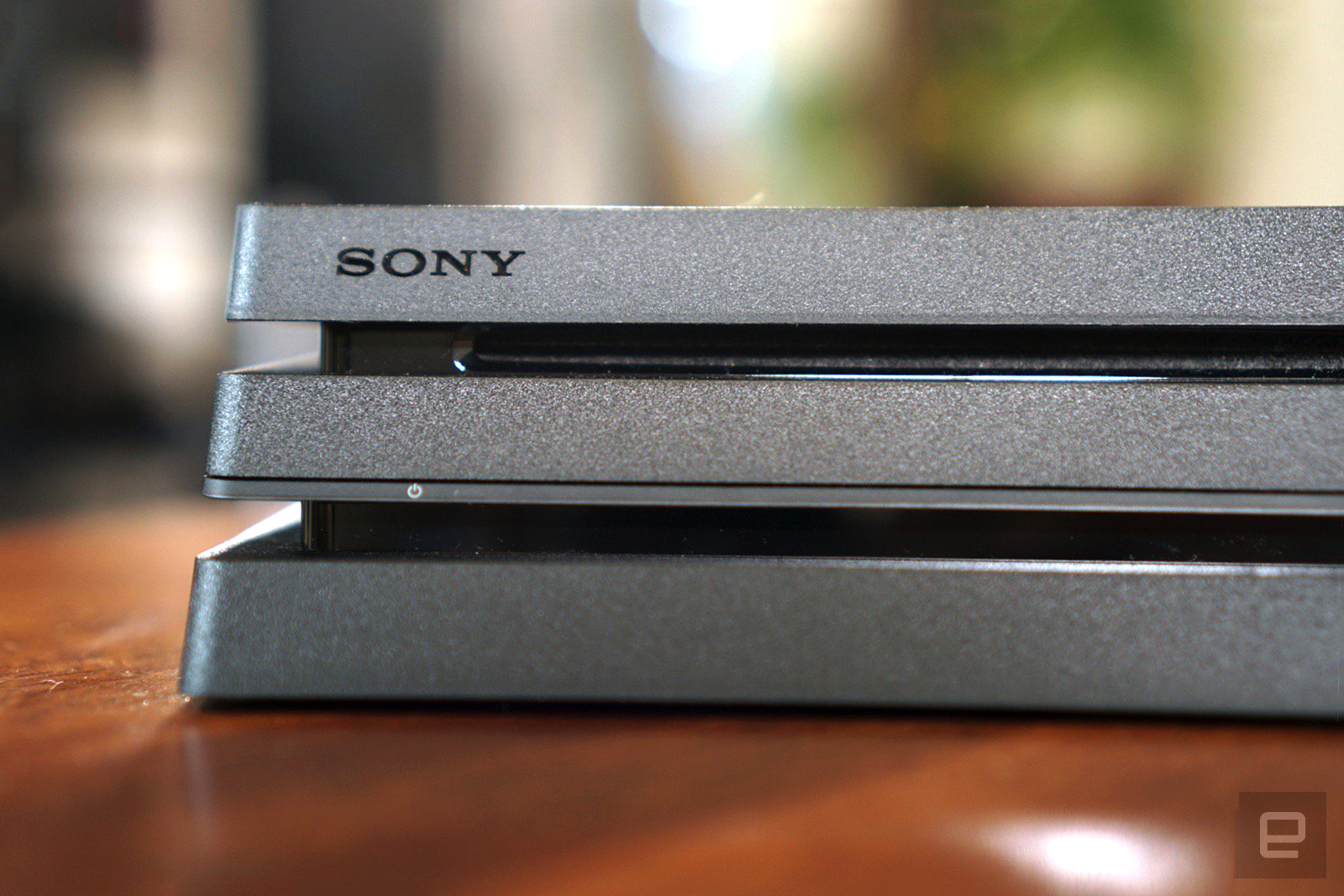
But forget aesthetics: What’s most important is what’s under the hood. And much of that is drool-worthy. The PS4 Pro packs in a speedier eight-core CPU; a new 4.2 teraflop AMD Polaris GPU that’s twice as fast as the original PS4; a 1TB hard drive; and 8GB of RAM. Just like the PS4 Slim, it also adds an 802.11ac 5GHz WiFi radio, which should make downloading games and large updates significantly faster. On paper, the PlayStation 4 Pro sounds more like a decent gaming PC than a console.
Sony’s revamped DualShock 4 also comes with the PS4 Pro, after first making its debut with the PS4 Slim. It’s functionally identical to the original controller, except the LED lighting from the front now carries over to a thin strip above the touch panel. That’s useful for figuring out things like which character you’re controlling in a multiplayer game. There are a handful of other minor aesthetic tweaks too, like using gray for the triggers and some buttons, but they’re honestly too minor to mention. If you’ve held a DualShock 4 before, you won’t feel much of a difference here.
While the PS4 Pro is packed to the gills with fresh hardware, there is one surprising omission: a 4K Blu-ray drive. That’s something the Xbox One S includes, and for $100 less than the PS4 Pro, too. Forgoing 4K Blu-ray particularly is surprising because Sony is one of the main backers of the Blu-ray format. It would be like if Microsoft chose to dump support for Word files in its next OS; it’s hard to fathom why they’d do it. Sony says it’s focusing on 4K/HDR streaming with the PS4 Pro (more on that below), but that doesn’t completely explain why it’s seemingly cutting off its own format at the knees. Did Sony forget that the PlayStation 2 was one of the big reasons DVDs took off so quickly?
In use

I’ve long argued that 4K isn’t something consumers should get too worked up about, at least not yet. But, in preparation for testing the PlayStation 4 Pro, I bit the bullet and purchased LG’s 55-inch B6 OLED TV. So, for once, I was actually excited about 4K. We’re also at the point where that format is finally beginning to make sense for mainstream consumers. 4KTVs are getting cheaper (I was astounded to find an OLED set under $2,000), there’s more high-resolution content out there, and HDR also makes a compelling case for upgrading (even more so than 4K itself).
Basically, it seems like we’ve finally reached a point where 4K isn’t just something being forced on us by TV makers. So it makes sense for Sony to jump aboard the bandwagon and introduce a console centered entirely around it.

I should also point out that I’m coming at this console after shifting much of my AAA gaming over to my PC. If I can get even better quality for the same price, and still pipe it conveniently to my living room from my PC, why would I choose a lesser console experience? Indeed, the PS4 Pro’s very existence seems designed to tempt PC gamers.
After excitedly connecting all of the necessary cables, I booted up the PlayStation 4 Pro and was honestly a bit disappointed just to see the same old PS4 home screen. It makes sense for Sony to avoid fragmenting its software too much, but still, I’d like something to indicate it’s different. Then I started playing some games upgraded to support the new console, and my mood changed considerably.

The games
I started off with The Last of Us: Remastered, a game that I know well after playing through it on the PS3 and a bit on the original PlayStation 4. It’s one of the first titles to get patched for the new console, an upgrade that adds an HDR mode and general improvements to make it hit 60 frames per second more consistently. While that might not sound very exciting, it means there’s a much bigger visual change here than a mere resolution bump. On supported TVs, HDR leads to higher contrast, greater color definition and much deeper blacks than we’re used to.
The Last of Us: Remastered is already an incredible-looking game, but the addition of HDR breathes new life into its environments. You can pick out more depth in the clouds and post-apocalyptic fauna, and pointing the camera at the sun makes it seem almost eye-searingly bright. It’s a good change for the most part, though it sometimes made environments seem artificially oversaturated with color. I didn’t really notice much of an overall performance upgrade either, but there might be some evidence of that later in the game. On my 1080p plasma TV, I didn’t notice any difference playing the game on the PS4 Pro versus the original console.
Sony is leaving it up to developers to figure out ways to tap into the PS4 Pro’s power. For the most part, devs will include some combination of rendering games at a higher resolution than 1080p, packing in more visual effects and delivering a smoother overall experience. As I’ve reported before, most PS4 Pro titles won’t render natively at 4K, though that’s not something you should get too hung up on. Running at something like 2160p (2K) with more graphical bells and whistles should still lead to much better looking games than on the original PS4. Wisely too, Sony isn’t allowing developers to charge for PS4 Pro support either.
Infamous Second Son lets you choose between playing in a higher resolution than 1080p, or better overall performance. And I quickly noticed that I’d much rather have the game running at higher frame-rates. Smoother gameplay suited Infamous’s fast, action-heavy setup more than a resolution bump. Unfortunately, though, the game also seemed to slow down quite a bit whenever I tried to play in the higher resolution mode.
You’ll have a similar set of choices in Rise of the Tomb Raider. You can either have it run at higher frame-rates in 1080p; get more visual effects at 1080p and 30 fps; or run the game in 4K at 30 frames per second. Again, I leaned towards the non-4K options. What most impressed me is that the game looked like I was running it off of a PC, no matter which mode I chose. Tomb Raider’s HDR support in some ways made it seem even more impressive than on PCs. The environments simply “popped” a bit more; things like the sun bouncing off snow and flames through the game seemed realistically bright, and character models were lit more dramatically.

When it comes to PlayStation VR, the PS4 Pro has even more potential to be useful. VR is the sort of thing where any hardware upgrade could improve your experience considerably. I was only able to test out the console in Sony’s PlayStation VR Worlds, but I noticed that the environments and characters were all sharper, and frame rates seemed generally smoother. It didn’t seem to improve head and hand tracking much, but the upgrades make PSVR seem like a more viable competitor to PC-powered VR moving forward.
One peculiar issue: You can’t run PlayStation 4 Pro games in HDR while the PSVR is connected. Sony’s VR system relies on a passthrough box that apparently can’t handle an HDR signal. That could be a huge inconvenience to many gamers, since it means you’ll probably have to constantly connect and disconnect the PS VR box whenever you’re using it.
While Sony is also positioning the PlayStation 4 Pro as something players with 1080p sets can enjoy, it doesn’t seem worth an upgrade for those consumers yet. You’ll notice the better graphics in games like Rise of the Tomb Raider, but you won’t see any of the HDR benefits. And I just have a hard time recommending a $400 upgrade for minor performance improvements. If you’re a 1080p TV owner who plans to upgrade to 4K eventually, it’s still worth waiting on the PS4 Pro, since it’ll probably be cheaper by the time you get a new tv.
4K media
So how do you get 4K video content when there’s no 4K Blu-ray player on the PlayStation 4 Pro? For now, mainly through Netflix and YouTube. Sony said it’s pinning its hopes on 4K streaming taking off in the future, though strangely enough, it hasn’t yet announced plans to bring the technology to the PlayStation Store. The company recently launched a 4K streaming store for its latest Bravia TVs, but I wouldn’t be surprised to see that reach the PS4 Pro eventually. Both Amazon and Vudu also have a healthy library of 4K content, but they haven’t yet upgraded their apps for the PS4 Pro.
The competition

There’s no doubt about it: The PS4 Pro’s greatest competitor right now is … the PlayStation 4. You might be able to find a decent discount on the original model, and I wouldn’t be surprised to see the Slim discounted for Black Friday. At normal pricing, though, the PS4 Pro is only $100 more than the PS4 Slim. It makes sense to pay a bit more now to future-proof your investment, rather than just settle for an underpowered console you might end up replacing sooner. Complicating things even further, Sony has also enabled HDR on all PlayStation 4 models, which makes it less of a must-have feature for the Pro.
Honestly, the PS4 Pro doesn’t really have direct competition until Microsoft’s next-gen “Project Scorpio” console debuts next year. That system will have an even more powerful 6 teraflop GPU, which could potentially allow developers to reach 4K more easily. Still, it’s hard to get too excited for Scorpio until we know more about it.
You might also consider a decent gaming PC instead of the PS4 Pro, but you’ll probably have to spend closer to $700 to get something that can handle today’s games. And of course, you’ll be out of luck if you’re interested in Sony’s exclusives. But if you can afford it and you care about graphics quality, a PC will deliver the best gaming experience.
Wrap-up

So who is the PlayStation 4 Pro actually meant for? After testing it out for the past week, I’d say it’s for people who haven’t yet bought a PS4 and want to show off their fancy new 4K/HDR sets. And of course, there are the hardcore gamers who will snap up any piece of hardware that promises to be faster. Most consumers are better off waiting until more games get patched for the new system, and until Sony figures out its 4K media strategy.
Japan has some exclusive PSVR titles, but you’re not missing much
Sony’s lineup of games and demos is often slightly different depending on the region. It’s something you may have noticed with PlayStation’s VR debut in both Europe and the US, — and that’s even more true for Japan. The virtual reality headset launched in Sony’s homeland with several titles on the PlayStation Store that are not available elsewhere. While standalone (much less stand-out) games are few, there’s still handful of experiences that are only playable with a Japanese PlayStation account. Fortunately for you, I’ve got one, and have played through some of this Japan-only content. From awkward teacher role-play with a Japanese schoolgirl, to anime J-Pop idol concerts, digitized musicians, Godzilla and virtual karaoke rooms (!), these regional exclusives very much cater to the locals. Here’s how they fared over a week-long playthrough. (Factoring in some time for Rez Infinite, of course.)
Summer Lesson
Price: 2,980 yen (about $29)
Summer Lesson is the most polished — and the weirdest — PlayStation VR game you can’t buy outside Japan. You play as a tutor hired to help Japanese high school student Hikari improve her grades. So far, so anime plotline. In reality, it’s not much of a game — more like one of the dullest PSVR experiences I’ve seen yet. The gameplay consists of choosing a lesson (logic, memory, etc.) and conversation starter (family, school, sports) with Hikari, listen through greetings and some small talk, rubberstamp a lesson report card (one of the rare in-game interactions) and wait for scenes to fade in and out. (It’s fortunate, perhaps, that you don’t have to actually sit through the multi-hour lessons.)
In the middle of study, the game lets you improve (or lower) the odds of a successful lesson by changing the learning environment. However, irrespective of what you choose to do during her lesson (vocally cheer her on, introducing a rapid-fire quiz, lowering the air-con, or even turning the lights off), it has no bearing on what you see in the next scene.
Marginally more interesting scenes are randomly drip-fed in throughout this daily grind. But even these hidden scenes aren’t exactly thrilling when written: You share headphones while listening to music, she drops her pencil, she searches for her favorite comic book or brushes some virtual fluff from your virtual shoulder. Then, after six lessons, you meet her one last time to hear the results of her midterm. This depends on how smart your lesson plans were, although it’s hard to see the reasoning behind what makes a lesson successful or not.
“Swing!” 😅 #psvr
A photo posted by Mat (@thtmtsmth) on Oct 27, 2016 at 5:06am PDT
After the eventual test result, you can repeat the whole thing again, this time armed with leveled-up lesson plans… even if the timeline is reset each time. She doesn’t remember you. She never will. She’ll tell you again and again that it’s weird to have a home tutor in her room, and that she loves softball. She always eats breakfast, loves manga comics. Oh, and she still really, really loves softball.
If there’s one redeeming feature here, it’s that you feel like Hikari is in the room; that you should obey social conventions (get too close and she will complain). When she gets a bit too close, you feel uncomfortable. But she’s not there. She’s inside the game. I have never felt that with typical video games. This is a sensation produced by VR.
The creep factor persists: Meet your weekly in-game targets and you’ll be rewarded with new costumes for your student. But for now, that’s about it . The game heavily hints at future content: At the Tokyo Game Show last year, Bandai Namco showed an English-language demo with a new caucasian student. As Summer Lesson stands, it’s an expensive mini-game that made me feel uneasy. Nonetheless, it speaks to the ability of virtual reality to convey human presence.
Joysound Karaoke
Price: 540 yen for 24 hours (about $5)

“The ultimate solo karaoke experience.” That’s the pitch, even if not everyone enjoys singing to their television, alone. Inside a VR headset. The experience adds cheesy, 360-degree video to your songs of choice. The lyrics run across the bottom of your virtual view, like any TV-based karaoke unit. (In fact, the company Joysound powers millions of karaoke bars across Japan.)
The videos are just as cloying and weird as the two-dimensional ones that we karaoke addicts are used to. There’s a cherry blossom picnic with the girls, a cat cafe (yesssss), picnic at the beach, an intimate music lesson setting and… a room full of handsome butlers. Those are your options, folks. At least for now. The karaoke app has already started to add a number of artist collaborations to flesh out the experience.
Japanese Visual-kei band “Golden Bombers” are one of the first artists to collaborate, offering two special edition 360-videos with two tracks. This includes possibly the most reality-blurring experience: singing said band’s song while the band itself cheers you on inside a 360-projected karaoke room. The second “experience” puts you on stage during a live concert, replete with cheering crowd. That’s pretty cool.
But back to the stock cat cafe/ picnic experiences: They aren’t limited to Japanese-language songs, so I was able to bust out half a rendition of “Under Pressure” before collapsing out of sheer shame. More concert-based content would totally work with VR and karaoke. Hopefully Joysound and Sony are on it.
360 Date
Price: 1,000 yen (about $10)
Combining the creepy schoolgirl component with the melodrama of a karaoke video, 360 Date is a short drama that tells the story of your walk home with a childhood friend who might be in love with you. (Spoiler: She is.) It’s a harmless, 360-degree mini-drama. The app suggests there will be further installments with different girls and different situations, but for now 360 Date consists of several scenes of your friend talking to you, with fade-out cuts between locations.
Your character manages a few one-word replies through the episode but it’s a borderline monologue. I didn’t have to touch the controller. I just watched. I didn’t want (or need to) play it twice. Because of the relatively low standard of acting (the poor girl is acting alongside a pole and a 360-degree camera), and the fact you can’t move around, the computer generated schoolgirl in Summer Lesson offered a greater VR sensation, more of a presence, than this human one. What’s happening to me?
Shin Godzilla
Price: Free
Sony collaborated with Godzilla studio Toho to make this very short VR teaser for the new feature film. You wake up to find Tokyo in flames, with Godzilla still terrorizing its residents. There’s no interaction — you just see the full computer-generated Godzilla shrug off the military attacks. (Fun fact: This Godzilla was built from the same model used in the latest movie.) It then somehow notices you, a lone human lying on the ground, and ambles over to you. Rocket launches, gunfire and crushed cars ensue. The demo finished even sooner than I thought it would — but at least it’s free?
Idolmaster: Cinderella Girls Viewing Revolution,
Price: 2,480 yen (about $24; glowsticks sold separately)
“Rhythm action game!”, I thought. “Cute anime characters that I dance along with, and look like an idiot!” I thought. Sure, that last part is true, but neither rhythm nor action are necessary — and again, it’s not really a game. Idolmaster virtually places you in the crowd while a fictional 3D anime J-Pop group sing/synth their way through a song. There’s more songs through DLC — I didn’t bite — and DLC accessories go as low as virtual glow sticks and wristbands for your audience member. Both are a con priced at three dollars each.
Sony’s PlayStation TV service comes to Mac and PC browsers
After coming to Android TV last week, PlayStation view has arrived on Mac and PC browsers, meaning it’s available on just about every device you can think of. It’ll work on Firefox, Chrome, Safari, Microsoft Edge and even Internet Explorer 10+ browsers, Sony says. The web service has some “unique features,” including a mini-player that you can shrink to the corner of a browser window while you look for more content.
PS Vue is an streaming service that includes live TV channels from NBC, Fox, ESPN and others starting at $30 a month, though availability depends on your zip code. It’s much like Sling TV, though the basic Vue package is $10 more. However, you do get more stations in total, and can buy channels individually or upgrade your subscription to get more.
PS Vue arrived to Android and iOS earlier this year, but mobile viewing is blocked for some channels, and DVR’d shows and other features are restricted away from your home network. Sling, on the other hand, lets you watch programming on any device, anywhere in the US, and also works on Apple TV, unlike PS Vue. Despite those limitations, Sony’s service is catching on, as the company reportedly signed up over 100,000 subscribers just a few months after it launched in March.
 AIVAnet