


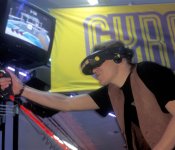
How serious are you about virtual reality?
 The absolute best/worst virtual reality stock photo we could find
Are you prepared to dedicate a room in your house to virtual reality? Perhaps you’re a little less crazy than me, but you’re okay with a wire running across your living room to a headset? Or maybe both of those sound crazy to you, but a headset that can plug into your phone is okay?
These are the emerging options for virtual reality: a medium finally coming into its own, that’s poised to disrupt industries and hairdos the world over.
Polygon‘s Ben Kuchera sent me this fascinating piece last week, written by Robert McGregor, which compares virtual reality to swimming pools. Stay with me. The long and short of the analogy is this: Both concepts are incredibly compelling, and both require a very serious investment for maximum impact. You can have fun with a kiddie pool (Google Cardboard), but you can have a lot more fun with a multi-level, ornate swimming pool (HTC Vive).
With VR, as it stands right now, there are distinct tiers. I’ve broken out four here, but I’d love to hear arguments for more distinct tiers. And no, I’m not including augmented reality solutions; VR and AR are, currently, distinct mediums.
TIER 1: Google Cardboard

The kiddie pool analogy with Cardboard is apt: It offers a great taste of VR, with none of the comfort, fidelity or depth that other headsets offer. It also costs next to nothing and works with nearly any phone (Android, and some apps also support iOS). The benefits of Cardboard are ease-of-use (accessibility) and price (accessibility).
It is the ultimate trade-off of low barrier to entry versus depth of experience — no one is spending more than 15 minutes in a Cardboard. Zero people. Even if you could, you wouldn’t; go figure, it’s not that comfortable pushing a piece of cardboard to your face.
Those aren’t knocks against Cardboard, but a comparative measurement. Putting someone in Cardboard remains the easiest way to give an interested person a quick VR demo. That cannot be oversold: Cardboard is very easy, and that’s a crucial component for the adoption of a new medium. It works with basically any smartphone! There aren’t any headstraps or controllers! It doesn’t cost very much money!
And hey, if you’d never experienced a pool of water, a kiddie pool is a pretty exciting first experience.
TIER 2: Gear VR
One gigantic step up from Cardboard, in both experience and cost, is Samsung’s Gear VR. The South Korean phone giant teamed with Facebook-owned Oculus VR on a phone-powered experience that offloads some functionality to the headset: a touchpad, a gyrometer and lenses (among other bits). There’s a strap, and you’ll need to do some fiddling to get it set up, but it’s mostly plug-and-play with your Galaxy Note 4 phone (and soon the Galaxy S6 and S6 edge as well).

Sure, you need to own a very expensive, brand-new phone to use Gear VR. And sure, you need to shell out another $200 to buy the headset. And yeah, after that, real games cost money in Gear VR. But the games are such a tremendous step up in depth and engagement from the experiences you get with something like Cardboard that it’s all worth it.
If we’re sticking to McGregor’s simile, Gear VR is the gym/sports club membership that grants you regular access to a swimming pool. A full, real pool! But it’s not yours and there’s limited access and other people are in it and whatever else. There’s no depth-tracking in Gear VR, and your experiences are limited by the Note 4’s processing power, but it’s a great second step in the VR continuum. And a pretty accessible one at that!
TIER 3: Morpheus
Yet another massive step up from Gear VR and similar experiences is Sony’s Project Morpheus: a highly capable VR headset with a high-res built-in screen, powered by the fairly capable PlayStation 4 game console. We’re getting into “I’m buying an out-of-ground pool” territory here.

With Morpheus, when it launches in 2016, you’ll need:
- A PlayStation 4 game console
- A PlayStation 4 camera
- A Morpheus headset
- Space to run a wire from your PlayStation 4 to the Morpheus processing box — a separate, small unit that has onboard processing and acts as a go-between from the console to the headset
- Space to run a wire from the processing box to the headset
- (Optional) PlayStation Move controllers
Ideally, you’ll also have some space to move around, and nothing getting in the way of any wires. This is a much more serious commitment to VR, and one that’s going to pay off tremendously in terms of experience.
Project Morpheus just got an update this week at the Game Developers Conference, where Sony revealed beefed-up specs and new software demos. The experiences you’re able to have in Morpheus are far deeper than in Gear VR: I ducked and dodged bullets in The London Heist, and my colleague Joseph banged his head into the wall dodging a murderous shark.
#fivemin-widget-blogsmith-image-220610display:none; .cke_show_borders #fivemin-widget-blogsmith-image-220610, #postcontentcontainer #fivemin-widget-blogsmith-image-220610width:570px;display:block;
 trydocument.getElementById(“fivemin-widget-blogsmith-image-220610″).style.display=”none”;catch(e)
Not only is it a gorgeous screen, but also the PlayStation 4 is simply capable of delivering more processor-intensive experiences. The camera tracks movement in three dimensions and Move controllers approximate hands far better than anything you can use with Gear VR. Morpheus is admittedly limited by the PlayStation 4 hardware, but that’s a pretty high limit.
TIER 4: Oculus Rift, HTC Vive and bleeding-edge VR
Call up the construction crew and go all in: It’s fantasy pool time. If you’re getting Oculus VR’s Rift or HTC and Valve’s Vive, get ready to dedicate a full room in your home to VR. Or maybe you’ve got a massive open area with a spare 15 x 15-foot chunk?
Wherever that space is, get ready to outfit it with a bleeding-edge PC. It’s not required, but why bother going this far and not all the way? The trade-off here is that every single time you use it, you’re going to be transported.

What Oculus and Valve are promising is the future of the medium: presence. I spent five minutes this week walking around and painting in three dimensions, with a virtual palette in one hand and a magical paintbrush in the other. It was an unbelievable experience, like nothing I’ve ever done before. I could have the same experience on the previously discussed VR solutions, but none would compare in depth.
Valve’s tracking solution — Lighthouse — enables an incredible ability to interact with the virtual world. While wearing HTC’s Vive, I was able to carefully articulate strokes in between a flower’s petals. It felt real. It was eerie.
For me, that is “presence.” The sense that I am actually somewhere else, not just allowing my brain to be tricked into believing I’m somewhere else. So I’m all in. I’m getting the in-ground pool. How serious are you about virtual reality?
Don’t miss out on all the latest from GDC 2015! Follow along at our events page right here.
[Image credit: Mediacolors/Alamy (stock lead image)
Filed under: Gaming, Peripherals, Wearables, Software, HD, Mobile, Samsung, Sony, HTC, Google, Facebook
Sony Xperia Z4 chassis allegedly leaked, reveals thinner design

Since the debut of the Xperia Z series, we’ve grown accustomed to twice a year flagship releases, even if not everyone thinks that is the best business model. That’s why it was a bit of a surprise when Sony made it clear that the Xperia Z4 wouldn’t be showcased at MWC 2015. While plenty of rumors and reports have popped up claiming Sony is moving to a more traditional 12-month release cycle, this isn’t necessarily accurate. Sony Mobile’s VP of Global Communications & PR, Tim Harrison, recently revealed that Sony hasn’t exactly moved to a 1-year release cycle, hinting that we should expect to see the Z4 sometime before September.
In other words, the VP’s comments suggest Sony might not be aggressively keeping its 6-month cycle, but instead will simply release phones whenever their ready — whether that’s six months, nine months or a year after their predecessors. We can’t say for sure whe the Xperia Z4 might surface, but a new a new alleged leak of the Z4’s chassis suggests, if accurate, that the Xperia Z4 will be thinner than its predecessor. Reportedly the Z4 is 1mm thinner than the z3, which would mean the phone is even thinner than the Galaxy S6 and S6 Edge.


Sony’s Omnibalance language is still very much present, looking at the frame, but Sony has switched a few things up. For starters, the microUSB port has been moved to the bottom and appears to be exposed, taking on the same capless design seen with the Xperia M4 Aqua and Xperia Z4 tablet. The Xperia Z4 will apparently have only one port flap, which will likely contain the microSD and nano-SIM slots. For what it is worth, some tech publications are speculating that Sony might be dropping microSD, but we wouldn’t rush to that conclusion just yet.
It goes without saying that we can’t confirm the validity of the Z4 frame leak, but the big takeaway is that Sony isn’t necessarily waiting until September to release its next flagship phone. However, they do appear to be taking their time to ensure that the Z4 is a more impressive upgrade than say the Z2 to the Z3. What would you like to see from the Sony Xperia Z4? Let us know your thoughts in the comments.
Xperia Z4 Tablet – so light that it floats?

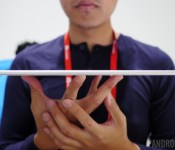
The newly announced Xperia Z4 Tablet may not look hugely different to its predecessor, but Sony has spent considerable effort trimming down all the excess space and fat from its new tablet, making the Z4 Tablet on of the most lightweight on the market.
How lightweight you ask? Well, light enough to be carried off by a few helium filled balloons it seems, as Sony has shown off in its latest promotional video filmed around the beautiful Fira Montjuic in Barcelona. Not only can the Z4 Tablet swim, but it can now fly too. Well, more like float, I suppose.
If that’s not scientific enough for you, the Z4 tablet is 6.1 millimeters thin, compared to 6.4 millimeters for the previous generation, and weighs just 389 grams. This makes it a full 50 grams lighter than the Z2 Tablet, and considerably lighter than Samsung’s similarly sized 467g 10.5 inch Galaxy Tab S.
Of course, Sony’s warranty team won’t feel sorry for you if you try a similar stunt yourself, so I doubt we’ll see flight as an advertised feature on the back of the box.
What do you think about Sony’s latest tablet design? Is weight a concern for you?
Sony’s Xperia Z3 is seen running Lollipop at MWC (Video)

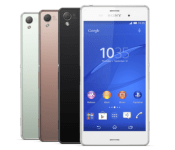
Lately, it seems that everyone is getting an Android 5.0 Lollipop update on their smartphones, there are even rumours that Android 5.1 might be rolling out to Nexus devices in the next few days. Even Samsung has been pretty speedy with updates to its older phones, with the Indian Note 3 being the latest to receive Lollipop. This isn’t any comfort to Sony Xperia Z3 owners though, as they are still on the waiting list of devices to receive the update. There may be cause for hope however according to this video (after the break) taken at Sony’s MWC booth shows a Z3 handset running Android 5.0.2, while the narrator says that the Z3 Compact was also seen running Lollipop.
As you can see in the video below, the Xperia Z3 appears pretty slick as the narrator navigates through the menus, showing off the various Lollipop features. The UI appears to adhere to the Material Design guidelines almost entirely. If, like me, you don’t understand Italian, remember to turn the subtitles/captions feature on in YouTube and have the captions translated into your language of choice. So, there’s some hope on the horizon, surely Sony won’t make Z3 and Z3 Compact owners wait too much longer for the Lollipop update.
Click here to view the embedded video.
Source: Spaziotech
Via: PhoneArena
Come comment on this article: Sony’s Xperia Z3 is seen running Lollipop at MWC (Video)

Sony provides statistics on users of the Lifelog activity tracking platform

Sony announced the Lifelog activity tracking platform last year at CES, which aimed to provide much more than the standard fitness tracking app. Lifelog tracks your physical, social and entertainment activities, like how active you are, what photos you take, or how you communicate with friends. Sony’s SmartWatch 3 even gained support for Lifelog, integrating all of the social and communication tracking technology with your Android Wear device. Since it’s been over a year since the platform was announced, Sony thought they’d give us some statistics as to how people are using the platform.
All in all, “Lifeloggers” are generally very healthy. On average, more than 40% of users of the platform get up before 6am after only six or fewer hours of sleep. Lifeloggers have also walked a total of more than 39 million miles collectively, and have run more than 6.5 billion steps. In turn, all of this exercising resulted in burning upwards of 354 million calories since April 2014. Not bad at all!
If you’re interested in checking out more statistics from Lifelog users, take a look at the graphic below:

Have you used the Lifelog platform? If so, how have you enjoyed it so far? Let us know your opinions in the comments below.

‘Metal Gear Solid V: The Phantom Pain’ sneaks out in September

Metal Gear Solid V: The Phantom Pain, the latest in Hideo Kojima’s nearly 30-year-old series of melodramatic espionage games, finally has a release date. The PlayStation 4 and Xbox One versions of will arrive on September 1st for $60, and on the PlayStation 3 and Xbox 360 for $50. PC players have to wait just a bit longer to experience the next generation of hiding from armed soldiers in cardboard boxes. Metal Gear Solid V will be available on Windows via Steam for $60 on September 15th.
The Phantom Pain has made a long, strange journey since its initial reveal. Metal Gear Solid V: Ground Zeroes, a notoriously brief prologue to the Phantom Pain released in 2014, was first announced back in 2012 but it wasn’t clear if it was going to be the proper follow-up to 2008’s Metal Gear Solid 4: Guns of the Patriots. It was technically unveiled in a trailer during the Spike Video Game Awards that same year but in a characteristically (for creator Hideo Kojima) theatrical, bizarre way. Announced without the Metal Gear name, it was credited to a fictional Swedish game maker named Joakim Mogren of Moby Dick Studios, who appeared in an interview with his head totally wrapped in bandages. It was months before The Phantom Pain was confirmed to be the full version of Metal Gear Solid V and that actor Kiefer Sutherland would be playing Snake, the main character.
Anyone excited to hop into Metal Gear Solid V‘s open-world stealth action, which includes building your own G.I. Joe-style secret base and recruiting goats, will have other purchasing options when the game releases in September. Alongside the standard editions is a $100 collector’s edition of the game that comes with a making-of documentary on Blu-ray, a replica of Snake’s bionic arm, a physical map and a host of downloadable content extras for both the single-player game and Metal Gear Online, its included multiplayer component.
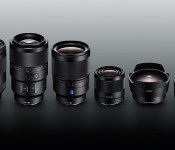
Sony unveils four much-needed lenses for the full-frame A7-II camera

We like Sony’s full frame Alpha mirrorless A7-II and light-vacuuming A7s cameras, but the downside is a narrow range of full-frame lenses. It’s now resolved the problem significantly with four new models, including a walk-around zoom and fast prime from Zeiss. The latter, a Distagon T* FE 35mm F1.4 ZA auto-focus model, creates “gorgeous” images according to Steve Huff, though it’s not for the faint of wallet at $1,698. The Sony 24-200 f/3.5-6.3 AF zoom, on the other hand, is aimed at tourists with optical stabilization, weather-sealing and a $1,000 price tag.

Rounding out the list is Sony’s FE 90mm F2.8 Macro G lens at $1,110 and the $450 FE 28mm F2 prime. Sony also revealed two new APS-C converters for wide-angle E-mount lenses, and another two (fish-eye and wide-angle) for the new FE 28mm F2 lens. With the new lenses and previous models from Sony and third-party vendors, Sony’s nearly filled up its full-frame E-mount dance card. The new zoom lens will hit shelves on March 17th, while the Zeiss lens will go on sale by mid-April. Expect to see the wide angle lens and adapters in May and the macro model by July.
Source: Sony

Sony announces Theme Creator for Xperia devices

Today, Sony announced a new project that will allow Xperia device owners to create their own themes. The project, which is currently available in beta form, is called Theme Creator and hands users control of over three-hundred graphical system assets. These items include icons, buttons, colors, and assets.
Those interested can download and install the Theme Creator BETA, take advantage of Sony’s directions (or go alone), and have it operating on a device.
Click here to view the embedded video.
Source: Sony
Come comment on this article: Sony announces Theme Creator for Xperia devices
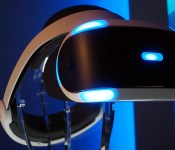
Sony’s PlayStation 4 VR headset launching in the ‘first half of 2016’

Sony’s PlayStation 4-powered virtual reality headset, Project Morpheus, has new specs and a slightly different look (seen above). Okay, it doesn’t look that different. What’s new? For one, the screen resolution is improved: it’s now 1920 x RGB x 1080. The refresh rate is doubled from last year at 120 Hz, and the new 5.7-inch screen also has a higher field of view (nearly 100-degrees). Oh right! It’s got a new, bigger screen at 5.7-inches! But you already guessed that. Further upping the specs is lower latency, now under 18 milliseconds.
Most importantly, the unit will launch at retail in “the first half of 2016.” That’s…kinda soon? Almost?
Price? No, no price yet. A new name? Nope, this thing is still called Project Morpheus. Sony’s announcements today were all about a new model of Morpheus. Let’s dig in on the news then. How about a review of those specs for starters?

First things first, there’s a new screen and it’s 5.7-inches. It’s an OLED, and the specs specifically are 1920 x RGB x 1080. Wait, what? The long and short is that the screen has a higher resolution than last year’s model. It will help reduce the “screen door” effect that many VR headsets suffer from, in so many words.
The screen is afforded “super low latency” (sub-18 ms) by way of improvements Sony’s made to the software across the past year, and the field of view has been expanded to “nearly” 100-degrees. And the design has changed a bit as well: it’s now got nine LED sensors on the outside, making it way more glowey blue than before, but also offering more points of articulation to be measured by the corresponding PlayStation 4 camera.
Sony also showed off a handful of new demos, which we’re going to go and try right now. Stay tuned!
Don’t miss out on all the latest from GDC 2015! Follow along at our events page right here.
Will you buy Sony’s Morpheus PlayStation 4 VR headset when it goes on sale next year?

The biggest announcements of MWC 2015 so far (part 2)

After the glitzy, high-profile announcements of Sunday, Monday’s march to the convention center is a more business-like affair. There’s still lots to see though, including announcements from a bunch of household names, and a dancing robot. Jump in the gallery for more.
Don’t miss out on all the latest news, photos and liveblogs from MWC 2015. Follow along at our events page.
Filed under: Cellphones, Tablets, Wearables, Sony, Google, Lenovo
 AIVAnet