


Google Wallet Adds “Orders” in Latest Update [Download]
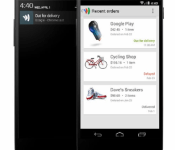
It is that magical day of the week when we usually see some Google apps get updates. Sometimes they are just bug fixes and other times you get a completely overhauled app. With today’s Google Wallet update you get a whole new feature that should help out many people who order things and use Wallet to pay for them.
 Inside the Google Wallet app you and activate a new “Orders” features. Once activated, it will allow you to see your various orders and see the shipping details of each. It cross syncs into your Gmail account and will pull the order receipts for you. Google has also set things up with various U.S. shipping partners so that when an update to your package is pushed, you will get a notification through Wallet.


Looks good to me. As always, the update is rolling out over the “next week” and is only for Android 4.0+ (US Only). If you don’t want to wait then you can always head over to GappsEarly and grab the apk right now and side load it.
Google Wallet – Play Store
Google Wallet APK location – Gappsearly.com
Via Google Commerce

Microsoft’s OneNote may come to the Mac this month

Microsoft’s OneNote app has been available on mobile, Windows and the web for quite some time, but Mac support for the note-taking software has proven elusive… at least, until now. Both The Verge and ZDNet hear that OneNote will be available for free on OS X later this month. Microsoft would also release a free desktop Windows app (the Windows 8-native app is already gratis) to better support its own platform. Both versions would include new features, too, including a Clipper service to save web content and a desktop variant of Office Lens’ document scanning. We’ve reached out to Microsoft to verify the claims. It’s easy to see why the folks in Redmond might expand OneNote’s ecosystem, though. The app is facing stiff competition from Evernote, which is available on most modern platforms — Microsoft would simply be countering a rival.

Appmethod lets you code native Android, iOS and desktop apps simultaneously (hands-on)

With different requirements and countless other incompatibilities, building applications for multiple platforms can be a tremendous chore. Embarcadero Technologies is setting out to simplify that process a bit with Appmethod, a multi-device development platform that lets you create apps for Android, iOS, Mac and Windows simultaneously. The WYSIWYG tool lets you drag and drop buttons, connectors, databases and other design elements into one emulated platform, then easily duplicate the app onto another.
Reps suggest starting out on the platform that’s most important to you. From there, you can easily migrate to another operating system, be that Android, iOS, Mac, Windows or even Google Glass. You should be able to sign up for Appmethod beginning on March 18th. Prices range from $299 per developer, per platform, per year for firms with up to five users, to $999 with the same pricing structure if you’re planning to work alongside six or more devs. Check out our SXSW hands-on video below to see the IDE in action.
Filed under: Software

Epic Games’ Unreal Engine 4 adds Firefox support, isn’t just for creating pretty demons

Yes, Epic Games’ Unreal Engine 4 can be used to create large, dramatic demon gods, but that doesn’t mean it’s only used to create large, dramatic demon gods. It’s also used to create sneaky thief demos! Oh, and as Mozilla demonstrates this morning with video of Unreal Engine 4 running from within Firefox, the engine can be used for much smaller-scale applications as well (such as the basic 2D platforming game seen in the video below the break). All this is to demonstrate that developers can use web clients (Firefox at least) to create games that are “almost indistinguishable from ones [you] might have had to wait to download and install” — the demo is running without plugins at “near-native” speeds. Apparently Unreal Engine 3 support simply wasn’t enough? We’ll be sure to ask when Mozilla shows off UE4 in Firefox next week at the Game Developers Conference.

Tinder wants to verify celebrities so you know they’re really into you

Tinder, the iOS and Android app that matches people by how close they are from one another, has a celebrity problem. While signing up to a dating app is probably the last thing you’d expect any privacy-conscious alphabet-lister to consider, Tinder already counts a few famous faces amongst its millions of users (Ashton Kutcher and Lindsay Lohan reportedly are fans), but they aren’t racking up matches because people believe their profiles are fake. According to Hollywood Reporter, the mobile startup wants to remove all doubt from that equation by introducing a verification system for celebrity users that could use Twitter-style checkmarks to signify that an actor, actress or musician (etc) is who they say they are. Tinder CEO Sean Rad also says that the company could drop the requirement for stars to sign up using Facebook, where they’d have to use their real name instead of an alias, allowing them “to enter Tinder in a different way.” We don’t yet know when the new system will be implemented, but if it does lure famous users to the service, you never know, you could only be five right-swipes away from Kevin Bacon.
Filed under: Cellphones, Internet, Software, Mobile
Source: Hollywood Reporter

Android users in Canada get first dibs on Wind-Up Knight 2
 The original Wind-Up Knight by Robot Invader was a wildly successful game that everyone seemed to love immensely. The team behind the game have been hard at work to bring the sequel to light in Wind-Up Knight 2. They took everything wonderful from the first game and only made things better, so it would seem from the Play Store listing and Mobile Syrup. You still run, slash, jump, block and roll through various levels but they have upped the graphics of the title along with lots of other side things to accomplish.
Wind-Up Knight 2 pulls in Side Quests to gain replay value for levels you have already completed. For instance, playing a level and not killing anything, or finding all the hidden diamonds. There is also a Tournament Mode where you can challenge your friends on Google Play Games for top spot. Check points have also been added to help get you through those longer levels. Take a quick watch of the teaser trailer released yesterday for Wind-Up Knight 2.
It will feature in-app purchasing, but since I am in the U.S. I do not know to what extent. It would seem that the main purchasing aspect will be for gold coins that you can use to buy tickets to play Tournament Mode, purchase power-ups and various other things for your knight. Mobile Syrup says the games mechanics are set up so you can play through without needing to spend real money unless you can’t sit and grind through to earn gold coins on your own. However, there is a flat fee of $4.99 to unlock all levels of the game that is handled through an IAP as well.
Anyone in Canada want to check it out? If so, hit the snazzy banner button below and give it a whirl.

Source: Mobile Syrup
Three more games added to the Humble Mobile Bundle 4
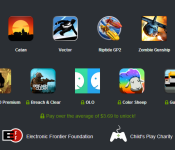
 The Humble Mobile Bundle is a great way to bolster your Android gaming collection and to help out charity. The concept is easy to grasp, pay what you want, set how you want the payment spent and collect your bundle. Pretty straight forward. As of posting this, the average pay is $3.69. If you pay less than that you get 4 great games. Pay more than that and you get 5 more games. Check out the list.
Pay under the $3.69 and get:
- Catan
- Vector
- Riptide 2
- Zombie Gunship
Pay over $3.69 and also get:
- BADLAND Premium
- Breach & Clear
- OLO – NEWLY ADDED 3/11/2014
- Color Sheep – NEWLY ADDED 3/11/2014
- Gunslugs – NEWLY ADDED 3/11/2014
If you do go for broke and spend a whole $3.70, or more, then you end up walking away with 9 games valued at $42. As an added perk, you are also getting all the in-app purchased unlocked in BADLAND and Breach & Clear. That is pretty stellar right there. Check out the short video preview of the whole thing real quick.
If you want to jump in on this great deal simply head over to Humblebundle.com and get your donation in.
Via HumbleBundle G+

Spritz’s speed-reading tech shows up to 1,000 words a minute, makes its debut on Samsung devices

Two weeks ago, we were so busy getting hands-on with the new Samsung GS5 and Galaxy Gear 2 smartwatch that an exclusive app for the two devices flew completely under our radar. That “app,” as we call it, isn’t really an app at all: it’s Spritz’s speed-reading technology, and if all goes according to plan, it will soon be embedded into loads of websites, apps and wearables devices. For now, though, the tech is making is debut on the GS5 and the Gear 2, with a public SDK set to come out in a few weeks.
Here’s how it works: Spritz shows you one word at a time through a narrow, rectangular viewing pane called the “Redicle.” That name is a pun of sorts, as each word has one letter highlighted in red (get it?!). In more technical terms, that letter is the “optimal recognition point,” the letter that helps your brain piece the word together quickly (and with as little eye movement as possible). The speed is adjustable, too, ranging from 100 words per minute to 1,000 — far exceeding Spritz’s claimed average of 220 words per minute.
Once Spritz releases its SDK, sometime in the coming weeks, developers will be able to build it into their apps, as well as create things like Chrome extensions. (Spritz CEO Frank Waldman says Spritz has no intention of doing this itself, which is probably fine, as 12,000 developers have already requested access to the SDK.). Website owners, meanwhile, will be able to integrate the technology by embedding some simple HTML code.
As of today, though, the GS5 and Tizen-powered Gear 2 are the only confirmed devices that will make use of the technology. On the GS5 in particular, Spritz will be baked into the native email application so that you can read your emails through a viewing pane at the top of the screen. I started out at 240 words per minute (just above the supposed average) and had no problem keeping up. I’ve embedded a demo gif below — and don’t mind the fact that I’m using a GS4 instead of a GS5.

It’s a similar deal with the smartwatch, which, when you think about it, is actually a genius place to install a speed-reading app. The idea is that you can speed-read from your wrist if you’re in a hurry, but if you want a longer look you can tap a “reply” button on the watch, which will prompt the email to open on your Galaxy phone. Once again, I’m using a last-gen device (the original Gear), as Spritz didn’t have any of the new devices on hand. But you get the idea.

Again, that’s it as far as officially sanctioned devices go. Still, the Spritz team has been doing some hacking on its own, if only to show developers what the technology is capable of. In particular, the company has cooked up an unofficial version of Kindle for Google Glass, allowing you to read novels and other materials, in addition to whatever you might encounter on regular websites. It’s a neat idea, and one I hope Amazon at least considers implementing. Still, it won’t be for everybody: after a few minutes of practice, I still struggled to read a simple young-adult novel at 280 words per minute. When it comes to fiction, at least, I might continue to read one sentence at a time, even if it does take me a little more time. But that’s just me. In any case, take a look for yourself (and thank the Google gods for that convenient screencasting feature for Glass).

Filed under: Cellphones, Wearables, Internet, Software, Mobile, Samsung

Oculus ends Rift dev kit sales citing parts supply issues

As forewarned, Oculus VR is officially ending sales of its first-run development kit. “We’re quickly running out of stock for the Rift development kit, so we’ve shut down sales in most regions,” a note from Oculus says. Specifically, the issue comes from certain pieces of the headset “no longer being manufactured.” That said, those headsets are more than a little long in the tooth at this point: both the HD version and the Crystal Cove prototype take giant leaps past the first dev unit, to say nothing of Valve’s prototype. Oculus isn’t offering anything official in terms of word on new dev kits (beyond what the company’s CTO told us last year), but we expect many devs already have some form of new hardware from the fast-growing VR company.
As of today, Oculus sold approximately 60,000 original dev kits; at $300 apiece, that’s about $18 million in just dev kit sales (without factoring in the cost to manufacture and ship those dev kits, that is). Of course, that’s a paltry figure compared with the enormous amount of money backing Oculus: just shy of $100 million in venture capital and personal investments. In so many words, it’ll require serious sales numbers of the forthcoming retail VR headset to make Oculus into a profitable company (at least in the short term).
As for official word on the next dev kit from Oculus VR, we expect it won’t be too far way. Oculus itself says, “We’ll have more news on this soon, so stay tuned!” With GDC next week and E3 looming ever-closer by the day, we’re getting ready for that news any minute.

Instagram for Android update sports refreshed UI, speedier performance

Is Instagram your go-to photo app on that trusty Android handset? If so, you’re about see a bit of a jump in performance with a new look. The filter-powered social snapshot software has been updated with a more polished UI that “feels native and at home on any Android device.” This means simplified (read: flat) design elements are used throughout and the app is faster and more responsible all the way around. The difference is immediately visible in the main navigation bar across the bottom. Some controls have been shuffled around, but the outfit promises the changes are in the interest of maximum useability, making the app “faster, cleaner and easier to use than ever.” If your Android device doesn’t alert you to update the app, mosey over to the Google Play store today and snag it.
Source: Instagram, Google Play

