



Drone inspectors: UK airline easyJet looks to tech to cut costs

Virgin’s the kind of brand we’re not shocked to see playing with the latest tech — after all, Richard Branson’s got a space plane. Experiments with Google Glass, smartwatches and iBeacon for Virgin have all focused on boosting customer experience, as long as you’re in Upper Class, anyway. European airline easyJet, however, is known for its no-frills, low-cost approach, which is why we’re curious to see the company investing in an “innovation” arm that looks at how new technologies can be applied to aviation, with no immediate return. easyJet sees it differently, though, as the long-term goal is to save money by reducing technical delays, or hopefully avoiding them all together. This has a knock-on effect of improving customer service by minimizing disruptions, of course, but make no mistake: easyJet’s motivated to explore emerging tech because a grounded plane might as well be a money pit.
easyJet envisions reducing aircraft downtime in a number of ways, the simplest (on paper) being better software. In this area, the airline’s testing a system that monitors its fleet in real time, and schedules part replacements before they fail, as well as looking at mobile apps that also take the hassle out of identifying and ordering the right parts. The main issue for easyJet, really, is when a plane is struck by lightning or suffers some other event that might’ve caused damage, and it needs meticulous inspection before returning to active duty. We’re told it can take up to a day for engineers to OK a plane, and it’s this lost time that easyJet is trying to cut dramatically by using a much smaller kind of aircraft: the drone.

Though the airline admittedly has no real idea of when it could deploy drones in support of its engineers, the pipe dream sees UAVs shrinking lengthy inspection times to little more than an hour. Instead of making engineers climb about the aircraft in search of damage, the thinking is drones could help get at hard-to-reach places quickly. While laser scanning and 3D modeling could be part of a drone’s job in the future, easyJet’s still just working on making sure camera quality is as good as it can be. The airline’s working with drone-builders CopterCraft and the Bristol Robotics Laboratory (UK) to perform proof-of-concept studies, with the latter even looking into autonomous scanning, multi-drone setups to divide workload and particularly outdoor flight in turbulent environments.

All aircraft maintenance is managed from a command center next to London’s Luton Airport, and the hope is that drone imagery and scans can enhance communication and data availability with engineers on the ground. Not limited to just drones, easyJet’s also testing hand-held and head-mounted cameras, as well as portable 3D scanners for relaying information back to base. AR headwear from the likes of Epson and Vuzix could also feed information the other way, giving engineers a heads-up as to where an issue might be found. Most of these applications are a long way from formal introduction, but some tech is set to save easyJet money right now. By the end of the month, the 25kg of flight manuals and other paperwork its planes lug around will be replaced by Panasonic’s rugged Toughpad tablets. And, according to easyJet, one kilo costs it $20,000 each year. In an effort to make truly paper-free planes, Sony’s large e-paper slates are also expected to substitute in for the plethora of forms the crew must fill out for each flight.

easyJet considers all these projects investments, and ones that will eventually pay off. It’s not concerned with other airline’s riffing of the ideas, either, and in some respects hopes to be a leader in assessing new technologies for their potential in aviation. Most of all though, easyJet wants its planes in the air as much as possible, getting you on your way and making dollars in the process.
Sharif Sakr contributed to this report.
Filed under: Robots, Tablets, Transportation, Wearables, Software, Sony
Source: easyJet

The world’s largest election is being led by a holographic politician

What do you do when you’re running for prime minister of one of the most populous nations on Earth and need to reach over 800 million people? How can you possibly shake every hand and kiss every baby, occasionally appearing in several locations at once? One solution is dark magic. The (slightly) more realistic solution, recently employed by Indian candidate Narendra Modi, is to simply turn your speeches into holographic affairs.
Yes, like Tupac’s 2012 performance at Coachella.
Modi’s used a hologram of himself to reach a huge portion of India’s voting public — some 814.5 million people comprise India’s eligible voting populous — appearing over 800 times as such. The hologram is actually a projection controlled from above the stage (rather than the Star Wars-esque devices we expected). It’s a novel concept that’s assisted in Modi’s rise to popularity in India; as John Oliver points out on Last Week Tonight, Modi’s also promising working toilets to every household. Which is to say, “The country with the world’s first hologram politician is also a country that lacks indoor plumbing on a wide-scale.” We live in a weird world, y’all.
Filed under: Displays, Misc, Software
Source: The Telegraph
Don’t go to North Korea, but do check out this travel app

When we think of the places we’d rather not go, a Whole Foods on a Tuesday night before Thanksgiving or your great-grandparents’ windowless basement apartment come to mind. And then there’s also North Korea, bastion of human rights violations and the favored destination of one Dennis Rodman. If, for some reason, you’ve always wanted to plan your own trip to the “most secretive nation” in the world, but felt it was too complicated, well, now there’s a 99-cent app for that. Yeah. But it doesn’t come from the genius minds of the Democratic People’s Republic of Korea’s propagandists. It hails from Uniquely.Travel, a London-based startup specializing in trips to difficult destinations and Magora Systems, a Russian software maker.
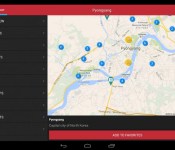
The app appears well-designed enough, with over 350 points of interest, slick menus, hi-res imagery and even recommendations from a tour guide with 10 years of experience traveling in the land that time (and justice forgot). The sights are helpfully mapped out and available for offline access should you need a handy reference while casually strolling through Pyongyang looking for that hot new Tapas bar. And the intrepid among you can even use it to customize your itineraries, compare price quotes from different travel agencies and book travel.
But, really, why would you?
Filed under: Cellphones, Software, Mobile
Via: Washington Post
Source: North Korea Travel

LinkedIn and Evernote partner to make business cards useful again

Fact: everyone likes doing business with the guy who remembers them. With that in mind, LinkedIn and Evernote just announced a new partnership to bring the Rolodex into the 21st century, and it all starts with a photo of a standard business card. Evernote will instantly digitize it and bring in any relevant LinkedIn info. You’re then given the option to connect with that CEO, secretary or digital prophet on LinkedIn or add their contact info to your address book. However, things get interesting as your business relationship blossoms. Over time, you can add things like audio from a meeting, documents, or even key emails with him or her to the card’s page in Evernote.
Evernote and LinkedIn are already in the business of digitizing business cards with Evernote Hello and CardMunch, respectively. However, today’s joint effort will ultimately sunset LinkedIn’s offering and bring all those users over to Evernote. Want to give it a try? The feature is available now for iOS, Mac and Windows users, with Android support headed down the pipeline soon. Card scanning is free for everyone for one year (after which it will require a premium Evernote subscription). Existing CardMunch users can port their existing cards into Evernote and score a bonus year of free service before they have to shell out any cash.
Image source: Shutterstock
Source: Evernote

Can’t I help you? Shoppers are shunning store assistants in favor of smartphones

Although it often feels like you’re stealing, being able to walk into an store, pay for a product with your phone and leave without any employee interaction can be liberating. It’s an experience that an increasing number of consumers are starting to enjoy too, as evidenced by a new report from Deloitte that suggests shoppers would rather pull out their smartphone or tablet inside a store than speak to an associate. More than half of the people surveyed admitted they prefer using a mobile device to compare prices, gather more information or check availability, while just under half of respondents said they’d rather use complete a mobile payment than head to a cash register. Even unmanned kiosks (think touch displays or tables full of tablets) outranked small talk with a retail employee.
Deloitte isn’t suggesting retailers should immediately go ahead and give sales associates the boot (at least not right now), but instead reinforces the need for companies to support consumers’ digital shopping needs. People are now more aware and comfortable around technology, which has given rise to automated self-checkouts inside supermarkets and the need to prove to an Apple Store associate that you’ve paid for your item with your iPhone before you leave (even though you don’t need to).

Filed under: Cellphones, Internet, Software, Mobile, Apple
Via: Wall Street Journal
Source: Deloitte (PDF)

Hyperrealistic virtual reality adventure Loading Human headed to Oculus Rift and Project Morpheus

As the medium of virtual reality progresses, its applications only get more incredible. Take Untold Games’ Loading Human, for instance. It takes Unreal Engine 4 and infuses it with the tropes of the adventure game genre, only instead of pointing and clicking, you’re in that world. Solving puzzles and exploring narrative are at the heart of Loading Human, and it shows in the eerily realistic gameplay clip the studio’s released. The game’s intended for Oculus Rift, naturally, and Sony’s Project Morpheus headset as well.
That’s if the studio achieves its Kickstarter goal of $30,000, of course. The 11-person team claims it can create the first episode of a planned three episode game for that paltry sum, with backer benefits ranging from the basic (a thank you in the game) to the extreme ($5,000 gets your face in the game in place of the main character — creepy!). But when will you get the game itself, given the total lack of a release date (or even a window) for consumer-ready VR headsets? Untold Games is anticipating “Q1 2015″ for Rift availability (though, ya know, that’s not from Oculus), so maybe then? Only time will tell.
Filed under: Gaming, Peripherals, Wearables, Software, HD, Sony
Source: Kickstarter

Crysis 8K resolution hack offers a peek at the next decade of gaming

Want to know what you’ll be playing on your PlayStation 5 or Xbox Two in the next decade? Take a look at K-putt’s Crysis 3 resolution hack. His tweak to the first-person shooter’s main Windows program file lets the game’s visuals run at up to a very wide 8K (specifically, 8,000 x 3,333). That’s about 13 times more pixels than you’d see in a 1080p image, folks. The results very nearly speak for themselves — screenshots look more like paintings, and even tiny objects are full of detail.
Don’t think that your hot rod gaming PC can make this playable any time soon. Even a behemoth graphics card like NVIDIA’s GeForce GTX Titan is barely good enough for running Crysis on three displays at 5,760 x 1,080; you’d need something with four times the pixel-pushing ability to keep up here. You can’t exactly find an 8K screen at the local computer store, either. Technology moves quickly, though, and we wouldn’t be shocked if both devices and displays are powerful enough to handle this kind of fidelity within a few years.

Via: ExtremeTech
Source: K-putt (Flickr), Reddit

You can now spice up those iPad docs with Hoefler & Co. fonts

Sure, you’re likely not buying $300 fonts just for your Pages and Keynote work on an iPad, but for those who’ve already splurged for a bite of Hoefler & Co.’s catalog, the option is pretty tempting. The popular type foundry has made purchased fonts available for use on devices running iOS 7, with the ability to download the requisite files directly from the site. A quick jaunt over to your Font Library page will show the options you’ve licensed with the option to “add to device” for an easy install. One thing’s for sure: those cover letters typed out in a pinch are about to get a major aesthetic upgrade.
Source: Hoefler & Co.

Symantec declares antivirus ‘dead’ as it focuses on damage control

Given how hard antivirus software makers push you to sign up, you’d think that business was booming. Far from it, according to Symantec’s Brian Dye. He tells the Wall Street Journal that antivirus tools like his company’s Norton suite are effectively “dead.” The utilities now catch less than half of all attacks, according to the executive — to him, the focus is on minimizing the damage whenever there’s a successful hack or infection.
To that end, Symantec plans to sell both recovery services and threat briefings to corporate customers. In the long run, it should also have technology that finds malware trying to imitate other apps. However, the developer can’t give up its original cash cow just yet. Antivirus packages like Norton still make up more than 40 percent of the company’s revenue, and the new services won’t safeguard your PC at home. You can still count on security software hanging around, then — just be aware that you may need extra software (and a healthy dose of caution) to stay safe.
[Image credit: Shutterstock / David Orcea]
Filed under: Internet, Software
Via: The Guardian
Source: Wall Street Journal

Microsoft OneDrive adds sharing and organization features for Android

If you’re a Microsoft OneDrive user on Android, sharing and organizing files just got a bit easier while on the move. Thanks to an update to version 2.5, the cloud-storage option allows those with Google-powered mobile devices to share via invite, link or sending files to an outside app. You can also download multiple files at once, while moving and sorting individual items and folders as needed. There are some new additions on the desktop side too, including adding items to a previously shared stash, publishing video content to Facebook, custom album covers and more. The new version of the Android app is available now in Google Play and the desktop features are rolling out to users “over the coming days.”
Source: Microsoft (OneDrive Blog), Google Play

