


Could Cortana be on Android devices one day? Microsoft says “Maybe”
 In the realm of virtual personal assistants, Apple has Siri, Android has Google Now, and Microsoft has Cortana. The last of these is the newest, currently only part of the Windows 8.1 developer’s preview, however that hasn’t stopped it garnering quite a lot of attention in the press. As a big Xbox and Halo video game series fan, I find myself wishing Cortana, who features as a major character in the games, would be ported to Android. Which poses the tantalizing question: Could Cortana be on Android devices one day?
I definitely seems like a long shot given that neither Apple nor Google seem content to bother supporting other mobile platforms with their respective assistants, however Marcus Ash, a Windows Phone Group Program Manager has said some interesting things about their aspirations with Cortana:
“We want to scale Cortana internationally and across devices. The Android/iOS question is interesting. We’re asking, would Cortana be as effective if she didn’t have access to the details on your phone? We’re still trying to get Cortana adopted on Windows Phone and figure out what it wants to become there. But we’re actively talking about this.“
If that’s not a “maybe”, then I don’t know what is. Perhaps damningly for Cortana, the Microsoft assistant is hardwired into using Bing as its search database, which would always struggle competitively against Google Now and its Google repository. Having said that, I’d still love to see them try, and at least we know the possibility is there.
Would you want Cortana on your Android device? Let us know what you think in the comments.
Source: Search Engine Land via TalkAndroid
//<![CDATA[
ord = window.ord || Math.floor(Math.random()*1E16);
document.write('’);
//]]>

Can Electronic Arts make a ‘Battlefield’ game that works?

I stopped playing Battlefield this year. Why did I stop playing the massively popular first-person shooter? Because it never works when it launches. For those who haven’t experienced the promise and defeat of a Battlefield launch, it goes as such:
- A multiplayer beta precedes the launch, often by a slim few months, which is chocked up to server testing.
- Players enjoy the beta, which is sometimes buggy, but often stable enough. And hey, it’s a beta.
- The game launches; millions of players splash into online servers; and it becomes unplayable for days, weeks and often months at a time.
Battlefield games come out every year. This was not always the case, but in the past four years, we’ve seen three Battlefield games. Zero of those three worked at launch (I actually wrote about this back when Battlefield 3 came out, at our sister site Joystiq). Battlefield 4 launched last October; it just started operating consistently. At E3 2014, EA announced this year’s entry in the series: Battlefield Hardline. It’s with this tremendous amount of baggage that I approached our interview with Battlefield studio head Karl Magnus Troedsson.
“You man up to the problems you’ve had, and you fix it.”
Troedsson knows my plight well. Aside from having heard as much from me in the past, my issues with Battlefield are far from unique. One look at the Battlefield help site demonstrates how widespread the issues are. In so many words, he hears complaints about Battlefield 4 quite often these days. As such, he’s prepared a characteristically positive response. Troedsson asks me, “I hear you. I hear you absolutely. But have you played Battlefield 4 lately?”
I haven’t. After several months of major issues — buggy gameplay, being kicked mid-game from online servers, unbalanced weapons, straight-up glitches — I quit. And I’m not alone. Around 150,000 people are actively playing the game across five game platforms: Xbox 360, Xbox One, PlayStation 3, PlayStation 4 and PC. Estimates put sales of Battlefield 4 in the range of 7 million. It’s pretty stark. How many of those folks will come back this holiday when the next game, Battlefield Hardline, launches?
Troedsson says the only thing he can do is be much more vocal with the community and create a great game. He says the studio culture has changed as a result of the last several years of botched launches. He says evidence already exists of that change.
“It’s a cultural thing of how we engage with the community. It’s a hardening experience to launch these kind of games, especially when we have challenges at the launch. The easiest way of going about something like that is becoming more closed off. As a company, as teams, it’s basically a human reaction to something like this. We’ve decided to opt the other way — to open up the kimono and say, ‘You know what? You know why it’s hard to make these games? Because it’s very complicated.’ That’s not an excuse!”
Except that it is an excuse. And Troedsson knows it, because he said, “That’s not an excuse!” before I could point out that customers who pay $60 for a broken product aren’t assuaged when the product maker says, “Making this product is really tough.” It absolutely is complicated making games, especially ones as sprawling as Battlefield 4. That, of course, doesn’t excuse DICE from making a working product.
So, will Battlefield Hardline function when it comes out this year? I truly doubt it, but — for what it’s worth — DICE is introducing a beta earlier than ever. Troedsson called it a “true beta.” Keep in mind that the last several Battlefield games all had beta periods ahead of launch. What’s a “true” beta, then? That remains unclear. It’s not that I didn’t ask, but this is what I was told when I did:
“The Battlefield 4 beta for instance; that was pretty close to the actual launch. That was more for the actual backend system. Because from that perspective, it is a true beta. The actual clients that people are playing on are very near final, but the backend is about doing the beta testing on those kind of systems.”
Regardless, considering Battlefield 4 only just recently started working, why in the world is EA releasing another Battlefield game this year? It’s hard to not see it as a naked cash-in on a franchise being milked for all it’s worth. Troedsson defends EA’s decision.
“We’re shipping another Battlefield game a year after, which some people feel is too close. But there is a commitment here from us that we’re gonna keep taking care of the products much more in a parallel way. People shouldn’t think of this as a serial exercise of dropping games; as soon as one is dropped, the other one dies. Naturally, unless people really scream for it, we perhaps won’t continue building a lot of paid DLC for BF4 after Hardline comes out, but will we still take care of the experience? Absolutely. If new problems occur, will we take care of them? Absolutely.”
Here’s the thing: Troedsson’s missing the whole point. It’s not just that fans who bought the past several games feel burned because they worry the game they bought will stop receiving support. The issue is that EA is asking them for money hardly a year after selling them a broken product. And the new product looks an awful lot like the broken one from last year.
Troedsson and I spoke for almost 20 minutes about mostly this. I’ve included the full audio below, which longtime Battlefield fans may be interested to hear. Troedsson is sympathetic to the plight of spurned fans, no doubt, and it’s worth hearing his tone. Though I might not agree with all his answers, he’s at least trying. Check it out for yourself below.
An interview with DICE head Karl Magnus Troedsson

Twitter expands Bing-powered translations for iOS and the web

Twitter’s been experimenting with Bing’s translation services for quite some time, but now it’s making it available to more people on a wider range of devices. As spotted by CNET, the company has begun outfitting its iOS app with translation buttons powered by Microsoft’s search service. It’s also making things clearer on the web by displaying a small globe icon beside tweets that aren’t written in English. Results are mixed, as you can see from the image above. Twitter first brought Bing’s services to Windows Phone on mobile and has displayed Bing translation tools inside the detailed tweet view on Twitter.com. Today’s changes make things easier for users who follow non-English accounts or might see more foreign-language tweets in their stream following the start of the World Cup.
Filed under: Internet, Software, Microsoft
Source: CNET

Firefox OS apps run like native apps on Android

The beauty of apps written for Firefox OS is that they’re basically just web apps — they’re built primarily on Java Script and HTML5. That means if you can run the app on Mozilla’s mobile operating system, you can run them in its browser too. In fact, if you install Firefox 29 on Android, you can run so-called Open Web Apps (OWA) on your Google-powered phone. Not only that, but they’re not confined to the browser. Apps installed from the Firefox OS Marketplace are treated just like native apps. They get their own icon in the launcher and home screen, can be uninstalled from the menu and run without the usual browser UI clutter (such as an address bar or back button). Of course, the performance probably won’t match truly native apps, and most won’t abide by Android’s interface conventions. Still, there are some developers who might enjoy the idea of building an app once and running it across all platforms.
Via: Android Community
Source: Mozilla
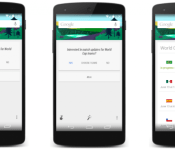
Did Google just leak the existence of Android 5.0?
 Google isn’t normally a company gives away much information before they are ready to do so, and they seem to have become masters at teasing future products with relatively inane details. One tactic that they are known to use is showing the number of the next major Android software build in the clock of Google app screenshots. The latest example of this has been when Google showed off their new World Cup features in Google Now. Perhaps only subtle enough for the people who know Google’s tactics, the clock in these screenshots shows the time “5:00″ which suggests the next build of Android will be Android 5.0.
Previous times that Google has used this method of teasing has included Gingerbread (2:30), Ice Cream Sandwich (4:00), and Jelly Bean (4:20). Current screenshots that Google uses features the time 4:40 of course representing the current build of Android, Android 4.4 KitKat. We’ve long wondered whether the next version of Android would be 4.5 or 5.0, but this latest tease from Google surely confirms that it is going to be Android 5.0, and with Google I/O just a few weeks away, it seems almost inevitable that we’re going to see something related to Android 5.0 at the event.
What do you think of the next build of Android being Android 5.0? What do you think it’s going to be called? Let us know your thoughts in the comments.
Source: Twitter via TalkAndroid
//<![CDATA[
ord = window.ord || Math.floor(Math.random()*1E16);
document.write('’);
//]]>

Visual encyclopedia builds itself by scouring the internet

Crowdsourced knowledge bases like Wikipedia encompass a lot of knowledge, but humans can only add to them so quickly. Wouldn’t it be better if computers did all the hard work? The University of Washington certainly believes so. Its LEVAN (Learn EVerything about ANything) program is building a visual encyclopedia by automatically searching the Google Books library for descriptive language, and using that to find pictures illustrating the associated concepts. Once LEVAN has seen enough, it can associate images with ideas simply by looking at pixel arrangements. Unlike earlier learning systems, such as Carnegie Mellon’s NEIL, it’s smart enough to tell the difference between two similar objects (such as a Trojan horse and a racing horse) while lumping them under one broader category.
Right now, the folks at the Wikimedia Foundation have little to worry about. LEVAN has only explored about 175 concepts as of this writing, and it can take as much as 12 hours to add another to the mix. It’s open to suggestions from the public, though, and the university has open-sourced its code so that anyone can build on the formula. You won’t want to depend on this self-assembling information hub for vital knowledge in the near future, but it should eventually be very useful for both schools teaching basic ideas as well as computer vision software that needs a helping hand.
Filed under: Internet, Software
Via: Phys.org
Source: LEVAN, University of Washington

How I got stabbed in the chest at E3 2014 (an Oculus Rift tale)

There I was, impaled by an alien. I was carefully walking around a space station, with nothing more than my (admittedly dim) wits and a motion tracker, watching a large, terrifying alien stamp about. My only direction was to survive. “You had one job!” I failed at it.
The tech demos are over: Oculus Rift’s second development kit at E3 2014 isn’t running any dalliances aimed at proving the tech. It’s running real-ass games. Alien: Isolation was the third game I played, and it was by far the most terrifying. You’re not a space marine, and you’re not named Ripley. You’re just some unwitting sheep running from assured death at the hands/tentacles/teeth of an H.R. Giger-designed alien. Delightful.
ALIEN: ISOLATION
Alien: Isolation is being made by Sega’s recently acquired game studio The Creative Assembly. Hell, it’s coming out this year on game consoles and PC. Again, the demos are over — there are entire game dev teams dedicating time to virtual reality at this point. Isolation is proof of that, and it’s a great first example. It’s not even clear how people will be able to play Isolation‘s VR mode at this point; the game’s headed to PC, but there’s no VR headset to buy just yet enabling said functionality. Sure, you could buy a dev kit and stuff, but that’s pretty far from ideal.
Anyway, Alien: Isolation is meant to terrify you. You’re stuck in a confined area of a space station while the aforementioned alien stomps about. If it sees you, you’re done. Not, “Oh, I’ll turn and run.” Not, “Shoot her! Shoooooooot herrrrr!”, Jurassic Park-style. It comes right at you and the motion sensor in your hand doesn’t offer any defense. So while I snuck from room to room looking for an out, I was able to avoid interacting with the hulking beast a few times. About three minutes in, though, he spotted me dead on. I turned to run. He caught up quickly and stuck me through with a vicious-looking appendage. I looked down and saw said appendage sticking out of my chest, blood dripping from it. The future of gaming is pretty messed up, y’all.
LUCKY’S TALE

Do you like Super Mario 64? How about Super Mario 3D World? Or Ratchet & Clank? Well you should be super pumped about Lucky’s Tale, the second game being published directly by Oculus VR. It’s being made by the folks behind Words with Friends and, before that, they were Ensemble Studios alums (Age of Empires, Halo Wars, etc.). It’s a colorful, cutesy third-person platformer. You feel a bit like god, looking down on a cartoony world filled with stars to grab and platforms to bounce on. “So what, it’s a platformer!” you say. Okay, okay — cool it.
What makes Lucky’s Tale especially cool is the gameplay implications of wearing a head-tracking VR headset. Lucky has to throw bombs occasionally; simply look at your target and push a button. Boom! How about hidden secrets? Just look around the level; having a VR headset on means the 3D platforming world of Lucky’s Tale is a physical platform just a few feet away from your gaze, able to be explored more deeply than ever before. What’s that next to the ledge? Just bend your head around the corner and take a look, why don’tcha? While the game at first feels like little more than a pretty 3D platformer, it quickly becomes a whole new experience in VR.
SUPERHOT

First and foremost, you can play Superhot right now. And you absolutely should, because it’s super boss. Check it out right here.
That aside, playing Superhot in VR is bananas. The conceit of the game is that time moves forward as your character moves. So it’s a first-person shooter, but the bullets only move toward you as you move your character. It’s kind of like living in The Matrix‘s bullet-time sequences; you can literally watch a bullet as it whizzes past your head, slowly moving forward as the bullet slowly creeps past you. It makes the whole shooting experience far more personal. One bullet takes you down, and there are many bullets. Playing Superhot feels like a game of virtual reality Twister. I found myself moving in short bursts, advancing time and carefully moving my head as to avoid the bullets flying my way.
Forget Team Fortress 2‘s VR support — Superhot is where it’s at for first-person shooting in virtual reality.

The man who made the game in ‘Her’ is about to release a game you can play

He’s fresh to game development, but David O’Reilly has already created a game you likely know very well: the game in Spike Jonze’s excellent film, “Her.” While that “game” was, ya know, in a film and not a real game, he’s just about to release his first actual game in Mountain. O’Reilly describes it as a “mountain simulator” — he explained to a crowd at Los Angeles’ Museum of Contemporary Art this morning that it enables you to “live out all your dark twisted fantasies” of, uh, being a mountain. Okay, so what in the world is happening here? In actuality, it’s a game about interacting with a relatively static mountain. Weather changes, music changes, and you can input melodies (via touch on iOS, keyboard on PC/OS X) which alter the state of the world.
Sometimes you push forward time, sometimes you change the weather, sometimes you zoom out into outerspace — where your mountain lives, apparently! O’Reilly says it’ll be out in the next few weeks, and it’ll cost “about a dollar.”

Console OS will let you run Android on a Windows PC or tablet

Toggling between Windows and Android on a single device? That sounds desirable enough maybe, especially the way Intel describes it, but the quest for a practical mixture of green and blue has had its hiccups. (And that’s putting it mildly.) A new project has just arrived on Kickstarter, however, which takes a slightly different tack. It’s called Console OS, and it’s based on the premise that easy-to-use dual OS’s don’t need to be baked in at the factory. Currently under development by the same people who brought us the similarly-themed iConsole.tv, this fork of Android 4.4 is designed to run as either a secondary or standalone OS. It claims to be equally at home in touch-based or mouse n’ keyboard environments, with compatibility promised for a bunch of recent devices (including Dell’s Venue 8 Pro, Lenovo’s Miix 2 and Intel’s NUC). What’s more, since Console OS runs natively on Intel’s x86 architecture, it also promises better performance than any virtualized or emulated solution.
None of this is especially easy to swallow without hard evidence, of course. Mainstream Android devs barely pay much attention to Intel’s chips, let alone to niche Android forks, so the performance and stability of Android apps and games remains to be seen. A significant time delay in switching between OS’s could also be an issue, even though Console OS is supposed to keep the wait down to just 10 seconds. In any case, the risks of investing in this project aren’t huge: a $10 contribution will get you a copy of the Pro version of the software, which allows unlimited windowed Android apps (running inside the Console OS interface, not Windows), faster OS switching and free upgrades for life. Paying more will buy you a greater say over which devices will be supported when the finished article arrives in December. Check out the Kickstarter page for more.
Filed under: Desktops, Laptops, Tablets, Software, Intel
Source: Kickstarter

Split-screen multitasking on an iPad could work like this

In the run-up to the reveal of iOS 8, there was a frission of eager rumors that Apple could add split-screen multitasking to the iPad, but then… nothing. Well, the good news is that code referring to it has been found nestled inside Apple’s incoming mobile OS upgrade, although we can’t regard this as confirmation that it’ll ever launch on iOS 8. More hopefully, however, Steve Troughton-Smith has gone as far as to tinker with the iOS 8 iPad Simulator to enable (at least partially) said split-screen skills, with a two-finger swipe to the side. The Safari web browser, at least in this test, can be swiped to take up specific quadrants of the screen, down to 75 and 50 percent, while at 25-percent size the browser looks awfully similar to the iPhone iteration — which, well, makes a lot of sense.
We’re yet to see the simulator run two apps (more?) concurrently, and given that Apple didn’t announce this Surface-baiting feature at WWDC a few weeks ago, could it simply be a curio that will never surface, or perhaps something that the company aims to fold into iOS 8.1? (Spoilers: there will probably be an iOS 8.1.)
Filed under: Tablets, Software, Apple
Source: @stroughtonsmith (Twitter)

