



Shazam, Duolingo and several other apps head to Google Glass

Just ahead of Google I/O, a slew of new Google Glass apps are hitting the MyGlass store. The new downloads include the popular music-recognizing service Shazam and Duolingo, which offers free foreign-language courses. Two fitness-focused apps, Runtastic and 94Fifty Basketball, are also new additions to the Glassware family. Rounding out the list are the GuidiGO personal tour guide, an app for The Guardian, Livestream, MusicXmatch, Goal.com and the game Zombies, Run! Finally, the Allthecooks app has been updated with voice commands, so you can use Glass hands-free while following recipes.
While I/O is expected to be all about Android Wear, Google’s platform for wearables, Google Glass will likely make an appearance as well. The Glass team says Glassware — the fancy term for Glass-specific apps — has grown 80 percent in the past six months, and we may get a look at some of the just-announced additions at the keynote tomorrow.
Filed under: Wearables, Software, Google
Source: Google Glass

Watch 168 hours of great games played live, really fast, right here

You can’t complete Super Mario 64 in under 10 minutes. Okay, it’s technically possible, but you almost assuredly cannot. That’s okay! We can’t either, but groups like Games Done Quick make it so we can watch the best of the best without any of the hard work. Of course, it’s not just Super Mario 64; as the group’s name implies, they play all types of games, and they play them quickly. Maybe you’ve heard of this practice before? It’s called “speedrunning,” and the result of said practice is, naturally, “speedruns.” We’re gonna just be straight up here: we heart speedruns. They’re the best. And twice each year, Games Done Quick has a week-long blowout where they stream live speedruns of awesome games all day, every day. But why? For charity! This summer, it’s Doctors Without Borders.
As such, we’re dropping this pin in Engadget for you to watch the stream all week. Lest you forget, we’ll remind you daily on social media that the madness is still going. Head below and see for yourself!
Wondering when your favorite game is coming? The schedule is right here, and the stream runs non-stop until June 29th. If the games don’t do it for you, the amazing commentary should. And hey, it’s for charity you monster!
Filed under: Gaming, Software, HD, Sony, Microsoft, Nintendo
Source: Games Done Quick
Sid Meier’s Civilization Revolution 2 coming soon to Android
Sid Meire’s Civilization fans are in for a treat really soon. 2k Games (Play Store) has been hard at work to build Sid Meier’s Civilization Revolution 2. It will be the first mobile installation of the game that has been built specifically for mobile from the ground up. If you are dual OS wielding user out there […]
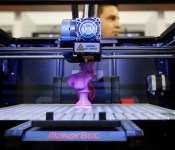
What you need to know about 3D printing

Dutch designer Iris van Herpen used one to send collections down the runway. Mink hopes you’ll rely on one to create custom makeup at home. Andrey Rudenko is optimistic that he can use one to help him build his next home. And soon we’ll create new human organs with them.
The mysterious agent of change I’m referring to is 3D printing, of course. Though these machines were previously accessible to only a small group of wealthy hobbyists, that’s no longer the case. As 3D printer prices have decreased and accessibility has increased, it seems like the possibilities are endless. But before each home has its own 3D printer, the technology is poised to dramatically impact how the industries we depend on manufacture the gadgets — and everything else — we know and love.
WHAT IS IT?
3D printing, also known as additive manufacturing, is making an object layer-by-layer. How does that differ from the usual methods? Simple: traditional manufacturing takes material away to create a desired shape.
On a macro scale, 3D printing is already transforming the way goods are manufactured in the US. According to a report released by data group PwC US in conjunction with The Manufacturing Institute, when over 100 industrial manufacturers were surveyed, it was revealed that two-thirds were already implementing 3D printing either experimentally or by already using it for prototypes or final products.
Early 3D printers were expensive, and difficult to handle without special training. But with companies like MakerBot and 3D Systems offering personal 3D printers, home manufacturing is now reality. With a little bit of an investment at the outset, you can now make parts for an appliance at home, a pair of glasses, toys, jewelry, shoes and more. It’s easy to imagine a marketplace in which, instead of buying an actual product online, you pay for the materials/intellectual property fees and make it on your own.
HOW DOES IT WORK?

It all starts with a digital file, the Computer-Aided Design file (one example seen above), which serves as the instructions for what to print. Think of the file as a blueprint. The machine then prints layer after layer of plastic, metal, nylon, or another of the many materials that can be used. These layers eventually create the final shape.
There are several different methods that can be used to 3D print, depending on variables such as what material you want to use and how much you want to spend. The most common method is Fused Deposition Modeling (FDM). With this method, an object is produced by use of melted thermoplastic material to form layers. Each layer stacks on top of and fuses with the previous layer as the material hardens almost immediately to create a 3D object.
WHY SHOULD I CARE?
3D printing offers manufacturers in the US the opportunity to actually manufacture in the US. With clothing, for example, 3D printing offers hope that clothing could be assembled in the United States — a rarity in the garment business. Why is this important? A variety of factors, least of all working conditions (think: the Bangladesh factory that recently collapsed, killing over a thousand garment workers). And it offers the possibility of the return of manufacturing jobs to an ailing US job market.
On a less serious note, 3D printing also offers far more room for personalization than traditional manufacturing. Let’s say you have a 3D printer of your own and you purchase the file for a pair of shoes. Other than the general shape the shoes will take, there’s a lot of room to make personal choices about aspects like color and the way the shoe fits. Or maybe you want to add some sweet wings? Go right ahead and add those sweet wings, friend.
WHAT’S THE ARGUMENT?
There’s no getting around it: 3D printing is likely the future of counterfeiting. For those not familiar, counterfeiting is using someone’s trademark (i.e. brand name and/or logo), for example, and passing it off as the real thing. If you live in New York (like us!) or another major city, just think about the folks selling “designer” bags out on the street. Counterfeits — unlike knockoffs — are always illegal, and they’re a huge concern for both companies and consumers.

With high-fidelity 3D printers, someone could easily create a pair of Ray-Ban Wayfarers, and the result would be a pair of glasses that’s hard to distinguish from the real thing. Individuals doing this for their own use could impact a brand’s bottom line, but the real nightmare is counterfeiters who have access to those printers. The customer gets ripped off — having bought fake sunglasses — and Ray-Ban (well, Luxottica) loses out on some cash. Nobody wins! That situation gets much more serious when you move beyond the world of luxury goods into more basic goods.
If you’re not sympathetic to multibillion-dollar international corporations losing dough because of 3D printers, consider this: counterfeit items are more that just intellectual property theft, as they can also be dangerous. These items don’t go through any sort of official inspection, so there’s no telling what materials or chemicals might be used in creating items for sale.
And while 3D printing is good for manufacturing in the sense that prototyping and production can be done locally, there may be a downside for workers involved in the manufacturing process. If more and more manufacturers start relying on 3D printers as opposed to workers to make goods, some jobs could become obsolete.
WANT TO KNOW MORE?

Make is for makers, but it’s also a great place to get started with 3D printing as it stands now and to read up on the community of makers support it. But perhaps you’re feeling far more serious? The Massachusetts Institute of Technology has a class on the subject. Okay, okay — that’s probably too much. For a more introductory approach, the folks at MakerBot have a vast array of videos on the subject. And if you’re audio-inclined, Josh Clark and Chuck “Chuckers” Bryant of Stuff You Should Know fame just recently did an episode on 3D printing.
[Image credit: AP Photo/Jae C. Hong (MakerBot printer), AP Photo/Mary Altaffer (bag/glasses)]

SEGA places Seven Sonic the Hedgehog Games on Sale for $0.99
I am sure some of you have been bank rolling your Google Opinion Rewards bucks for a couple of month by now. I know I am almost at $8 currently. Picking up apps and games when they are on sale is one of the best uses for that free cash in my opinion and right now SEGA of America might just snake some of that money from you today. They have just dropped the price tag on seven Sonic the Hedgehog titles, which looks to be every single one of them.
 It is hard to pass up the classics for under a buck. Many of you might already have some of them, why not fill in the blanks. The titles, and the links, are as follows:
- Sonic the Hedgehog
- Sonic the Hedgehog 2
- Sonic 4 Episode I
- Sonic 4 Episode II
- Sonic CD
- Sonic Jump
- Sonic & SEGA All-Stars Racing
Additionally, Sonic 4 Episode II THD (Tegra optimized version) is also showing up for $0.99, but I am not entirely sure it is on sale or if that has been the price for a while since it isn’t showing up in the AppSales App.
If you pick up all 7 games, you will be looking to spend $6.93. That is a savings of $15 over the full retail price tag. We cruised over to the SEGA blog but aren’t seeing any particular reason for the sale from them, nor do any of the game descriptions offer up any clues. Seeing as we aren’t sure what SEGA is up to, you should probably go grab the ones you want before they go back to full price, whenever that might be.
//<![CDATA[
ord = window.ord || Math.floor(Math.random()*1E16);
document.write('’);
//]]>

Google now offers links to music apps when you search for bands on Android

Google is making it a little bit easier to start listening to musicians you’re researching. If you search for a band on Android the results will now show quick links to the artist’s page in your music apps. So, lets say someone suggests you check out Kvelertak (which we can tell you is excellent advice). Now when you Google the Norwegian metal band you can simply tap on the Spotify link to start listening immediately. Or, if you’re a big fan of music videos, you can quickly launch YouTube after searching for Solange. Right now the feature is limited to the US, but it does work with a broad range of apps, including Rdio, iHeartRadio, TuneIn, YouTube, Spotify and Google Play. Other countries and services like Deezer will be added in the future.
Source: Google
Google brings ‘Supervised Users’ setting to Chrome OS
If you are a parent and utilize a Chromebook in your home, then chances are your kids use it too. I have a 13-year-old and keeping her safe and away from things she doesn’t need to be doing online is a daunting task. If you have handed over the Chromebook you can block things through the router, but if you share it then you don’t want to be restricted. Finally there is another option for parents out there that Google has recently added to the Chrome OS, Supervised Users.

This snazzy little option can be enabled through the primary user account and gives parents a ton of control over Chromebooks and Chromebox devices. A supervised user doesn’t need a Google account or even an email address in order to use the Chrome OS. You as the account holder can follow a few simple little steps to create a supervised user and have control over what that users can access, view and even check back on the browsing history.
To get started you will want to head to your Chrome Settings. While you are at it, you might want to check out the Google support pages about it all too.
Source: +FrancoisBeaufort Via 9to5Google
//<![CDATA[
ord = window.ord || Math.floor(Math.random()*1E16);
document.write('’);
//]]>

Google to the rescue: Android 4.4.4 gets a speedy release to plug security Holes
 Just a few weeks after Android 4.4.3 was rolled out to Nexus and Motorola devices, a new software update has already popped up. Android 4.4.4, or KTU84P for those keeping track with builds, allegedly deals with some security issues, presumably ones which have arisen due to the last update. People with devices on Android 4.4.3 and suffering an array of issues shouldn’t get too excited though; while it is a new iteration of Android, the build progression has only gone from KTU84M for Android 4.4.3 to KTU84P for Android 4.4.4, and accordingly, the changelog is extremely short.
This is eerily similar to what occured when Android 4.4 was first announced and needed to be patched almost immediately to remove security issues. Still, it’s always good to know that Google can act quickly when it needs to, but everyone who is currently struggling with major and minor issues on Android 4.4.3 probably wish Google would act quickly to help them too. The factory images for Android 4.4.4 on Nexus devices are available now, and the OTA updates have been reportedly already started rolling out.
Have you gotten the Android 4.4.4 update yet and have you noticed anything different? Let us know what you think in the comments.
Source: Google via Phone Arena
//<![CDATA[
ord = window.ord || Math.floor(Math.random()*1E16);
document.write('’);
//]]>

The next version of Android will enhance battery life, speed up apps

Several months ago, Google added an experimental runtime option to speed up apps in Android 4.4 KitKat. A runtime, for the record, supports the apps running on your device — without it they’d be nothing but piles of useless code. Called ART (short for Android Runtime), that same mode will become the default when Mountain View releases the next version of its operating system. Developers spotted tweaks to Android’s open-source code indicating the upcoming change, and the update looks to be a positive one. Without getting bogged down in details, ART essentially makes apps run faster and more efficiently, with the downside being that they’ll take up slightly more space on your phone, as well as lengthier install times.
ART will likely replace the current app-running software Dalvik as the default on Android, though the latter option could still be available. In addition to enhancing app performance, ART is said to slightly increase battery life. Even if the gains are small, that’s good news for anyone using the most popular mobile OS in the world. And with Google I/O just a week away, we may hear about the next version of Android very soon.
Filed under: Software, Mobile, Google
Via: Phone Arena, Android Authority
Source: XDA Developers

Watch Conan O’Brien make E3 2014 into an even bigger spectacle than it already was

As if the game industry’s annual trade show weren’t enough of a spectacle on its own, massively tall comedian/talk show host Conan O’Brien took to E3 2014‘s lavish booths and talked with swaths of attendees for a hilarious recap video. He makes the rounds: luging at Sony’s Project Morpheus, high-speed driving in Forza, and making childhood fantasies a reality with Nintendo’s gang of ladies (not quite “booth babes,” but not quite not either). Sadly, we can’t get away with asking crowds of people to applaud our rock-solid run through Hyrule Warriors, but Conan does it and makes it funny. Head below for the full video, but be prepared to set aside about 10 minutes. He’s thorough!
Filed under: Gaming, Wearables, Software, HD, Sony, Microsoft, Nintendo
Via: Joystiq
Source: Team Coco

