



[ROM] The Android L preview has been ported to the HTC One M7, currently in Alpha
 For many of us with Nexus devices, the Android L preview has only been a pipe dream that we can, for now, only gawk at from a distance. Well, thanks to the boffins at XDA, there is another device to gawk at now, and that device is the HTC One M7. The Android L preview has been ported to the HTC One M7, a photo of which is shown above, and although the ROm is currently in alpha, it’s undoubtedly better than nothing.
This alpha build comes courtesy of XDA Senior Member, ssrij, and his team, achieved the feat by making changes to ramdisk and the kernel; for those in the know (which doesn’t include me), this has had some side-effects on the device’s performance and stability. As it stands, there are outstanding issues with the Wi-Fi, Bluetooth, data, sensors, camera and sound, and predictably there is a lot of work to do before it is stable. But the fact they achieved it at all is extremely impressive, and if you’re interested in trying out their work so far, be sure to visit the forum page here for instructions on how to do so.
Are you pining for a chance to try Android L on your device? Which device would you like to see it on next? Let us know in the comments.
//<![CDATA[
ord = window.ord || Math.floor(Math.random()*1E16);
document.write('’);
//]]>
The post [ROM] The Android L preview has been ported to the HTC One M7, currently in Alpha appeared first on AndroidSPIN.

Dropbox makes syncing your large files faster

Cloud storage service Dropbox has announced a feature called Streaming Sync, which promises to improve the way its platform handles the syncing of large files. Thanks to Streaming Sync, which is part of a revamped desktop client, users will get a major speed boost when syncing any file over 16MB — up to twice as fast as any regular sync, according to the company. Dropbox notes that it was able to accomplish this by overlapping the upload and download phase of the file synchronization, meaning it can use its servers to push the data to your device, rather than letting your smartphone, tablet, laptop or desktop do all the work. Along with Streaming Sync, Dropbox also brought support for four additional languages to the app, as well as the ability to view your most recent account activity via a new notifications menu.
Filed under: Storage, Internet, Software
Source: Dropbox

Photoshop Express blemish removal and RAW support boosts mobile editing

Adobe has been making quite the heavy-handed push with its mobile apps as of late, and one of its older no-cost options just received a significant update. Photoshop Express for both Android and iOS tacked on blemish removal and defogging tools to further enhance edits on the go. There’s also a new intensity control that allows you to tweak how much of those built-in presets are applied — a feature similar to Instagram’s recent add-on. Last but not least, the software can also import RAW files for editing purposes; however, it’s unclear whether you’re tweaking a smaller “thumbnail” version that remains tied to a desktop, as is the case in Lightroom mobile. At any rate, those files are uploaded through the free tier (unless you’ve committed funds) of Adobe Revel before syncing with the app. If those trusty mobile devices have yet to alert you to the update, both versions are available for download via their respective repositories.
Filed under: Tablets, Software
Via: 9to5Mac
Source: iTunes, Google Play
Microsoft kills off ‘Streets & Trips,’ hopes you’ll use Bing Maps instead

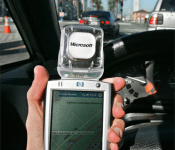
Microsoft MapPoint has been around a long time. How long? So long that a stock-image search pulled up this gem from 2005 — a photo of “Streets & Trips” running on a Pocket PC. In fact, the mapping platform is even older than that: It was first created by a company called NextBase in 1988, which MIcrosoft later acquired in 1994. Incredibly, it’s lived on, even long after people stopped storing maps on CD-ROMs. Finally, though, the software is going the way of the floppy disk: The company has discontinued MapPoint, Streets & Trips, and AutoRoute, with users encouraged to use Bing Maps instead. And, ya know, that kind of makes sense, considering CEO Satya Nadella only yesterday posted an open letter describing Microsoft as a mobile- and cloud first company. Somehow, knowing Engadget readers, we suspect this won’t affect you much, but in the event that you do still use Streets & Trips, you’ll continue to have support through at least July 2015. After that, you may need to get with the times.
Image credit: Associated Press
Filed under: Internet, Software, Microsoft
Via: Re/code
Source: Microsoft

Samsung keeps its distance from the Android pack with Galaxy Apps store

Samsung has spent the last several years trying to separate itself from the rest of the Android pack. Of course, that was much to the chagrin of Google. And while the two apparently reached an agreement to reduce the amount of bloat and branded services, Sammie is quite ready to give up on building its own ecosystem just yet. The company announced a major redesign and rebranding of its own app store, which is now known as Galaxy Apps. The goal, according to WonPyo Hong, president of the media solution center at Samsung Electronics, is to provide “differentiated solutions and services.” And that including delivering “hundreds of apps exclusively available to users of Samsung Galaxy mobile devices.” Though, what compelling apps are included in that and whether or not anyone will use them is still not exactly clear.
The move seems particularly interesting in light of Samsung’s apparent decision to hand over the reins of its enterprise friendly Knox project to Mountain View. Elements of the security suite are going to be incorporated into the next version of Android and security features for the OS will be entirely controlled by Google. But that leaves Sammie in a slightly awkward spot, it doesn’t want to be a commodity handset maker, but ways to stand out are increasingly hard to come by. Whether or not a streamlined, exclusive app store will be enough to do that is debatable. And there’s always the chance that this will rub Google the wrong way and lead to another round of tense negotiations between the maker of Android and its largest hardware partner.
Filed under: Software, Mobile, Samsung, Google
Via: Telegraph
Source: Samsung

Angry Birds Star Wars 2 picks up 30 new levels in ‘Master Your Destiny’ Update
Rovio has a new update awaiting your download. 30 new levels have been added to Angry Birds Star Wars 2, 15 for the bird side and 15 for the pork side. The new set of levels is called ‘ Master your destiny’ and allows you to pick from your saved characters or from telepod characters. This means you are in control of what bird, or pig, you toss at the opposing side.
Get ready to MASTER YOUR DESTINY! Start as a Jedi Youngling or Sith Hopeful and rise the ranks in this all-new chapter! This time you choose what bird or pig to sling into battle from your saved characters or by scanning your Telepods! Plus, it’s now free to download on both iOS and Android!
It seems there could be some confusion with that “Free to download on both iOS and Android” statement. While ABSWII has always had a free and paid option for the main app, it was the add-on levels that required a lot of work in collecting the slingshot coins or some real world cash to buy a bunch. The Master Your Destiny update is unlocked from the get go.
//<![CDATA[
ord = window.ord || Math.floor(Math.random()*1E16);
document.write('’);
//]]>
The post Angry Birds Star Wars 2 picks up 30 new levels in ‘Master Your Destiny’ Update appeared first on AndroidSPIN.

Sonic Jump Fever bounces its free-to-play way to the Play Store

SEGA of America has recently released a follow-up title to Sonic Jump, the Sonic the Hedgehog themed vertical jumping game that was released back in 2012. The follow-up title, Sonic Jump Fever, ditches the paid app model and adopts the trending free-to-play model with an emphasis on leader-boards, competing against your friends for top slots, unlocking characters and upgrades.
Similar to its predecessor, Sonic Jump Fever has you bounce your way vertically through levels while avoiding and killing various badniks, rescuing animals that are locked up and collecting rings. You snag power ups on the way, such as a shield, and hit the red stars for a fast boost through a quick little ring bonus round that appears briefly.


 Sega did a good job at being very upfront about the in-app purchase model right from the get go, as you cans see in that first screenshot, and even tell you that you can disable them in your devices settings. They are also very upfront on the apps description in the Play Store about it not working with ART. So if you use ART, be sure to disable it before you try to jump through the game.
Being a free-to-play model you will quickly see where the money is made. Not only are their in-app purchase options, but there are also ads. However, the ads aren’t really terrible as they are a full-page pop up that happens on a different screen after every couple of rounds. Simply hit the ‘X’ and you are back to jumping. The ads can be disabled with your first purchase of items. Also, be prepared to jump free and clear for about 10 to 15 minutes at a time. There is a power bar that deletes with ever round played and when it is empty you will need to either wait a while for it to refill, ask a friend for some power, watch a couple of ads or spend some money.
For a free-to-play title though, it is pretty nicely done. The game play is fast and action packed. If spending money on IAP’s isn’t your thing, it should still prove to be a fun game to open and bounce through a few levels while you stand in line at the post office, or hide out in the bathroom at work. Feel free to snag it down below and give it a whirl.
//<![CDATA[
ord = window.ord || Math.floor(Math.random()*1E16);
document.write('’);
//]]>
The post Sonic Jump Fever bounces its free-to-play way to the Play Store appeared first on AndroidSPIN.

What you need to know about Kickstarter, Indiegogo and the concept of crowdfunding

You have what you think is a cool idea, but you aren’t sure if you can convince investors about the sales potential of, say, a tiny monitor strapped to your face, or a watch that is also a computer. Besides, who are “investors” and how do you summon them from their secret offshore lairs to pass judgment on your notional widget? Wouldn’t it be easier if you could just put your idea on the internet, letting regular people who might be on your wavelength pledge directly to help get it done?
That’s what crowdfunding is about. Services like Kickstarter, Indiegogo, Patreon and others gather funds directly from buyers, to make potentially crazy ideas a reality. Crazy ideas like a salad… made with potatoes. But it’s not all free money and rampant innovation.
WHAT IS IT?
Crowdfunding sites allow project creators to post their ideas, with a certain timeline for completion, and a set monetary goal. For example, Oculus VR sought $250,000 over 30 days toward its goal of a development kit for its “Rift” 3D headset (it raised its goal in the first day, and finished with $2.4 million).
They all work a little differently. If a Kickstarter drive fails to reach the funding goal before the end of the (user-defined) fundraising period, nobody is charged and the fund drive fails. Indiegogo, however, allows creators to receive whatever money is pledged during a drive, even if it doesn’t meet the minimum funding goal. The Breathometer, a noteworthy Indiegogo success story, didn’t need to invoke that rule, as it well exceeded its $25,000 goal — but even if only one person had pledged $1 toward a breathalyzer for smartphones, that lone person would have been charged (and probably wouldn’t have received anything).
Patreon is set up for a different kind of funding altogether. Rather than pledging one-time payments toward a single goal, a Patreon drive seeks recurring pledges for an ongoing project. Project creators can ask for monetary contributions per video, per article, per month or per whatever unit makes sense for their project. Naturally, then, the service is popular among YouTube video creators — in fact, it was co-founded by Jack Conte of the band Pomplamoose, best known for their YouTube presence. Both Conte and his bandmate Nataly Dawn use the service to fund their own music videos. Here’s an especially crazy one:
HOW DOES IT WORK?
Creators design their projects and post them publicly, usually with a nice video, an explanation of the project and some of the risks inherent to the project (a requirement in Kickstarter’s case, so backers can judge whether this person might be able to overcome said risks!)
Every project also has a list of rewards — what you get for putting in different amounts of money. This is entirely up to the creator. Of course, with almost all projects, “the thing you’re crowdfunding” is one of those rewards. But there are also fancier variants of the thing, or personalized things, or T-shirts, or making-of books, or whatever you can think of that might incentivize someone to hand over their money. Patreon rewards are usually serialized like the fund drives are, so rewards tend to be digital and include backer-only newsletters, chats with the project creators and early access to releases.
WHY SHOULD I CARE?
It’s likely you participate in the world’s economy in some way, both as a consumer and a producer, and crowdfunding has implications for both. In simpler terms, it’s a new way to buy stuff, and to sell stuff.
For producers, it’s a way for products or projects to exist that would not be able to before, and without as much costly infrastructure. You want to make an album, book, device or whatever, and so you ask for exactly as much as that costs (plus the costs of whatever rewards you’re offering, as well as shipping, and you might consider throwing a tiny bit of profit in to make all this work worthwhile); if you get enough money, you make it and everyone who wanted it gets one. Now you have enough money to produce a run for direct sale!
For consumers, it means all kinds of new things are coming out that wouldn’t have before, and you can take a more direct role in making that happen. Classic styles of video games from veteran creators are coming back left and right in the post-Double Fine world — everything from Wasteland 2 to Shadowrun Returns to the PlayStation 2 music game Amplitude. Young entrepreneurs are getting their own inventions made.
Companies big and small are able to just put an idea out there and see how viable the world thinks it is. In broad terms: If it’s worthy (and happens to get enough attention), the money will probably arrive.
To return to the world of video games, the developer Die Gute Fabrik launched a Kickstarter for its game Sportsfriends, a collection of four weird sports games for people to play with friends. Without online multiplayer, and in the case of the included game Johann Sebastian Joust (seen below), with no interaction with the TV screen, it seemed like a tough sell for game consoles. But publisher Sony and Die Gute Fabrik raised their $150,000 goal on Kickstarter, providing incontrovertible, numerical proof of interest. Now Sportsfriends is available on PlayStation 3 and 4.

Wing Commander creator Chris Roberts and his Roberts Space Industries launched a multi-tiered crowdfunding effort aimed at making Star Citizen a fully fan-funded game with a major publisher-tier budget. A combination of Kickstarter and the WordPress IgnitionDeck plugin allowed RSI to continue seeking stretch goals in perpetuity, as it approaches $48 million in funding. You can pledge funds to get in-game items like really, really expensive virtual spaceships.
And, thanks to Patreon, fans can directly support their favorite artists, allowing struggling freelance writers and creators to more easily create their art regularly. Full disclosure here: My own hand-held gaming news site, Tiny Cartridge, is Patreon-supported, allowing me to supplement my income with a writing gig I can do while my toddlers sleep.
HOW MUCH DOES IT COST?
If you’re backing someone else’s project, of course, the costs are completely defined by the project. Creators set their prices for each reward level, ranging from a dollar for a “thank you” or a credit on a special page, to thousands of dollars for commemorative T-shirts, posters and a personal dinner meeting with the creators — plus the actual item you’re crowdfunding, of course. People who put in an astounding $10,000 for the Double Fine Adventure Kickstarter drive got “lunch with [developers] Tim Schafer and Ron Gilbert, a tour of the Double Fine offices and all previous reward tiers” including original art used in the game, portraits of themselves, a signed hardcover book, a poster, a boxed copy of the game and a documentary.
Impossible to imagine someone sinking $10,000 into a single video game? Four people did that.

If you’re trying to get your own project going, there are some costs beyond, you know, what it costs to make the thing. The crowdfunding services all take a percentage of the total: Kickstarter takes 5 percent; Indiegogo takes 4 percent (if your project hits its goal; 9 percent otherwise — it’s complicated); and Patreon takes 5 percent of every monthly take. In addition to that, you lose a percentage of your total to credit card fees (Kickstarter and Indiegogo take 3-5 percent depending on country, and Patreon takes “an approximate 4 percent.”)
WHAT’S AT STAKE?
A few billion dollars, no big deal. Kickstarter, by far the most popular crowdfunding service, has seen over $1.2 billion pledged to its projects to date. Patreon creators have gotten more than $1 million through the service in just over a year.
WHAT’S THE ARGUMENT?
A great way to get lots of visibility for your nonexistent project is… also a great way to get a bunch of money from people and run. Crowdfunding backers can quickly learn what “professional” investors already know, which is that even if something has appropriate funding, it might not happen for any number of reasons. The ease of access of crowdfunding (you go to a website) means you’re likely to run into amateurs. It may not be immediately apparent who has the know-how to actually finish a project, and who is just a kid with a cool, but impossible, idea.

It may be that someone didn’t realize how much shipping would cost on all those T-shirts they offered as incentives. Or that the item they dreamed of making just wouldn’t work. To see what happens when a Kickstarter doesn’t work out, check this article about the programming-education game Code Hero, and this update for the comic Sad Pictures for Children in which the creator explains at length why he decided to just stop shipping stuff out. There’s a happy ending for those Sad Pictures, at least, as Cards Against Humanity‘s Max Temkin has stepped in to take over fulfillment.
And those are all projects that were seemingly started in good faith. Kickstarter screens projects for potential fraud, and creators are required by law to fulfill their promised rewards or refund their backers, but there’s always going to be an element of risk in putting your money down for something that does not yet exist. Really, think of it as betting that it will someday exist.
WANT TO KNOW MORE?
Kickstarter, Patreon and Indiegogo are all eminently browsable, with lists of current funding drives in various categories. There’s even a Kickstarter film festival featuring crowdfunded films, and a collection of games made possible by the service.
But real talk: You want to see some really embarrassing crowdfunding drives, right? Well, that’s what Kickfailure is for.
[Image credit: Shutterstock (Cash); Kickstarter (Oculus VR, Double Fine, Code Hero); YouTube (Pedals); Die Gute Fabrik (Sportsfriends)]
JC Fletcher is a freelance writer from Austin, Texas. When not spending time with his twin toddlers, he runs the hand-held gaming site Tiny Cartridge.

Mix beats and loop vocals with Propellerhead’s Take for iOS

If you saw Reggie Watts’ musical set at Engadget Expand (don’t worry, there’s video after the break), then you probably noticed the table full of gear he needs to construct his loops. Propellerhead — the Swedish software company behind Reason, not the electronica duo — is hoping to lighten this load with Take, a creative vocal loop recorder that’s being given away free to iPhone users. The interface is reasonably simple, offering you a wide variety of pre-made backing loops as well as three tracks that you can rap, sing or otherwise make noise on. It’s tremendously easy to use, but it won’t compensate for your lack of musical talent, which is why we won’t be sharing our ham-fisted efforts with you.
Filed under: Cellphones, Portable Audio/Video, Software, Apple
Source: Take (App Store)

Computer glitch resurrects draft cards for 14,000 long-dead Pennsylvania men

Come a guy’s 18th birthday in the US, he’s afforded new privileges. Aside from being able to legally buy cigarettes, lottery tickets and porn, he also has a couple of shiny civic duties to follow: signing up for the Selective Service System and voting on a regular basis. In terms of the former, draft dodging is a pretty serious offense, as the families of very old (and most likely very deceased) men in Pennsylvania were recently reminded. According to Boston, a database operator’s error caused some 14,250 notices to go out to men born between 1893 and 1897, stating that their failure to fill out draft cards could result in fines and imprisonment. How’d that happen? Well, if you’re familiar with the Y2K Bug, the story makes a lot more sense.
The Pennsylvania Department of Transportation’s cataloging software apparently uses a two-digit birth-year field, and, as a result, the operator unknowingly selected gents hailing from a hundred years prior the actual target range of 1993 to 1997. Keystone State employees didn’t realize the issue until they were inundated by calls from understandably confused family members asking what the deal was. To its credit, the SSS issued an apology and noted that those files would be deactivated from the database and will send a personal letter of apology to President Lincoln posthaste.

[Image credit: Getty]
Filed under: Software
Source: Boston
 AIVAnet