


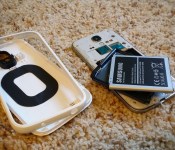
Halo Galaxy S 4 Power Case review
Looking to extend the time period between charges of your Samsung Galaxy S4 but don’t want to bulk up? Consider the new Halo S4 case from Lenmar. Thanks to its internal 2600mAh battery, you’ll essentially double the time you stay away from a charger.
Not simply just a battery, it’s also a clean (white) and stylish case that protects the phones edges and back. Indeed, there are cut-outs for headphones, microUSB, microphone, and camera. You won’t have to worry about anything proprietary or awkward for charging, it’s the same port. In fact, you get an extra microUSB cord in the box.
One of the features we liked best about the Lenmar solution is that it’s NFC-capable. We’ve seen extended life batteries from other companies that leave this option out. Depending on what your usage is like, the lack of NFC could be a dealbreaker.
The Halo S4 case is actually comprised of multiple parts: a battery housing and the shell case (NFC found here). You’ll remove the back from your handset and use the Lenmar case for protection. The battery is placed inside a separate battery unit and the combined unit goes back into the phone. Slap the back on and you’re good to go!

We did find the case to be a bit more slippery than we would have liked. What’s more, it liked to grab smudges and oil, which could make things even worse. Putting the case on was relatively easy though we did have to snap some seams together on a second pass around the case. Our recommendation here is for a textured back and possibly a second color choice.
Overall we were impressed with the case as it didn’t add too much weight or thickness. We were concerned it might have wonky weight distribution but that never proved to be the case. A few quibbles aside, it’s certainly something we’d suggest for those who spend their days on the go.
The Lenmar Halo Galaxy S4 case retails with a suggested price of $59.99 and includes a 1 year warranty. We did a quick check and found a number of retailers offering the unit, including Amazon, Best Buy, and Fry’s.
The post Halo Galaxy S 4 Power Case review appeared first on AndroidGuys.
Android 4.4.2 KitKat hitting Galaxy Note 3 international variant
Samsung is pushing out its the latest update, KitKat 4.4.2, to the Galaxy Note 3. It includes a host of UI changes along with some performance enhancements to keep your tablet, I mean phone, running smooth!
The update is currently only available in Poland via Samsung Kies, however more countries are being pushed out soon. Now remember, this is for the unlocked international variant, so if you think your updates are coming to your carrier based Note 3, well you are at the mercy of your specific carrier.
Changes:
- Music album art shows on the lock-screen while music is playing
- A camera shortcut is now displayed on the lock-screen
- New emojis support
- Select between the stock messaging app or Hangouts for SMS and MMS
- Select between TouchWiz or other launchers through settings
- Wireless printing
- Updated Google apps
- Updated Galaxy Gear Manager brings improved connectivity and better email options
Source: Phandroid
The post Android 4.4.2 KitKat hitting Galaxy Note 3 international variant appeared first on AndroidGuys.

Some Samsung Galaxy S5 specs “Confirmed”
It is about that time again. The time where the rumors start meeting with the actuality of the next flagship device from a manufacturer. In this case we have supposed confirmations of what the Samsung Galaxy S5 will indeed be supporting. The news comes as an exclusive via SamMobile so we are pretty confident that they are as close to the real deal as possible before an official announcement is made.
 They are confirming that the Samsung Galaxy S5 will indeed come in two primary physical models. One being a metal housing/backplate and one being a plastic housing/backplate. So those looking for a heavier build quality feel will be spending a bit more and those looking to save money but have all the goods can get the traditional plastic styling. Price wise in Euros it is said to be 800 Euros for the metal and 650 Euros for the plastic.
Screen wise the Galaxy S5 hits a home run with a resolution of 2,560 x 1,440. Official size is still missing, but 5.25-inches still seems to be the most likely size to keep it under the Note category. That same 5.25-inch size was previously mentioned to be in full production already as well. Internal processor is confirmed as one of two variants. There will be a Exynos 6 CPU variant and a Qualcomm Snapdragon 805. Traditionally, the Exynos has been the choice for international variants whereas the Snapdragon finds its way to the US. However, we are hearing that the Exynos processor has no issues with stateside LTE connections any more. It is possible that the larger price difference between the metal and plastic versions also reflect a processor difference. Being that the plastic variant pulls the Snapdragon and the metal version pulls the Exynos 6.
The camera is pushing up to 16MPs and of course it will be launched with Android 4.4 on board. Some elusive specs still remain, like RAM and battery capacity. We are certain there will be more unofficially confirmed specs as we move closer to the announcement which is tentatively suggested to be in March. Followed up by a global release in April.
Is the Galaxy S5 shaping up to be everything you are dreaming of?
Some Samsung Galaxy S5 details purportedly ‘confirmed’
The details of the Samsung Galaxy S5 have been “confirmed” with roughly two months until its release. According to SamMobile, Samsung’s next flagship smartphone will be powered by Android 4.4 KitKat and come in both plastic and metal versions.
The display is said to be QHD in that it is 2560×1440 pixels; Samsung will employ Super AMOLED technology. The rear is said to house a 16-megapixel camera however it’s unclear whether it will feature optical image stabilization.
Internally, the Galaxy S5 should come with two processor designs: Samsung Exynos 6 and Qualcomm’s Snapdragon 805 CPU. Things are a little muddy as to how Samsung will choose the processor, especially since LTE doesn’t pose a problem for the Exynos chipset. It’s possible that the medal version could employ a 64-bit Samsung Exynos with the more traditional plastic design getting the Qualcomm chip.
The Samsung Galaxy S5 is slated for announcement in March, likely at an event in London around the middle of the month. Assuming Samsung sticks with its previous game plan we could see the availability of the device(s) in April.
Looking further down the road (May or June), Samsung is also expected to introduce a Galaxy S5 Zoom and Galaxy S5 Mini. Both, as of now, are listed as running KitKat, however the other details are unclear.
SamMobile has a long record of delivering on its rumors and leaks so we see no reason to think the aforementioned stuff is inaccurate. We’ll still have to wait, of course for details such as memory, storage, and finer points. With two months to go there’s plenty of time for that to bubble to the surface.
The post Some Samsung Galaxy S5 details purportedly ‘confirmed’ appeared first on AndroidGuys.
Flash any Samsung Device via Your Web Browser with JOdin3!
As of today’s era everything we do is involved with some sort of application we utilize, from organizing our daily lifestyle to entertainment & productivity it all revolves around applications. Keep in mind there are various types of apps, web apps, hybrid apps & like the majority, “native apps”, are those we have on our devices home screen.
Today I want to introduce to you a new application or program that many Samsung owners have used before, except this time we have it in a web based flavor if you will. XDA Recognized developer Adam Outler has created yet another useful tool to make our crack flashing lives just a tiny bit easier. If you aren’t familiar with the famously known Odin software then you might not have a Samsung device or just don’t flash your phone much. Odin is essentially software used for flashing firmware to Samsung devices via Download mode which is useful as I just stated, for flashing back to stock firmware, custom stock roms and is helpful in unbricking a mistake. Moving along, Adam has developed a web app to do just the above but using only your web browser, now that is impressive.
Previously this could only be accomplished on windows via an application. All of that has changed, now you can now use JOdin3 to flash your device from the web browser on Linux, Mac or Windows. As astonishing as it sounds it’s all true. Not only is it versatile on various OS platforms, it’s open sourced. This is an original in mobile flashing and it sure is going to keep getting better and better with more support. Head over to the official website of JOdin3 below for more in-depth details on how and why JOdin3 is the next alternative to flashing your device on the web and even using it as an offline flashing tool! Below are the steps on how JOdin3 functions.
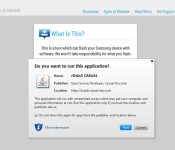
Upon using JOdin3 you will be asked to run java on this site, click yes.
 After that, all you need is common sense.
 Finally you are presented with the initial starting point of flashing to your hearts content. Enjoy !
 Source: Casual-Dev
Samsung Galaxy Note 3 begins Android 4.4 KitKat rollout in Poland

Sometimes, even the most massive of updates have humble beginnings. This is the case with the Samsung Galaxy Note 3, a device that offered Android 4.3 Jelly Bean upon its debut. We all figured it was just a matter of time before an upgrade to 4.4 KitKat became available to users, and it appears Samsung is now ready to offer it — albeit, on a rather small scale starting in Poland. According to SamMobile, Polish Note 3 owners (for the Snapdragon 800 quad-core version, at least) can now sideload the update through the manufacturer’s Kies software. This is a pretty quiet and restrictive launch, so Samsung hasn’t officially made any announcements, but we have a feeling that the company’s limiting the rollout at first to ensure all of the possible bugs have been squashed prior to worldwide availability.
Filed under: Cellphones, Wireless, Mobile, Samsung, Google
Via: Ars Technica
Source: SamMobile

CES 2014: HDTV & home theater roundup

Every year, CES is filled wall to wall with flat-screen televisions and the things that plug into them. 2014′s show brought its own variations to that theme. Curved TVs, OLED TVs, Ultra HD TVs or some combination popped up wherever we looked, and unlike last year, many of them will go on sale soon. Big manufacturers like Samsung, LG and Sony dominated news for high-end sets, but others like Vizio are promising an unprecedented slew of features at value prices.
Ultra HD/OLED
When even Polaroid has an Ultra HD television to announce for CES, it’s probably fair to say there’s a trend occurring. Of the ones we saw that are likely to ship this year, Vizio’s jump off the page first — both for their quality and extremely reasonable prices. Sony demonstrated black levels on its LCDs that must be seen to be believed, plus a unique new design that brings a new level of quality to integrated TV speakers. The battle to the death between LG and Samsung reached new levels of absurdity as both showed off flexible, bending displays, one LED and one OLED. Meanwhile, Samsung curved its new 9000 series UHD TVs and LG whipped up a sweet, new version of webOS for its line. Sharp’s answer? Something between 1080p and 4K, while Panasonic spiced up its TVs with voice and face recognition. This was CES 2014 for TVs… and it was bizarre.
Sony’s new UHD TVs are built to support Netflix in 4K when it arrives
We just got to watch Samsung’s big-ass 105-inch curved TV
Panasonic ups its smart TV game with the VIERA Life+ Screen, complete with voice and facial recognition
Sharp Aquos lineup for 2014 bears 1080p and 4K TVs, a revamped SmartCentral platform and the new Quattron+ Series
Vizio’s HDTV plans for 2014 focus on Ultra HD, in sizes going all the way up to 120 inches
LG’s latest 84-inch 4K TV breaks cover at CES
LG’s 105-inch UHD TV isn’t coming to CES alone: flat 65-, 79-, 84- and 98-inchers on the way
LG’s bringing Ultra HD OLED TVs in more sizes to CES, ramping up production
Samsung announces its curved 78-inch UHD TV: runs faster, works smarter
Samsung: cheap OLED TVs won’t be ready for three to four years
Samsung’s 105-inch curved UHD TV and 85-inch bendable screen hit retail this year
Samsung shows off its 85-inch curved TV that bends with the touch of a button (video)
Sony’s new Bravia HDTVs get a wedge-shaped redesign (update: hands-on photos)
Kogan’s ultra-budget 4K TV and 3G tablet arrive at CES
Toshiba enters 2014 with extra-bright 4K TVs, simpler streaming media hubs
Sceptre’s showing off 4K TVs, Roku Ready displays, earbuds and pretty much everything, ever at CES
Smart/Connected TV
Internet-connected and highly personalized services for our TVs and the devices connected to them have gone from a curiosity to the norm. Now, we may be finally entering the period where there’s enough reason to separate the wheat from the chaff and decide who has the best smart TV platform. LG is showing its hand with webOS and Roku integrating directly into TVs, but it may be another 12 months before we can pick a winner (or at least top three).
Hands-on with LG’s smart TV running webOS (video)
LG teases webOS for most of its smart TVs, Lifeband Touch with Android, iOS sync
Dish’s ‘Virtual Joey’ is a streaming app for smart TVs that takes the place of a set-top box (video)
Samsung’s new TV remote for 2014 has a new pebble shape, 80 percent smaller touchpad
Roku renews bid for the living room with streaming-ready Roku TVs
Android TV at CES 2014 highlighted by Chinese manufacturers Hisense and TCL
Netgear’s NeoMediacast is an Android-powered TV set-top on a stick
Streaming
Streaming could move from a secondary service to a top priority, with a bevy of new and smarter TVs and connected devices, plus the availability of 4K content before it hits broadcast. Is this the end for traditional pay-TV or does that market have some life left in it yet? That will be one of the many, many stories we’re following in 2014.
Netflix confirms it will stream House of Cards in 4K this year, posts full season two trailer
Samsung’s Ultra HD TVs will stream 4K video from Amazon, Comcast, DirecTV, Netflix and more
Hulu’s original TV shows for 2014 are a mix of new series, new seasons and foreign transplants
YouTube to show off lower-bandwidth 4K streaming at CES
Plex website relaunches as Plex.tv, one-stop home for all of its media streaming abilities
Panasonic will bring Firefox OS to your smart TV this year
GoPro to launch extreme sports channel on Xbox One and 360
Prototype
Flexible displays, network DVRs and ultrawide Ultra HD — this is the place to check it out.
TiVo prototype DVR recordings stay in the cloud, watch them anywhere on any screen
Toshiba cares not for 4K, has an ultra-wide 5K TV ready for CES
Take that Samsung: LG’s got a 77-inch OLED UHD TV that bends on command (video)
The projector section
We love projectors, but Sony and LG took them in an odd direction this year, courtesy of lasers.
LG sneaks a new version of its ‘Laser TV’ projector into CES 2014
Sony’s $30k+ Life Space UX projector all-in-one puts a 147-inch 4K screen on any wall
Sony’s Life Space UX demo envisions projectors, screens everywhere
Filed under: Home Entertainment, HD, Samsung, Sony, LG

CES 2014: Household roundup

Alongside the TVs and tablets, CES is also home to the future of… homes. LG had smarter washing machines and robot vacuums that you can turn on by texting with everyday language, while Samsung introduced an entirely new ecosystem: one it’s inviting third-party hardware companies to join. Qualcomm had a similar proposition with AllJoyn: Some companies are looking to dominate smart homes. This tech will come to your house. In Vegas, however, it’s often the smaller companies that pique our interest. Don’t we all want an appliance to automatically marinate our meat?
Smarter homes

LG and Samsung are old stalwarts of the household sector of CES, but we also saw the likes of Panasonic staking a claim, with a new voice-activated pendant that allowed you to control TVs and other internet-linked appliances (not only Panasonic ones). With it, a “good morning” could open your curtains or turn on the TV to your favorite morning fare. Again, Panasonic promises it’ll understand natural language, too. Beyond your home theater and kitchen, Sleep Number’s x12 smart bed monitors sleeping patterns, heart rates and — most importantly — features a Partner Snore function that will raise the guilty party’s head, and hopefully jog them out of it.
SmartThings has taken its series of sensors and added richer app interfaces, buddying up with Sonos, WeMo and Philips Hue, making the notion of low-energy sensors and unobtrusive installation — you just stick the sensor where you need it — an even better proposition. We have several editors already testing out (and in love with) the SmartThings system.
Smarter cooking
 Alongside the explosion in wearables, sensors and processors are also elbowing their way into smaller household appliances. From a distance, Belkin’s Crock-Pot WeMo slow cooker looks a lot like any other slow cooker, but this one ties to a WeMo app that lets you adjust temperatures and set timers without being in the kitchen. Belkin is also promising more WeMO-compatible devices (including space heaters) very soon.
Then there was Mr. Marinator. It’s not all that smart, but it marinates meat. It revolves your favorite cut in a soup of deliciousness. For however long you want. It should probably win some kind of award.
Unleashing the tech show hype beast

There’s a technological revolution going on; innovation is at all-time high; and we’ve seen it all before. While many of the devices we’ve seen this week are new and even exciting, the unending hymn of hyperbole that echoes through the halls of the LVCC is an old standard. For months leading up to the big show, small startups and tech giants flood the inboxes of tech journalists, attempting to catch their attention with bold and often ridiculous claims. And on the show floor, sprawling booths from the likes of Samsung and LG boast laundry lists of “world’s firsts.” Each year, we put all of that aside to bring you only the freshest goods CES has to offer — until now. It’s time to unleash the hype beast!
A war of words
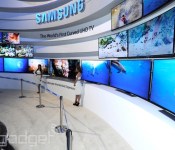
You know something fishy is going on when Pizza Hut is touting itself as a technological tastemaker. The fast food chain was at a pre-show event celebrating the 20th anniversary of “the first physical good ever purchased over the internet.” It’s a mouthful, but that’s the sort of subtle phrasing that’s necessary to set yourself apart in a sea of “world’s firsts.” Samsung and LG are the kings of this sort of nuance. The Korean tech giants both claimed a slew of ultimate achievements, but the devil is in the details. Samsung’s booth featured the “world’s thinnest ultra narrow bezel,” while LG had the “world’s narrowest bezel 3.5mm video wall.” We didn’t bust out the measuring tape, but as you can see, there’s a fine line when it comes to promoting even the tiniest of things.

Believe it or not, bezels weren’t the main attraction at CES. The real confusion came in the 4K TV space. While LG presented its “world’s first 4K flexible OLED TV,” Samsung was just a few doors down showing off its own flexible 4K display. This one, however, was of the LED variety. The outfit didn’t publicly promote the TV as a first, but a Samsung rep told us it was the “world’s only one.” Both companies had a number of other claims scattered about their booths, with LG touting firsts with HD portable projectors, an Ultra HD 3D wall, an ultrawide QHD monitor and the world’s largest Ultra HD display at 105 inches. Nearby, Samsung staked claim to the first curved UHD TV and the world’s largest Ultra HD TV at 110 inches. It even carried the hyperbole over to its household appliances with the “world’s largest washer and dryer” and the “world’s only sparkling water refrigerator,” serving up SodaStream bubbles from its door.
Samsung’s and LG’s were among the biggest booths on the show floor both in terms of size and bombast. However, one of their biggest competitors for show floor real estate took a subtler approach to pushing its products. Sony’s booth relied more on its products than marketing jargon to set itself apart. The booth, which covered a massive corner of the LVCC, featured a number of new and impressive devices like its diminutive $2,000 4K camcorder, but there wasn’t a single proclamation of a world’s first, smallest, biggest or thinnest. Instead, three slogans featured relatively subtly above a series of the Japanese manufacturer’s new wedge-shaped 4K TVs, promoting the best brightness, color and picture ever.
World’s firsts you didn’t know you didn’t need
When it comes to hype, size doesn’t matter.
When it comes to hype, size doesn’t matter. The big brands often dominate CES coverage, but there are hundreds of smaller companies jockeying for headlines on the show floor and they’re often just as quick to yell: FIRST! This year’s show played host to an enormous amount of “revolutionary” innovations that claimed to do something no one else had. More often than not, these devices fill a gap that no one knew existed, like iToy’s “first connected fighting mini robots” or the Phantom 2 Vision, the “world’s first consumer quadcopter with a built-in high-performance camera capable of high-quality photography out of the box.” Also on display this year: Nymi’s “world’s first cardiac ID technology” that aims to replace passwords and PINs by using the wearer’s ECG as a biometric for authentication and RJ Reynolds’ “world’s first digital vapor cigarette.” Unfortunately, neither Stephen Dorff nor Courtney Love was on hand to provide a celebrity endorsement.
The Official Hype Machine of CES 2014

It wouldn’t be CES without a few grandiose statements from the CEA itself. In years past, the organization has sent out a press release just days after saying attendance has reached an all-time high. That may not be the case this year, but that hasn’t stopped the wheels of hyperbolic sentiment from turning. The CEA claimed a “record amount of innovation” in 2014 (something that’s clearly hard to measure) with 3,200 exhibitors covering 2 million square feet. In an email, it also touted itself as “the world’s largest mobile technology event.” That’s not a distinction we would have bestowed ourselves. The big brands are abandoning the trade show circuit for their own launch events, and Sony was the only major player to launch a phone at CES this year. One area where we’re more than willing to give the CEA credit is in the growth of autos. In a November 18th press release, it proclaimed a record number of automotive exhibitors. Given, that number is nine, but they came correct, so we’ll let that one slide.
If you ask the CEA, it will tell you this is the greatest show on Earth, and given the media circus surrounding it, we’d have to agree.
Lead image by Will Lipman
Filed under: Cellphones, Displays, Misc, Home Entertainment, Robots, Transportation, HD, Mobile, Samsung, Sony, LG

Samsung’s budget Galaxy Note 3 Neo reportedly caught on camera

Remember that talk of a lower-cost Galaxy Note 3? You may be looking at the phone right now. SamMobile claims to have photos of the rumored Galaxy Note 3 Neo (aka Lite), and they show what you’d expect — a slightly smaller, less advanced version of Samsung’s pen-toting flagship. The leak also includes benchmarks that back up rumors of an 8-megapixel camera, a 720p screen and a hexa-core processor with performance between that of the Galaxy S 4 and the full-size Note 3. There’s no guarantee that the photos or the specs reflect a shipping product, but there are murmurs of a possible Neo launch at Mobile World Congress in late February; we may not have to wait long to learn more.
Filed under: Cellphones, Mobile, Samsung
Source: SamMobile

