


Samsung reveals pricing for Gear 2, Gear Fit
Samsung has revealed pricing for its Gear 2 and Gear Fit wearable smart devices, albeit for the Taiwanese market. According to SamMobile, the Gear 2 will fetch roughly $295 US with the Gear Fit fitness band getting around $200. As for the Gear 2 Neo and its camera-less model, it should come in around $250 when it arrives. All three are expected to hit retailers and consumers on April 11, coinciding with the Samsung Galaxy S5.
The post Samsung reveals pricing for Gear 2, Gear Fit appeared first on AndroidGuys.
Samsung Gear 2 and Gear Fit pricing revealed
Samsung has releasing the pricing of their smartwatch Gear 2 and fitness tracker Gear Fit in Taiwan, and incidentally revealed an indication of pricing worldwide.
The Gear 2 smartwatch will cost NT$8,990 or $294 while the Gear Fit will cost NT$5,990 that works out at around $200.
With the Android Wear announcement and a whole host of smartwatches entering the market over the next year, Samsung needs to get these to market and at the right price.
The post Samsung Gear 2 and Gear Fit pricing revealed appeared first on AndroidGuys.

Samsung teases a site dedicated to its design philosophy and latest concepts (video)

Samsung has gone to pains to try to explain the consideration and thought processes that go into its design — especially with its Galaxy smartphones — even if a lot of us still have beef with some of its material choices. Here’s a renewed effort, then, with the electronics maker teasing a new design site for launch on March 27th next week. A YouTube teaser suggests there will be more tales of design from across its product family — obviously thought-up, written and made by Samsung — as well as eye-widening futuristic concepts of floating screens, properly bending smartphones and well, whatever else the company’s wizards can imagine.
Filed under: Cellphones, Home Entertainment, Tablets, Mobile, Samsung
Source: Samsung Tomorrow
Samsung Galaxy S4 Replacement Battery (2600mAh) [Accessory of the Day]
Need to replace the battery on your Samsung Galaxy S4? Maybe you like to have a spare one around so you can toss it into a bag for an extended night on the town. Whatever the case, you can scoop one up from Amazon for as little as $10.48 today. Discounted 79% off the normal price, it’s one heck of a bargain. Note that this is the real deal from Samsung and not an off-brand replacement.
The post Samsung Galaxy S4 Replacement Battery (2600mAh) [Accessory of the Day] appeared first on AndroidGuys.

Samsung reportedly working on a SIM-equipped watchphone

The Gear 2 isn’t even out, but we’re already seeing rumors about something else that’s lurking in Samsung’s R&D labs. The Korea Herald is reporting that the company is working on a SIM-enabled watchphone that’ll make calls without the aid of a smartphone, just like LG’s old Watch Phone and Samsung’s own SPH-WP10. Of course, if a model does exist, it’s likely to be an exclusive for Korean network SK Telecom in the same way that local users get first dibs on Samsung’s Exynos-powered Galaxy phones. Considering the power needs of such hardware, however, it’s likely going to gain a few pounds like the hefty Neptune Pine and chunky XS-3, so maybe we’re better off waiting for version two… or three.
Filed under: Cellphones, Wearables, Samsung
Via: GSMArena
Source: Korea Herald
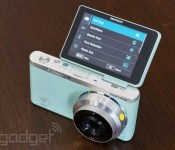
Samsung’s interchangeable-lens NX mini sports 1-inch sensor, fits in your pocket (hands-on)

Hey “style-conscious” men and women in your 20s and 30s, Samsung’s got a new camera just for you. The electronics giant is touting its NX mini as the world’s thinnest and lightest interchangeable-lens camera, and while it technically falls at the low end of the company’s NX line, this new cam comes along with a 1-inch (smaller) sensor and a scaled-down lens mount, which means new lenses, though you can use larger NX glass with a $150 adapter. Without a lens, the camera weighs 158 grams (5.6 ounces), making it lighter than “some bananas” (the fruit), as Samsung demonstrated with a PowerPoint slide during a presentation earlier today. There’s a 20.5-megapixel BSI CMOS sensor, WiFi, NFC, a 1/16,000 max shutter speed, 25,600 top ISO, 6 fps burst mode, 1080/30p video, a battery that can capture up to 650 shots with a full charge and a 3-inch HVGA flip-up touchscreen.
We spent a few minutes poking around the mini’s menu system and taking some sample shots (which we were required to leave behind). The camera performed well, with speedy focusing and accurate exposure (based on reviewing images on the LCD). It’s hardly the fastest mirrorless ILC on the market, but Samsung’s making no such claim — performance was what we’d expect from an entry-level model. Both the 9mm (24.3mm equivalent) f/3.5 pancake lens and 9-27mm (24.3-72.9mm) f/3.5-5.6 zoom are incredibly compact and lightweight. With the prime lens attached, the mini will fit in a jacket pocket. There’s also a 17mm (45.9mm) f/1.8 lens in the works, which should ship in July. The camera, meanwhile, will be available black, white, brown, green and pink sometime next month. A 17mm kit will retail for $450 while a version with the zoom lens instead (that also includes a tiny external flash) will be available for $550. Both pairings ship with a free copy of Adobe Lightroom 5.
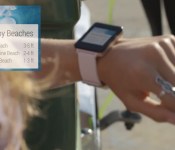
Android Wear: Zen and the art of smartwatch design

Are you ready for a smartwatch that knows where you are, what information is important to you and, above all, wants you to forget that you’re even wearing it? That seems to be the basic idea behind Google’s Android Wear platform, which promises to deliver contextual, relevant information to you whenever you need it, while fading into the background when you don’t.
With today’s announcement of the Android Wear platform for wearables, much of the discussion has revolved around how Google is following the Android smartphone playbook and focusing on creating an ecosystem that can accommodate multiple manufacturers, with a range of products with different price points and feature sets. And Google has lined up an impressive list of partners, including smartphone makers HTC, LG and Motorola; chipmaker and smartwatch-wannabe Qualcomm; and watchmaker Fossil. Even Samsung, which just last month held a splashy launch for its latest round of Gear smartwatches, is in on the game.
… Google doesn’t see wearable devices as full-fledged computers or smartphone replacements.
Those partnerships instantly make Android Wear a major platform in this nascent category. However, what’s most interesting about Google’s approach isn’t the business model, which isn’t that different from Microsoft’s SPOT platform of a decade ago. What matters most about Android Wear is Google’s approach to the category. Unlike, say, Samsung, which initially marketed Galaxy Gear as the real-life successor to Dick Tracy’s wrist communicator, Google doesn’t see wearable devices as full-fledged computers or smartphone replacements. They’re designed to help you get snippets of crucial information — like the weather, your flight status or whether there’s a jellyfish warning in effect for your beach — when you need them most, and then allow you to get on with the rest of your life.
The philosophy is consistent with Google’s approach to its first wearable, Glass. The media may obsess about how Glass can be used to pirate movies and play games. But the device, first and foremost, is designed to make it easier to focus on the here and now, while still being able to check to see if your boss sent you that important email you were waiting for. As Glass Senior Developer Advocate Timothy Jordan said at Engadget Expand last year, the best apps for Glass “help technology get out of the user’s way, but [are] there whenever they want [them].”
The philosophy is consistent with Google’s approach to its first wearable, Glass.
The first Android Wear watches extend that idea further, bringing Glass’ location awareness and voice control to a more socially acceptable design. Nobody is likely to ask if you’re recording them, and cops probably won’t pull you over, just for wearing a Moto 360. In today’s Android Wear announcement, Google SVP Sundar Pichai called watches “the most familiar wearable,” and said that devices based on the company’s new platform “understand the context of the world around you, and you can interact with them simply and efficiently, with just a glance or a spoken word.”

Google isn’t the first to treat the smartwatch as a simple way to access actionable information without interrupting the flow of your life. Pebble, for one, takes a similar approach. CEO Eric Migicovsky says developers are encouraged to look for a “subsegment” of their smartphone apps that can work effectively on a small screen. Unlike Pebble, however, Google’s ambitions are to give you access to just about all of the information you can get on your smartphone — but to allow you to do so unobtrusively and with minimal effort. Android Wear apps, according to Google, should “provide the maximum payload of information with a minimum of fuss, optimized to provide tiny snippets of relevant information throughout the day.” User input, according to Google, should take place only “when absolutely necessary.”
In 1991, computer scientist Mark Weiser declared that “the most profound technologies are those that disappear. They weave themselves into the fabric of everyday life until they are indistinguishable from it.” Weiser envisioned a future dominated by “ubiquitous computing,” with invisible technology that is always there. Android Wear, with its Zen-like approach to “allowing you to be connected to the virtual world and present in the real world,” and with a developers’ guide that lists being “unobtrusive” as a key design principle, seems to be an attempt to deliver on Weiser’s promise. The question is, in a world where it’s become socially acceptable to pull out a smartphone in the middle of a meeting, and where the most exciting developments on the gaming front all involve immersive virtual reality environments, is there still a market for technology that just gets out of your way?
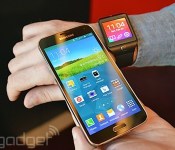
Samsung Galaxy S5 will cost £69 in the UK on Three

It’s a big day for Three as it becomes the first UK network to reveal how much it’ll charge for the Galaxy S5 when it lands on April 11th. The handset will set you back £69 up front on a variety of two-year deals, the cheapest priced at £38 a month for 2GB data, while £44 a month gives you all-you-can-eat texts, minutes and data with an additional 2GB for tethering. No other UK network has tipped its hat thus-far, but we’ll keep harassing them until they break down and tell us everything.
Filed under: Cellphones, Mobile, Samsung
Samsung Galaxy S5 UK pricing gets revealed by Three
If you were wondering what the Samsung Galaxy S5 may cost you when it arrives next month, then Three UK have just revealed their pricing structure for the new device.
A Galaxy S5 purchased through Three will cost £69 upfront on a 24-month contract starting at £38 per month which includes 600 minutes and 2GB of data, with the top tier contract setting you back £44 a month for unlimited minutes and data.
Pre-orders for the Samsung Galaxy S5 will be available online and in-store from March 28th, with the release of the Galaxy S5 set for April 11th.
The post Samsung Galaxy S5 UK pricing gets revealed by Three appeared first on AndroidGuys.
ADD52 gives Samsung another reason to ask Galaxy owners if they “Got Milk”
On the heels of launching Milk Music, Samsung has just announced a partnership with Russell Simmons and Steve Rifkind, co-founders of All Def Digital (ADD) and All Def Music, along with Narrative_today, and the world’s leading music entertainment company, Universal Music Group (UMG) to launch the new ADD52 service that will be a platform for emerging artist. .
Singers around the world can take their shot at stardom simply by posting their tracks to ADD52.com. The only requirements are that the musicians have an original song and a dream for a record deal. Several tools are made available online to help the emerging artists promote on the site and across various social media.
“For artists, it’s the place to be discovered. For music lovers, it’s the place to discover,” — Russell Simmons
Using Samsung’s new radio streaming service as the core platform, the curated ADD52 station will be exclusively on Milk. Selected artists will get more than just exposure and airtime on ADD52; production budgets will be extended to a select few in order to create their own music videos and remixes. Other perks include access to world-class studios, mentorship from industry legends, and the ADD52 TV show hosted by DJ Skee. The new ADD52 service gives Samsung another reason to ask all of it’s users if they “Got Milk”.
Milk Music is a free and ad-free streaming radio service launched by Samsung launched for select Galaxy smartphones (currently U.S. only) and is available in the Google Play Store.
Source: BusinessWire
The post ADD52 gives Samsung another reason to ask Galaxy owners if they “Got Milk” appeared first on AndroidGuys.

