


Smartphones in one year: Project Ara (Opinion)

Smartphones have come a long way since their inception; though the idea of a portable device with internet connectivity and calling features has been around since the 1980s, it was not well received until 2006, with Blackberry’s new devices such as the Curve and Pearl. It revolutionised the way mainstream society viewed portable electronic devices and our uses for mobile phones. However, Blackberry did not enjoy this success for long, with the launch of the revolutionary iPhone, from Apple. It incorporated a touchscreen, and only 4 buttons. People were amazed by the fluidity of a device which essentially had nothing but screen on the front face. Apple’s market share grew rapidly, for example, increasing 626% globally in the smartphone sector, between the last quarter of 2008 and the first quarter of 2009.
The smartphone industry proved itself unpredictable once more in 2010, with Android’s new ‘Gingerbread’ overtaking iOS in the US, having already overtaken iOS in markets such as South Korea in 2009. With this saw the rise of OEMs such as Samsung, LG and HTC. Apple released the iPhone 4, a beautifully designed phone with ‘Retina display’ which yielded a positive response from the consumer market. Blackberry’s RIM was still going strong, however, failing to generate sales. 2010 also saw Microsoft’s attempt to tap into the smartphone market with Windows Phone, which did not meet good reception.

The home interface of Android gingerbread – image source: http://developer.android.com/about/versions/android-2.3-highlights.html
In 2011, with the release of Android 4.0.4, or ‘Ice Cream Sandwich’, Android phones finally started to be perceived as high-end, mainly due to the refreshed, sleeker interface Ice Cream Sandwich brought, and the smoother user experience, thanks to ‘Project Butter’, in Jelly Bean, 4.1. Android’s market share grew further to 36% in the US, placing them in a comfortable first position in terms of market share. Samsung also released the hugely popular Galaxy S2, and Apple released the iPhone 4S, which brought in Siri, a voice controlled assistant. By this point, Blackberry’s market share in the US decreased to less than that of Android and iOS.

The home interface of Android Ice Cream Sandwich – image source: http://developer.android.com/about/versions/android-4.0-highlights.html
Fast forward to 2014, where 80% of the world’s smartphones run on Android, and where Samsung is the biggest producer of smartphones internationally. Android Kit Kat brought performance and aesthetic improvements to Android, and Apple’s iOS got its long-awaited makeover in iOS 7 – which produced mixed opinions. HTC and LG gained a significant amount of market share, with the One M8 and G3 respectively, in markets such as the US, Europe, South Korea and Australia. However, it came as a shock that less popular manufacturers such as Huawei, Lenovo and Xiaomi had superceded manufacturers such as LG, Sony and HTC in the global market. This reiterated the influence that the Chinese market had on global business, and its sheer size.
The sudden entry of China into the smartphone market was expected, but not to the scale which it has. Not only have the consumers in China played a huge role in the global market share of OEMs, but their manufacturers such as Huawei, Xiaomi, Lenovo, Oppo, and more recently, OnePlus, have given the traditional smartphone manufacturers such as Samsung a real dilemma. Samsung is rapidly losing profits; quarterly projections going down by numbers such as 40% and 60%, and LG and HTC are struggling to keep their heads above the water. Chinese manufacturers are beginning to build great devices such as the OnePlus One, or the Xiaomi Mi3, with high-end specs, but sell for half the price of their counterparts of traditional OEMs.

The ‘flagship killer’ OnePlus One, from OnePlus – image source: http://oneplus.net/
I believe that next year will be pivotal in the smartphone industry; due mainly to the speculated release of the modular phone; Project Ara.
Project Ara will be the ‘next big thing’. It can be tailored to the needs of the individual, therefore, has the capacity to be a high-end or mid-range device. The concept of not having to buy a new handset every time a new chipset comes out, or when the screen is cracked, is intriguing. If marketed and manufactured well by Google, it will cause the idea of the ‘complete handset’ totally redundant. Consumers will only buy a new processing package, insert it into their modular phone, at only a fraction of the cost of buying a totally new handset.
This will pose a serious concern for current manufacturers. Instead of building complete handsets, companies will look for ways to monopolise the industry for a certain part of the modular phone. For example, Samsung and LG may both aim to control the displays of Project Ara, while Qualcomm with the chipsets. Unless the business can achieve a monopoly or duopoly of such industries, they will experience severe losses, provided that Project Ara is successful.
What must also be considered is the third-party, non-authorised manufacturers. These will be extremely popular in markets such as China, which, as proven before, is a market crucial to the survival of a consumer-oriented business. These ‘pirate’ manufacturers will provide parts of lesser quality, however, cheaper price, and can cause a formidable dent in the income of respective manufacturers.
The potential repercussions of the launch of the Project Ara platform to the smartphone industry are concerning. If it is as popular as it is believed it will be, it will result in the complete monopolisation of the smartphone market with Android, and with only one handset. It will minimise variation, innovation, originality and creativity; the smartphone industry will be extremely static. Therefore, I can hope another company will reciprocate Project Ara in an equally fantastic product, in order not to let Google singularly rule the industry, and maintain the dynamic, multifaceted environment of the smartphone industry, which is ultimately what renders the sector as stimulating as it is.
 |
The post Smartphones in one year: Project Ara (Opinion) appeared first on AndroidGuys.

Samsung and Facebook strengthening relationship, but what’s in store?

Officials from Samsung and Facebook have met for the third time this year. It is not that much of a surprise considering the Gear VR is made with the Facebook-owned Oculus VR. By now, meetings should have moved on to other projects because the Gear VR is approaching a release. Apparently this latest meeting was a big success for both companies.
At the latest meetig, the two met at Samsung’s Open Innovation Center in Silicon Valley to discuss “futuristic” projects. Samsung and Facebook are working together to assist one another with their core strengths. If there is one area Facebook can help Samsung, it is user interaction. On the other side, Samsung could help Facebook gain success when it comes to hardware.
What is to come from these meetings? No one really knows. It could be hardware or it could be software. Maybe even both. Another Facebook phone seems highly unlikely due to the social network’s failed products. It could actually be something as simple as Facebook be pre-installed on select Samsung devices. However, that just does not sound like a futuristic project. It probably has something to do with hardware because Samsung is present; therefore, keep an eye out for something like a social smartwatch powered by Facebook.
Source: The Korea Times, The Korea Herald
Via: G 4 Games
Come comment on this article: Samsung and Facebook strengthening relationship, but what’s in store?

Samsung’s free DSLR trade-in promo comes to LA today

After a successful first run in New York City earlier this year, Samsung is now taking its free camera-swap program to the West Coast. If you’re in the Los Angeles area, you’ll have a chance to trade in your DSLR, so long as it’s fully functional, for either a Samsung NX30 or NX Mini — both of which are two of the South Korean company’s newest cameras. Compared to the previous event in the Big Apple, Samsung has now included the NX Mini as part of the promotion, giving an option to people who prefer something a little more compact. Today’s Ditch Day will be taking place at Hollywood & Highland Center, from 10AM to 7PM PT; supplies are limited however, so be sure you get there as early as possible. For those interested, details on the trade-in criteria can be found below, and you can check out the rest of the terms and conditions right here.
Qualifying DSLR Cameras: For your existing DSLR camera to qualify for the Trade Up Reward, it must be a DSLR camera, including the main battery and functioning lens, must not be permanently marked or defaced and must be complete and undamaged (reasonable wear & tear accepted) (the “Trade-In Criteria”). For the avoidance of doubt, each of the following is considered beyond reasonable wear and tear: cracked/split or open chassis structure, cracked or non-working display, missing battery (if applicable), or lens cracked. Only cameras that fully comply with the Trade-In Criteria shall be deemed a DSLR for the purposes of this Promotion and such determination shall be at the sole discretion of the Promoter.
Participants may only submit one DSLR for a maximum of one Trade Up Reward.
Filed under: Cameras, Misc, Peripherals, Samsung
Source: Samsung

Anki Drive will now work with (some of) your Android devices, too

Ever watched your iOS-device toting friends playing modern-day Scalextric slot cars and wondering when it’d be your turn? Anki has announced that Anki Drive is now available to use on your Android device, that is, if you’re rocking a Galaxy S4, S5, Note 3, 4 or 10.1 (2014 Edition). Those not hoisted to Samsung’s mast aren’t excluded totally, as Nexus 5 owners are also able to join in on the fun. In its defense, the company points out that the slow adoption of Bluetooth LE, tech necessary for Drive to work, has hampered progress bringing the game to Google’s party. There’s also no cross-platform racing just yet, but is something the company has pledged to work on in the future. Still, if you’re yet to give it a go, Anki cut the price down to $150 / £150 last month, so maybe this is the moment you’ve been waiting for.
Filed under: Cellphones, Samsung, Google

Samsung Galaxy Note 4 to go on sale in India on October 17

Samsung has sent out invites for a Galaxy Note 4 launch event it’s holding in India on Friday, October 15. According to the invitations, the handset will be available to purchase in stores from Sunday, October 17, and is expected to be priced at around Rs. 56,650.
India will also be receiving an exclusive Exynos 5433 octa-core variant of the Note 4, in addition to the standard quad-core Snapdragon 805 model. Both versions will sport a 5.7-inch QHD Super AMOLED display, 3GB of RAM, 32GB of internal storage and a 16-megapixel rear-facing camera.
The new Note will run the latest build of Android 4.4.4 KitKat with Samsung’s TouchWiz user interface plastered over the top. The device is, however, expected to be one of the first on the market to receive the much-anticipated Android L update when it’s distributed later this year.
If you’re in India we’d love to know you answers to the following questions: Are you eagerly awaiting the launch of the Galaxy Note 4? If so how much do you think it should sell for? And, finally, will you be sticking to TouchWiz or installing a custom ROM? Be sure to let us know your thoughts in the comments section below.
Via: SamMobile
Come comment on this article: Samsung Galaxy Note 4 to go on sale in India on October 17

The Galaxy Note 4 gets firmware update in time for worldwide launch

Samsung has pushed out a software update for the International variant of its flagship phablet, the Galaxy Note 4, in preparation for its worldwide launch later this month.
Update ‘XXU1ANJ4′ weighs in at 36MB and transports bug fixes, stability improvements and speed enhancements, in addition to a line of code that “significantly” extends battery life.
If you’ve pre-ordered or intend to grab a Note 4 on launch day, you should see the firmware update icon appear in your notification panel the instant you connect to Wi-Fi. Hit the upgrade button and you’re good to go.
Source: AllAboutSamsung
Come comment on this article: The Galaxy Note 4 gets firmware update in time for worldwide launch
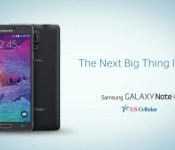
Samsung Galaxy Note 4 coming to U.S. Cellular on October 17th

U.S. Cellular has announced they will join the ranks of carriers offering the Samsung Galaxy Note 4 on their network. The device will be available in stores and online starting this Friday, October 17th. U.S. Cellular is only making the device available in Charcoal Black. Customers can get the Galaxy Note 4 with $0 down if they qualify for U.S. Cellular’s equipment installment option that spreads payment out over 24 months, although they do not indicate what the full retail amount to be financed will be.
Customers can also opt to get the Galaxy Note 4 for $299 with a two-year contract. U.S. Cellular is actually taking pre-orders now for the Galaxy Note 4 if a customer wants to go this route. If you want to place a pre-order, the link is below.
source: U.S. Cellular (MarketWatch), U.S. Cellular Pre-order Link
Come comment on this article: Samsung Galaxy Note 4 coming to U.S. Cellular on October 17th
Samsung announces Wi-Fi breakthrough of 10X today’s speeds

One of the most frustrating things is waiting for a video to load in order to watch it. My wife and I don’t have cable or satellite, we just watch TV and such through Hulu and Netflix on our Chromecast. While we love our Chromecast, there are times that it isn’t perfect and we have to wait for things to load and buffer. Well, Samsung says they have solved this problem.
On Saturday, Samsung announced that it has created a new Wi-Fi technology that will be 10 times faster than current Wi-Fi devices. This 60 GHz will enable a 1 GB movie to be transferred in less than three seconds. Do you understand what this means? Go ahead, count three seconds out loud. Boom. 1 GB of data, downloaded.
Commercialization of this technology is going to be as early as next year. I can just see the commercials now of the Samsung Galaxy S6, making fun of Apple that it’s Wi-Fi is 10 times faster.
Are you excited about this?
via Bloomberg
Deals, Discounts, Freebies, and More! Click here to save today! |
The post Samsung announces Wi-Fi breakthrough of 10X today’s speeds appeared first on AndroidGuys.
.CPlase_panel display:none;
Samsung announces development of commercially-viable 60GHz Wi-Fi technology

Samsung have been winning so much at the Android game that it is easy to forget that the tech giant has their hand in so many other technologies. In a press release today, Samsung announced that they have begun development of 60GHz Wi-Fi technology, allowing for data transmission speeds five-times faster than what is capable with current consumer technology.
Samsung’s advancements removes the barrier between actual and theoretical speeds by eliminating co-channel interference regardless of how many devices are on the same network. In the past there were many challenges in adopting 60GHz Wi-Fi as the signal had weak penetration properties resulting in a weaker and slower signal. Samsung overcame these obstacles by developing a wide-coverage beam forming antenna and the world’s first micro beam-forming control technology, allowing them to achieve the highest-quality commercially capable 60GHz Wi-Fi technology.
Commercialization the 60GHz band is expected as early as next year and Samsung plans to implement the technology into many of their products including telecommunications equipment and medical devices. Sounds promising and will come in handy as many streaming services are slowly rolling out 4K content and streaming video games. Let us know in the comments what you think of Samsung’s exciting new technology!
Source: Samsung
Come comment on this article: Samsung announces development of commercially-viable 60GHz Wi-Fi technology
.CPlase_panel display:none;
Samsung readying crazy fast next-gen WiFi devices

Samsung has revealed that by 2015 it may be selling WiFi devices that use unlicensed, 60GHz spectrum to transfer data at 575MB/s — five times faster than current tech. If that sounds familiar, it’s also the WiGig Alliance‘s 802.11ad WiFi standard, which has a moderately faster theoretical speed of 875MB/s. However, “theoretical” is the operational word — in practice, WiGig bounces off walls rather than penetrating them, so speeds drop rapidly without line-of-sight transmission. In addition, WiGig’s short wavelengths are susceptible to interference by other devices. Samsung claims it’s solved those problems by using beam-forming antennas that adapt to changing conditions in less than 0.33 milliseconds. It plans to put the tech in a variety of devices, including its Smart Home and mobile products as early as next year. We’re not sure if those devices will conform to the WiGig standard or fork it, so we’ve reached out to Samsung for more info.
[Image credit: JOSEP LAGO/AFP/Getty Images]
Filed under: Wireless, Samsung
Source: Samsung
.CPlase_panel display:none;
 AIVAnet