


One of the Samsung Galaxy S6 wallpapers gets leaked out days before its announcement
Samsung is expected to announce two new devices on March 1st at its MWC 2015 press conference as some of its most important devices to date. The Samsung Galaxy S6 and Galaxy Edge are poised to be the devices that get Samsung out of a downward spiral of falling profits, and it’s done everything in […]
The post One of the Samsung Galaxy S6 wallpapers gets leaked out days before its announcement appeared first on AndroidSPIN.
Samsung joins HTC with live stream info for March 1st event starting at 9:30 a.m. PST
In a few short days the world will get their first official looks at both the HTC One M9 and the Samsung Galaxy S6. There are talks HTC will be bringing a bit more to the table than just a new phone though. Last night HTC put up the link details for their live stream […]
The post Samsung joins HTC with live stream info for March 1st event starting at 9:30 a.m. PST appeared first on AndroidSPIN.
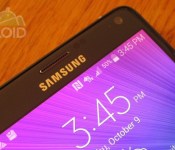
Samsung Galaxy S 6 themes to change icons, status bar, sounds, and more

In a few days, the highly anticipated Galaxy S 6 will be unveiled for the world to see. The wait comes to an end on Sunday and we will see premium design met with scaled back software. The software side of things will have just two Samsung apps being pre-installed. Like the Galaxy A3 and Galaxy A5, the Galaxy S 6 will also have themes.
Themes will provide owners of the Galaxy S 6 with personalized touches. Samsung, according to SamMobile, will allow users to make changes to “icons, color bar, voice tones, background image and background color in the menus.” This is in addition to the custom fonts that Samsung currently offers in a limited capacity.
Everything will be downloadable from the new Theme Center; however, it is unknown whether or not third-party themes are going to be accepted.
Source: SamMobile
Come comment on this article: Samsung Galaxy S 6 themes to change icons, status bar, sounds, and more

Privacy advocates want the FTC to investigate Samsung’s smart TVs

The Electronic Privacy Information Center (EPIC) wasn’t convinced when Samsung explained that its smart TVs aren’t actually eavesdropping on people. In fact, the privacy group has just asked the Federal Trade Commission to investigate whether the South Korean company has really been recording people’s living room convos. If you recall, Samsung stirred up controversy earlier this month due to the phrasing of its privacy policy, which stated that “some voice commands may be transmitted (along with information about your device, including device identifiers) to a third-party service that converts speech to text or to the extent necessary to provide the Voice Recognition features to you.” The outcry that ensued forced Samsung to clarify that its smart TVs can only hear what you say if you push a designated button.
While “listening” to spoken words is par for the course for a device that uses voice commands, EPIC believes it still warrants an investigation. “The key point is that Samsung is not just recording voice commands to operate the TV, as many would expect,” EPIC director Marc Rotenberg told The New York Times. “The company is capturing all voice communications, including conversations between people in the room.”
In the official document it filed, the group wrote:
This complaint concerns certain business practices of Samsung Electronics, Ltd. that adversely impact consumer privacy in the United States. As set forth in detail below, Samsung routinely intercepts and records the private communications of consumers in their homes. Consumers who have learned of this practices have described it is as both “unfair” and “deceptive.” Samsung’s attempts to disclaim its intrusive surveillance activities by means of a “privacy notice” do not diminish the harm to American consumers. It is incumbent upon the Federal Trade Commission to take action in this matter, and to enjoin Samsung and other companies that engage in similar practices, from such unlawful activities.
In addition, the privacy group says Samsung violated the FTC Act by claiming it encrypts voice recordings before sending them to third-party services. The company admitted later on that it doesn’t actually encrypt recorded voice commands or their transcriptions. EPIC also accuses Samsung of violating the Children’s Online Privacy Protection Act, which prohibits collecting information from minors. The group has compiled all its complaints against the electronics company, along with comments from researchers, journalists, ordinary internet users and other privacy advocates in its official investigation request.
Filed under: Home Entertainment, Samsung
Source: The New York Times, EPIC

Decline in profits forces Samsung to freeze employee salaries

It’s no secret that Samsung has been struggling to replicate its past success in the mobile industry. The profits churned in by the company have declined rapidly, even threatening an executive reshuffle late last year.
A new report now suggests that the Korean manufacturer has put a hold on the employee salaries given the financial situation that it’s in right now. It’s important to note that the last time the company did something similar was back in 2009, which was incidentally before it went big with the original Galaxy S handset.
In order to increase profits, Samsung has implemented certain cost cutting measures. Employees were asked to take time off vacation to get back into work, while executives were urged to take economy class flights for a journey of under 10 hours. The company has also done some employee reshuffling, which has helped to some extent.
Samsung has placed all its eggs in the Galaxy S6 basket now and will hope dearly for its success. Judging by what we’ve seen in the leaks so far, it seems like Samsung will not disappoint. The handset is expected to be unveiled this Sunday on the 1st of March.
Via: Sam Mobile
Come comment on this article: Decline in profits forces Samsung to freeze employee salaries
A closer look at Samsung’s new UFS memory and why it’s important
http://c.brightcove.com/services/viewer/federated_f9?isVid=1&isUI=1
Following on from its recent eMMC 5.1 and ePOP mobile memory chip announcements, earlier Samsung announced that it is to begin mass production of in-house memory packages based on the Universal Flash Storage (UFS) 2.0 standard. This technology could soon become the default memory technology in high-end mobile products.
UFS is pegged as a successor to the current eMMC standard for embedded NAND flash memory, and aims to offer some of the benefits of faster SSD memory in a lower-energy chip. The package contains the NAND flash memory and controller, designed for small, mobile products. According to Samsung, UFS offers high performance benefits of the SATA interface used in PCs and the flash-optimized low power consumption of eMMC.

In terms of speed, UFS 2.0 comes in two types – HS-G2 allows for a bandwidth of 5.8Gbps, while HS-G3 has a peak bandwidth of up to 11.6Gbp/s.
Samsung’s UFS solution claims to achieve 19,000 Input/output operations per second for reads, almost double the 11,000 IOPS offered by eMMC 5.1. Samsung also claims that bandwidth can scale to 1200MB/s, three times as fast as eMMC 5.1, and that latency can fall to 50us, although we will have to wait and see if these claims make their way into products. Furthermore, UFS’s serial interface and Full-Duplex data transfer can offer two to four times the peak bandwidth of eMMC’s parallel 8-bit interface. Different manufacturer implementations of UFS will produce slightly different speed results, but you can read a full breakdown of the technology here.

Essentially, UFS will make any task requiring memory access that little bit faster. Memory bandwidth is very important for recording high-resolution video content and other memory intensive reading or writing tasks, which are becoming increasingly common operations in mobile devices. Downloading data through a fast WiFi or USB connection and installing apps can also be bottlenecked by slow memory, but UFS’s scalable 6GBps bandwidth should overcome this issue.
Samsung claims that data transfer times between PC and mobile can be reduced by 50 percent compared with eMMC, and UFS can provide about a 60 percent reduction in latency compared to eMMC, if app swapping is supported by the host. With networking speeds constantly increasing, UFS is a more futureproof solution for mobile products.

Via: AnandTech
Samsung also boasts a 50 percent reduction in energy consumption, meaning that devices should be able to run for longer, especially when playing back from large files, such as video. This could be particularly beneficial in devices with higher resolution displays which can make use of high-end content.
Samsung aims to provide the new memory type in 32GB, 64GB and 128GB capacities, another sure sign that this technology is destined for the premium tier of mobile products in the near future. Toshiba and Qualcomm are also known to be working on UFS memory technologies, suggesting that the standard will eventually be integrated into a wider range of mobile SoCs.
Given the timing of the announcement and the fact that the Galaxy S6 is rumored to come in 32GB, 64GB, an 128GB versions, there’s a solid chance the new flagship will feature this USF memory module. That should help with performance and battery consumption, though other factors weigh in the balance as well.

Samsung Galaxy S6 wallpaper leaks

Talk Android has been covering the wallpaper leaks from HTC for the past month, but now we’re getting a look at a wallpaper that will be arriving with the Samsung Galaxy S6.
One of the big design elements we’re expecting from Samsung‘s “Project Zero” smartphone is a metal chassis, and this wallpaper really emphasizes that aesthetic approach.

According to the source of the wallpaper, it will be found on both the Galaxy S6 as well as its Galaxy S6 Edge variant.
Source: SamMobile
Come comment on this article: Samsung Galaxy S6 wallpaper leaks

New images show Galaxy S6, S6 Edge, and a glimpse of a familiar TouchWiz
Samsung did a slightly better job keeping the Galaxy S6 under wraps, but just like HTC, the Korean giant is now seeing its surprise ruined by revealing last-minute leaks.
Yesterday, an XDA user began posting images of what seems to be the Galaxy S6 – the device in the images features a metallic frame, a glass back, and the same camera and flash modules we’ve seen in numerous leaks so far.
Now the same source provided two images that show the Galaxy S6 and its curved screen variant, the Galaxy S6 Edge, side by side.

From these shots alone, it seems that the two edges of the Galaxy S6 won’t be as pronounced as that on the Note Edge. The primary role of the curved sides seems to be to offer a unique design twist, rather than to add functionality like on the Note Edge. Notice how there is no side panel like on the Note Edge, though Samsung may take advantage of the sides in other ways.

The images also give us a brief glimpse at the user interface of the Galaxy S6 and Galaxy S6 Edge. It looks like Samsung opted to keep the familiar aesthetic of TouchWiz, at least when it comes to the home screen. It remains to be seen if there are more significant changes in other areas of the UI. Samsung reportedly drastically cut down the number of pre-loaded apps on the new Galaxy S6, and worked to speed up and optimize TouchWiz.
Unless the XDA leaker puts out a more detailed look at the new Galaxy S6 and Galaxy S6 Edge, we may have to wait until Sunday for more details. We’ll keep an eye on the thread, but meanwhile, tell us what you think of these shots.

Samsung has an ultra high speed 128GB UFS 2.0 storage module ready for smartphones

Think about the last smartphone you purchased. Consider the cost. Surmise the storage. Chances are, the device was a pretty penny and yet contains only 16/32GB on-board disk space if it’s a flagship, or 8/16GB if it’s a lower-end model. While many smartphones now have expandable storage via microSD, wouldn’t it be nice to get a lot more for your dollar? Samsung might have just the ticket.
Korea’s largest OEM has just announced the world’s first 128GB smartphone storage module that makes use of Universal Flash Storage (UFS) 2.0, a cutting-edge technology that allows for blazing fast data access speeds. It makes use of “Command Queue”, which involves accessing SSDs via a serial interface and has allowed Samsung to make 19,000 I/O operations per second in random reading. This is approximately 2.7 times faster than the standard 8-bit-parallel-interfaced eMMC (5.0) currently deployed for smartphones.

In random write-to-storage tests, the UFS format had 14,000 I/O per second making it 28 times faster than a standard external memory card. This will greatly add to the list of achievements flagship smartphones can perform as it will allow things such as seamless Ultra HD video playback while simultaneously multitasking.
Rounding out the feature-fest, Samsung promises a 50% reduction in power consumption which would make these tiny storage modules a theoretical match made in heaven for the increasingly demanding app array and multitasking that power users throw at their phones.

Could the upcoming Galaxy S6 or Galaxy S Edge be the first devices to make use of the amazing new storage chip?
While 128GB is the largest storage option, 64GB and 32GB variants will also be available. The goal is to see that all flagship smartphones begin to make use of the new UFS technology chips and relegate eMMC to standard-affair, budget and mid-range products.
While Samsung is now mass-producing these chips, it remains to be seen as to if next week’s Galaxy S6 will, in fact, use such technology. Due to supply constraints or timing issues, it’s possible we won’t see them until the Galaxy Note 5 later this year, or even the rumored Galaxy Tab S2 line. Given that Samsung is the world’s largest producer of SSD/NAND flash storage modules in the world, this latest development is just another milestone in the company’s pursuit of the future of technology.
The full press release follows.
Samsung is now mass producing the industry’s first 128-gigabyte (GB) ultra-fast embedded memory based on the much-anticipated Universal Flash Storage (UFS) 2.0 standard for next-generation flagship smartphones. The new embedded memory’s UFS 2.0 interface is the most advanced JEDEC-compliant, next-generation flash memory storage specification in the world.
“With our mass production of ultra-fast UFS memory of the industry’s highest capacity, we are making a significant contribution to enable a more advanced mobile experience for consumers,” said Jee-ho Baek, Senior Vice President of Memory Marketing, Samsung Electronics. “In the future, we will increase the proportion of high-capacity memory solutions, in leading the continued growth of the premium memory market.”
UFS memory utilizes “Command Queue,” a technology that accelerates the speed of command execution in SSDs through a serial interface, significantly increasing data processing speeds compared to the 8-bit parallel-interface-based eMMC standard. As a result, Samsung UFS memory conducts 19,000 input/output operations per second (IOPS) for random reading, which is 2.7 times faster than the most common embedded memory for high-end smartphones today, the eMMC 5.0. It also delivers a sequential read and write performance boost up to SSD levels, in addition to a 50 percent decrease in energy consumption. In addition, the random read speed is12 times faster than that of a typical high-speed memory card (which runs at 1,500 IOPS), and is expected to greatly improve system performance.
In the future, Samsung anticipates that UFS will support high-end mobile market needs, while eMMC solutions remain viable for the mid-market, value segments.
For random writing of data to storage, the blazingly fast UFS embedded memory operates at 14,000 IOPS and is 28 times as fast as a conventional external memory card, making it capable of supporting seamless Ultra HD video playback and smooth multitasking functions at the same time, enabling a much improved mobile experience. Samsung’s new UFS embedded memory comes in 128GB, 64GB and 32GB versions, which are twice the capacity of its eMMC line-up, making it today’s optimal memory storage solution for high-end mobile devices.
In an attempt to provide more design flexibility to global customers, Samsung’s UFS embedded memory package, a new ePoP (embedded package on package) solution, can be stacked directly on top of a logic chip, taking approximately 50 percent less space.
Over the next several years, Samsung will continue to set the pace for memory solutions that combine truly high-performance with high capacity.

Here’s how Lollipop 5.0.2 looks on the Galaxy Tab S 8.4 and 10.5

Given the flagship tablet status Samsung bequeathed onto last year’s pair of Galaxy Tab S devices, it’s a bit sad to see their being relegated to “second rate” status with respect to Lollipop updates. Perhaps it’s simply a matter of numbers (as in smartphones sell better) or else the Magazine UX took longer than expected to coat with the new touches.
Thankfully, SamMobile has obtained a working build of the software which showcases the somewhat subtle changes that have been made. Take a look, and be sure to admire the awesome background setup:
As mentioned in the video, the changes are somewhat minimal, with the animations receiving a slight alteration, and various toggles (such as the volume slider) adopting the Lollipop look. Multi-user support has been added directly to the drop-down notification shade. Additionally the carousal recent apps list can be seen as well as lock screen notification cards.
Perhaps the greatest addition, however, is the fact that Samsung has left the original sound profile settings as is on the notification shade: Sound/Vibrate/Mute are all there, something that Google has infuriated countless users with having removed them from the stock AOSP Lollipop build.
Unfortunately no information is given as to what build is running on the device (near final? beta?) nor is there any release date information provided. According to leaks from earlier this year, Samsung was allegedly going to be updating its tablets after all the flagship phone releases were complete. Hopefully within the next few weeks the update will be finalized and deployed to eager owners, at least in terms of the Wi-Fi and SIM-unlocked variants go. Carrier branded models? That’s another story.
Assuming the recent rumors surrounding a Galaxy Tab S2 series go, will it have the same UX build as the one pictured here? Or will Samsung try and unveil a significantly redesigned Lollipop experience?
 AIVAnet