


Pre-orders for the Samsung Galaxy S6, S6 Edge on Verizon begin April 1st

Verizon has just announced that pre-orders for both the Samsung Galaxy S6 and S6 Edge will begin on April 1st. While we now have an official pre-order date, the carrier has yet to mention when the phone will actually become available.
Verizon is one of the first US carriers to reveal any specific dates regarding the handset. Sprint, T-Mobile and AT&T (among others) have announced that they’ll eventually carry the devices, but these carriers only allow users to pre-register for them so far. With that said, we couldn’t imagine it will be too much longer until the other carriers hop on-board with pre-orders dates.
Wondering what we’re talking about? At MWC 2015, Samsung recently announced its two newest flagship smartphones, the Galaxy S6 and S6 Edge. Both devices feature almost identical specifications, including a 5.1-inch Super AMOLED display with an impressive resolution of 1440×2560. Also on-board is Samsung’s own Exynos 7420 processor, 3GB of RAM, 32/64/128GB of internal storage and a 16MP rear-facing camera. The S6 Edge has a slight curve to it on each side, and also comes with a slightly larger battery. Both devices also come in a number of different colors. We went hands-on with the Galaxy S6 and S6 Edge a few days ago, and you can find links to those posts below.
Read more: Samsung Galaxy S6 hands-on and first impressions, Samsung Galaxy S6 Edge hands-on and first impressions
brightcove.createExperiences();
Any Verizon customers out there waiting for the Galaxy S6?
Reports coming in that the Samsung Galaxy S6 may have a problem with touch sensitivity
No device is without issues and it appears Samsung‘s new flagships aren’t going to be the exception to the rule either. Asia Today is reporting that the Samsung Galaxy S6 may have a problem with touch sensitivity and that the millions of devices already built and waiting to be sold could already have this issue. The […]
The post Reports coming in that the Samsung Galaxy S6 may have a problem with touch sensitivity appeared first on AndroidSPIN.
Grab the Samsung Galaxy S6 wallpapers and apps
We don’t have to wait for the Samsung Galaxy S6 to launch since the wallpapers and apps that will be bundled with the flagship device have just surfaced online.
Courtesy of XDA Developers, you can now grab the app APK’s and sideload them, as well as enjoy the official Galaxy S6 2560 x 1440 wallpapers.
Apps:
Source: XDA Forums
The post Grab the Samsung Galaxy S6 wallpapers and apps appeared first on AndroidGuys.
Samsung Galaxy S6 apps available to install on TouchWiz Android 5.0 devices
Much of the world knows a bit about the latest announcement from Samsung when they showed off the Galaxy S6 and S6 Edge. The new devices bring a premium design to the Galaxy S line with a mix of metal and glass, ditching their plastic backs and parts. They made a number of changes that […]
The post Samsung Galaxy S6 apps available to install on TouchWiz Android 5.0 devices appeared first on AndroidSPIN.
Verizon will take Samsung Galaxy S6 and S6 Edge pre-orders April 1
Anytime I see April 1st as a date from a carrier, manufacturer or pretty much anyone else, I immediately think it is an Aprils fools joke. I highly doubt it is a joke when it comes to pre-ordering of Samsung’s new flagship devices on the biggest carrier in the US though. A tweet went out […]
The post Verizon will take Samsung Galaxy S6 and S6 Edge pre-orders April 1 appeared first on AndroidSPIN.

Our top picks from MWC 2015!

MWC 2015 has wrapped up and our team is now getting ready to pack up and head home. Before MWC even began, we knew it was going to be a stellar show, with our eyes locked on HTC and Samsung in particular. It’s true that the spotlight shone brightest on HTC and Samsung this week, but honestly there were a ton of great devices showcased and at least a few surprises as well, such as the exceptionally attractive Huawei Watch and the eye-scanning ZTE Grand S3.
As is our tradition, we have now spent some time going over the many great products we saw over the course of the last several days and have picked out nine devices which we feel are worthy of being showcased as Android Authority MWC 2015 top picks.
Samsung Galaxy S6
Easily one of the biggest announcements of MWC 2015, the Samsung Galaxy S6 finally brought the world a much needed infusion of premium materials, melding a glass back with a metallic frame. The design may have required a few sacrifices, such as the lack of microSD and a non-removable battery, but the latest member of the Galaxy S family certainly takes things up a notch when it comes to looks.
On the hardware front you’ll find an Exynos 7420, no Snapdragons here. You’ll also find 3GB RAM, a 5.1QHD display, and internal storage options that begin at 32GB and go up as high as 128GB. Samsung hasn’t just changed up the aesthetics and given us a hardware upgrade, the software side has also received improvements including a new theme system, a dramatic reduction in bloatware and several other improvements that should make the Galaxy S6’s software the fastest iteration of TouchWiz to date.
The Galaxy S6 finally brings Samsung’s design language a bit more on par with premium devices like those from HTC and Sony, and, for the most part, the device seems to have been well received by the tech world at large. We’ll certainly be diving in deeper with the Galaxy S6 in the months to come, but there’s no doubt in our mind that the latest Galaxy is worthy of being deemed an AA top pick.


Learn more about Galaxy S6:
- Samsung Galaxy S6 vs iPhone
- Samsung Galaxy S6 vs S5
- Samsung Galaxy S6 color comparison
- Samsung Galaxy S6 fingerprint and themes feature focus
- GS6 Hands on and first impressions
Samsung Galaxy S6 Edge
Announced alongside the Galaxy S6, the Samsung Galaxy S6 Edge might not be dramatically different from its standard-screened brother, but its unique dual-curved display helps it stand out from the crowd. The Galaxy S6 Edge packs the same specs as its brother, with only a few minor changes like a slightly larger battery. That means you get a 5.1-inch QHD display, a 64-bit Exynos 7420 processor and 3GB RAM. One area that the Edge does stand out from the GS6, aside from aesthetics, is when it comes to the software.
The Galaxy S6 Edge offers two special features. The first of these is People Edge, which lets you assign colors for up to five contacts, and when you put the phone face down, you can know who is calling because you see the colors from the right edge. The other special feature is the ability to show notifications and bits of info on the edge, giving users a quick way to see texts, calls and more, without the need to open the case.
For those that are impressed by what Samsung did with the Galaxy S6, but are looking for a product that will stand out in an even bigger way, you can’t go wrong with the Galaxy S6 Edge. And that’s why it’s no surprise we chose the Galaxy S6 Edge as a top pick.
Learn more about Galaxy S6 Edge:
- Samsung Galaxy S6 and S6 Edge announced
- Samsung Galaxy S6 Edge color comparison
- Samsung Galaxy S6 Edge first look
HTC One M9
The HTC One M9 might not have seen the aesthetic enhancements some were hoping for, but that doesn’t mean it isn’t a device worthy of your attention. Further refining the design language started with the M7 and arguably near-perfected with the M8, the M9 takes what we loved about its predecessors and infuses the experience with a few coats of extra polish.
Gone is the much criticized UltraPixel rear cam, replaced with a 20MP shooter. Other improvements include the jump to a Snapdragon 810 with 3G RAM, and several software improvements introduced with Sense 7.0 including HTC themes and more. HTC One M8 owners might find the device too similar to be worth an immediate upgrade, but M7 owners and those new to HTC will certainly be tempted by the stylish One M9 and its 2015-level specs.
Could HTC have done more to set the One M9 apart from the M8, aesthetically? Arguably so, but don’t be fooled, this is still one premium device with quite a bit of raw power under the hood.
Learn more about HTC One M9:
- HTC One M9 officially announced
- HTC One M9 Dot View Case first look
- HTC One M9 hands-on and first impressions
- HTC One M9 vs HTC One M8 quick look
Huawei Watch
Before MWC we heard at least a few rumors and whispers about Huawei’s plans for wearables and for Android Wear. At MWC 2015 the Huawei Watch became a reality, and what a stunning looking watch it is. The new wearable stands out as the most “watch-like” smartwatch to date, bearing a full circle display like the LG G Watch and Urbane, but within a less bulky package. The Watch also offers a 1.4-inch AMOLED display with a resolution of 400×400 that’s protected by a sapphire crystal display, and the body is equally durable thanks to 316L corrosion-resistant stainless steel.
As far as internal hardware and software goes, the Huawei Watch should perform similarly to its existing brethern from the likes of LG, Sony, Samsung, Acer and Motorola. There’s a Snapdragon 400 underneath backed with 512MB RAM, and the software is the same stock experience as you’ll find elsewhere, although Huawei is bringing 40 unique watch faces to help set its wearable apart.
Android Wear is still very much in its infancy and while the platform is far from a mainstream success at this stage, devices that push decent specs with excellent aesthetics are exactly what Android Wear needs if it is ever going to appeal to more casual watch buyers and not just the hardcore techies that want and need the latest and greatest.
Learn more about the Huawei Watch:
LG Watch Urbane
The LG Watch Urbane was actually announced a bit ahead of MWC 2015, but it wasn’t until this week that we had the opportunity to go hands-on with the latest LG watch. The latest watch features a premium metal design that’s sleeker and more elegant than the G Watch R, though, aside from aesthetics, we’re looking at pretty much the same device.
That means you’ll get a Snapdragon 400 with 512MB RAM, a 1.3-inch POLED 320×320 display and a 410mAh battery. There’s also the same stock Android Wear experience, which, judging by the G Watch R, should fly through the elements with these specs. Whether the Urbane is as attractive as the Huawei Watch, or more so, will largely depend on your own personal tastes, but there’s no denying that LG is continuing to step up its game with each new watch it brings to the plate.
Learn more about the LG Watch Urbane:
Alcatel OneTouch Idol 3
An underlying theme with all the mid-range smartphones featured in this list is that they all have something unique to offer, beyond what their otherwise mid-range nature, and associated price point, would suggest. In the case of the Alcatel OneTouch Idol 3, that differentiating factor comes in many forms.
Apart from the the fact that this device packs an impressive 13 MP rear camera and an 8 MP front-facing unit that should be a delight for selfie lovers, as well as a beautiful Full HD display, the OneTouch Idol 3 also boasts a fantastic audio experience with dual front-firing speakers featuring JBL audio with Clari-Fi technology, with the built-in MIX music application available to really let the amateur DJ in you shine. All these features are often not available with even far more expensive flagships, which is why the Alcatel OneTouch Idol 3 is deserving of our top pick list for MWC 2015!
Learn More:
Sony Xperia Z4 Tablet
It’s not really a surprise to see the Sony Xperia Z4 Tablet make it as our top tablet pick, with every earlier iteration making its way on to a similar list previously. Sony continues to excel in the high-end tablet arena, with the Xperia Z4 Tablet taking everything we loved about its predecessor and making it even better.
Weighing just 389 grams and only 6.1 mm thick, the Xperia Z4 Tablet further refines the already fantastic design language and handling experience, and of course, comes with the bump in specifications you’d expect from a current generation high-end Android tablet. The minimalistic Xperia UI on top of Android 5.0 Lollipop really lets the Snapdragon 810 processing package shine, and media consumption will be a blast on the Quad HD display. Sony staples like water and dust proofing also return with this device, which is just one of the many reasons why the Sony Xperia Z4 Tablet is our pick for the best tablet at MWC 2015!
Learn More:
Lenovo Vibe Shot
It is easy to mistake the Lenovo Vibe Shot for a slim point and shoot digital camera when looking at it from the back, which is exactly the affect the company hoped to achieve. Premium mid-range best describes the look and specifications of this smartphone, but its standout feature is the 16 MP rear camera and 8 MP front-facing unit, and the overall experience it offers.
A dedicated tactile shutter button is coupled with a physical toggle to easily switch between “Smart” and “Pro” modes, with the latter offering the level of manual control you’d usually get with a regular camera. The 16 MP auto-focus rear-facing camera comes with a 6-piece modular lens, an infrared auto focus, tricolor flash, OIS, and 16:9 BSI sensor, and in our short while with this device, we were certainly impressed with it, and can’t wait to put it through its paces. For all that it offers, the Lenovo Vibe Shot merits one of our top smartphone picks of MWC 2015!
Learn More:
- Lenovo Vibe Shot hands on and first impressions
- Lenovo’s latest camera-centric smartphone launched at MWC 2015
ZTE Grand S3
Even with a couple of huge flagship announcements dominating this year’s event, the smaller players in the world of Android found a way to not get lost in the crowd, mostly due to the unique features they offered. In the case of the ZTE Grand S3, this noteworthy feature was in the form of “Eyeprint ID.”
The device uses the 8 MP optics of the front-facing camera to not only capture a video of how your eyes look, but also see the blood vessels inside of the eyeballs, and further refines the scan information every time you use this feature to unlock your smartphone. It is a first implementation that is sure to get better over time, and this may not be the fastest way to unlock your smartphone, but this remarkable attribute of an otherwise decidedly mid-range smartphone is the reason why the ZTE Grand S3 is entitled to one of our top smartphone picks of MWC 2015!
Learn More:
Wrap up
CES might have been a bit tepid this year as far as mobile is concerned, but at least MWC 2015 made up for, with several OEMs bringing their A-game. While we listed some of the biggest hitters, there were many other products announced at MWC 2015 that helped make this event an absolute thrill to watch unfold.
What do you think about this year’s Best of MWC 2015 top picks winners? Agree, or feel we left anything out? Let us know what you think in the comments.

Grab Samsung’s Galaxy S6 apps and wallpapers here

Called useful by some and bloat by others, the Galaxy S6 comes with the latest version of Samsung’s custom Android applications, which have been re-designed and spruced up with some new features for the latest Lollipop version of Touchwiz. XDA forum member Albe95 has ripped these apps from a Galaxy S6 and made them available for other Samsung Lollipop handsets owners.
To install these apks you will need to be running Touchwiz on an Android 5.0 Lollipop device. If you have recently received one of Samsung’s numerous OTA updates or have manually flashed some stock 5.0 Samsung firmware, you’re pretty much set and ready to go. You’ll just need to enable external apk installation in the developer options menu, unzip the files and install. Here are the links:
The Galaxy S6’s wallpapers are also up for grabs, which you can download from the images below (click to enlarge).


For additional screenshots and installation instructions for each of the apps, check out the source link below.

Could the Samsung Galaxy S6 have a major hardware fault before it’s even launched?
Samsung have chosen to completely refine their design and move away from the previously criticised ‘cheap’ looking handsets to a more premium build.
However, the move to a completely new frame and bezel setup may have resulted in the Galaxy S6 developing a quote significant hardware flaw before it’s even been launched.
According to some research and testing captured on a YouTube video, the flaw involves the screen not registering input near the bezel and will only recognise touch from a few millimetres into the screen.
This is what it should look like:
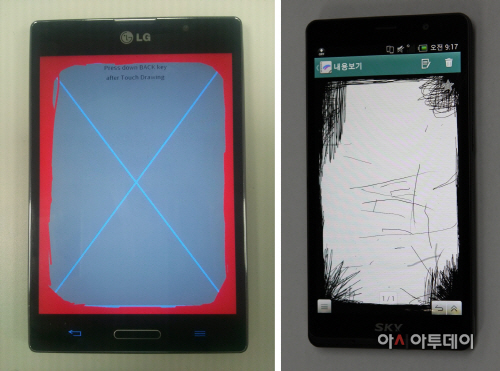
It seems like this isn’t just something that can solved with hardware and is in fact a fundamental flaw in the hardware of the Galaxy S6.
Can Samsung fix it before launch? Is this intended? Let us know what you think in the comments below.
The post Could the Samsung Galaxy S6 have a major hardware fault before it’s even launched? appeared first on AndroidGuys.
Samsung switches to LPDDR4 and UFS 2.0 memory, but what does it mean?

Earlier this week we took a look at Samsung’s new Exynos 7420 SoC, which is just one of the new technologies squeezed into the Galaxy S6. Samsung is also leading the way with faster LPDDR4 RAM memory and internal memory designed with the new UFS 2.0 standard.
UFS 2.0 internal memory replaces the common eMMC 5.0 / 5.1 standard found in most last generation handsets. We already covered the technology last week, and essentially it is designed for faster reading and writing from internal storage, allows for simultaneous read/write processes, and prioritizes incoming commands to execute them as quickly as possible.

Although flash memory doesn’t particularly mind how data is arranged, sequential read and write speeds can be important when dealing with large file sizes. Particularly when it comes to large HD video, lossless audio or game assets, which are usually stored neatly in large sequential chunks of data on the hard drive. But rather than relying purely on Samsung’s speed numbers, a newly published AndroBench comparison gives us a closer look at what the standard is capable of compared with last generation handsets.
http://embed.chartblocks.com/1.0/?c=54f88ab2c9a61d0d5569df80&t=29ebd26dc37d131
However, benchmarks don’t necessarily represent real world performance and you’re not going to notice these speed differences in day to day tasks. But when it comes to particularly media heavy reading or writing of data, UFS 2.0 is clearly a cut above eMMC 5.0.
New LPDDR4 RAM is the other half of Samsung’s latest memory arrangement, which is a successor to commonplace LPDDR3. Qualcomm’s Snapdragon 810 SoC also features LPDRR4 memory.
Rather than storing large, permanent files, RAM is temporary memory used by applications and the operating system for whatever needs processing. LPDDR4 can offer up to a 50 percent performance boost than LPDDR3, depending on the implementation. The aim of the game here is increased memory bandwidth, which allows for faster communication between the RAM memory and the handset’s processors.
http://c.brightcove.com/services/viewer/federated_f9?isVid=1&isUI=1
This is particularly important when it comes to memory intensive applications. Again we’re looking at media centric scenarios, where large chunks of data have to be moved around with minimal delay. One example is slow-motion video, where 120 image frames have to be stored in RAM memory each second. At 2K or 4K resolutions, that’s a lot of data to be pushing around, and additional bandwidth is very important in these types of applications. Gaming is also a potential benefactor here, as mobile GPUs have to pull resources from the main memory pool. Bandwidth requirements increase greatly at larger display resolutions.
Samsung’s Galaxy S6 LPDDR4 has a 1552MHz clock speed. Assuming the standard dual-channel 32-bit design as previous Exynos chips, this gives us a bandwidth of 24.8GB/s. For comparison, the Snapdragon 810 offers a similar bandwidth, while the older LPDDR3 in the Snapdragon 801 has a bandwidth of 12.8GB/s and the Exynos 5433 offers 13.2GB/s.

However, these are just upper limits and real world results rarely sustain this bandwidth. There also is not a direct one-to-one relationship between bandwidth and performance. Our own AnTuTu test shows a decent performance gain, but not the suggested 50 percent boost. Like UFS 2.0, you’re only likely to notice this improvement in some specific scenarios.
On top of a speed boost, LPDDR4 lowers the memory’s core voltage to 1.1 volts, down from 1.2 volts, and implements low voltage swing logic at 0.4 volts. This aims to help save on energy consumption, which is especially important in battery powered smartphones, given how often the memory is accessed.
In summary, the move to LPDDR4 and UFS 2.0 are complementary improvements to system memory, which will prove particularly useful when it comes to high resolution media playback and capture, gaming, and larger file transfers and downloads. The change here is just one of the many improvements introduced in the Samsung Galaxy S6 that should (hopefully) lead to an overall superior experience when compared to Galaxy handsets of the past.
A closer look at the Galaxy S6’s Exynos 7420 SoC

As was expected, the Samsung Galaxy S6 is another industry leading flagship smartphone, packing in some of the latest and greatest pieces of mobile tech. This time though, Samsung has opted to exclusively use its in-house Exynos 7420 SoC, rather than a Qualcomm processor as it has done in previous years. So, let’s delve into the specifics to see why Samsung has so much confidence in its latest SoC.
One of the Exynos 7420’s big talking points has been the move down to a 14nm FinFET manufacturing process, which puts Samsung ahead of Qualcomm’s 20nm Snapdragon 810. When it comes to manufacturing size, smaller numbers are better, as shorter transistor distances consume less energy and boost processing speeds. However, smaller, closely packed transistors can lead to current leakage between parts of the chip, an issue that FinFET manufacturing addresses by enclosing the conducting channel in a thin silicon “fin”.

For the same processor design, lower power consumption means more heat headroom for increasing clock speeds or additional battery savings, which will help explain some of the capabilities of Samsung’s chip as we dive down deeper.
The bulk of the Exynos 7420’s processing components are rather familiar. It is built from ARM’s reference Cortex-A57 and A53 CPU cores and its Mali-T760 GPU technology. At a quick glance, the design is very similar to the Galaxy Note 4’s Exynos 5433 chip.
| Exynos 7420 (Galaxy S6) | Exynos 5433 (Galaxy Note 4) | |
|---|---|---|
| Architecture | ARMv8-A (32 & 64 bit) | ARMv8-A (AArch32 only) |
| CPU cores | 4x ARM Cortex-A57 + 4x Cortex-A53 (big.LITTLE with GTS) |
4x ARM Cortex-A57 + 4x Cortex-A53 (big.LITTLE with GTS) |
| CPU clock | A57 – 2.1GHz A53 – 1.5GHz |
A57 – 1.9GHz A53 – 1.3GHz |
| GPU | ARM Mali-T760 MP8 | ARM Mali-T760 MP6 |
| GPU clock | 772 MHz | 700 MHz |
| RAM support | 1552MHz LPDDR4 | 825MHz LPDDR3 |
| Process | 14nm FinFET | 20nm |
Samsung is using ARM’s high-end octa-core Cortex-A57 and A53 big.LITTLE configuration for an efficient balance between peak performance, using the Cortex-A57s, and energy efficiency, by delegating background tasks to the low power Cortex-A53s. Samsung has again implemented Global Task Scheduling with this chip, which enables the use of eight cores at the same time, as well as dynamic core voltage and frequency switching.


The Exynos 7420 also implements ARM’s AArch64 64-bit execution state, while the Exynos 5433 will likely only ever use AArch32 (32-bit mode), even though it uses ARMv8-A CPU components.
While 64-bit app support is slowly gaining momentum, Android Lollipop’s ART runtime is optimized for 64-bit processors and so should result in a few performance benefits for the 7420 too, depending on the situation. For example, all pure Java apps receive instant benefits from ART’s 64-bit optimizations.
Thanks to the smaller manufacturing process, Samsung has been able to up its clock speeds by 200MHz on the CPU side and by 72MHz on the GPU side, working out to around a very rough 10 percent increase over the Exynos 5433. While this will inevitably lead to some performance gains, the biggest changes have been made to the SoC’s memory and GPU specifications.
The Exynos 7420 is Samsung’s first SoC with LPDDR4 memory, which runs in a 32-bit dual-channel configuration with a clock speed of 1552MHz. Peak bandwidth reaches 25.6 GB/s.
The GPU is where Samsung has implemented the largest performance gains-over the Exynos 5 series.
This already adds up to tangible improvements so far, but the GPU is where Samsung has implemented the largest performance gains-over the Exynos 5 series. As well as the clock speed increase, Samsung has scaled up the number of GPU cores from six in the Note 4 to eight in the Galaxy S6. This extra graphics grunt will come in handy when gaming on the Galaxy S6’s QHD display, and the smaller 14nm manufacturing size has also allowed Samsung to drop the GPU voltage by between 200 and 300 mV at 700MHz. Samsung states that the move to 14nm reduces power consumption by 35 percent and much of that saving looks to have been pumped back into the two additional GPU cores.


Comparing our Galaxy S6 AnTuTu test against the Galaxy Note 4 (SM-N910C), we see a rather substantial increase when it comes to 3D graphics performance at 2560×1440. Benchmarks don’t indicate real world performance differentials, but it certainly confirm the areas in which Samsung has managed to make improvements. RAM speed also sees a decent performance gain from the move to LPDDR4 and AnTuTu also registers a favorable boost to the CPU’s capabilities too, due to the smaller die size and higher clock speeds.
http://embed.chartblocks.com/1.0/?c=54f5abf7c9a61d493d69df80&t=6bf207018f1a3ee
With performance up and energy consumption down, Samsung’s push for 14nm has clearly paid off and it is clear why the company chose to drop Qualcomm’s Snapdragon series this generation. Although CPU performance is only marginally better than some existing flagships, additional GPU performance and battery savings are precious improvements for Samsung’s QHD Galaxy S6.
The Exynos 7420 will likely remain a top performer throughout 2015, as Qualcomm is not looking to reach sub-20nm until end of the 2015.
 AIVAnet