


Samsung Galaxy S7, six months on

It’s been half a year since we reviewed the Galaxy S7; now it’s time to revisit things.
Oh how quickly time flies. It’s hard to believe that the Galaxy S7 has already been on sale for over six months, as we published our review on March 8. The GS7 has been what I consider my “primary” phone since then (with requisite time spent away from it with review devices), so I’ve racked up plenty of experience using Samsung’s base-level flagship since it was launched.
Revisiting a phone several months after reviewing it gives necessary perspective, particularly as sales continue and potential buyers keep considering the Galaxy S7. So how has it stood up to a half-year of use? Read on for my experiences.

Still holds up
Galaxy S7 Hardware
I wrote our review of the Galaxy S7 edge, but never could get comfortable with the larger curved screen and immediately gravitated to using the “standard” Galaxy S7 instead. The 5.1-inch screen and svelte overall body are just the right size for me: big enough to not feel cramped, and small enough to fit in my pocket and manage with a single hand.
After months of use, my Galaxy S7 is still looking rather pristine, though I’m admittedly not too rough on any of my phones as they often spend hours a day sitting on a desk. I’m also cognizant of the dangers of scratches, bumps and drops while I travel, and my GS7 usually lives in a clear TPU case or Samsung’s battery pack case when I hit the road.
My GS7 has spent 80% of its life outside a case, and hasn’t picked up any cosmetic damage.
With that being said, my GS7 has probably spent 80% of its life outside of a case, and really hasn’t picked up any cosmetic damage. The metal frame has a few tiny scratches, and the back glass is the one place where damage is pretty unavoidable — you can see a few shallow scratches and swirls from sliding around on various surfaces. No cracks or pits in the glass on either side, though, which is a huge victory — and considering how well the GS7 is made I’m not surprised.
The Galaxy S7’s display continues to be marvelous, from its punchy colors and crisp resolution to its fantastic daylight visibility. Samsung’s displays have been class-topping for a couple years now, and while there are plenty of other phones out there with great displays, they all come up a little short of Samsung’s AMOLEDs. Some people aren’t as drawn to its over-saturated look, but I quite enjoy it — and if you prefer something more true to life you can tune it back in the settings.
Water resistance has saved my phone numerous times, but it’s really about the peace of mind.
Over the past six months I’ve been using some other phones, too, and I’m regularly reminded how awesome it is to come back to the Galaxy S7 with its water resistance. Though more and more phones are adding some level of resistance, it isn’t entirely ubiquitous, nor is it up to the same IP68 rating that Samsung uses. I don’t use the Galaxy S7 to take photos under water, nor am I going out of my way to get it wet — but it’s just one less thing to worry about when I’m carrying around a $650 phone. I set it out when I’m at the pool, rather than stuffing it in a bag. I leave it in my pocket when I’m walking on the beach and don’t have to be worried about a rogue wave ruining it. I can put it on a crowded dinner table even though it’s practically inevitable someone will spill a drink. And importantly for Seattle, I can use the phone while I’m on the sidewalk in the rain and not be worried.

Plenty fast
Galaxy S7 Daily use
The phone’s hardware is a known quantity that doesn’t change with use, but the software and experience can certainly deteriorate over time and erode your enthusiasm for a phone. Modern devices are pretty much always going to be quick and show off their features well when you’re in a store, or in the first couple days of use, but how well those features still work several months on shows the true character of a phone.
Software and performance
We use our phones all day every day, and a common refrain is how they slow down over time. My Galaxy S7 has survived this seemingly inevitable deterioration of performance, thankfully, despite loading it up with all of my usual apps and using it exactly as I do any other phone.
Performance is still absolutely great, even after 6 months of use.
Now considering the Snapdragon 820 processor and 4GB of RAM inside this really shouldn’t come as a surprise, as the hardware inside really is overkill for most of what we do. It’s difficult to know how well a phone will far longterm during the initial review period. But now I know that the Galaxy S7 handles my daily needs the same now as it did when I first received it.
The software hasn’t had to grow on me at all, as I was already plenty happy with it when I first used the phone. Samsung’s interface is consistent and just fine on the eyes, so my only real complaint at this point is the pile of duplicative apps that can’t be disabled or uninstalled. I often use other apps as my defaults for functions like calendar and email, and I want to be able to remove Samsung’s versions so they’re no longer cluttering my app drawer and settings — this just isn’t possible given how deeply Samsung bakes them into its system. At this point, it’s the one area that still detracts from my enjoyment of Galaxy phones.
When it comes to software updates, Samsung has done better than expected, while at the same time leaving us a bit underwhelmed. The Galaxy S7 and S7 edge have both received monthly security patches with a regular cadence, but they’ve been delayed by a few weeks in most cases. They’ve also been inconsistent across carriers and regions, with Canadian carriers being particularly poor at working with Samsung to push updates and some regions not receiving updates at anywhere near a monthly interval.

Battery life
The single downside of the smaller size of the Galaxy S7 is its smaller battery, which leads to consistently adequate — but not astounding — battery life. I know exactly how long my phone’s going to last based on what I’m doing that day, and with my average use that means not worrying about charging until I head to bed at night. I don’t need to watch what I do on the phone, use power saving mode or even turn off the battery-draining Always On Displa. I’ve continued to use the GS7 like I do any other phone and the battery holds up.
If I have to go hard on the phone I may be down in the danger zone by nighttime, and if I’m traveling I’m almost guaranteed to have to pop on the Samsung battery case or hit a wall plug for 45 minutes, but those are fringe cases that don’t ruin the experience for me. Few phones out there can handle a full day of travel or hours of hotspotting on top of my normal use, and I don’t expect the GS7 with its 3000 mAh battery to provide any more than it does.
Cameras
Even six months later, I still hold the Galaxy S7 camera as the standard by which other phones are measured. Not only in terms of overall photo quality in a vast range of situations, but in the general experience. The Galaxy S7 still consistently launches faster — with a simple double press of the home button — than any other phone, presents you with a simple interface and captures shots the instant you press the shutter button.


The photos you can get out of the Galaxy S7 still blow me away, and the consistency from shot to shot is still there. The low light shots are generally fantastic, but are admittedly a little grainy and can sometimes rely too much on a high ISO versus a slow shutter speed in situations where there are both bright and dark parts of a scene. But that decision makes sense from the perspective of keeping images crisp — the main feature most are looking for.
If you’re willing to switch into Manual mode you can tweak things for some really great shots, including long exposures using a tripod, but the important part is that it isn’t necessary. You can get great photos time after time in full Auto with Auto HDR turned on.

Age is just a number
The bottom line, six months on
Samsung has likely already sold tens of millions of Galaxy S7s at this point, and now six months on many of them are coming to the same conclusion that I have: the GS7 is still a damn good phone. Although there will always be questions about fragility of a glass body, the sturdiness and outstanding feel of the GS7’s hardware is undeniable, and I really enjoy using it. The screen hasn’t been surpassed by any phone in the meantime, and I personally appreciate its manageable size next to all of the other mainstream phones that have gravitated toward 5.5 inches.
Just as importantly, the daily experience on offer from the Galaxy S7 is still great, even after several months using the phone and loading it up with all kinds of apps and data. I still wish that Samsung would scale back on its duplicative apps that can’t be disabled or uninstalled, but the interface is slick and fast, with no performance issues. At the same time, battery life is good enough to get your through a day without worrying about hitting a charger. And then you have the camera, always waiting and ready to snap a picture at a moment’s notice with excellent results in a variety of situations.
Considering how well the Galaxy S7 has held up to my use, I still have no hesitation in recommending it someone who wants the best of hardware, performance and camera in a phone that’s still a manageable size. Even six months on with some price cuts the GS7 is still quite expensive, but it continues to offer excellent value that few other phones can match.
See at Amazon
Samsung Galaxy S7 and S7 edge
- Galaxy S7 review
- Galaxy S7 edge review
- U.S. unlocked Galaxy S7
- Should you upgrade to the Galaxy S7?
- Best SD cards for Galaxy S7
- Join our Galaxy S7 forums
Unlocked
AT&T
Sprint
T-Mobile
Verizon
Forget pumpkin spice lattes! Get your pumpkin fix with these wallpapers

Fall is officially here.
This means so many wonderful things: getting to wear jackets outside without melting like the Wicked Witch of the West, there’s some new Google phones getting announced next week, and I can break out the fuzzy knee high socks! Woo hoo! Oh, also — PUMPKINS ARE BACK! Now, that may not mean a lot to you, but that’s because you’ve never had my pumpkin seeds. Pumpkins may just be set dressing or photo fodder for most of us, but this tech-loving snacker knows better. The best use for pumpkins isn’t chunking them out a cannon, it’s for gutting them and baking the seeds…
And wallpapers. They do make really good wallpapers.

Look at this! It’s too ridiculously adorable. I think we can all agree it doesn’t get more adorably fall than a little black cat with a jack-o-lantern. Now, there are two things about this wallpaper: first, this is a paid wallpaper, and I have no problem paying for it because LOOK AT THOSE EYES! Second, if you’re a Chrome browser user, it also comes as an adorable Chrome theme.
Just be careful looking at those eyes, they will cut deep into your soul and drag the biggest AWWW out of you.
Pumpkin paper by Apofiss

Now, in Cinderella we had a glass slipper, but what would’ve been amazing is if that pumpkin she’d been riding in had turn to glass. I mean, look at that! So shiny, so round… so perfect. Isn’t it a wonder? And while it’s not a ridiculously bright orange, the dark burnt orange of the wallpaper fits with a broader set of themes and home screens than other, more bold colors.
36 Glass Pumpkin by UltraShiva

This is Halloween, this is Halloween! Pumpkins scream in the dead of night!
Can you keep a secret? I sing this to my pumpkins as I carry them into my house to gut them. The Nightmare Before Christmas may be an odd duck among the Disney portfolio, but there’s no denying its distinct and wonderful flair. Jack is the Pumpkin King, and his lovely, skeletal grin has graced many a pumpkin. This dark wallpaper lets Jack share that skeletal grin with your home screen.
The Pumpkin King

There are Pokemon that look like pumpkins. Of course there are! And look at the Pumpkaboo, aren’t they just the end of all cuteness? I’d be scared to own one, though, because I’d be afraid it would hide next to the pumpkins I intend to carve. I’d also be afraid of traumatizing it by gutting a bunch of things that looks like it and then baking and eating their guts. Also, this wallpaper will work beyond Halloween if you’re the type to not change wallpapers often, because the Pumpkaboo are forming a Christmas tree, complete with a Shiny Pumpkaboo for a tree topper!
Pumpkaboo!!!! By artico
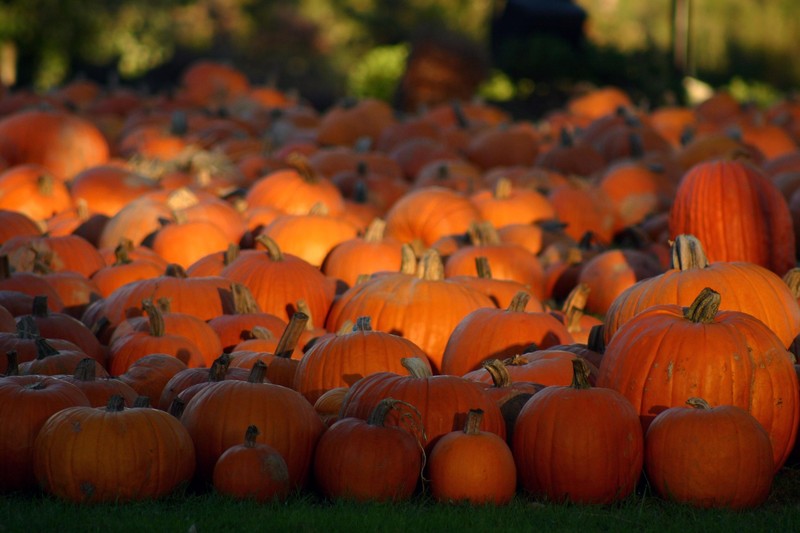
No, I’m not drooling. Shut up… Okay, I’ve tooted my horn about my pumpkin seeds, and I know the question on all of your minds: how do I make them? Well, here’s my secret: I brine them. After I cut open a pumpkin, like the ones on this wallpaper, I give the seeds a rinse and then brine them in a half-cup of water and two tablespoons of pickling salt. After a few hours (usually overnight), I drain the seeds and dry them on a tea towel for a half hour. I then melt a half-stick of butter for every cup of seeds, stir in two more tablespoons of pickling salt, coat the seeds in this loveliness, spread them in a single layer on a parchment-lined cookie sheet, and bake them at 340 until golden, crispy, and delicious.
Pumpkin patch
Alphabet’s health watch has changed a lot since last year
You know that health-tracking watch Alphabet’s X research division showed off more than a year ago, the one you’re looking at above? Yeah, you’ll want to forget about that design. MIT Technology Review managed to get a peek at a prototype of what should be “at least” the second generation of the now Verily-made design, and it bears precious little resemblance to the squarish block from 2015. At is heart is a familiar-sounding circular e-paper screen — not as exciting as the OLEDs and LCDs on smartwatches, but vital for a device that you’re supposed to wear as often as possible.
Logically, it’s loaded with sensors. There’s an outer ring that measures your electriocardiogram (aka your heart’s electrical rhythm), a heart rate sensor and motion detection. You’d also see four unknown metal pads, although it’s not clear if they’re being used for additional sensing (such as galvanic skin response, which reflects stress) or something more mundane, like charging. The device has a brass-hued analog-style casing that looks “ordinary,” according to MIT. That’s possibly a good thing for wristwear that you don’t want standing out.
You aren’t going to buy this watch yourself. Verily mainly wants to use it for research projects like Baseline Study, which will look for disease predictors in everything from blood to sensor data. The company’s Brian Otis also hints that the equipment could change: the company is “constantly iterating” on designs, he says. Even so, it’s a sign that Alphabet is committed to wearable tech that can answer vital medical questions.
Source: MIT Technology Review
iOS 10 Overtakes iOS 9, Now Installed on 48% of Devices
Just over two weeks after iOS 10 was released to the public, its adoption rate has reached 48.16 percent, successfully overtaking iOS 9, according to data obtained from Mixpanel’s iOS 10 adoption tracker.
iOS 10 is now installed on slightly more iOS devices than iOS 9, with Mixpanel’s numbers suggesting 47.79 percent of iPhones, iPads, and iPod touches continue to run Apple’s previous-generation operating system. 4.06 percent of devices still have iOS 8 or earlier installed.
Since iOS 10 was released, its adoption numbers have been growing steadily and have been almost on pace with iOS 9 adoption rates during this time last year. One day after release, iOS 10 was installed on 14.5 percent of devices, and at just under one week, following the release of the iPhone 7 and iPhone 7 Plus, it was installed on 34 percent of devices.
iOS 10 saw some early installation issues that may have made people wary of downloading the update, but its steady growth can be attributed to the many appealing features it offers, including a revamped Messages app with stickers and a full App Store, a Siri API for developers, a redesigned Lock Screen experience, a new Music app, new facial and object recognition capabilities in Photos, and more.
Last year, less than two weeks after iOS 9 was released, Apple said it was installed on more than 50 percent of active devices, making it the operating system with the fastest ever adoption rates. Based on Mixpanel’s numbers, it doesn’t appear iOS 10 has outpaced it, but it did come close.
Related Roundup: iOS 10
Discuss this article in our forums
‘FIFA 17’ marks a new beginning for the soccer franchise
I’ve been playing FIFA since its first title launched on Super Nintendo, when characters on the screen looked like nothing more than colorful stick figures. Nowadays, thanks to the power of modern gaming consoles, the visuals and gameplay are as close to the real thing as it gets. So much so, in fact, that oftentimes when FIFA is on my TV someone asks, “What game are you watching?” FIFA 17, which arrived yesterday in the US and lands tomorrow worldwide, is no exception.
This year, publisher EA introduced a major change to the franchise by choosing its Frostbite engine to develop it, the same one used on more intense series like Battlefield. That’s not the only new feature, though, so let’s walk through a few more before you spend $60 to play on your Xbox 360, PlayStation 3, Xbox One, PlayStation 4 or PC.
Xiaomi hopes to open 1,000 stores by 2020
To date, Xiaomi has focused overwhelmingly on internet sales of its smartphones and media devices in order to keep costs down. Even its tiny retail footprint has largely been limited to service centers and “experiences.” However, that’s all going to change in the next few years. Xiaomi has revealed that it plans to open 1,000 honest-to-goodness retail stores by 2020. It’ll make sure that customers can “touch and test” Xiaomi’s technology, CEO Lei Jun says. He hasn’t said where those stores will be, but it’s reasonable to expect most or all of them to be located in greater China.
A spokesperson tells Tech in Asia that the retail plan is an acknowledgement that Xiaomi has “become a household name” in China, and that you’ll see its presence grow relatively quickly. The firm is converting its existing Mi Home outlets into full-on stores, and expects 60 Mi Home locations to be up and running by the end of 2016.
The dive into retail is bound to be expensive for Xiaomi, and a gamble when the company is almost legendary for its razor-thin profit margins on hardware. It might not have much choice, mind you. While it’s true that Xiaomi is well-established, its smartphone shipments plunged this year — in no small part due to rivals like Huawei, which has a whopping 11,000 stores across China. Physical stores could both snap up more impulsive buyers and remind customers that Xiaomi is still a force to be reckoned with. There’s no guarantee that it’ll work, but Apple’s recovery in the 2000s was partly credited to launching stores that both increased availability and presented its products in the best light. Xiaomi is no doubt hoping for a similar effect.
Via: Tech in Asia
Source: Shanghai Daily
Yahoo reportedly downplayed security for years
That massive Yahoo hack might have been less of a one-off disaster and more a symptom of larger, systemic problems with security at the internet pioneer. New York Times sources claim that Yahoo made security a relatively low priority for years, prioritizing convenience when possible and reacting only after serious incidents (such as bug bounties following an account breach in 2012). Reportedly, the company even skipped out on safeguards that are considered virtually mandatory in many places — CEO Marissa Mayer rejected a password reset out of concern that it would drive users away from Yahoo Mail.
The company took a big step by hiring chief information security officer Alex Stamos, who implemented valuable measures like widespread encryption, collaboration on threat data and “red teams” that broke into Yahoo systems to see how vulnerable they were. However, Mayer supposedly fought with Stamos’ group, depriving it of resources and stalling the implementation of vital features like intrusion detection. Many of its security staffers have left for Silicon Valley mainstays like Apple, Facebook and Google, according to insiders.
A spokeswoman suggests to the Times that things are on the mend. It spent $10 million on encryption in 2014, and that its security investments jumped 60 percent between 2015 and 2016. Yahoo has a “deep understanding” of online threats, the representative says, and it tries to “stay ahead” of those dangers to keep you safe.
If the report is accurate, though, it hints that the increased spending might be necessary for catching up. It’d be an acknowledgment that the company’s previous focus on ease of use over security was too risky, and that whatever inconveniences you suffer from added security are far, far more preferable to losing sensitive info to hackers. And lax security doesn’t just scare away some customers — it could even jeopardize that lucrative Verizon deal.
Source: New York Times
GoTenna’s new communicator crowd sources for a better signal
If you’re a fan of exploring the great outdoors, especially in areas of devoid of cell service, you may have already sought out a GoTenna. These walkie-talkie-like enablers pair with your mobile device via Bluetooth so you can send messages and GPS data to others in the area using radio frequencies. Today the company is pushing the off-the-grid envelope even further with the introduction of GoTenna Mesh, along with a new premium subscription service and an SDK for developers to play with. The addition of mesh networking makes it one of the first devices of its kind, providing mobile (not fixed point), off-the-grid, long-range communication to users — so long as there’s a smattering of devices to help leverage its capabilities.
This is also the first time GoTenna is launching its product internationally, utilizing available public radio spectrums in each area. Early birds can pick up a set starting at $129 on Kickstarter, but if you wait for the retail launch it’ll run you $179 per pair.
The new hardware is smaller, albeit a touch chubbier-looking than its predecessor, and there’s no longer a need for an antenna extension. The basic range without mesh networking in action is similar to the previous model, covering up to about one mile in urban areas and three out in the sticks. From there, however, once a few devices are in play, the range extends from one device to the next nearby and so on, letting your data daisy-chain its way across greater distances.

The new technology augments the range of communication by sending data pings in the background to various nearby devices, hopping around until an efficient and successful path is found to the intended recipient. As an example, if you’re hiking and have friend A three miles ahead of you (in range) and friend B six miles ahead, the signal can hop from one to the next, retransmitting from the closest device until it gets where it’s going.
Obviously, with a robust network of active devices, the better the service can become. To help build a community for people to share their active locations, GoTenna launched the site: imeshyou.com, where users can anonymously list the area they’re in with their Mesh. That way, you’ll know if you’re heading into an area where you can get a boost from the locals or other travelers nearby.
As before, you use the GoTenna app for iOS and Android to send messages as text or GPS coordinates. There’s still a public broadcast channel that anyone with a device nearby can pick up, while group messaging and one-to-one communication offer end-to-end encryption for privacy’s sake.
The company is also launching its first premium subscription service called GoTenna Plus. During the first 90 days, users can get a year’s worth of service for $10, with the price then landing at $30 per year. This gives you detailed topographic maps, delivery notifications for up to six users at a time, location tethering to keep tabs on other verified users in your group and trip statistics. Plus, there’s network relaying, so you if you don’t have a cell signal, but a connected friend does, you can piggyback on their service and send SMS messages to the outside world.
Twitter opens its Moments story-telling feature to all
Twitter debuted Moments as a means of slowing down the news feed almost a year ago. Back in August, the social network announced that all users would soon be able to employ the tool and today the company is keeping its promise. Everyone is now able to create their own Moments to highlight an event or story with the narrative feature. Whatever the topic or occasion may be, you can now compile a collection of tweets should the need arise. All you have to do is select “Create a new Moment,” add the relevant tweets, select a cover image and publish it for all of your followers to see. The feature is now available on the web and will soon make its way Twitter’s mobile apps.
For everyone who wants to make a Moment – starting today you can! Creators everywhere can now tell stories with Tweets. pic.twitter.com/ZJtNBoTPWf
— Twitter (@twitter) September 28, 2016
Source: Twitter (via Twitter), Twitter Support
Pink, fluffy dining at the ‘Kirby’ cafe
If you didn’t know, Kirby is a squidgy pink ball. With minimal facial features. That’s about it. Which is why he’s adorable (and popular) enough to warrant a whole bunch of merchandise, as well as temporary pop-up cafes across Tokyo, Nagoya and Osaka. Japan isn’t lacking for gaming culture — in fact, we’ve already toured a few in our guide to Tokyo. It’s just a shame that this one is a temporary arrangement. If you’re a fan of all things pink and circular, get to Japan while you can: The Kirby Cafe closes at the end of October, and you need a ticket to merely get inside. Even if you’re able to get in, though, can you stomach a Kirby pancake?
Created by Masahiro Sakurai (of Smash Bros. fame), Kirby’s simple design was intended as a placeholder midway through game development. However, Sakurai decided to keep it as the final character design. In fact, at one point during development of the first game, Nintendo legend Shigeru Miyamoto wanted to change the character from pink to yellow, which sounds outrageous now. Not that it mattered much back then: The game launched on the monochrome Gameboy.

The character’s Tokyo pop-up site has been hugely popular. To get into either the cafe or the shop you have to receive a ticket, given out early each day. I got there before 9am, and my shop slot was midday (for a shop!) and 1pm for the cafe itself. The food looked great and fortunately tasted pretty good, especially for what might otherwise have turned out to be a gimmicky theme eatery.
The place is a branded takeover of a relatively decent (if not all that notable) Italian brasserie, which ensured most of the dishes and desserts were made from fresh ingredients, cooked in-house. Fear not, though: There are still plenty of stars, power-up strawberries and rainbows.

I tried as much of it as I could. “Waddle-Dee Hayashi rice” is thinly-sliced beef cooked slowly in red wine, added to a well-seasoned demi-glaze sauce. The rice came with grilled vegetables on the side, with star-shaped pickles scattered around it. (It’s a Japanese thing.) This all comes together on the plate looking like the face of a Waddle-Dee. (The Kirby universe’s version of a Super Mario’s goomba.) I didn’t feel short changed by the quantity of food, and it was pretty delicious for Hayashi rice. Meanwhile, I sipped a “Dream Fountain Sparkling Cocktail” (pink grapefruit juice, Blue Curacao), which was far more unremarkable. The star-topped muddler was the best part. But the menu states in print that I wasn’t allowed to steal keep it.

The Kirby pancakes were the highlight of my visit. A substantial layer of cream, flavored and colored with raspberry puree, laid on top of two thick, fluffy pancakes, decorated with raspberry sauce and berries. It felt like a shame to ruin the presentation by actually eating it. The first cut was the deepest. And then I vacuumed it all up in seconds, Kirby-style. I wrapped up my visit with arguably the laziest menu option: a cappuccino decorated with a Kirby stencil, cocoa powder and a splash of fruit syrup. (The coffee itself was fine.)
After all that food, I paid a second visit to the store. Kirby’s popularity meant that some bags, soft toys and tees had already sold out, but my blood sugar-level was high: I left with a fridge magnet and Japanese-style hand cloth.

The food isn’t cheap, but it tastes good and is surprisingly faithful to the character’s design — which is why I’m paying so much for pancakes and rice. I also wanted to test out Whispy Woods salad and focaccia. Here’s the whole menu: It looks the part. Tokyo’s Kirby Cafe trades in cute and pink foodstuffs until October 30th.
Source: Kirby Cafe (Japanese)

