


Technology is coming for your retail jobs
Amazon recently unveiled a new type of grocery store: one that doesn’t require cashiers at all. Called Amazon Go, the brick-and-mortar location uses sensors and gates to automatically identify what you bought, calculate your total and charge you for your purchases when you leave. It gets rids of pesky long lines in front of cashiers or self-checkout kiosks but also more or less eradicates the need for checkout counters altogether.
While that’s exciting for loathers of long lines (like me), it also sounds like it could cause a decline in employment, just as automation wiped out millions of manufacturing jobs over the past couple of decades. The reason for the drastic decrease there has been fiercely debated; many argue that trade agreements like NAFTA have resulted in jobs lost to other countries, but data suggests that increased productivity is really to blame.

Increased productivity has traditionally been linked to improvements in technology, which enables more output without adding more workers. Data from the Bureau of Labor Statistics (BLS) shows that the number of jobs in manufacturing saw a sharp decline in 2000 (and then again in 2010 after the credit crunch), not 1994, when NAFTA went into effect. In fact, between the years 1994 and 1998, the number of employees hired in manufacturing actually increased, if only slightly.
According to a 2010 report by the conservative Heritage Foundation, which cites BLS data, declines in manufacturing jobs coincide with significant growth in productivity and output.

So it appears trade agreements are not to blame: Increased productivity is the more likely culprit. And advances in technology are going to continue to impact employment. In fact, a World Economic Forum report from Jan. 2016 predicts that we will lose 5 million jobs by 2020, thanks to technology and automation.
It’s unclear what this, and Amazon’s new shopping tech, could mean for jobs in the retail sector. While it’s easy to assume that this automated-checkout system could replace human cashiers, many believe that existing staff could be repurposed for other positions in stores.
Tom Coughlin, IEEE senior member and president of Coughlin Associates, believes that stores could get their employees to focus more on servicing customers by helping them locate items and even assist them in bringing their heavy shopping out to their cars, instead of spending time trying to collect money from them.

Indeed, a report from the BLS also states that in an effort to combat online shopping, brick-and-mortar stores may emphasize customer service to improve sales. “Traditional retail stores should hire more sales workers to provide this service,” says the bureau’s retail industry forecast for 2014 to 2024, which projects a 7 percent increase in jobs.
Human workers are also more versatile, and they are able to perform a broad range of job duties that include helping customers find items, operating a cash register and re-stocking shelves. “Because retail sales workers have this versatile range of functions, their usage should also increase,” states the report. It’s important to note, though, that most stores today already employ stockers and customer service attendants, so it’s not clear if companies will increase hires in those areas enough to compensate.
Of course, a lot of this is speculation sparked by Amazon’s introduction of its new retail format, which is only in one outlet in Seattle right now. It’s unclear whether it will gain popularity and become more widespread.
Even if this cashier-free system takes off, though, there are ways to maintain the number of jobs in retail. The rise of online shopping did not appear to severely impact the number of jobs in the industry between the years 2004 and 2013, although employment did suffer between 2007 and 2010 because of the overall economic downturn.

“A technology driven increase in productivity should not cost any net jobs,” says Josh Bivens, director of research and policy at the Economic Policy Institute. “The faster productivity growth we’ve ever seen came between 1945 and 1970 and 1995 and 2001 — and job growth in these periods was the fastest, not slowest, on record,” he says.
Bivens believes that managing the macroeconomy to ensure enough growth in demand to soak up the extra productive capacity is key to maintaining the number of jobs. Of course, that’s easier said than done, and it requires the injection of more money into the economy. That means more than just increasing GDP; it means growing a base of consumers through increasing wages and creating new jobs. And those jobs can’t be focused entirely in high-skilled fields.
Regardless of the feasibility though, Bivens reiterates that technological advancements are not to be shunned. “The policy bungling is what’s to be feared, not the productivity growth,” he says. In other words, while it is possible that developments in tech, such as Amazon Go, and the resulting bump in productivity could kill jobs, it’s up to economists and politicians to make sure that they don’t.
NASA mission will study Earth’s ‘breathing’ from space
Scientists know that the Earth “breathes” carbon, particularly through plants that absorb carbon through photosynthesis when they’re healthy and give it up when they lose their leaves or die. They haven’t had an extremely detailed look at that breathing cycle, however, which is where NASA and the University of Oklahoma come into play. They’re launching a satellite mission, the Geostationary Carbon Cycle Observatory, that will both study plant health as well as the exchange of key gases (carbon dioxide, carbon monoxide and methane) between the land and the atmosphere.
The satellite will float 22,000 miles above the equator and examine both solar-based fluorescence (a sign of changes in photosynthesis and plant stress) as well as gas levels in the atmosphere. At a ground resolution of 3 to 6 miles, the mission promises “unprecedented detail” — it’ll show just where carbon is coming from and where it’s going.
There’s no mention of a specific launch date. However, NASA expects to spend $166 million on the mission over the next 5 years. That’s not a trivial amount, but it could pay dividends if it gives researchers a much better understanding of both Earth’s natural rhythms and our effect on them through deforestation.
Source: NASA
Bluetooth 5’s faster, longer-ranged wireless is here
Bluetooth is about to become a lot less hassle-prone. The wireless standard’s Special Interest Group has officially adopted the Bluetooth 5 spec, clearing the way for device makers to use the much-improved technology in everything from phones to wearables to smart home equipment. This doesn’t mean that you’ll see it right away, of course. The group expects Bluetooth 5-equipped products to hit the market in the next 2 to 6 months, or right around when the next wave of smartphones is likely to arrive.
Again, the new spec is all about raw performance. You can expect up to four times the range, twice the speed and eight times the amount of data in broadcast messages. Those will be particularly helpful for smart appliances and the Internet of Things, where the existing Bluetooth 4.2 standard might not be powerful enough to connect an entire home. However, it should also make a difference anywhere that you notice Bluetooth’s existing limitations. Smartwatches could see a serious upgrade, for example — one of the biggest bottlenecks on wristwear is the slow connection to your phone. And regardless of the device you use, there are techniques to reduce interference with other wireless devices.
Just don’t expect much of a boost to audio quality. While Bluetooth 5 could help with range, you won’t see improvements to audio compression, latency and power use until 2018. The newly adopted format is primarily about dragging Bluetooth’s range and speed into the modern era, and future efforts will build on top of that groundwork.
Source: Bluetooth SIG
Scientists find bacteria resistant to last-ditch drug treatments
If there wasn’t already a reason to develop a solution to drug-resistant “superbugs,” there is now. Scientists have found bacteria on an American pig farm that resists carbapenems, a variety of antibiotics used only against germs that resist normal antibiotics. There was a similar incident with cattle earlier in 2016, but that bacteria couldn’t transmit its resistance to anything but its offspring — this strain could jump between bacteria without much trouble.
Thankfully, the scientists didn’t find evidence of the bacteria reaching the pigs or their food supply. And while the bacteria would pose a threat to people who are already sick, it’s not normally dangerous to humans. That’s not exactly reassuring in the long term, though, and the team tells Popular Science that it wants to find methods of preventing this sort of contamination in the future. The group is also worried about the resistant bacteria’s origins. It’s unlikely that the resistance developed at the farm given the lack of antibiotics, so there’s a good chance that it came from something outside.
Plenty of research is underway to develop both more sophisticated antibiotics and treatments that avoid antibiotics altogether. However, this discovery reinforces the need for short-term steps to prevent particularly stubborn bacteria from spreading, such as better procedures and preventative technology. Ideally, the medical community would buy enough time to have a true answer to superbugs before the best available options prove ineffective.
Via: Popular Science
Source: American Society for Microbiology
Sprint stores are PokéStops and Gyms for ‘Pokémon Go’
As rumored, Niantic is bringing brand partnerships to its hit augmented reality game, Pokémon Go. The software developer has announced that Sprint will have the first sponsored locations in the US, with more than 10,500 stores expected to be turned into PokéStops and Gyms. It’s worth nothing this doesn’t only include Sprint’s namesake shops, but also those from Boost Mobile and RadioShack — which are owned by the carrier. These spaces will feature in-store charging stations too, in case your smartphone can’t keep up with all your quests.
Now don’t get too excited (or do), but Niantic says you should keep an eye on its social media channels on December 12th. That’s when it will be sharing details about new Pokémon additions to Pokémon Go, and we know you’re dying to find out all about that.
Source: Niantic
YouTube in 2016 was all about viral challenges
Like clockwork, the 2016 edition of YouTube’s annual Rewind retrospective video is here to sweep us back through all the whimsy and virality that made its way across the streaming site in the past year. For 2016, YouTube lined up an impressive roster of over 200 creators and artists like Hannah Hart, Casey Niestat, the Slow Mo Guys, Unbox Therapy and (of course) James Corden’s Carpool Karaoke team to recreate the most popular videos, memes and songs from the past year, including the bottle flip heard round the world. The whole package is wrapped up in a new mashup by The Hood Internet and remixed by Major Lazer, but first: the Rock and his infamous fanny pack get to do the intro.
All told, the top 10 videos on YouTube this year had a collective 550 million views for a combined 25 million hours of time spent watching. Adele’s Carpool Karaoke naturally topped the list with nearly 136 million views alone, followed by latecomer Pen-Pineapple-Apple-Pen with 95 million and homegrown curiosity channel What’s Inside? with nearly 60 million views on its “What’s Inside a Rattlesnake Rattle?” video.
Also new this year: YouTube filmed a couple of the Rewind 2016 scenes in 360 video as a dizzying Easter Egg for the superfans.
Source: YouTube Blog
Apple’s AI Team Working on LiDAR, Smaller Neural Networks, Image Processing and More
At an exclusive invitation-only lunch at an AI conference in Barcelona, Spain that took place on December 6, Apple head of machine learning Russ Salakhutdinov and other Apple employees talked about their work on artificial intelligence.
Quartz has obtained some of the slides that Salakhutdinov used during the presentation, giving us a glimpse at the advancements Apple is making in AI and machine learning.
Based on one of the slides, topics at the lunch were wide-ranging, including health and vital signs, volumetric detection of LiDAR, prediction with structured outputs, image processing and colorization, intelligent assistant and language modeling, and activity recognition.
One of the slides, related to Apple’s LiDAR work, featured a picture of two cars, but Apple engineers did not mention cars or any automotive research, such as self-driving vehicles. Another slide focused on Apple’s image recognition algorithms, which are able to process 3,000 images per second, twice as fast as Google’s capabilities. Apple’s work on smaller neural networks that can run directly on devices was also covered.
Another slide focused on Apple’s ability to build neural networks that are 4.5 times smaller than the originals with no loss in accuracy, and twice the speed. The technique, not unknown in AI research, uses a larger, more robust neural network to teach another network the decisions it would make in a variety of situations. The “student” network then has a streamlined version of the “teacher” network’s knowledge. In essence, it predicts the larger network’s predictions about a given photo or audio sample.
The discussion also covered some of Apple’s research focus areas:
– Deep generative models
– Model compression
– Holistic scene understanding
– Model reliability
– Deep reinforcement learning
– Unsupervised learning, transfer learning, one-shot learning
– Reasoning, attention & memory
– Efficient training on distributed computing
Going forward, Apple plans to allow its AI and machine learning researchers to start publishing papers, marking its willingness to contribute to the research community. Apple has always been notoriously secretive, but allowing researchers to publish could attract top talent that would not otherwise want to join the company.
A full rundown of the slides from Apple’s presentation can be seen over at Quartz.
Discuss this article in our forums
Apple Negotiating to Offer Rentals for Movies Still in Theaters, but at a Price
Apple wants to bring new movies to iTunes more quickly, and is in talks with several film studios over rights that would allow it earlier access to content, reports Bloomberg.
Warner Bros, Universal Pictures, and 21st Century Fox are all seeking deals to offer higher-priced rentals of new movies as soon as two weeks after they debut in theaters, and the studios are said to be considering an offer from Apple.
Like Apple Music exclusives, access to earlier releases could draw more people to Apple’s platform, but encryption is said to be a concern. Studios aren’t sure whether iTunes will be a secure platform for showing movies that are still in theaters, because content can be recorded and leaked online.
The most recent talks are part of longer-running efforts by Cupertino, California-based Apple to get new movies sooner, two of the people said. Such an arrangement could help iTunes stand out in a crowded online market for movies, TV shows and music. While the iTunes store helped Apple build a dominant role in music retailing, the company hasn’t carved out a similar role in music and video streaming.
Most major movies that debut in theaters are not available on iTunes and other streaming platforms for a period of 90 days, but film companies are said to be looking to expand beyond theaters to find new revenue streams.
At least one option studios are considering involves a $25 to $50 fee for a new rental, which is potentially more affordable than a movie theater ticket depending on how many people are watching a film.
No deal has been established as of yet, and it’s possible the film studios could decide to offer the rights to a competing company.
Related Roundups: Apple TV, tvOS 10
Tags: iTunes, bloomberg.com
Buyer’s Guide: Apple TV (Caution)
Discuss this article in our forums
LG G6: What to expect from LG’s next flagship

LG has a lot at stake with the G6. What do they need to do to succeed?
It’s safe to say that LG didn’t take the world by storm with the G5 this year. The phone had a lot of things going for it, but the Korean company, whose mobile division has been in Samsung’s shadow for the past half decade, emphasized its modular ambitions a bit too much without supporting it with actual accessories worth buying.
Judging by the nearly-$400 million loss this past quarter, mainly caused by an underperforming mobile division, LG’s shareholders and management were likely as unhappy as its loyal consumers. The company’s most recent high-end phone, the oversized LG V20, is far less mainstream than the G5, but gets a lot more right, too. Unfortunately, the V20 is also available in only a handful of markets, and nowhere outside North America, leading to the impression for many that LG only released one phone this year, and a not very good one. (Samsung has the same problem, but at least the Galaxy S7 and S7 edge are fundamentally great products.)
Now that we’re getting on to 2017 at a fast clip (whoa, it’s December already!), let’s look ahead to LG’s next flagship, tentatively titled the G6. We’re fairly certain about a few things at this point, but let’s talk about what the G6 needs to be successful.
Forget about modularity

This one is a given. LG found no success with the G5’s so-called Friends, especially those that relied on attaching itself to the removable battery. Motorola’s Moto Mods proved itself to be a much more elegant solution, and as we’re learned Lenovo is committed to at least four Mods per quarter, a strategy that LG all but abandoned right after the G5’s release. It’s almost like the company’s heart wasn’t really in it (if corporations had hearts).
At the same time, modularity as a rule isn’t a bad idea, and LG could adapt the Friends strategy to focus on building an ecosystem of high-quality accessories for the G6 that go beyond the average rollout of battery cases, headphones and other knick knacks.
Move on from the removable battery

I know, this one will be controversial for loyal fans of The Removable Battery, but hear me out: it’s far easier, and often faster, to charge a larger internal battery with a wall plug, wireless charger or battery pack, than having to purchase a second battery and a separate proprietary charger and lug it around. Sure, there is safety in knowing that you can replace an aging cell, and quickly replace it should its charge fully deplete, but there are reasons companies have moved to internal batteries: they can be made larger in the same cavity, and the phone itself can be better sealed, both for structural integrity and water ingress.
According to the [latest rumors](https://www.slashgear.com/lg-g6-rumors-waterproof-wireless-charging-non-modular-06466420/, the G6 will be waterproof, which would likely require a sealed-in battery, and may support wireless charging, bringing it more in line with what we expect from a flagship — and what we’ve seen from Samsung in 2016.
Double down on dual cameras

Cameras are increasingly becoming the backbone of a smartphone. Indeed, it’s not uncommon to see people refer to these devices as cameraphones.
The LG G5, for all of its faults, has an unimpeachable camera setup, with an excellent wide shooter and a fun ultrawide lens that takes amazing landscape photos. Dual-camera setups are becoming increasingly common in the industry, but LG’s take is still relatively unique. There are many reasons why it would double down on this trend, improving the sensors and glass on both cameras and finding ways in software to make them work better together. Less gimmick, more substantive improvement.
Stop kowtowing to carriers

The LG G5 and V20 are some of the worst carrier bloatware culprits in the U.S. LG seems increasingly willing to load up its devices with Asus levels of preloaded apps, carrier utilities and frustrating, difficult-to-remove notifications, all at the expense of the user experience. Sure, this nets them some much-needed capital, but it erodes consumer faith in the brand at a time where that is sorely needed.
Lower prices

Here’s something we don’t often discuss: the $700 market is full. Samsung and Apple have largely wrested it from every other manufacturer, and there just isn’t room for the LGs and HTCs to price their flagships at these levels. If LG wants success with its next flagship, it needs to think about using price as a maneuver. It would cut into the bottom line in the short-term, but there would be plenty of potential to make it up with volume.
What do you think?
The LG G6 is only a few months away from its debut, and the company has a lot at stake. What do you think it needs to do to eke a win from a fickle and saturated Android market? Let us know in the comments!
LG G5
- LG G5 review
- LG 360 CAM review
- LG G5 complete specs
- LG’s G5 Friends modules are a neat idea, but they won’t matter
- LG G5 Hi-Fi Plus w/ B&O
- Join the LG G5 discussion
AT&T
Unlocked
Sprint
T-Mobile
Touch Circle is an awesome twist on the boring live wallpaper
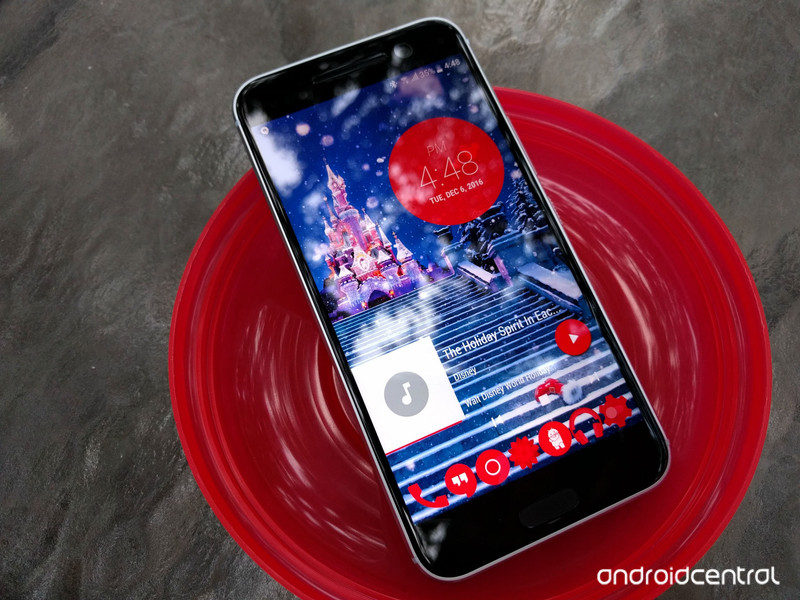
Live wallpapers have languished in recent years.
It’s a shame, too, because there is so much potential for beautiful and useful wallpapers rather than a boring static image. Google’s Wallpapers app utilizes a live wallpaper… but only to change out static images every day. Well, there are some developers who are looking to bring back the live wallpaper, and if they all start off as well as Touch Circle, this themer hopes to be swimming in them by summer.
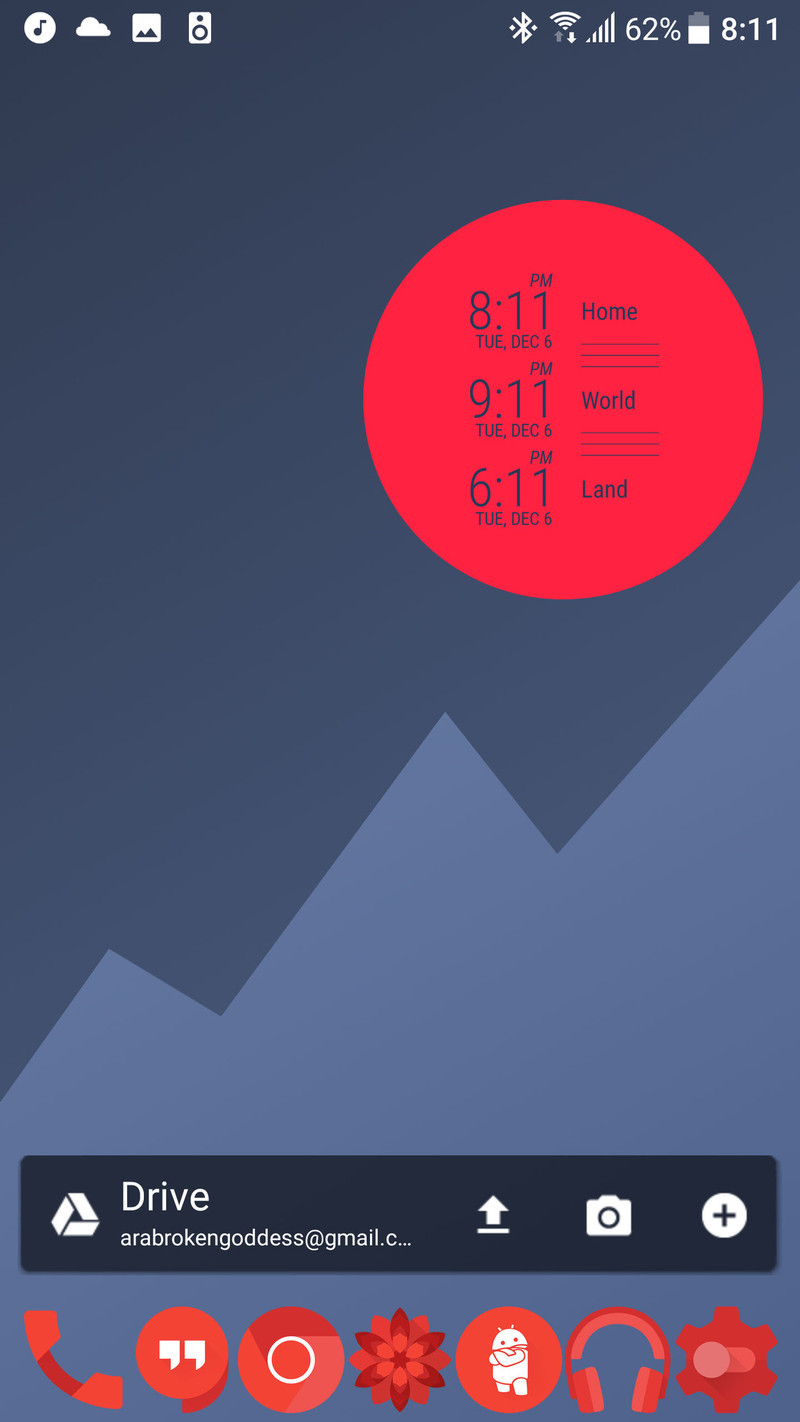
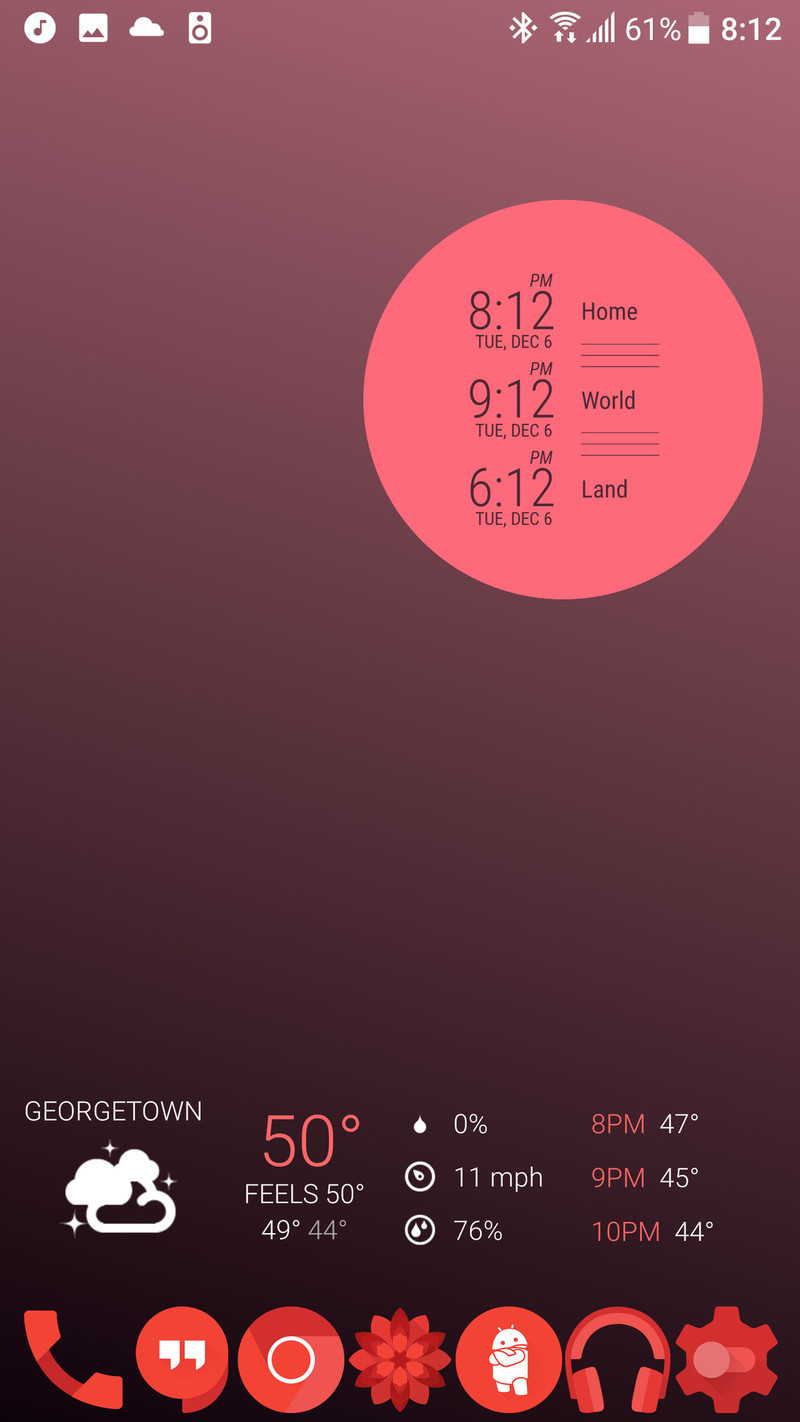

Touch Circle is a live wallpaper with a simple premise: it puts helpful content inside a circle on your wallpaper that you can cycle through and activate with gestures and taps. The free wallpaper puts a material mountain behind your Touch Circle in your choice of colors, but if you pay for the Pro version you can instead opt for a soothing gradient or put your own image behind the Touch Circle.
The content in that Touch Circle is somewhat limited right now, but offers some basic functionality and a lot of shortcuts, as you can launch a different app for each content slide. You can cycle through the following on your Touch Circle:
- Time: This shows the time, date, and the next set alarm, if you have one.
- Time Zones (Pro): Show times for up to four time zones with the ability to pick personal labels for each zone.
- Next calendar event: next single calendar event.
- 3 calendar events (Pro): show the next three events on your calendar in a timeline format.
- Motto: Display a custom phrase. You can also use this to leave yourself a reminder, such as ‘STOP DRINKING SODA AND GET UP!’
- Day countdown (Pro): Count down to a future date. 12 days to Christmas, 12 days to Christmas, plenty of time to do your Christmas shopping!
- Symbol: pick your favorite symbol to display. This is useful to leave up when you might not want others to see other content in your cycle like calendar info or a reminder in Motto.



I kept four of these content slides enabled, and while it would be nice to re-order then at some point, it was easy to find the slide I wanted to look at and easy to trigger the app attached to it. If you’re a heavy gesture user on your launcher like I am, you might have to play around to get the gestures to play nice between the two apps, but once you do, Touch Circle is quite quick to respond to the gestures.
Touch Circle can seem like a glorified widget in live wallpaper form, but it’s a widget that works and can easily replace three or four other widgets on your screen. It’s an app that’s still in its infancy, but one that I’m interested in seeing grow. The base app is free, but the dollar upgrade for Pro can easily justify for the extra content.
Touch Circle (Free, $0.99)
We’re also giving out 50 Touch Circle Pro codes [in our forums!]((http://forums.androidcentral.com/wallpapers-ringtones-themes/752148-touch-circle-live-wallpaper-contest.html#post5596236)
 AIVAnet