


I’ve accidentally joined the cult of Pokémon
Pokémon passed me by when it arrived in the UK back in 1999, and I’ve never really been a fan. The way my friends were suddenly gripped by its cult-like lure made it seem like the worst thing ever. In my mind, 15-year-olds shouldn’t be hunched over their Game Boy Colors; they should be trying (and failing) to talk to girls. I also objected to the title on moral grounds, since it glorifies bloodsports like dogfighting for an audience that isn’t old enough to appreciate nuance. My stance between the ages of 15 and 30 was simple: fuck Pokémon. Which is why it’s so galling that I spent last weekend roaming the city for Pokéballs. Thanks to Pokémon Go, I’ve become everything that I hate.
I’m not much of a gamer, but I installed Pokémon Go out of a sense of obligation to the site I work for. I figured that at some point I’d have to cover the title, even if the only game I play is FIFA 13 on Xbox 360. But I decided to have some fun with it, using the Pikachu workaround to capture it first and then wind up my colleagues and friends. I sent them a screenshot of my captured Pikachu and told them that I’d won the game on my first try and therefore never needed to play it again.
I didn’t bother with it much after that thanks to the one-two punch of me not liking Pokémon and also thanks to Niantic Labs’ hilarious server issues. But, while out for a walk a few days later, my wife spotted a Pidgey close to our home and encouraged me to catch it. The further we wandered, the more times her phone began to vibrate, informing her of a nearby animal to capture. After the third or fourth capture, I started to enjoy the Paper Toss-esque mini-game in which you attempt to bounce a ball on the head of your prey.
At the end of that trip, I stumbled across a Golduck with a combat points rating of 165, far in excess of the 10-point minnows we’d been catching. Naturally, we both went for it, but I managed to rinse my supply of 45 Pokéballs attempting to capture this thing which kept escaping my clutches. That was probably the moment when I became lost to the cause, since I was determined not to let this creature get away. It meant, naturally, that I had to swing past plenty of Pokéstops on the way back to replenish my supply.
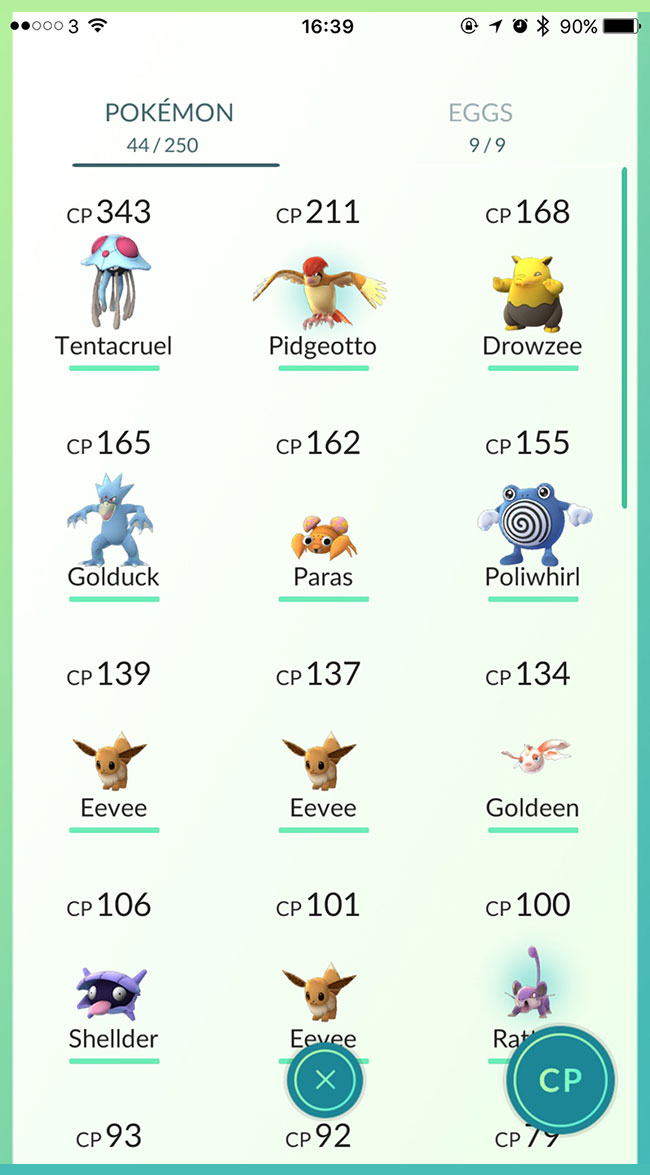
This is what a winner’s Pokédex looks like, if they suck at winning.
In the UK, it’s customary to celebrate a lunchtime Sunday roast with a long walk to balance out the Thanksgiving-level of calories you’ve just consumed. So we decided to venture out, but while we’d planned to just walk across the river, Pokémon Go had other ideas. It began suggesting that, through the older, cobbled streets that surround the cathedral, there was a litany of Pokéstops. So, we obligingly began to follow that path instead, stocking up on powerups, eggs and balls. On the way, we found a medieval defensive tower we’d never encountered before, plus a hidden riverside pathway that isn’t obvious from the road.
The walk was twice as long as planned, and I returned delighted to have found all these new spots nearby. I’d also managed to rinse my phone battery in about four hours — a new record even for me. The following morning, those same colleagues I’d ribbed the week previously were now dealing with a litany of questions. I wanted to know how best to level up, how gyms worked and what was the best way of improving my collection so that I can take over the gym across from my home.
Today, I’ve not been out on the catch, although I’ve had my phone open for much of the day picking up anything that comes within my range. When I’m done writing this, I’ll wander at least as far as my local Pokéstop to re-up on supplies, and maybe think about going a little further. I can’t believe that any game is getting me out of the house and wandering around historic sites, let alone a Pokémon game. It’ll be a while before I can get to the point where I’ll be able to fight my locals — their Pokémon all have combat points in the thousands — but I’ll get there at some point.
Fitbit data has been utilized for various clinical trials
Fitness wearable manufacturer Fitbit and Fitabase, a research platform, have announced that their individual tech has been picked up by researchers round the nation to help further medical studies.
Fitabase has collected over 2 billion minutes of data from users who actively wear their Fitbit activity trackers to measure sleep, activity and more. Such data has been pulled for studies on spine surgeries like that of the Northwestern Medicine and the University of California San Francisco’s work.
This isn’t the first time this sort of data has been gathered from a wearable or portable device, such as with Apple’s ResearchKit, but it does call into question how reliable the data actually is. When Fitbits will measure steps when I’m wearing it and typing vigorously, is that data still viable for clinical trials?
Either way, this is an interesting step for Fitbit to take, especially with so many users out there and various trackers to take advantage of.
Via: BusinessWire
Source: BusinessWire
Possible iPhone 7 Lightning to 3.5 mm Adapter Surfaces in New Photos
A collection of new photos and a video showcase a Lightning to 3.5 mm adapter, which has previously been rumored as a bundled accessory for the iPhone 7 this fall as a way to assuage users of the smartphone’s long-rumored removal of the 3.5 mm headphone jack. The adapter in today’s photos was reportedly obtained from a Foxconn factory in Vietnam (via Tinhte.vn) [Google Translate], and the report’s author believes it could be a genuine Apple adapter.
As shown in the pictures shared today, the adapter’s cord appears short and visually similar to that of Apple’s current adapters sold on its website, including the USB-C to USB and Thunderbolt to Gigabit Ethernet accessories. The Lightning plug does not appear to fit particularly well into its sheath, but it’s unclear if it might be an incomplete part, damaged during disassembly, or simply a knockoff product.
When the Lightning to 3.5 mm adapter is plugged into a device running iOS 9 or lower, the software displays an incompatibility message to the user, but when used on devices with a beta of iOS 10 installed, the dongle appears to work “immediately” without any issues. The author also notes that if headphones are plugged into both the standard headphone jack on a current iPhone and the adapter connected to Lightning, the device gives priority to the Lightning port for audio output.

While the adapter shown today could still potentially be a third-party product, it fits with Apple’s design aesthetic and its ability to function with the large number of 3.5 mm headphones already in the wild could be a better solution than a previous, sketchy rumor that hinted at Lightning-enabled EarPods coming with the iPhone 7.
Regardless of whether this leaked adapter is a genuine Apple product or not, Apple’s solution will undoubtedly be sleeker than most other current third-party solutions, but many users remain opposed to the removal of the headphone jack that will cause conflicts for users looking to use wired headphones and charge their devices simultaneously.
Related Roundup: iPhone 7
Tags: tinhte.vn, Lightning
Discuss this article in our forums
Samsung Doubles Apple’s Share of Smartphone Market as Customers Await iPhone 7
The latest data from market research firm IDC reveals that Samsung shipped nearly twice as many smartphones as Apple in the fiscal third quarter. Android-based Galaxy smartphone shipments totaled an estimated 77 million, compared to 40.4 million iPhones, during the three-month period that ended in late June. For Apple, the fiscal third quarter is seasonally its lowest of the year.
Samsung was the most popular smartphone vendor in the quarter with a leading 22.4 percent market share, nearly double Apple’s 11.8 percent market share. Samsung experienced 5.5 percent year-over-year growth on the strength of the Galaxy S7 launch in March, whereas Apple declined 15 percent compared to the year-ago quarter as customers await the iPhone 7 series in September.
One bright spot for Apple was the lower-priced iPhone SE, although the iPhone’s average selling price dropped to $595 compared to $662 last year:
Apple’s second quarter saw the Cupertino-based giant ship 40.4 million iPhones, representing a 15.0% year-over-year decline from the 47.5 million units shipped last year. The new 4-inch iPhone SE proved successful in both emerging and developed markets as the new SE has captured many first-time smartphone buyers as well as Android users switching over to the Apple ecosystem. The success of the cheaper SE did, however, have an impact on the overall average selling price (ASP) for an iPhone in the quarter. The ASP for an iPhone was $595, down 10.1% from $662 one year ago. As smartphone competition continues to escalate and upgrades continue to slow, Apple will look to drive sales with a newly designed iPhone 7 combined with their upgrade program come this fall.
Apple also ceded market share to Chinese rival Huawei, which ranked third among smartphone vendors with an estimated 32.1 million shipments and 9.4 percent market share. Huawei manufactures Google’s popular Nexus 6P and introduced new dual-camera P9 and P9 Plus smartphones in April, but its presence in the United States and other regions is still limited compared to China.

Chinese rivals OPPO and Vivo rounded out the top five smartphone vendors with quarterly sales of 22.6 million and 16.4 million units respectively. OPPO in particular saw explosive 136.6 percent year-over-year growth over the three months, increasing its market share to 6.6 percent compared to 2.8 percent in the year-ago quarter. Vivo had 9.1 percent market share, an 80.2 percent year-over-year change.
Worldwide smartphone shipments totaled an estimated 343.3 million units in the quarter, an increase of only 0.3 percent from the year-ago quarter, when vendors shipped an estimated 342.4 million units. The relatively flat growth is the result of market saturation and lengthening upgrade cycles, which vendors have attempted to offset by offering incentives such as the iPhone Upgrade Program.
On Wednesday, Apple CEO Tim Cook said the company recently sold its 1 billionth iPhone.
Tags: Samsung, IDC, Apple, Huawei
Discuss this article in our forums
Apple’s ‘Hard-Nosed’ Negotiating Tactics Leading to Trouble in Television Market
Apple’s “assertive” negotiation tactics have made it difficult for the company to establish deals with cable providers and networks, reports The Wall Street Journal, stymieing its efforts to build a more robust television platform.
According to The Wall Street Journal, Apple started talking with the Walt Disney Company in early 2015 about getting Disney-owned content onto its then-planned streaming television service, but Apple executives, iTunes chief Eddy Cue in particular, made demands networks were not prepared to meet.
In particular, Apple wanted to freeze for several years the monthly rate per viewer it would pay to license Disney channels. TV channels usually get annual rate increases and rely on them to fuel profit growth.
Disney balked. Similar talks with media giants that included 21st Century Fox Inc. and CBS Corp. also stalled.
Apple sees TV as a way to push further product growth, but persuasion tactics that have worked in the mobile phone and music industries aren’t working in the television industry. Content providers are reluctant to agree to Apple’s terms because it would compromise traditional revenue streams. As The Wall Street Journal points out, inking a “sweetheart” deal with Apple could lead to traditional cable distributors demanding similar deals.
Over the last several years, Apple has made several attempts to enter the television market, seeking deals with Time Warner, Comcast, and other providers, but nothing has panned out. In one instance, Apple wanted full on-demand seasons of hit shows and a recording feature that would include ad-skipping in newly aired shows, something cable executives were surprised by.
Apple sought payments of $10 a month per subscriber from the cable providers and refused to rule out seeking an even higher share of each monthly subscription in the future, according to people involved in the talks. It also wanted users to sign in with Apple IDs, even though Comcast and Time Warner Cable would handle billing and customer service.
Up until last year, Apple was still in talks for a streaming television service that would bundle several popular live channels and on-demand television at a price point of approximately $30 per month, but Apple reportedly put the project on hold after being unable to establish the necessary deals because content providers were reluctant to unbundle their channels. Cue, who leads most of the deals, is known for his “hard-nosed” negotiating style and refuses to settle for less than what Apple wants.
Instead, Apple has shifted towards positioning its Apple TV set top box and the tvOS App Store as a platform to allow networks to share their own original content. Apple is also following in the footsteps of Netflix and Amazon Video with original programming aimed at promoting services like Apple Music and the App Store.
Three shows are in the works: a dark semi-autobiographical drama starring Dr. Dre called “Vital Signs,” a reality series that follows App Store developers called “Planet of the Apps,” and a music-based reality show that’s a spinoff of “Carpool Karaoke.”
Related Roundups: Apple TV, tvOS 10
Buyer’s Guide: Apple TV (Neutral)
Discuss this article in our forums
Apple Confirms Upcoming Retail Store at World Trade Center
Apple market director Jason Barlia has confirmed the company’s plans to open a retail store at the World Trade Center Transportation Hub in Lower Manhattan, according to CNET. The store will be located in the Oculus transit and retail complex, and it is expected to open later this year.
WTC Transportation Hub – Oculus (Image: Priscilla C. via Instagram)
The location will mark Apple’s tenth retail store in New York City after its first Brooklyn store opens in Williamsburg this Saturday. Apple has another six stores in Manhattan, one in Queens, and one on Staten Island. The Bronx is the only borough that remains without an Apple Store within New York City limits.
Apple’s plans to open a retail store at the new World Trade Center have been rumored since 2013, and an alteration permit confirmed the company’s construction plans earlier this year. The store is said to be situated at the underground level, and it will reportedly span two floors with up to 10,000 square feet of space each.
Related Roundup: Apple Stores
Tag: New York City
Discuss this article in our forums
LG V20: Imagining a next-gen, ‘phablet-class’ LG phone

After the flop of the G5, LG could do just about anything with the anticipated follow-up to the V10. Let’s look into our crystal ball and imagine how a larger, beefier LG smartphone might materialize.
The LG V10 was one of the more underrated phones of 2015 — in many ways, the logical conclusion of the plastic Android smartphone. The hardware was a weird mishmash of metal and plastic. Performance was fast. The screen was pretty good. The camera impressed. The software was kind of a mess. There was a removable battery!
LG augmented all this with some standout camera software features, a pair of front-facing cameras (one regular, one wide-angle) and a quirky second screen up top, which could show notifications in tickertape form, or let you quickly hop between apps.
The V10 was targeted at content creators and power users — a good chunk of the audience Samsung attracts with its Galaxy Note series. So a year on, and with Samsung in an even more dominant position, how might LG react? Let’s take a look at a few possibilities for the V10’s successor, reportedly coming to market as the LG V20 this September.

Surprise! Turns out LG’s modular experiment with the G5 has largely failed. That device has, by its manufacturer’s own admission sold in disappointing numbers. And if nobody’s buying the phone, we can be sure few are snapping up the lackluster selection of plug-in modules. As a result, the ecosystem of modular LG “friends” is as good as dead.
LG isn’t afraid to try all sorts of crazy concepts, as evidenced by the aforementioned modular mess, and the fact that things like the LG Rolling Bot exist. It’s also a phone maker with a notoriously short attention span, unafraid to drop ideas that don’t work without much of a second thought.
Case in point: the Nexus 4’s sparkly glass back, the LG G4’s leather hide, and the laughably bad G Flex 2 “self-healing” back, which scratched up faster and more permanently than any phone I’ve ever used. Before long the G5’s modules will surely end up on the same conceptual scrapheap.
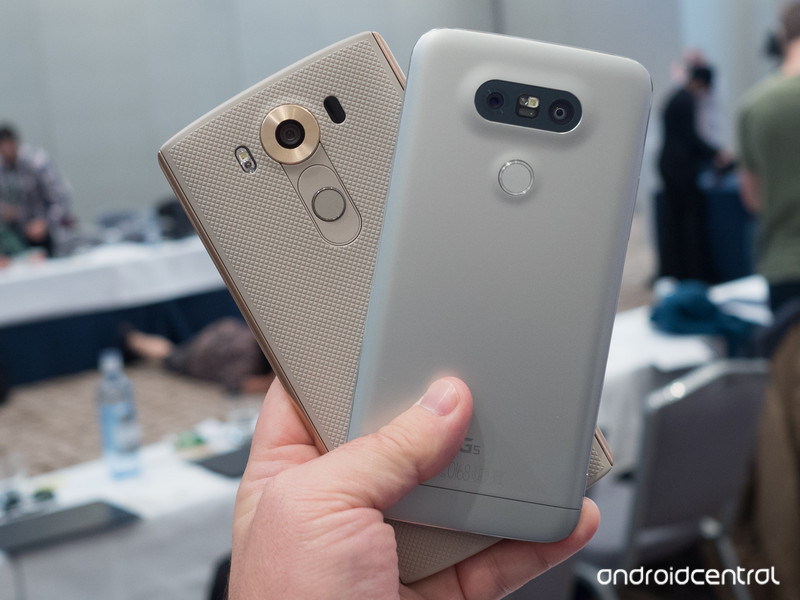
A lot of crap has been thrown at the wall, but very little has stuck.
Consequently, LG isn’t chained to any particular design language or feature set in developing the V20, mainly because its recent efforts have been so haphazard. It could do just about anything with its next phone. And after a disappointing start to the year, we’ll be looking to the V20 for signs that LG can stay relevant at the high end.
We shouldn’t overdo the doom and gloom, though — there are strengths to be built upon. LG’s cameras have been superb lately. Although mostly identical to the G4’s, the LG G5’s rear camera can challenge Samsung in most conditions. And the secondary wide-angle camera is a great example of how twin cameras can add real value.
And LG Display makes great screens — not just for LG phones, but also for the likes of Apple.

With all that said, what’s the best option for LG? Surely we’ll see another large display, likely around the 5.7-inch mark, as before. The standard collection of high-end internals will be along for the ride — probably a Snapdragon 820 or 821, 4 or 6 gigabytes of RAM. Expect USB Type-C and some form of quick charging. So far, so Android smartphone in late 2016.
As for the chassis containing all these guts, anything could happen. But we think it’s time for LG to finally move past removable batteries and the design compromises involved in making a phone you can take apart and remove components from. There’s a good reason LG’s the only manufacturer left making high-end phones with removable batteries — everyone else has figured out you can make more solid, better-looking gadgets if they’re not designed to be disassembled by the average user.
That being the case, the question is which direction LG will go in. Free from the constraints of a removable battery, LG could step up from the G5’s mix of resin-coated (plasticky) aluminum to a more traditional unibody. A glass back is another possibility, and one LG explored way back when with the Optimus G and Nexus 4. Plastic isn’t inherently bad — see last year’s Moto X for an example of how to combine metal and polycarbonate in a way that works. But it’s getting harder and harder to justify anything but premium materials in a $600+ smartphone.

The V20 might have a big reason to move away from ‘buttons on the back.’
Next, let’s talk about back buttons, and how the G5’s move away from rear-mounted keys didn’t really make much sense. Sure, the power switch stayed back there, but LG had a great little differentiator in its trademark rear-mounted volume keys, which made its quick-launch camera shortcut really easy to use.
As much as we’d rejoice to see back buttons return, LG has a big reason to move even more stuff off the back of its next phone. Back in May LG Innotek unveiled the first fingerprint scanner embedded into the front glass of a smartphone. It’s unclear when it’ll be ready for the mass market, but if this technology was used in the V20, LG might want to stick all its buttons back on the side, and rely on its fancy new screen-mounted fingerprint reader.
Speaking of the screen, we’re hoping to see the return of the V10’s quirky secondary display. It’s one of those features that’s way too easy to mock until you’ve actually used it. Sure, the default function — showing your name or some cutesy message — is dumb. But as a way to hop between recent apps in fewer taps, or flash up notification content without obscuring other apps, it works shockingly well. And depending on its size and placement, it could double as a reasonable “always-on” screen.
LG’s cameras are already really good, but it needs to not stand still in this crucial area.
LG’s cameras are already really good, but it needs to not stand still in this crucial area. It’s used the same 16-megapixel Sony sensor and f/1.8 lens in the G4, V10 and G5, so it’s time for some progress — be it in the sensor, the lens, the stabilization or all three. LG’s doing some good stuff with dual lenses, but the V10 needs to be more than just a G5 with a bigger screen to turn heads. (Samsung can afford to just build a bigger version of its small phone thanks to the S Pen, and the fact that the small phone in question is exceptionally good. LG doesn’t have that luxury.)
As for software, there’s always room for improvement when it comes to design, and LG’s taken a lighter tough to software “skinning” this year. Arguably it’s still well behind Samsung in this area though. If nothing else, the G5 is lightning fast, and the most onerous of LG’s software additions are easy to disable. What’s most important for the V20 though, considering its likely footprint of 5.7 inches or above, is that it ships with Android 7.0 Nougat. The phone would then benefit from Nougat’s native multiwindow support, as opposed to the half-baked implementation used in earlier LG phones (which as it happens was bizarrely absent from the G5.)
Standing out and successfully differentiating a new high-end smartphone is hard, even for a company with the resources of LG. That’s surely why we’ve seen so many off-the-wall ideas over the years from Samsung’s local rival. But by now the firm has no excuse for knowing what works and what doesn’t, because it’s tried just about everything.
The V20 should be better, and not just different.
In recent years LG has, it seems, looked at Samsung and just tried to be different. Now, with the benefit of countless product cycles, it’s time to prioritize being better. Mobile Nations Managing Editor Derek Kessler remarked to me after the G5 launch event that this phone was LG at its most LG — its most different for different’s sake. That’s the mindset LG needs to move beyond if it’s to succeed with the V20 and, eventually, the G6.
So will the V20 be the device that finally brings some fire to LG’s mobile division? According to reports from the Korean press, the LG V20 is set to break cover in early September. We’ll be watching with interest, bringing you full coverage along the way.
What would you like to see from the LG V20? Share your hopes and fears down in the comments!
MrMobile reviews the smartwatch on steroids — Casio’s WSD-F10
There’s something about summer. The fresh air. The hot sun. And the ability to dive up to 50 meters with your MIL-STD-810G smartwatch.
In his latest video, MrMobile reviews the Casio Smart Outdoor Watch — also known as the WSD-F10 — an Android Wear smartwatch that can go pretty much anywhere, and withstand pretty much anything. While it lacks some key fitness features, like heart rate and GPS, it has everything a hiker — or diver — could want, including directional, atmospheric, accelerometer, and gyrometer sensors.
But at $500, is it worth the expense?
See at Amazon
When you’re done, be sure to subscribe to MrMobile on YouTube if you enjoyed this video!
Moto G4 review: Balanced on a budget

The Moto G4 proves a budget phone can be quite capable.
The Quick Take
The Moto G4 is a 5.5-inch Android phone that lacks any kind of definition to help it stand out. With a single top speaker grill, and its rounded corners, it blends in. It delivers a great display that is easy to see both inside and outdoors, along with a battery that will keep you going all day — and then some. It’s got a decently-performing camera, and new access to manual features for photos.
The Good
- Solid feel in your hand
- Good camera with manual features
- Great battery life
The Bad
- Processor gets overworked from extensive use
- Camera lags when opening
- Only 16GB of onboard storage
About this Review
I (Jen Karner) after a week of using a Moto G4 for about ten days, running Android 6.0.1 with the May 1, 2016 security patch. The build number is MPJ24.139-48. It was connected to the AT&T network in Halethorpe, Maryland.

The best of plastic
Hardware
| Display | 5.5-inch Full HD display, 401 PPI, Gorilla glass 3 |
| Processor | Qualcomm Snapdragon 617 SoC (Octa-core Cortex-A53) |
| Storage | 16GB, expandable by 128GB Adoptable storage |
| RAM | 2GB |
| Rear Camera | 13MP, PDAF and laser autofocus |
| Front Camera | 5MP |
| Battery | 3000 mAh |
| Size | 153 x 76.6 x 7.9 mm154 g |
In your hand, the Moto G4 feels sturdy, but definitely made of plastic. The back plate is smooth, with a textured cross hatch that can feel a bit strange at first, especially if you’re moving to the G4 from a metal framed phone. Despite its large screen, the phone fits and can be used with a single hand.
When you’re looking at it, the phone could pass for any other rectangular, round-cornered phone. There’s only one piece of branding at all, on the backplate: the Moto logo just underneath the camera. This is a phone that is striving for simplicity, something you can tell by glancing at it. There are only two buttons, both located to the right of the screen. The power button is seated on top, with a textured pattern to help tell it apart from the volume rocker. The rocker, is seated just under the power button and is smooth. Both of the buttons are metal, and are easy to tell apart from the phone’s plastic body.
The screen does its job well, delivering a great experience even in direct sunlight.
There are only two ports on the phone, the micro-USB charger at the bottom, and a 3.5mm headphone jack. There is a single speaker located above the screen, and while not amazing, it gets the job done. To the right of the speaker grill is the lens for the front facing camera. On the back of the phone you’ll find your rear facing camera. The back plate of the phone also pops up revealing your SIM card slot, an microSD card slot, and the unremovable battery.
The screen on the Moto G4 is a 5.5-inch Full HD display with a Gorilla Glass 3 overlay that reaches nearly across the entire phone, with space above and below it. The screen does it’s job and well, delivering a great experience even in direct sunlight. You’ll get vibrant and poppy colors that aren’t washed out, or oversaturated. Even when you dim your screen, it’s never so dark that it’s unusable so long as you are indoors.
The Snapdragon 617 processor is adequate to let you get everything done, but doesn’t go above and beyond. Likewise, the phone occasionally heats up when playing a battery-intensive game like Pokemon Go or Avengers Academy for a prolonged period of time. For the most part, though, the phone is capable of handling anything from social media and the web to playing Match-3 games for an hour and a half.

Android all the way
Software
Happily, the Moto G4 is running Android 6.0.1 out of the box. Having the most up to date software possible is a must for many people, and seeing a budget level phone up to date is always a good thing to see (though it won’t be up-to-date for long). Instead of seeing overbearing Moto software, there is an emphasis on Google and stock Android, with a few Moto flourishes thrown in.
Those flourishes include gestures, but sadly lacks the Moto Voice feature that allows you to quickly access specific notifications usually found on more expensive Motorola devices. You will be using those Moto gestures as you become more acquainted with the phone. You can launch your camera by quickly double twisting the phone, or flipping it to lay face down to silence an incoming phone calls.
When the phone did start to heat up was when there were some issues with the performance of the phone.
There were some issues when the phone was used for an extended amount of time, though. The entire thing would heat up, and while never becoming too hot or issuing a warning, it did become uncomfortable in my pocket or hand. When the phone did start to heat up was when there were some issues with the performance; apps would stutter, and it was easier to just put the phone down and let it cool back down before trying to do much of anything.
To storage, if only 16GB of space seems like too little, you’re still in luck. The Moto G4 takes advantage of Google’s Adoptable Storage feature, letting you mount up to 128GB microSD card to augment the storage you have access to.

An expected flaw
Performance
The Moto G4 is running on a Snapdragon 617, with 2GB of RAM which, while technically an upgrade from its predecessor, is aging quickly and as you’re running around doesn’t always stand up to the abuse. That’s not exactly rare with a lower-end phone, but it is still just a bit disheartening.
For most people, the processor will be exactly what you need out of the phone. However when used heavily, the phone does occasionally try to rebel. On several occasions during my time with the Moto G4, it got hot and jittery enough that I had to clear all of the open tasks, or even restart the phone. This was generally after heavy extended use that most people wouldn’t get to.

Fine tuned controls
Camera
For plenty of people, the camera on their phone is a pretty big deal. You want something that can capture the moments in your life that matter. For the most part, the Moto G4 has delivered a great camera. With a 13MP sensor on the back and a 5MP front facing shooter you’ll be covered. The one big flaw, though: no matter how you open the camera it takes several seconds to load. It’s not a deal breaker, but it can be frustrating when you’re trying to grab a shot in the spur of the moment.
Once it opens up, you’re good to go. The camera allows you to adjust between regular shooting, and with the G4 they’ve added manual controls. While many people don’t want to fuss with these, there are others who like being able to fine tune the photos they snap and now they can. LG is already known for their manual settings, but it’s nice to see Moto joining in as well.


Switching between photo and video capture is simple, and just involves a few taps. If you want to adjust your default settings for photo and video, the settings are available by swiping to the side. If you decide to dive into the professional mode, you’ll have access to all of the manual settings. These settings pop up on a sliding scale for adjustment after you tap on the appropriate settings on the right side of the screen.
Another small downside to the camera: how long the HDR takes to process. Occasionally you’ll get a message asking you to hold your phone steady while taking a photo. For most people holding still for an extra second or two isn’t a big deal, but it can produce problematic blurry photographs if your hand is shaking. This didn’t happen often, but it’s worth noting.
Overall the camera performs really well, especially for a phone under $300. The laser autofocus also means that you can easily grab great candid shots. You’ll just need to make sure the camera is open in advance. It would have been nice to see some optical stabilization, but given the small size of the phone it’s usually pretty easy to hold steady.

It just keeps going
Battery
There’s something to be said for a phone that has a battery capable of getting you through the day without needing a charge. The Moto G4 is packed with a 3000mAh battery that will get you through your commute, and work day, along with getting you home. A single full charge got me through nearly a full day when I needed to charge it.
The adapter included with it is equipped with TurboPower charger, Moto’s take on Qualcomm’s Quick Charge 2.0 standard. It’s easy enough to just plug in for 10 or 15 minutes and see a 20% improvement in the battery. If the Moto G4 dies on you, which only happened to me once, it’ll only take about an hour and a half to get you back up to a full charge again.
For everyday users this battery will get you through at least a full day. For heavier use, it’s good for about 16 hours.

It’s worth it
Bottom Line
So is the Moto G4 worth the $199.99 price tag? In a word, yes. This phone packs a serious punch for its asking cost. You get fantastic battery life, a decent display, and a camera that delivers great results. While there are some small issues it doesn’t take away from the whole package, and the Moto G4 is a contender in the budget range of phones.
While Motorola used to dominate the budget range, those days might be running out. There are progressively more budget phones, and each one has it’s own particular perks. While the G4 may not be the best overall phone, you can deny the appeal of a battery that can take whatever you feel like throwing at it.
See the Moto G4 at Amazon
ICYMI: Robot spiders can patch an airship during flight

Today on In Case You Missed It: Lockheed Martin is unveiling a new hybrid airship in a couple years (a la Hindenburg) but is first addressing any potential tears in the hull by creating magnetic robots they call spiders, which can crawl over the ship and work autonomously to patch holes as they appear. Meanwhile China’s State Media says the country finished a year-long build of a huge seaplane that will be able to perform water rescues of up to 50 people at a time.
While the plane is down there, it could always pick up more of the mysterious orb just discovered by the Ocean Exploration Trust’s vessel that may be an as-yet undiscovered species of mollusk. That video is here. As always, please share any interesting tech or science videos you find by using the #ICYMI hashtag on Twitter for @mskerryd.

