


Microsoft’s ‘HereHere’ project maps what’s wrong with NYC neighborhoods

It’s no secret that New Yorkers love to complain — the city’s ’311′ non-emergency line serves as a hotbed for grievances on everything from burnt out streetlights to wildlife on the loose. Now thanks to a new project called HereHere from Microsoft’s Future Social Experiences Lab (FUSE) you can keep up to date on your neighborhood’s many complaints through curated notifications.
The initiative displays issues from 40 NYC neighborhoods in a cartoon map with icons representing the largest problems for each neighborhood. Residents can see what issues are affecting their area, as well as opt into an email newsletter detailing local problems. Neighborhood-specific Twitter accounts can also keep you in the loop. The goal of the project is to make the data more accessible to average citizens so they can help prevent issues and help solve those that already exist. At the very least, you’ll know that everyone else in the ‘hood is as pissed off as you are about those “incessant ice cream trucks.”
Filed under: Microsoft
Via: CNET
Source: Microsoft Research, HereHere

Watch us play Titanfall for Xbox One (poorly) right here! (update: and it’s over!)

Xbox One’s first major release officially drops this week: Titanfall, from the folks who made Call of Duty into the 800-lb. gorilla it is today. Well, specifically, it launches tomorrow, but we’ve got it right now and thought you’d like a taste before deciding if it’s your next thousand-hour addiction, so we’re streaming it via Twitch just below the break. Though both Ben Gilbert (that’s me!) and Tim Seppala are on the stream today, you’ll have to settle for just Ben’s audio as we try and figure out how to incorporate more editors into the mix. Technology is hard, folks.
And hey, this is our first stream, so let us know what you think in the comments: love it? hate it? what would you like to see? what don’t you? Your input is appreciated! Now let’s go shoot some robots.
Update: Sorry for the troubles, folks. With the Xbox One Twitch app still in beta, we’re having some issues keeping a stream up and running. Bear with us!
Update 2: Okay folks, we’re out! Again, please let us know how you feel about this concept in the comments/via email/on Twitter/etc.! Head below for the archived video, and thanks very much for joining us!
Filed under: Gaming, Software, HD, Microsoft
Source: Twitch

Titanfall: The Joystiq Review

Titanfall is strictly coiled around the player. You couldn’t excise even one piece without slackening it like a ruined kidnapper’s rope. The serpentine level design, the liberating sense of movement, the flawless controls and yes, the enormous bipedal tanks dropping from the sky, are equally indispensable in this arresting shooter.
Given the studio’s splintered status as a former Call of Duty custodian, Respawn Entertainment has made a multiplayer game fit for those who have spent years peering through the eyes of a speedy killing machine – a seasoned six against six in battles for land or a higher kill count. A history with rapid-fire aim and fleet-footed 3D movement is not essential here, but recommended.
Click here for more
Filed under: Gaming, Software, HD, Microsoft
Source: Joystiq

A closer look at Titanfall’s not-so-secret weapon: Microsoft’s cloud

While you were busy running along walls and throwing missiles back at your opponents during the Titanfall beta, countless data centers across the world were making sure that each AI-controlled Titan bodyguard had your back. Much of the frenetic action in Respawn Entertainment’s debut game rests on one thing: Microsoft’s Azure cloud infrastructure.
Up until last November, Microsoft CEO Satya Nadella’s baby was mostly used for business applications, like virtualization and acting as an enterprise-level email host. With the Xbox One, though, the company opened up its global server farms to game developers, giving them access to more computing power than could reasonably be stuffed into a $500 game console. Since the Xbox One’s debut, Microsoft has been crowing about how Azure would let designers create gaming experiences players have never seen before. Now it’s time for the product to speak for itself.
With Tuesday’s release of the online-multiplayer-only Titanfall, Redmond’s gamble takes center stage. Players are no doubt concerned about the game’s stability at launch. With one look at the problems that plagued Diablo III, SimCity and Battlefield 4, consumer skepticism is easy to understand. The folks behind Titanfall believe they’ve got a not-so-secret weapon to circumvent the foibles those games endured, or are still enduring, in Microsoft’s server infrastructure. It’s been in place and running pretty successfully since 2011.
Respawn engineer Jon Shiring says that since the beta ended, some skeptical devs have already changed their minds about the feasibility of using Azure for the parts of a game traditionally handled by a user’s console or PC. In Titanfall‘s case, that largely includes artificial-intelligence-powered teammates.
“Back when we started talking to Microsoft about it, everyone thought it was kind of crazy and a lot of other publishers were terrified of even doing it,” Shiring says. “I’ve heard that since our beta ended, they’ve been pounding down the doors at Microsoft because they’re realizing that it really is a real thing right now.”
By eliminating the hassles of setting up a game’s cloud infrastructure, Redmond is letting developers focus on what’s important: making killer games.
Shiring has touched on what Redmond’s back-end would allow before, but even then, it wasn’t clear just how intrinsic Azure was to the game’s twitch-based multiplayer mayhem. Aside from providing dedicated servers for low-lag online matches, Azure’s remote horsepower is part of what sets Titanfall apart from contemporary first-person shooters.
To understand how Respawn ended up working with Microsoft, we have to travel back to 2007, back when Miley Cyrus was still Hannah Montana and Call of Duty wasn’t a household name.
IN THE BEGINNING
In the span of five years, Call of Duty house Infinity Ward sold millions of plastic discs and, with 2007′s Call of Duty 4: Modern Warfare, it established the prototype for current multiplayer gaming. After a very public falling out with parent company Activision three years later, key creative staff left the studio to form Respawn. While the new team was in the early stages of deciding what its first game would look like, Shiring was already pushing hard for dedicated servers. The downside, however, is that those CPU stacks and the space to house them aren’t cheap. Luckily, Respawn had friends in the right places.
“Microsoft got really interested in the idea, and that was early on,” says Shiring. “I’d say I started to nudge them in 2010, but it really was 2011 when we were coming at them like ‘What can you do? We can’t afford this.’”
This was around the time that Redmond was deciding what to do with the online service for the as-of-yet unnamed Xbox One.

“There are other games like Battlefield that have dedicated servers, but they haven’t gone the same direction that we have with them,” Shiring says.
“We knew in the early stages of developing Xbox One that we wanted to tap into the power of the cloud in a way that hadn’t been done before,” says John Bruno, Xbox Live’s lead program manager. “We were convinced that enabling dedicated servers using cloud computing presented a great opportunity to realize our vision for Xbox One.”
Microsoft is providing the garage and the tools for game developers to work with, and, perhaps most importantly, it’s keeping the rent cheap. By eliminating the hassles of setting up a game’s cloud infrastructure, Redmond is letting developers focus on what’s important: making killer games. For a startup like Respawn, that was pretty attractive and would allow the studio to achieve its vision with minimal compromise.
GOTTA KEEP IT DEDICATED
While a good number of PC games use dedicated servers, most console titles rely on a player hosting each multiplayer session. This introduced more than a few roadblocks to Respawn’s vision. For starters, it wouldn’t allow for the resource-intensive AI-controlled combatants and busy battlefields the team had in mind.
“Having these servers with a significant amount of CPU power and bandwidth available is absolutely essential to our game: Having these machines that are regional and servers that have good ping — that’s huge,” he says. “That has completely changed the way we make games.”
Many look at Titanfall as the first true next-gen game, offering an experience we haven’t seen on last-generation hardware (think: the PlayStation 3 and Xbox 360). From what Shiring says, the fact that Respawn wasn’t held back by a console’s local processing power was key to letting the studio achieve what it has.
“There are other games like Battlefield that have dedicated servers, but they haven’t gone the same direction that we have with them. We have all of this AI and things flying around in the world; that has obviously let us build a different game than we would have if we’d have gone with player-hosted,” Shiring says. “Really, the biggest thing with that is that it has uncapped our designers and let them do things that were previously impossible to do.”
Because Titanfall‘s advanced AI is handled by the Azure servers, your Xbox’s or PC’s innards can be used to achieve more detailed graphics and the game’s silky-smooth frame rate. The Titan bodyguards, dropships and legions of AI-controlled combatants are essentially free from a processing-power standpoint. Without Redmond’s cloud, it’s highly likely that Titanfall‘s six-versus-six player limit would be painfully apparent. Since these features live on remote servers, though, making sure they seamlessly appear in-game is paramount.
THE LAST MILE
As is often the case with networking, the distance between access points is where things tend to fall apart. In player-hosted gaming, it’s no different. When you start a typical multiplayer game on a console, the quality of your experience often relies on how good your connection to the host is. If someone in their house starts watching True Detective on HBO Go or, worst-case scenario, the host leaves, chances are that your experience will suffer as a result.
Shiring believes that, eventually, centralized hosting will become the new normal.
Ping — the time it takes in milliseconds to transfer data between remote machines — is the crux of multiplayer gaming. Simply put: If it’s too high, the bullets you fire at an enemy won’t hit their target because your network is running slower than the game is animating player movement.
For details on why Titanfall doesn’t feature cross-platform play, check out the full interview with Respawn’s Jon Shiring.
Azure’s regional data centers address this by providing a clean, semi-local connection point between your console and the server where it connects. Naturally, the lower your ping is, the better; most PC gamers try to select servers that have a ping of 100ms or less. Shiring tells us that when Respawn’s offices in Los Angeles connect to the Azure data center in San Francisco, the average ping is 19ms to 20ms. “We’re talking barely more than one rendering frame to get a message to the server and back again, which is outstanding,” he says.
“What I’ve found is that a lot of the latency in consumer broadband is at the edges: Getting to another user is slower than getting to a hub and back again,” Shiring says. Because the Azure data centers are regional, he says that the latency is a lot lower than what you would get if the connection was to another player. That means that every non-player-controlled character should do what it’s supposed to do, when it’s supposed to, almost anywhere on the globe.
With Azure taking care of Titanfall‘s external AI elements, the speed that they’re delivered to a game session needs to be near-seamless for a good player-experience. It has to feel like you’re fighting alongside scripted AI teammates in a single-player campaign — not like a typical, stuttery multiplayer match — for the computer-controlled characters to be valuable. After all, a robotic bodyguard is useless if it takes even a millisecond longer for your Titan to detect an enemy than it does for the enemy to kill you. If the technology hiccups because of a slow connection, the illusion breaks. At its core, Respawn’s use of Azure promises a consistently fast connection where you don’t see the stitches holding the game together.
PEAK TIME
These regional data centers also allow Respawn to keep everyone playing even if their closest server farm is overloaded. During the beta, the studio ran Titanfall on an intentionally limited number of servers to discover where the infrastructure’s weak points were when running at a full load. Some 2 million people participated in the game’s test run (across both PC and Xbox One) and at one point, a portion of Europe’s data centers were running at full player capacity and couldn’t accept more users.
Respawn had a contingency plan in place: moving the affected players over to the East Coast US data centers, behind the scenes. This meant higher ping of course, but not by a dramatic amount. “We don’t look forward to doing that at all, but if we have a bunch of people sitting unable to play the game, then we’re going to make sure that the experience is good enough — maybe not ideal — to get them playing,” Shiring says.
In a way, this was a method of answering the biggest question the developer could face during launch: What will happen if everyone tries playing the game at the same time and can’t?
An entire country will miss out on a console game because of the lack of Microsoft’s servers in the region.
“We’re trying to figure out how many people will be playing and trying to make sure the servers will be there for that,” Shiring says. Essentially, that’s where Respawn’s responsibilities end. If player experience is suffering at launch, that’s on Redmond to fix.
“One of the really nice things about it is that it isn’t my problem, right?” Shiring says. “We just say [to Microsoft], here are our estimates, aim for more than that, plan for problems and make sure there are more than enough servers available — they’ll know the whole time that they need to bring more servers online.”
Titanfall benefits from dedicated servers, but it’s dangerously dependent on them to function; there are parts of the world where Azure data centers don’t exist. Like South Africa, for instance. Because Respawn couldn’t guarantee the quality of the experience, its debut game won’t be released there. An entire country will miss out on a console game because of the lack of Microsoft’s servers in the region.
THIS IS JUST THE START
Shiring is keenly aware of the pressures on him and his coworkers to not only launch well, but also to maintain a consistent level of quality throughout Titanfall‘s lifespan. It isn’t just the first tentpole title of the current generation of gaming; it could also be the killer consumer app for Microsoft’s Azure tech.
He expects that once his team’s game ships and is complete, the studio will have more confidence that the grunt work associated with brand-new code and technology will be done. From there, other developers can build on Respawn’s foundation. Shiring believes that, eventually, centralized hosting will become the new normal. He also recognizes the risk in being first.
“Working with Microsoft is great, but we’re kind of taking a bullet with doing the pain of proving that the game will scale up, and we’re finding bugs that every system has at launch,” he says.
The only other proof that Azure actually works for gaming is Xbox One launch title Forza Motorsport 5. The game’s Drivatar system uses the cloud to catalog your racing behavior and create a virtual driver that competes in other people’s online races, earning in-game money while you’re away. Doing laps around the Indianapolis Motor Speedway, however, doesn’t have as wide an appeal as, say, operating a three-story robotic death machine. Should Titanfall and Azure live up to expectations, Shiring thinks that Redmond’s infrastructure could change how studios approach developing games. If he’s right, this could lead to much more Respawn-style experimentation from other studios and maybe create entirely new genres of games as a result.
“Suddenly, the publisher solution becomes more risky than the cloud solution,” he says. “That will be a big shift in the industry for everybody.”
Filed under: Gaming, Home Entertainment, Software, HD, Microsoft

How would you change HTC’s 8X?

It seems like forever ago that HTC was making Windows Phone devices, but it’s not even been a year. HTC’s 8X earned plenty of praise for the fantastic performance, build and battery life – not to mention the display and camera. The downside, of course, was Windows Phone 8, which, at the time, was still too young to hit the spot for our tame phone reviewers. But what about you? We guess that plenty of you would have picked up this phone, so share with us your experiences and what, if anything, you would have changed.
Filed under: Cellphones, Mobile, Microsoft, HTC
Source: Engadget Forums

Greetings, from Joystiq

My Dearest Friends at Engadget,
With this letter I have enclosed a large, slightly frayed chunk of styrofoam that we all thought resembled the prominent “t” in the Engadget logo – you know, the one wearing the cute Wi-Fi hat. We have no use for this item here at Joystiq, so we thought you might hoist it above your reeking desk-beds, or use it in another story about 3D printers.
Assuming this part of my missive isn’t covered in little white bits, I’d love for you to once again consider my proposal for publishing select content from Joystiq, your sibling website that covers the video game industry in a more granular fashion than your folks do. We review everything in the spectrum between indie and AAA, find the best in the worst games, stream upcoming releases twice a week, and have no qualms about making an MIT professor talk about massively multiplayer Pokémon. That does not happen twice a week, but we can work on it.
Of course, the last thing I want to do is inundate your loyal audience with gaming detritus that they already know, so we’ll pick the most relevant and comprehensive articles for Engadget. How’s this one to start? “How many megapixels was the camera in BioShock? The answer will shock you.”
Kind regards,
Ludwig Kietzmann, Editor-in-Chief of Joystiq
P.S. Please do not publish this letter verbatim.
—
Hello LUDWIG KIETZMANN,
We regret to inform you that delivery to the following recipient failed permanently:
ENGADGET STAFF
Technical details of permanent failure:
Google tried to deliver your message, but it was rejected for being “too game-y.” We recommend fewer references to goombas and headshots to avoid this error in the future. The error that the server returned was: 1UP LOL 1337 No relaying allowed – psmtp (state 13).
That said, we’d, uh, love to have you over some time. Not sure when we’re available just yet, but we’ll get back to you really soon. In the meantime, why not just drop those hot Joystiq pieces directly on Engadget so we don’t have to surf all the way over. Surfing is tiring. Uh oh … we’ve dropped the facade, haven’t we?
Filed under: Announcements, Gaming, Meta, Software, HD, Sony, Microsoft, Nintendo

Get Forza 5 free with your new Xbox One (for a limited time)

Americans won’t necessarily have to track down a Titanfall bundle (or move to Europe) to get a free game when they buy an Xbox One. Microsoft has announced that some US retailers will start including free digital copies of Forza Motorsport 5 with the console as of next week, offering gamers a flagship game no matter what system they get. However, the Forza deal will only be available for a “limited time.” We’ve reached out for a clearer time frame, but it’s safe to say that you’ll want to hurry if you’re a racing fan. Don’t fret too much if you miss out, though. Microsoft’s willingness to give away major titles so early in the Xbox One’s life cycle suggests that this is the start of a trend — it may launch similar offers in the future to help fend off some very fierce competition.
Filed under: Gaming, Microsoft
Source: Major Nelson

Watch Dogs arrives on May 27th

When Ubisoft showed off Watch Dogs for the first time in 2012, there was no such thing as PlayStation 4 and Xbox One. Well, okay, they existed in some sense of the word, but both consoles were far from publicly ready, making Watch Dogs an unbelievably pretty game for Xbox 360 and PlayStation 3. Unbelievable to the point that many journalists were incredulous about it not being touted as intended for next-gen, but Ubisoft couldn’t say it was headed to unannounced consoles. In so many words, Watch Dogs was essentially the first “next-gen” game shown off…even before the consoles were unveiled. It’s somewhat hilarious then that we’re here to tell you today that Watch Dogs now has a release date — May 27th — after being delayed past the actual launch of the new consoles. It’s unclear if that means all versions (Xbox 360, Xbox One, PlayStation 3, PlayStation 4, PC and Wii U) will arrive on the same day, though the Wii U version was already given a release date sometime after the other versions. Sorry Wii U, owners!
Filed under: Gaming, Software, HD, Sony, Microsoft, Nintendo
Source: Ubisoft
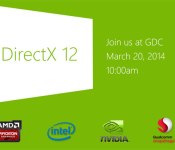
Microsoft teases DirectX 12 reveal for GDC, rumors pit it against AMD’s Mantle

That death knell AMD has been ringing for DirectX? Microsoft’s having none of it. The software giant is now teasing the next version of the Windows graphics API, inviting developers to join it at GDC for the official reveal of DirectX 12. The splash page reveals little besides the version’s numeric and announcement time, but it does feature partner logos for Intel, Qualcomm, Nvidia and, of course, AMD. AMD’s disdain for the platform helped birth Project Mantle — a competing API that gives developers lower-level access (and as a result, more leverage over) PC graphics hardware. One of Microsoft’s GDC sessions suggest that something similar is in the works for its own development platform: “You asked us to bring you even closer to the metal… …so that you can squeeze every last drop of performance out of your PC, tablet, phone and console,” reads the description for one of the firms DirectX presentations. “Come learn our plans to deliver.”
It sure sounds similar, and indeed, it meshes well with recent rumors. Sources close to ExtremeTech say that while the two APIs will have different implementations, both should offer the same benefits. They also say that Microsoft’s “close to the metal” lower-level access API is a relatively new project in Redmond, meaning it probably won’t muscle in on Mantle’s territory until sometime next year. Between that, and the fact that Microsoft has recently taken to limiting Direct X upgrades to Windows upgrades, it’s possible that we might not see DirectX 12 in access until we’re installing Windows 9.
Filed under: Gaming, Microsoft
Source: Microsoft, ExtremeTech

Daily Roundup: the travels of Myspace Tom, a business card that plays Tetris, and more!

You might say the day is never really done in consumer technology news. Your workday, however, hopefully draws to a close at some point. This is the Daily Roundup on Engadget, a quick peek back at the top headlines for the past 24 hours — all handpicked by the editors here at the site. Click on through the break, and enjoy.

Where are they now? The travels and trash talk of Myspace Tom
Remember August of 2003? That’s when many of us gained our first friend on Myspace. Since then, however, the once thriving social network has transitioned to a music hub. But what about its creator? Read on as we explore the travels and mishaps of the site’s founder, Tom Anderson.

A business card that plays Tetris
It’s a bird… It’s a plane… Nope, it’s a business card that runs Tetris! Built by Oregon programmer Kevin Bates, this Game Boy look-alike is comprised of a barebones Arduino board with an OLED display. And yes, a Pokemon version is on the way.

OnLive is back with two new features
If you thought cloud-based gaming platform OnLive was down for the count, you weren’t alone. But today, the company announced two new initiatives, CloudLift and OnLive Go, which it hopes will spawn new life for its community.

A guide to Xbox One gamepad updates
The March Xbox One update is live, and that means new gamepad firmware is available. Revamping your controller isn’t required by Microsoft, but should you attempt it, we’ve got a nifty step-by-step guide that’s sure to ease the process.

