


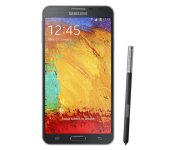
Samsung Galaxy Note 3 Neo aims to offer S-Pen experience without flagship specs

We’ve seen the Galaxy Note series get larger and larger as time passes, but this is the first time we’ve seen the Note actually get smaller. The Galaxy Note 3 Neo has now been officially unveiled by Samsung Poland and will come in two flavors — 3G and “LTE+,” and the latter offers connectivity on higher-speed Category 4 networks (up to 150Mbps down/50Mbps up). The two share a lot of similarities, but there are a couple key differences as well: as you might expect, the LTE+ model is the more specced out of the pair and offers a hexa-core processor consisting of two 1.7GHz Cortex-A15 cores and four 1.3GHz Cortex-A7 cores. The 3G (HSPA+ 21Mbps) version, on the other hand, will enjoy a quad-core 1.6GHz processor of unknown make.
So what’s important about the new Neos? Both versions of the Android 4.3 Jelly Bean device feature a 5.5-inch 720p Super AMOLED panel with full S-Pen capability, which means you’ll be able to take advantage of Air Command, S Note, Multi-Window and other pen-related functions; in other words, it’ll be a less expensive version of the Note 3 for those who want the functionality without the absolute top-of-the-line features. It even comes with the same leatherlike back cover as its flagship counterpart (shown below).
The 162.5g Neo is 8.6mm thick, is compatible with Samsung’s Galaxy Gear smartwatch and comes with a pretty decent array of specs: you’re looking at a 3,100mAh battery, 8MP rear camera/2MP front-facing camera, 2GB of RAM, IR, NFC, WiFi 802.11 a/b/g/n/ac, 16GB internal storage and microSDXC capacity up to 64GB. Not too shabby for a “Note 3 mini” of sorts, although we’re not sure what the price is at present time. Samsung says we should expect a global rollout next month (except the US and the UK, if the company hasn’t changed its mind) in our choice of black, white or green.

Filed under: Cellphones, Mobile, Samsung, Google
Via: PhoneArena, SammyToday
Source: Samsung Poland (translated)

What does national security have to do with the Lenovo-Motorola deal?

Lenovo’s planned acquisition of Motorola’s mobile phone business will likely be reviewed by the Committee on Foreign Investment in the US (CFIUS), the government agency that makes sure foreign investments don’t impact national security. Though the deal will inevitably be heavily scrutinized, few experts expect the agency to scuttle it. That doesn’t, however, mean Lenovo’s deal will be rubber stamped.
When Lenovo bought IBM’s PC division in 2005, members of Congress openly fretted that the Chinese company would use its new asset to spy on American rivals – and the US government. One concern: IBM was (and still is) a major supplier of computers to the government. “Why would the US government be reliant on a Chinese company whose major shareholder is the Chinese government?” Rep. Don Manzullo told The Wall Street Journal. “That in itself sends a chill up and down the spines of members of Congress.”
Similar issues have been raised over Lenovo’s plans to buy part of IBM’s server division. However, as with IBM’s ThinkPads before them, the company’s x86 servers are already being made in China. “If you worry about penetration via your low-end server, you’re going to have to figure out a way to monitor all servers, not just say kick the Chinese company out and we’ll be safe,” says Professor Theodore Moran, a senior fellow at the Peterson Institute for International Economics.
Moran says there are three specific issues the CFIUS looks at, and none of them seem likely to affect the prospect that Lenovo will be able to go ahead with the Motorola deal. The first, having to do with allowing a foreign company or government to manipulate supply, doesn’t apply, he says, because Motorola “represents a very small part of the market.” The CFIUS also checks to make sure no sensitive or advanced technology is being leaked. “They’re not even top-of-the-line cellphones,” says Moran. Finally, there’s the risk of the technology being used to allow foreign companies or governments to infiltrate US government or military systems via backdoors or spyware, something Moran also sees as a minimal risk, given Motorola’s small market share.
In gaining approval for both the IBM server deal and the Motorola acquisition, Lenovo also has history on its side. Earlier fears that Lenovo might pose a threat have gone unrealized. After nearly a decade as the owner of the most venerable brand in the PC business, the company has become a staple of corporate purchasing managers, building on IBM’s long history in enterprise sales. “It doesn’t give them a free pass, but it weighs in their favor,” says Jason Waite, an international trade and regulatory attorney with Alston & Bird in Washington, DC. “How could it not?”
That doesn’t mean it’s smooth sailing for all deals involving Chinese companies. Today, although China and the US are more interdependent than ever, mistrust between the two nations remains high, and it extends in both directions. The NSA’s global spying operation has allegedly included Chinese computers among its targets, while the US accuses China of cyber-attacks on American computers. According to a new report, the number of investments reviewed by the CFIUS has grown in recent years, and in 2012 Chinese companies topped the list of deals reviewed by the agency; that same year, one deal resulted in a rare Presidential ban, after the CFIUS recommended rejecting the purchase by a Chinese firm of a wind farm located near a military facility.
Lenovo itself reportedly lost a bid to buy BlackBerry last year, after the Canadian government vetoed it based on national security concerns. However, Motorola, despite having a long history of supplying telecommunications technology to the US government and military, doesn’t have the kind of ties to Washington that BlackBerry does to Ottawa, and doesn’t enjoy the same kind of ubiquity among government users that BlackBerry once had. “It could be helpful that Motorola isn’t in widespread use in government,” says Waite.
Government pressure has also forced some Chinese companies to scale back their US ambitions. Huawei dropped at least two planned deals amid charges the company was a threat to national security because its networking gear could be used to spy on the US government and feed that info back to its masters in China. ZTE has faced similar accusations. Both companies have denied the charges. “You can get so much anti-Chinese bad press that a deal gets withdrawn,” says Moran, who serves on Huawei’s International Advisory Council. “Huawei didn’t do a good job” projecting an image of transparency in its congressional testimony, according to Waite. Even if Congress holds hearings on the Motorola deal, Lenovo is likely to fare better, he says. “Lenovo has been there before. They’re not going to make that mistake.”
In the end, most experts see the deal gaining approval — though it may face some bumps along the way. “I’m not saying some congressman won’t stand up tomorrow and say something nasty,” says Moran. “But I don’t see a regulatory problem here.” Adds Waite: “If Congress is going to hold hearings on Smithfield, I won’t be surprised to see them take on the sale of an iconic brand like Motorola.” That deal, in which a Chinese company sought to acquire pork processor Smithfield Foods for almost $5 billion, was later approved by the CFIUS.
(AP Photo/LM Otero)
Filed under: Google
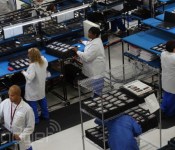
What Lenovo’s Motorola deal could mean for American manufacturing

Lenovo purchasing Motorola from Google raises a lot of questions. But, lost amid all the speculation over what this means for the marketplace, is the potential human cost. Motorola directly employs over 4,000 people, many of them at its headquarters in Libertyville, Ill. — a wealthy suburb north of Chicago rich with brick single-family homes and more trees than people. For the moment, at least, those employees and the executive team appear to be safe. During yesterday’s conference call following the announcement of the deal, Lenovo officials said there were no immediate plans for layoffs or a leadership shakeup. Things are a little more uncertain for those who rely indirectly on Motorola for their paycheck, for example the people working the Moto X assembly line in Fort Worth, which is run by subcontractor Flextronics.
On that very same call, when asked what the purchase meant for those workers, Lenovo danced around the question, saying only that it would do whatever was necessary to “grow the brand.” It was a rather ominous statement that seemed to imply the relationship with that particular Flextronics manufacturing plant would not last. But, after the Lenovo call ended and journalists rushed to update their articles, the story continued to evolve. Flextronics held its quarterly earnings call shortly afterward and said it anticipated no immediate changes at its Fort Worth facility. In fact, the company’s CEO Mike McNamara took time to brag about its “fabulous relationship” with Lenovo, which it hopes to grow on the heels of the Motorola deal. The Chinese manufacturer later issued a statement saying that “there are now no plans to change Motorola’s approach to manufacturing.”
That doesn’t necessarily mean those jobs are safe beyond the immediate future. But there is reason to believe (hope) that Motorola phones will continue to be manufactured here in the US. As a contractor with both Motorola and Lenovo, Flextronics already has its foot in the door. And, while it has never built phones for Lenovo, its experience building highly customized flagship handsets on short order may appeal to the Chinese company as it looks to distinguish itself from other players in the market and make its mark in the Americas. In fact, that ability to customize an order and still deliver it quickly was one of the many competitive advantages Jay Parker, president of Lenovo North America, cited as an advantage of its newly opened plant in Whitsett, NC, where it employs 115 people. (This was also the reason that Google decided to build the Moto Maker editions of the Moto X in Texas.) Just down the road, Lenovo has another 2,200 employees working out of its American headquarters in Raleigh, NC, with hundreds more scattered across the country.

Lenovo is particularly proud of its investment in America. The CEO, Yang Yuanqing, even took time out during the Motorola press conference to reference President Barack Obama’s call to invest in America during the State of the Union. Before announcing that his company was doing exactly that. In a follow-up statement, it claimed that the purchases of Motorola and IBM’s server business mean that it has invested about $6 billion in the American market since 2005.
Flextronics cannot predict the future and, while it’s hopeful about extending its manufacturing partnership with Motorola, it acknowledged that everything could change in a year from now. Still, when one of the few companies building PCs in the US joins forces with the only company building smartphones in the US, it’s hard not to be at least slightly optimistic about the future of high-tech manufacturing in the country.

Google finishes up 2013 on a high note, Motorola on a low one (financially speaking)

We’ve grown accustomed to Google making piles of money, and the fourth quarter of fiscal year 2013 continues the trend . How big’s the pile this time? $16.86 billion in revenue and almost $4 billion in income for Q4. Google’s own sites accounted for around two-thirds of its inbound cash overall, and its international properties continue to be strong performers, with $8.77 billion coming in from outside the US. Motorola, for its part, brought in $1.24 billion of revenue, but continued to lose Google money to the tune of $384 million — that’s over $130 million further into the red than last quarter. No wonder Big G’s eager to make that a Lenovo problem. Of course, the overall picture is a rosy one, as the company’s monetary performance in 2013 consistently outpaced 2012. Naturally, we’ll have more to add once we’ve heard Google’s earnings call, so stay tuned.
[Image credit: Google]
Filed under: Cellphones, Internet, Software, HD, Mobile, Google
Source: Google Investor Relations

[Rumor] Lenovo to Make One of the Last Nexus Products?

Eldar Murtazin has been stirring up some Android controversy lately, with his random tweets about about the Nexus line and Lenovo. It first started with him tweeting that the Nexus line was going to end next year, and that the Google Play Edition line was essentially going to take its place. Boy did that strike a cord. Without even giving it an ounce of thought, many out there infuriated and wanted Eldar to be hung from a tree for even mentioning the Nexus line was going to end. Then after the “out of left-field” announcement yesterday about Google selling Motorola to Lenovo, he tweeted out that Lenovo will make a splash in Chromebooks. That one doesn’t seem so far fetched, but then he dropped yet another doozy, and again, it is causing the community to scream at their monitors.
Lenovo will launch one of the last Nexus product  volume will be huge and it will be focused on US market.
— Eldar Murtazin (@eldarmurtazin) January 30, 2014
So apparently Lenovo will make one of the last Nexus devices, and then we will bid farewell to the name. Now by all means is anyone confirming this to be true. I think a lot of readers immediately insinuate that when we post about these rumors, we are agreeing with them, so we end up taking fire. But when all said and done, it goes like this: we don’t know. Sure, we can take the biased approach and call it a bunch of BS and rant about it, or we can remain neutral and just report what we hear and give our opinions.
My opinion on the matter, is that if Google thinks it is a right decision, then so be it. Yes, Nexus devices are the core of the Android Community, but having the Google Play Editions take over is not a bad thing at all. We can scream back and forth about the good things and the bad things about the move, but that is just time wasted on something out of our control. If it’s silly rumors that Eldar is spreading, well then we can all show up at his doorstep with torches and pitch forks. If not, we will have to say farewell to the beloved Nexus phones we have loved for years. Feel free to let us know your opinion about all this, but please try to do so in a not so hostile way.

Ricoh Theta enables 360-degree photo uploads to Google+ and Maps

Folks who shelled out $400 for Ricoh’s quirky Theta camera can now show off their 360-degree masterpieces to a larger audience. Circle-loving shutterbugs just got the option to upload their images to Google+ and Google Maps via the camera’s companion apps for Android, iOS, Windows 7/8 and Mac. While users have been able to upload to Twitter, Tumblr and Facebook for quite some time, it’s only now that the firm has made the apps compatible with Photo Sphere. As a nice plus, dedicated sphere photographers can string multiple 360-degree pictures together to create Street Views, though they’d probably look too trippy to help out a lost tourist.
Source: Ricoh, Google Play, iTunes, Windows/Mac
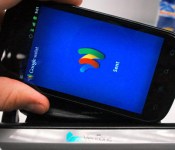
Google Wallet will make collecting loyalty points easier and noisier

Early adopters of mobile wallet services are brave enough to hand over the keys to their finances in the name of convenience. When you’re signed up to a plethora of loyalty schemes, though, inputting all these details before ditching the plastic could be quite the opposite. Google doesn’t want you burdened with such tasks, and in an impending update to its Wallet app for Android, has said it’ll introduce a new feature that adds loyalty cards with one click of your smartphone’s camera shutter. A natural progression from the recent recognition feature that adds debit and credit card details in the same way, snap a picture of your loyalty card and Wallet will do the rest. Furthermore, when you’re near a store with which you have a card, you’ll get a notification to remind you (that Google knows all). While the Android app was updated yesterday, there’s no mention of these additions, so we’ll take Big G’s word that it’s “rolling out this week.” No news on when an update could hit the iOS version of the app, but as Wallet only launched on the platform a few months ago, we’re not going to hold our breath.
Filed under: Cellphones, Software, Mobile, Google
Source: Google (G+)

Korea remembers to fine Google for unauthorized data-gathering in 2010

South Korea’s communications regulator has fined Google $196,000 (or the more impressive-sounding 210 million won) for sucking up personal data during a Street View mapping project back in 2010. These “payload data” fragments apparently included details on unprotected WiFi networks — the same stuff you heard about when both Germany and France fined the company. The regulator has ordered Google to delete all collected private data and to keep the public updated as this deletion progresses. Given the pace at which this case has moved so far, we’ll give ‘em four years.
Via: TNW
Source: Korea Herald
Motorola’s Project Ara team being integrated with Google’s Android team
The Internet is buzzing about Lenovo’s acquisition of Motorola Mobility and you may be wondering what is going to happen to Motorola’s Project Ara.
We have great news for you…. the Googlely project will remain with Google. It seems that the about $3 billion purchase of Motorola Mobility to Lenovo does not include the Advanced Technology and Projects group led by former DARPA director Regina Dugan, whose biggest project is the Project Ara modular phone.
According to The Verge, sources familiar with the matter said that the team of just under 100 people will be moving from their current offices in Sunnyvale to Google’s Mountain View office where they will be integrated with Google’s Android team. There Dugan will report to Android/Chrome OS chief Sundar Pichai, while maintaining “a more independent role.”
Anyone think that Project Ara could potentially become a Nexus some day? Thoughts?
via The Verge
The post Motorola’s Project Ara team being integrated with Google’s Android team appeared first on AndroidGuys.

Lenovo gets Motorola, but Google gets to keep its skunkworks

Lenovo may be buying a brand to help it sell smartphones across the world, but it’s not getting everything that was under Motorola’s umbrella. In addition to the “vast majority” of Motorola’s patents, Google will also hold onto the Advanced Technology and Projects division and fold it into its Android team.
That group is responsible for some of Motorola’s more wild-eyed projects, like the authentication pills and tattoos that ATAP chief Regina Dugan showed off at AllThingsD’s D11 conference. The most eye-catching example of the group’s work was Project Ara, the modular smartphone initiative that first started turning heads in late October. Motorola CEO Dennis Woodside said the prototype phone was nearly done just over a month later, and the company planned to get the Ara module dev kit out the door this winter. It seemed like the team was making real progress, but we’ll soon see if those plans have shifted now that Motorola is leaving the building.

