


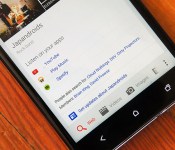
Google now offers links to music apps when you search for bands on Android

Google is making it a little bit easier to start listening to musicians you’re researching. If you search for a band on Android the results will now show quick links to the artist’s page in your music apps. So, lets say someone suggests you check out Kvelertak (which we can tell you is excellent advice). Now when you Google the Norwegian metal band you can simply tap on the Spotify link to start listening immediately. Or, if you’re a big fan of music videos, you can quickly launch YouTube after searching for Solange. Right now the feature is limited to the US, but it does work with a broad range of apps, including Rdio, iHeartRadio, TuneIn, YouTube, Spotify and Google Play. Other countries and services like Deezer will be added in the future.
Source: Google
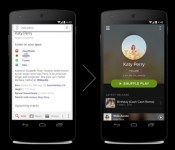
Google Now learns a new quick links trick when you perform a music search

Google Now keeps on moving forward, adding in new features all the time. This time they’ve added a small, but a nifty one.
If you decide to search for music of some kind, Google will (as it did thus far) show you the results of your search. However, from now on it will offer you quick links to listen directly via your favorite music apps. This is quite convenient considering it’s skipping a few steps this way, you don’t have to open those apps manually in order to listen the music you’ve searched for.
As we said, this is just a small addition to the service, but a very useful one. We hope Google will keep on adding features like this in the future like they did thus far.
Source: Twitter (Google)
The post Google Now learns a new quick links trick when you perform a music search appeared first on AndroidGuys.

Blame Canada: Google ordered to block website links worldwide

A minor Canadian court dispute has resulted in a judge’s far-reaching decision that Google must block a website’s search results worldwide, not just in Canada. It arose from a case involving a company that stole its ex-partner’s intellectual property and fled abroad to sell pirated equipment online. Following a court order, Google Canada pulled the rogue firm’s search results, but it put up new sites faster than they could be erased. As a result, a judge ordered Google to spike all its links worldwide — an unprecedented ruling against a search company. Google said that it would appeal to BC’s highest court, claiming the judge overstepped her jurisdiction. Many legal critics also found the ruling puzzling, saying it could set a legal precedent limiting the right to free speech.
As the NYT pointed out, the judge oddly didn’t order Bing, Yahoo or another search providers to pull the results, however. There’s also the thorny question of whether search sites should be held accountable for the illegal actions of others, any more than property managers are responsible for shady handbills. More importantly, many have pointed out that if such rulings stick, rogue nations could use them as an excuse to stifle free speech. Either way, along with the the EU’s recent ruling that Google must strike individual search results on demand, it’s one more headache for Google.
Via: NY Times (Paywall)

Google adds new market availability for Play Books, Play Movies

Google this week expanded the number of countries offering its Play Books and Play Movies apps and services. The former picks up nearly a dozen new markets while the latter gets almost twice as many new areas. There are quite a few countries left for each property however we’re glad to see Google pushing forward with these. Below is a breakdown of the new markets.
Google Play Movies
- Albania
- Argentina
- Armenia
- Azerbaijan
- Belarus
- Croatia
- Czech Republic
- Estonia
- Greece
- Kazakhstan
- Kyrgyzstan
- Lao People’s Democratic Republic
- Latvia
- Lithuania
- Moldova
- Poland
- Slovakia
- Tajikistan
- Thailand
- Turkmenistan
- Uzbekistan
Google Play Books
- Bolivia
- Costa Rica
- Dominican Republic
- Ecuador
- El Salvador
- Guatemala
- Honduras
- Nicaragua
- Panama
- Paraguay
- Uruguay
Click here for a full list of all of Google’s Play services and their respective availability.
The post Google adds new market availability for Play Books, Play Movies appeared first on AndroidGuys.

Quantum computing firm calls ‘bullshit’ as scientists undermine its technology

How do you evaluate a quantum computer you just bought from D-Wave for $15 million? It’s not easy, especially since no one can really understand how the machine — with its ones, zeros and superpositioned “one-and-zeros” — actually functions. Instead, all you can do is throw increasingly complex questions at it, and hope that it answers them quicker than a top-end classical computer. This quest for evidence of so-called “quantum speeedup” has been going on for a while, with little in the way of positive results. Now, a freshly-published collaborative study involving Google (owner of a D-Wave box), Microsoft (owner of some very advanced traditional tech), and a team of university scientists, has achieved new results that are equally disappointing. Science magazine describes the study as “the fairest comparison yet.” D:Wave’s founder, meanwhile, has described it as “total bullshit.”
The dispute partly arises over the choice of questions that were run through each type of machine. The latest study deliberately used questions that both computers could readily answer, and D-Wave claims that these were too simple. The company has also pointed out that it’s a “scrappy startup,” whereas the rival classical machine had the benefit of decades of research and trillions of dollars of investment, so it’s pretty remarkable that the quantum computer was even able to keep up. By contrast, the university-backed researchers say that their comparison was based on challenges that were tailored to be extremely easy for qubit-based processing, so there could and should have been evidence of speedup if quantum mechanics are truly being exploited.
It’s not clear where things will go from here. The study has a conclusive-sounding tone, as does one of its lead researchers, Matthias Troyer from the Institute of Theoretical Physics in Zurich, who simply says “we don’t see quantum speedup.” Then again, Troyer acknowledges that other sorts of tests may reveal the phenomenon “eventually.” Perhaps the onus is now on D-Wave to find some way to silence the skeptics, not just by keeping up with standard technology, but by surpassing it in a meaningful way. Whatever happens next, it sounds like relations between D-Wave and the scientific community are becoming fractured — and that sort of tension will either speed progress up, or slow it right down.
Via: Science (paywall)
Source: Microsoft Research [pdf], Wired

Chrome’s latest experiment is three soccer mini-games with a samba beat

We’ve had the World Cup doodle, and now Google’s Chrome is getting into the Beautiful Game’s big tournament, with three experimental games that connect between your smartphone and browser. (Well, the third title, Shootout, can be played on your phone). Compared to prior titles, however,, they’re a little lame. We found controls on our iPhone to be,well, outright unstable. Rather than our lack of skill, which is usually to blame for our low scores, a buggy connection and unresponsive controls were what usually stopped our keepie-uppies. Slightly insipid gaming aside (c’mon, they’re free and neither Infinite Kick nor Space Kick have an end), the best part is the Brazil-flavored soundtrack. Top scores and bragging rights belong below in the comments, please.
Filed under: Cellphones, Desktops, Gaming, Google
Source: Kick With Chrome

Android Wear Introduced in New Video from Google Developers

Android Wear will be in our lives hopefully sooner than later, and the developers over at Google wanted to make sure we knew what it was all about. The video below was posted on the Google Developers YouTube channel, and it gives you all kinds of info about Android Wear. And when I say info, I mean in-depth info of how Android Wear works, and where they want to take it. Android Wear will be appearing on the LG G Watch and the Moto 360, but many of us still have hopes for that Nexus Watch we keep hearing about. So check out the video below to get educated with Android Wear. Let us know how excited you are to get a watch with OS running on it.
//<![CDATA[
ord = window.ord || Math.floor(Math.random()*1E16);
document.write('’);
//]]>
Android 4.4.4 rolling out to Nexus 4, 5, 7 and 10

Earlier this month Google started rolling out Android 4.4.3 update to certain Nexus devices and now we have yet another update by Google; 4.4.4 is here.
Suffice it to say, Android 4.4.3 update caused issues on certain devices. People have been reporting issues with bluetooth and wi-fi signal most of all. This might be the reason Google is pushing yet another update so soon after the 4.4.3 update. Other than certain Nexus and Google Play Edition devices only Moto X, G and E have received 4.4.3 update thus far. Google has released factory images for Android 4.4.4 (KTU84P) update, although it doesn’t seem to be available OTA just yet. The only differences seem to be under the hood, as we said probably squashing some bugs and stuff.
Do you have Android 4.4.3 on your device(s) and are you having issues with it?
VIA: Phandroid
The post Android 4.4.4 rolling out to Nexus 4, 5, 7 and 10 appeared first on AndroidGuys.
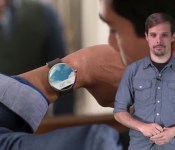
See more of Android Wear, Google’s wrist-borne OS

Google pretty much divulged the most important things about Android Wear when it launched the OS, but this new video lays out all the details complete with visual aid. Timothy Jordan, the company’s developer advocate, shows off a number of user interface elements in the video and explains how it doesn’t make sense putting phone icons on a smartwatch. As mentioned before, you can issue voice commands by saying “OK, Google,” and the OS uses Google Now-like cards to show you various information (weather, flight details, etc. — the usual things available on regular Android).
Jordan also details how apps made for the platform can use different types of notification, like Stacks, which, well, stacks several for easier viewing. There’s also the Pages format that shows one lengthy notification in several cards, and the Replies format, which gives you the option to respond through the watch itself using voice commands. Bottom line is that Android Wear, according to Jordan, is “glance-able” and reduces the time you need to interact with your smartwatch. The point of the video is to show you all these features before the LG G Watch and the Moto 360 come out, though, so press play below to see it all for yourself.
Filed under: Wearables, Google
Via: Android Beat

The next version of Android will enhance battery life, speed up apps

Several months ago, Google added an experimental runtime option to speed up apps in Android 4.4 KitKat. A runtime, for the record, supports the apps running on your device — without it they’d be nothing but piles of useless code. Called ART (short for Android Runtime), that same mode will become the default when Mountain View releases the next version of its operating system. Developers spotted tweaks to Android’s open-source code indicating the upcoming change, and the update looks to be a positive one. Without getting bogged down in details, ART essentially makes apps run faster and more efficiently, with the downside being that they’ll take up slightly more space on your phone, as well as lengthier install times.
ART will likely replace the current app-running software Dalvik as the default on Android, though the latter option could still be available. In addition to enhancing app performance, ART is said to slightly increase battery life. Even if the gains are small, that’s good news for anyone using the most popular mobile OS in the world. And with Google I/O just a week away, we may hear about the next version of Android very soon.
Filed under: Software, Mobile, Google
Via: Phone Arena, Android Authority
Source: XDA Developers
 AIVAnet