


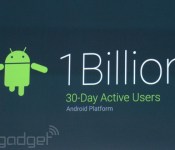
Android still the dominant mobile OS with 1 billion active users

Free-falling product demos and Rube Goldberg multimedia installations aside, there’s always a level of predictability to an opening day keynote. And Google I/O 2014 is no exception. Like clockwork, SVP Sundar Pichai took to the stage in San Francisco this morning to tick off the company’s latest accomplishments. He started off by touting one of the company’s biggest strengths: Android. According to Pichai, Google now has over 1 billion active users (that’s as of the last 30 days) on the OS.
Developing …
Google’s apparently opted to track 30-day usage as opposed to year-over-year numbers as in the past. That said, last year, the company boasted 900 million Android activations, up from 400 million the year before. We likely won’t get a direct comparison due to the change in tracking, but even with the numbers we have, it’s clear Android is still the dominant mobile platform. During its WWDC 2014 keynote earlier this month, Apple’s Tim Cook announced the company had reached 800 million iOS devices to date, fewer than Google’s Android activation numbers from the year prior.
Continuing the theme of unconventional stat tracking, Pichai championed the strength of the platform saying Android users send 20 billion text messages each day and 93 million selfies. What’s more, those self-absorbed phone holders apparently take 1.5 trillion steps each day, and check their handsets a total of 100 billion times every 24 hours.
Filed under: Cellphones, Tablets, Wearables, Internet, Software, Mobile, Google
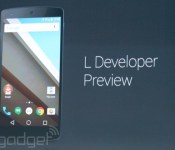
Google’s next version of Android ‘L-release’ has a new look, deeper ties to the web

KitKat may have only found its way on to roughly 15 percent of phones at this point, but that won’t stop Google from looking to the future. The new version, teased by Sundar Pichai is simply being referred to as the “L-release” right now. As previous leaks have indicated, this will be the most dramatic UI overhaul the OS has enjoyed since Ice Cream Sandwich debuted back in 2011. The heart of this overhaul is called Material Design — a flatter look, with rounder elements and softer edges that will extend beyond tablets and phones to Chrome OS and Google’s various web services. You can see some of the new design philosophy at work already in the latest version of the Google+ app on Android. But it goes beyond that. Shapes are simplified and there are smooth transition animations across the UI. Developers can also add the illusion of depth by adding “elevation” which automatically stacks visual elements appropriately and adds drop shadows.
Developing…
Of course, if all that was new with Android was a facelift, it wouldn’t be all that exciting. But there are also plenty of new features. Not that there was anything wrong with notifications in KitKat, but there’s always room for improvement. In L you’ll be able to interact with notifications right from your lock screen. That can include quickly swiping them away or you can double tap on the notification to head straight into the relevant app. The notifications aren’t ordered simply chronologically anymore either, they’re sorted by relevance and importance, which is determined by a number of details, like the source app, etc… For truly important events, Google has introduced heads-up notifications, which pop interactive notifications over your current task. In a demo an incoming call showed up at the top of the screen while Dave Burke, director of engineering for Android, was playing a game. He could simply ignore the pop up completely, or he could tap the options to accept or dismiss the call.
One of the more intriguing changes is the deeper ties to the web and Chrome. The new recents interface will pull in not just apps you’ve launched but tabs you’ve opened on your desktop. And, developers can make links go to apps instead a webpage. So, if you search for a restaurant on your laptop, the recent menu won’t just open up a web page, but could launch directly into the Yelp reviews.
Then there’s the ART runtime, the software library that actually makes all your pretty little apps work. ART brings a whole bunch of advantages. For one, apps should run significantly quicker, and in particular they should launch much faster. But, it should also increase battery life because Android will be wasting less processing power decompressing apps.
Filed under: Cellphones, Software, Mobile, Google
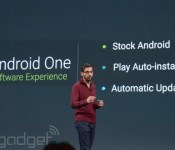
Google’s Android One program will set minimum standards for bargain-basement smartphones

For every HTC and Samsung, there’s tens of Android hardware makers who have to redesign their smartphones to hit a certain low price. This is especially true in the developing world, where keeping the cost down means a lot of effort is spent tweaking devices — something that Google feels is a waste of time. That’s why it’s launching Android One, a program where Mountain View’s engineers will design cost-conscious hardware, and other companies will simply manufacture it. There’s plenty of fringe benefits, but the biggest one is that Google will be able to dictate a minimum set of standards for forthcoming Android handsets.
Since the company is targeting the developing world, Google is initially teaming up with Indian smartphone makers like Karbonn, Cromax and Spice. In an example presented on stage, Sundar Pichai talked about a Micromax Android One device with dual-SIM and SD card slots, a 4.5-inch display and FM radio priced at just $100. As well as that, these phones will get the same preferential treatment as the Nexus and Google Play ranges when it comes to automatic software updates. Is this, then, the much-rumored Android Silver program? Possibly, but given that it’s going to be aimed toward the bottom end of the Android world, it seems like the notion that Silver would kill-off the Nexus line won’t come true today.
Filed under: Cellphones, Software, Mobile, Google

Google’s new ‘Material Design’ UI coming to Android, Chrome OS and the web

Google’s annual I/O developer keynote has only just begun, but already we’re being treated to some of its announcements. In a bid to create a new “visual language” for users, Google is taking the design of Android, Chrome OS, and web properties back to basics with its new “Material Design.” According to Google, Material Design organizes interactions and makes better use of space, serving different views of the same content when viewed on a smartphone, tablet or desktop. Google’s Android apps will be updated to reflect this change, and you may have seen it in early Gmail and Calendar app leaks.
The new design language is more than just a visual refresh, though. In its on-stage demo, Google showed new animations that are designed to present the maximum amount of content while ensuring that scrolling remains smooth. It’s inviting developers to make use of improved typography, grids and more color to improve the layout of apps and services, making user interaction more seamless.
Developing…
Filed under: Cellphones, Mobile, Google
Source: Material Design Guidelines (PDF)

Android personal unlocking will bypass security in ‘trusted environments’

Google wants to make it faster to unlock your Android device in trusted environments with a new feature called “personal unlocking.” For instance, if your Bluetooth watch is connected and nearby, you’ll be able to swipe open your home screen without an unlock code. If the watch is off, however, you’ll need to punch in the code. It also won’t challenge you for a code under certain conditions like your locations, and even by sound of your voice. That’s part of the new Material Design UI coming up for future versions of Android which you’ll see in the upcoming versions.
Filed under: Cellphones, Mobile, Google

Watch Google’s opening keynote at I/O 2014 here!

Although we’ll be liveblogging the opening keynote of Google’s annual developer conference in just about an hour, we don’t want to dismiss the fact that many of you like to follow along when a livestream is available. Google’s got you covered: keep a tab open at this page for live video footage of the keynote. We expect a lot of news this morning at San Francisco’s Moscone Center, and we’ll keep you posted on all of the latest announcements and developments as it happens.
[Image credit: Getty Images]
Filed under: Announcements, Google
Source: Google

Live from Google I/O’s 2014 opening keynote!

Get ready for two crazy hours of Google awesomeness: I/O’s opening keynote is about to begin. This is typically the time for the company to unveil some of its biggest projects and set the tone for the following year. Just two years ago, for instance, co-founder Sergey Brin skydived onto the roof of the venue and biked into the keynote while wearing Google Glass. Whether we’ll see anything as adventurous this year remains to be seen, but that’s why we liveblog these things — so you, dear reader, can experience every second of the madness right along with us. So join us right back here at noon (EDT), okay?


Filed under: Announcements, Cellphones, Mobile, Google

Demo of iPad Passcode Theft via Google Glass Highlights Benefits of Touch ID [iOS Blog]
Looking over a nearby person’s shoulder is a common technique used to steal a PIN code for a device that is targeted for imminent theft. But as reported by Wired, a research team from the University of Massachusetts Lowell has taken this shoulder surfing trick to a whole new level by increasing the working distance and automating the process using Google Glass and other similar camera-equipped, mobile products.
The UMass Lowell researchers improved passcode theft by analyzing video captured from wearable and mobile devices such as Google Glass, the Samsung Gear smartwatch and the iPhone. The system anlyzes the incoming video using a custom video recognition algorithm that detects the shadows from finger taps and uses that information to predict PINs codes. Unlike the standard over-the-shoulder method that requires a direct view of the target device’s display, the UMass method also can be employed at an indirect angle, allowing someone to steal a password while standing at your side.

(Image from Cyber Forensics Laboratory at University of Massachusetts Lowell)
The system is surprisingly accurate — allowing a malicious user to capture PIN codes inconspicuously with at least 83 percent accuracy from a distance as far as three meters. This accuracy was improved to more than 90 percent when a sharper camera such as the iPhone was used or manual error correction by the researchers was added to the video analysis.
“I think of this as a kind of alert about Google Glass, smartwatches, all these devices,” says Xinwen Fu, a computer science professor at UMass Lowell who plans to present the findings with his students at the Black Hat security conference in August. “If someone can take a video of you typing on the screen, you lose everything.”
The researchers didn’t test longer passwords, but believe they could reach an accuracy rate of 78 percent when stealing an 8-digit password from a device such as the iPad. If you are concerned about password hacking, your best line of defense is to cover your display as you type or when possible do away with a PIN code entirely such as by using the Touch ID fingerprint in the iPhone 5s.
With the results of this study, the researchers hope to convince mobile operating system companies to improve the security of their PIN input screens by taking steps such as randomizing the layout of the keypad.
Apple’s Touch ID fingerprint authentication is of course another alternative to traditional passcodes. The feature launched on the iPhone 5s last year and is expected to make its way to the iPad and iPad mini later this year. Aside from increased security compared to passcodes, Touch ID has also increased usage of security features, with Apple noting during its WWDC presentation earlier this month that passcode/Touch ID usage has risen to 83% on the iPhone 5s, up from just 49% passcode usage previously.
We’ll see a new version of Android previewed at Google I/O, Sundar Pachai confirms

Sundar Pachai, head of Android, has been talking to Bloomberg ahead of Google I/O which is about to start in a few hours. They’ve talked about all sorts of things, but what caught our eye was an apparent confirmation we’ll see a new version of Android previewed at this year’s Google I/O.
I’m willing to bet this is what most of you have been wanting to see at Google I/O, aside from maybe some Android Wear software and hardware. Well, we’ll see at least a piece of it. Don’t get your hopes all the way up though, we’ll see it previewed, not released. That will probably happen later this year.
While you wait for the Google I/O to kick off in order to see the new Android in all its glory, check out some leaked screenshots which allegedly show a piece of it.
Source: Bloomberg
Via: Pocketnow
The post We’ll see a new version of Android previewed at Google I/O, Sundar Pachai confirms appeared first on AndroidGuys.
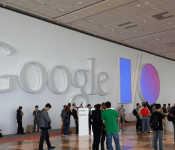
How to watch Google I/O keynote live stream

Google I/O is Google’s biggest event of the year. There are many of you who will want to check out Google’s keynote and probably some other stuff that will be live streamed from this year’s Google I/O. You can do all that if you follow this link.
Google I/O keynote is starting in a couple of hours at Moscone West Convention Center in San Francisco. 9am PDT, which converts to 4pm GMT or 12pm EDT. Sundar Pachai already confirmed we’re about to see the next version of Android previewed at this year’s Google I/O. We’ll also see some Android Wear hardware and software, so if you’re interested in purchasing Moto 360 or LG G Watch for example or just interested in Android Wear in general stay tuned. This is just a piece of the puzzle though, Chrome will definitely be a part of the event along with a bunch other Google stuff. We’ll get mainly software news, but who knows, aside from Android Wear hardware we might even get a preview of a new Nexus tablet if not see it released in the next 2 days.
For our Google I/O predictions visit this link. We’ll do our best to get you the latest news from Google I/O as they happen, so stay tuned to AndroidGuys, SmarterWatching and ChromeWatching for that.
The post How to watch Google I/O keynote live stream appeared first on AndroidGuys.

