


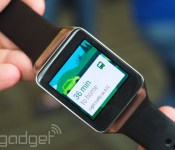
Google Play encryption bug is blocking paid apps from using Android Wear

If you ordered one of the Android Wear devices Google showed off last month, you’ll want to keep an eye out for updates: the wearables aren’t playing well with paid apps. Normally, Wear apps are downloaded from Google Play alongside an app’s handset component, installing automatically over Bluetooth to a paired Wear device — but the wearable component of paid apps just aren’t transferring. According to Android Police the problem lies in Google’s app encryption measures, a sort of copy-protection system enacted to keep pirates at bay. For whatever reason, Android Wear devices simply aren’t able to find Wear apps in encrypted packages. It’s a small bug but it’s also a major issue, effectively blocking all paid apps from taking advantages of Google’s new platform. Hopefully Mountain View will issue a fix before too long.
Filed under: Wearables, Mobile, Google
Source: Android Police

Google Project Tango smartphones heading to space this week

Google is no stranger to having some of its devices up in space, what with the Nexus S and One each taking on different missions in years past. Up next: Project Tango. The search giant’s smartphone, which packs 3D sensors that allow it to track and map just about anything around it, has been playing a role in NASA’s Synchronized Position Hold, Engage, Reorient, Experimental Satellite program, otherwise known as SPHERES. As Reuters notes, these spherical satellites could one day “take over daily chores for astronauts or even handle risky duties outside of the vessel.” Accordingly, on July 11th, NASA and Google are doing good on the promise to launch Project Tango smartphones into orbit, where they be will be used as “the brains and eyes” of the bowling ball-sized, hovering robots at the International Space Station.
SPHERES Project manager, Chris Provencher, told Reuters they had been looking to add better processing power, cameras as well as a slew of sensors to the robots, and smartphones were the way to go. “This type of capability is exactly what we need for a robot that’s going to do tasks anywhere inside the space station,” he said about Tango possessing the right attributes to meet the program’s needs. “We wanted to add communication, a camera, increase the processing capability, accelerometers and other sensors. As we were scratching our heads thinking about what to do, we realized the answer was in our hands [smartphones].”

[SPHERES image credit: NASA]
Filed under: Cellphones, Misc, Robots, Alt, Google
Via: VentureBeat
Source: Reuters

Tour the world’s largest cruise ship with Google Street View

From electrical system breakdowns to backed-up toilets and even a capsized ship, it hasn’t been a great decade for the cruising industry. Even when your trip goes off without a hitch, you’ll probably be eager to disembark after a week in close quarters with 2,000 other families — even on the world’s largest cruise ship, the nearly 1,200-foot Allure of the Seas. Fortunately, that vessel is now open for virtual tours, courtesy of Google’s Street View, so you can see what cruising’s all about. You can stroll (or click) through some of the more popular “neighborhoods,” such as Central Park or the Royal Promenade (a shopping mall). You can also check out five of the 26 restaurants, from Chops Grille to Cupcake Cupboard, or the “Family Fun” areas, such as the H2O Zone water park or the onboard ice rink, all from the comfort of your spacious hotel room.
Filed under: Transportation, Internet, Google
Via: Telegraph
Source: Royal Caribbean

What you need to know about DARPA, the Pentagon’s mad science division

There’s a certain entity within the Pentagon that’s quite (in)famous for developing terrifying robots, advanced weapons and futuristic tech. It’s called the Defense Advanced Research Projects Agency or, as most people know it, DARPA: the Department of Defense’s “mad science” division. While all the machines coming out of the agency make it seem like its sole purpose is to build a killer-robot army, DARPA has many, many other projects to speak of. In fact, DARPA’s at the heart of some of the most significant technological advances of our time. Hell, there might not be an internet to read this article on if DARPA didn’t create it.
HOW DID IT BEGIN?
President Dwight Eisenhower founded DARPA way back in 1958 in order to develop cutting edge technologies for the United States. Originally known as ARPA (same meaning, but without “Defense”), its first purpose was “to prevent technological surprise like the launch of Sputnik, which signaled that the Soviets had beaten the US into space.” Since then, it’s been involved in several technological milestones; for instance, it developed an early networking system that went live in 1969 called the ARPANET. It’s one of the networks that eventually led to creation of the internet, which, suffice it to say, changed the world. Love Siri or Cortana? You can thank DARPA for those virtual assistants, too, as its Speech Understanding Research (SUR) program in the 1970s played a key role in advancing speech recognition technology widely in use today.
HOW DOES IT OPERATE?
Despite being part of the Pentagon, DARPA operates independently from the Defense Department’s military research division. Its personnel are divided into groups led by a manager, with each one tackling a particular issue the agency wants to address. These teams are free to look for ideas that would solve the problems they’re given both from within and outside the organization. DARPA then provides each group with anywhere from $10 to $40 million in funding. Some projects receive far less funding, but big projects could get up to $100 million. If you’re wondering, the agency had a $2.779 billion budget for the 2014 fiscal year and is currently requesting $2.915 billion for fiscal year 2015.
So, what is DARPA doing with the people’s money, exactly? Here are some of its most prominent, wackiest and latest projects:
ROBOTS
One of the first robotic projects DARPA has ever funded is Shakey the robot, which began development in 1966. Shakey was a multi-purpose machine on wheels that could perform menial tasks like switching lights on or off. These days, the agency’s probably most known for its advanced machines, some of which look undeniably unnerving. These include a number of Boston Dynamics creations, such as the four-legged Cheetah, which later became known as WildCat, that can sprint faster than Usain Bolt. BigDog, one of the company’s other DARPA-funded projects, is also a four-legged machine designed to traverse tricky terrains while carrying heavy supplies and equipment.
Other than those two quadrupeds, Boston Dynamics continues to refine its disaster response humanoid machine called Atlas for the agency. It’s even preparing the biped to walk without a tether before the year ends. When the company was acquired by Google last year, it promised that it would still fulfill its military contracts. But as Mountain View made it clear that it won’t be pursuing government funding, it’s likely that we won’t be seeing a new DARPA-funded Boston Dynamics robot again. Don’t worry — it’s not like the agency doesn’t have other ways to look for outstanding ideas to add to its roster.
DARPA also hosts an annual Robotics Challenge, with the intention of funding the one that wins top honors. This year’s ongoing contest is looking for a humanoid robot to serve as first responder in times of disaster. Sadly, the strongest contender just dropped out, because (surprise, surprise) Google bought SCHAFT, the Japanese company that designed it, last year. SCHAFT is now gearing up to produce the first retail Google robots, so the acquisition sounds like a good thing… unless you’re worried that Mountain View’s forming a robotic infantry of its own.
PROSTHETICS

DARPA’s bionic limbs have also been making headlines in recent years — after all, the division has already sunk $150 million into its prosthetics program. Its earliest mind-controlled bionic arms have been serving their owners for years: the first woman and fifth patient to get one had hers attached back in 2006. Even so, the agency’s not resting on its laurels and hasn’t stopped trying to come up with better products. In 2013, DARPA took a project that’s developing a low-cost three-fingered artificial arm under its wing and also started working on a brain-controlled arm that can feel. Just this May, the FDA certified the DARPA-funded “Luke” arm, which can understand several commands at once and was developed by the same man who designed the Segway.
MEDICINE

They’re not as widely known as their robotic counterparts, but DARPA’s also funding several projects that deal with medical technology. One, for instance, is working on a brain implant to help with psychological issues soldiers usually deal with, such as PTSD and extreme depression. Another one’s attempting to conjure up a liquid-to-foam substance to stop bleeding instantly. In other words, the division’s heavily investing in medicine for the military, which brings us to the next entry…
MILITARY/DRONES

Hey, DARPA’s part of the Pentagon, so it goes without saying that it plays a huge role in developing new military technologies. In 2011, the division tested a hypersonic weapon by flying it across the Pacific Ocean, while it signed a $6 million contract to develop highly accurate laser-equipped sniper scopes last year. More recently, the agency unveiled a head-mounted display that tracks friends and enemies alike and lets soldiers communicate with each other.
Of course, DARPA wouldn’t be DARPA if it’s not brewing something totally out of this world. Some of its crazier-than-usual projects include developing the technology to climb walls like Spider-Man, as well as designing stealthy hybrid bikes for covert operations. “Plan X” sounds like its wildest idea to date, though, as it ultimately aims to turn the real world into 3D that military personnel can access via Oculus Rift. In this crazy virtual world right out of the movies, soldiers will be able to shoot down hackers like on the battlefield.
Drone initiatives are par for the course, as well. Apparently, DARPA’s in the process of turning old surveillance drones into WiFi hotspots, conjuring up a design for drones that can transform into whatever the military needs and developing robotic sea pods that release drones on cue.
SPACE
You didn’t think an agency as forward-thinking as DARPA would limit itself to Earth-bound technologies, did you? One of its space programs called XS-1 is working towards building an unmanned spacecraft that would be a lot cheaper to fly than current models. Then there’s the Phoenix program, which aims not only to salvage working parts from dead satellites, but also to send robots to space to assemble satellites on the spot. Also, DARPA’s been working on the Space Surveillance Telescope since 2002 in hopes of providing a means to capture images of small objects floating around, including space debris that could collide with and destroy military satellites.
CONTROVERSIES
As you’d expect, a military agency that receives billions in funding is bound to have its share of controversies. In 2011, it was discovered that DARPA signed a $1.7 million contract with a bomb detection firm owned by the family of its then director, Regina Dugan. That even prompted the Pentagon to do an ethics probe on the agency, though it was later cleared of any wrongdoing. Still, controversy followed Dugan when she left DARPA for Google, especially since a Washington federal appeals court ruled that any Google-NSA relationship can remain a secret, just as she made the transfer. Needless to say, that development led people to wonder whether DARPA had anything to do with the NSA’s efforts to snoop on Gmail accounts.
WANT TO KNOW MORE?
Think of DARPA as a huge octopus, with tentacles too many to count — you can’t really tell what it’s doing unless you focus on it. If you truly want to know the scope of its countless projects, you can follow the agency on Facebook, Twitter, Google+ and YouTube, where it not only reports newly signed contracts, but also posts updates to older ones.
[Image credit: DARPA, AP Photo/Chitose Suzuki, Breaking Defense]
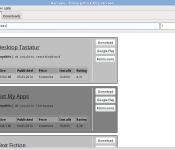
Download Raccoon v2.3 – A Google Play Store desktop client

Is your device not officially supported on the Google Play Store, or perhaps you no longer have the Google Play Store on your device after flashing a custom ROM? Or, maybe you just want to get back to an older version of an app because an update has introduced some bugs?
This might just be for you!
Courtesy of onyxbits over at XDA, you can now download a Google Play Store desktop client. Named Raccoon, you’ll have access to download all the APK files in the Play Store and cache them locally on your computer, and that includes multiple versions of the same app.
How to use:
- Install Java
- racoon.jar should now be executeable, start it like any other program
- Enter your loginname and password (prefererably from a throw away account).
- type “Onyxbits” into the textfield.
- You should now see a list of all the developers apps
- Either search for an app or download a prebuilt list
- you will get an APK file, transfer that to your phone by whatever means suit you (e.g. copy via USB cable).
- Enable “Unknown Sources” on your device to install the APK
Sound like something that’ll be useful? Here’s the download link.
Download Link
The post Download Raccoon v2.3 – A Google Play Store desktop client appeared first on AndroidGuys.
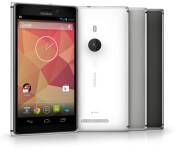
A proper Nokia Lumia device running Android is coming our way, report says

We’ve all heard this rumor before, we’ve heard it numerous times in fact. All that hope and then we get Nokia X which is an abomination of sorts, not an Android device, hence the use of “proper” in the title. Abomination might be a strong word, but Nokia X is neither a Windows Phone nor an Andriod device. It looks like a WP and it is run by extremely limited Android platform which lacks some basic Google apps and it’s an entry level phone. Anyhow, we’re not here to talk about Nokia X.
When Microsoft bought Nokia it was hard to believe they’d ever release an Android powered handset. You might recall that Nokia X was also launched before that deal closed, although Microsoft did introduce Nokia X2 afterwards, so that did leave us some hope I guess.
Well, a known leaker @evleaks shared something rather interesting with us today. @evelaks is usually right so we decided to give this leak some attention. He teased us with the following sentence:
“Big news: Android-powered Lumia incoming, from Nokia by Microsoft”
Unfortunately we don’t get any more details when it comes to this leak, but this is still something. You might notice he mentions “Lumia” in that sentence, which leads us to believe this won’t be another Nokia X-like device but a proper Android offering by Microsoft-owned Nokia brand.
I don’t know about you, but we’re very, very excited about all this. As I said, this leaker has an amazing track record, so he definitely did get our hopes up. How about you, do you think this will ever happen and would you buy an Android-powered flagship Lumia device, presuming they don’t mess with Android on a core level?
Source: @evleaks
The post A proper Nokia Lumia device running Android is coming our way, report says appeared first on AndroidGuys.

South Korea makes it easier to get refunds for Android and iOS apps

If you’ve ever been burned by downloading a mobile app that you don’t want or doesn’t work, relief may be in sight… so long as you’re in South Korea, at least. The country’s Fair Trade Commission has ordered both Apple and Google to make their app refund policies more consumer-friendly. To start, Apple must make it easier to claim refunds on in-app purchases; if your kid goes wild buying in-game items, you should have an easier time getting your money back. Google, meanwhile, has to let developers set their own refund terms.
There are a handful of smaller tweaks in store. Apple will have to notify shoppers whenever it alters the App Store’s terms of service, and Google must stop apps from automatically charging you the moment a trial period ends. All the new rules are limited to South Korea for now, but Apple says it might change its terms on a global level. Google isn’t considering a similar approach at this stage, but the Fair Trade Commission is hoping that it created a “ripple effect” which leads to similar policies elsewhere. If the rules do spread worldwide, that would undoubtedly be good news — you could try paid apps without the risk of being left high and dry.
[Image credit: Jung Yeon-Je/AFP/Getty Images]
Filed under: Cellphones, Mobile, Apple, Google
Via: Korea Herald, MacRumors

Google makes sure its founders will survive a Terminator assault

The Connor family may be doing a great job preventing Skynet from becoming self-aware and declaring war on humanity, but Google apparently isn’t taking any chances. The internet giant has quietly uploaded a “killer-robots.txt” Easter egg file that tells Terminators to avoid hunting down the company’s co-founders, Larry Page and Sergey Brin. There’s more to this joke text than stopping murderous automatons from the movies, of course. It’s really there to mark the 20th anniversary of robots.txt, the document you put on a site to exclude pages from Google’s search crawler. However, it does make us wonder why Google didn’t see fit to save people like Andy Rubin or Sundar Pichai — surely it would expect those behind Android to get some mercy from androids.
Filed under: Robots, Internet, Google
Via: Search Engine Land, The Verge
Source: Google

There can’t be only one: Technology’s singular obsession

Last week, Google announced the aptly named Android One, a plan to unite the myriad budget devices running its mobile operating system. But Sundar Pichai and crew aren’t alone in banking on the singular power of one. No, Google’s One is just one of many in the industry’s recent past. It turns out, everyone wants to be the one.
[Image: Getty]
Filed under: Cellphones, Misc, Laptops, Science, Internet, Software, Sony, Microsoft, HTC, Google, Acer

Is Google teasing an alternative on-screen buttons for Android “L”?

As you all know by now, Google announced a new version of Android, called Android “L” (for the time being at least). Along with that they announced a new design approach to Android, called “Material Design” in which they, amongst other things, introduced a new set of on-screen buttons.
Our current vanilla on-screen buttons are going to be replaced with a simple geometric forms which will trigger back, home and multitasking actions (for those who get the “L” update eventually of course). Those buttons at least in our opinion look nice and everything, but it seems there’s more to it than we thought. Google seemingly teased another set of buttons that may appear in “L”. While explaining transitions and animations on their official webpage they used on-screen buttons we haven’t seen before (featured in the middle on the image above). These buttons look basically like the ones we use now with some subtle changes. The most noticeable of which is on the multitasking button, instead of showing screen behind a screen at an angle, second screen is now centered behind the first one. This button actually fits nicely with the carousel multitasking design on Android “L”.
What do you think, will Google give us an option to use these buttons as a second choice? Does this mean developers will be able to create their own offering and we’ll be able to use those as well?
The post Is Google teasing an alternative on-screen buttons for Android “L”? appeared first on AndroidGuys.

