


Google must offer more to end EU antitrust case

A few months back, it looked like that Google was set to avoid fines from the European Commission stemming from a multi-year probe into the outfit burying rival ads in search results. With new “arguments and data,” the competition said it isn’t satisfied with those concessions, and Reuters reports that the search giant will have to pony up more in order to close the case. If you’ll recall, Google had agreed to give Bing, Yahoo and others equal visibility rather than face a $5 million fine, but after those companies weren’t happy with the proposal and submitted new claims, the Commission wants a revised offer. In response to an ad by publishers on the other side, executive chairman Eric Schmidt posted a letter on Financial Times over the weekend. Saying that it was built “to show results that answer the user’s queries directly,” Schmidt maintained that the company doesn’t promote its own stuff “at the expense of our competitors.”
[Photo credit: Getty Images]
Source: Reuters
.CPlase_panel display:none;
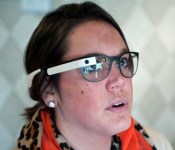
Google Glass can tell if you’re stressed out

It’s not always easy to tell when your stress levels are through the roof, and you may not always want to break out a heart rate sensor just to find out when it’s time to relax. You might not have to, if researchers at Georgia Tech and MIT have their way; they’ve developed BioGlass, an Android app that uses Google Glass to determine how frazzled you are. The software measures your heart and breathing rates by checking for tiny movements picked up by Glass’ accelerometer, gyroscope and front-facing camera. In theory, you’d only have to wear the smart eyepiece to know when it’s time to calm down.
The existing project doesn’t do more than record data, but future software could do a lot more. You could get instructions on stress-relieving breathing exercises, for example, or even queue up soothing songs at the very moment you need them. Glass also isn’t strictly necessary, if you’d rather not wear a $1,500 headset that occasionally causes stress. Any wearable with the right sensors would do the trick. The biggest challenge is getting an accurate reading while you’re moving. BioGlass currently requires that you stand still, but the hope is that it will eventually warn you when you’re literally hopping mad. If all goes well, you may always know when it’s time to chill out — and hopefully avoid a ton of health problems.
[Image credit: Nicholas Kamm/AFP/Getty Images]
Filed under: Wearables, Science, Google
Source: BioGlass
.CPlase_panel display:none;

False Alarm: Crane notice at Google wasn’t for Android L lawn statue
 We Android fans are particularly excited when a new build of Android is about to be released, not only because there is going to be new, fantastical software, but also because there’s going to be a new lawn statue at Google HQ. So when a notice for impending crane work went up at Google HQ (see above), we naturally assumed they might be bringing in the new Android L lawn statue. While the event in itself might not be the most exciting, it’s what the lawn statue is going to be ‘made of’ that is the exciting part – is it going to be Lemon Meringue Pie as many pundits are suggesting?
As it turns out, the Android L lawn statue wasn’t brought in and only some rearrangement of the existing lawn statues was done. Check out the pictures below to see if you can spot the differences:

Before

After
You could definitely make the case that they are making space for the Android L lawn statue, but we’ll have to go back to speculating what the “L” in “Android L” is for a little while longer. Hopefully though, it won’t be much of a wait.
What do you think about Android L and what its real name will be? Let us know your opinion.
Source: Google+, MobileSyrup via Android Police
//<![CDATA[
ord = window.ord || Math.floor(Math.random()*1E16);
document.write('‘);
//]]>
The post False Alarm: Crane notice at Google wasn’t for Android L lawn statue appeared first on AndroidSPIN.
.CPlase_panel display:none;

Watch MIT’s Atlas humanoid robot drag a metal pillar like it’s nothing

We’re interrupting your regularly scheduled programming full of cute, service robots to bring you the latest update on Boston Dynamics’ terrifying humanoid machine: Atlas. A group of MIT researchers have been working to refine their Atlas unit’s capabilities since 2013 for DARPA’s Robotics Challenge. The result? They’ve managed to program the machine to carry objects of different weights in each hand, making it more effective for real-life applications, like construction or clearing debris during times of disaster. You’ll see what we’re talking about when you watch the video below, showing Atlas lugging an aluminum pillar with one hand.
Via: IEEE, TechCrunch
Source: MIT DRC
.CPlase_panel display:none;

Farewell, IFA 2014

Everything that goes out of fashion, we’re told, will eventually come back, which is why we still have a pair of tight leather pants and some bell-bottom flares stashed in the back of our wardrobe. It’s a similar trend with consumer technology, and this year’s IFA has seen fit to bring back head-mounted VR (last seen in the early ’90s), netbooks (declared dead a in 2011) and digital watches. Of course, it wasn’t just these devices that got unveiled at the show, after all, there was also Samsung’s bent-screen phablet and Kobo’s waterproof e-reader. Still, if you think that you missed out on any of the devices that were announced over the last week, why not check out our gallery for a few of the highlights.
Filed under: Samsung, Sony, ASUS, Google, LG
.CPlase_panel display:none;

Google Glass lands in the Play Store next to phones and smartwatches

Itching to strap on a $1,500 face computer so you can follow directions floating in front of your head? Well, Google just made it a little easier to claim a head-mounted display of your own — it quietly added Google Glass to the Play Store the other day, and the search giant seems intent on making it sound, well, cool. To hear the Mountain View spinmasters put it, Glass Explorers aren’t just the people who need to try tech before the teeming millions. No no, they’re “bold and inspiring,” folks who “make move and marvel through Glass.” This isn’t the first time that Google has tried to broaden Glass’ reach — they opened up the Explorer program to all comers in the US back in May, but it insisted at the time that it was still very much a “beta” product. Between then and now we’ve seen a slightly tweaked version of Glass launch and a few software updates go live — none of those changes seem terribly earth-shaking, but it sure is interesting to see Google stop treating Glass like a special little flower that isn’t ready for public consumption.
Source: Google Play Store
.CPlase_panel display:none;
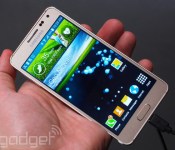
The Samsung Galaxy Alpha is smaller, lighter and more elegant than the GS5

With a 4.7-inch 720p display, 6.7mm profile, 115g (4.06 ounce) weight and aforementioned design language, the Alpha is tight, light, slim and classy. Since it’s a little smaller than most modern-day flagships and comes with straight sides and chamfered edges, it’s very easy to hold onto without losing my grip or feeling uncomfortable. The sides are also mostly flat until they approach the corners, where they curve slightly outward.
Despite the new design, the removable back still looks more like the Galaxy S5 than the Note 4; the latter has more of a leather-like appearance, whereas the Alpha’s polycarbonate back uses a series of very tiny divots. The back itself is flat except where it slopes inward toward the edges. The phone will come in five different colors, and some definitely look better than others; this is one of those times in which the gold version actually looks a little better than the black one, since some of the front and back colors blend better with the sides than others do. The 12MP camera (not quite as high quality as the GS5 or Note 4) sits in the top middle, with an LED flash and heart rate monitor module to its left.
With a smaller screen, the lower-resolution display is completely fine; everything looked crisp and sharp. It also comes with the same fingerprint scanner as the flagship phones. The only thing that truly concerns me with the Alpha right now is the 1,860mAh battery, which is quite limited for today’s standards (its battery is significantly smaller than the GS5’s). It also doesn’t come with external memory, so the 32GB internal storage will have to do.

The Alpha will come in two versions, much like many of Samsung’s other phones: An octacore Exynos 5-powered option, which comes with four 1.8GHz Cortex-A15 cores for higher performance and four 1.3GHz Cortex-A7 cores for smaller tasks, and a 2.5GHz quad-core Snapdragon 801 version. Both options will come with 2GB RAM. Samsung uses this two-model setup often, in which the Exynos model is typically sold in Korea and other select countries, while the Snapdragon model goes to the remaining regions like the US and Europe.
With a few exceptions, the Alpha seems to look like another Galaxy S5 mini of sorts, but with better specs and more elegant design. While Samsung is still keeping quiet on pricing — it’ll likely be dictated by region and carrier — it’ll likely be higher-priced than many of its competitors. If it manages to be competitively priced, however, the Alpha could easily become a hit among shoppers who want something more on the classy side without getting a monster-sized phone.
Photos and video by Zach Honig.
Filed under: Cellphones, Wireless, Mobile, Samsung, Google
.CPlase_panel display:none;

Chrome on Android is the latest Google app to get a cleaner, flatter look

Google’s “Material Design” was a major part of this year’s I/O conference and now it’s rolling out to an Android app you probably use a lot more than the Play Store: Chrome. The browser’s stable version is the latest recipient of the not-quite-flat façade and fancy animations. Lest you think the mobile web-surfing tool’s new tricks are only skin deep, however, Mountain View has added a bit more functionality, surely. Signing into the application with your Google account now logs you into the search giant’s websites, like Groups, as well. It’s pretty easy to see where Page and co. see the hierarchy of importance for their apps, given the sequence of what’s getting the Material Design threads and when. Should Gmail be next in line, it likely wouldn’t surprise too many people. The odds of Google Voice getting these new duds anytime soon? Slim — but that’s just a guess.
Filed under: Cellphones, Tablets, Internet, Mobile, Google
Source: Google Play
.CPlase_panel display:none;
Google to refund consumers $19M in unauthorized in-app purchases
You may recall quite some time ago when Google got in some trouble for violating a pretty hefty FTC complaint. The Federal Trade Commission launched a prohibition on unfair commercial practices by billing consumers for charges by children in kids’ apps. This was way back in 2011, and we’re finally getting to see the outcome of their mistake.
We all know what happens in children’s games: the app itself may be free to download, but once in the app, you can use real money to get further in the game. And in kids’ games, it isn’t their own money that they’re using… it’s their parents’. Well, Google is now required to give a minimum of $19M worth of refunds to consumers wrongfully charged (or charged by accident).
Since 2011, Google has done a few things to create a better system for IAPs. Aside from racking up tons of money in in-app purchases, there’s another way users were wrongfully charged for children accidentally purchasing apps. Before purchase a paid app, users must enter in their Google account password. However, there is a 30-minute window after the password is entered to purchase anything in the Play Store without re-entering the password.
Getting back to today, Google must contact consumers who have made in-app purchases to inform them of the refund process. The company is required to issue at least $19 million worth of refunds to consumers. If they refund less than the set cost within 12 months, Google is required to remit the remaining balance to the FTC to either help remedy consumer complaints, or to return the rest to the United States Treasury.
Source: FTC
The post Google to refund consumers $19M in unauthorized in-app purchases appeared first on AndroidGuys.
.CPlase_panel display:none;

Thanks to Google you can now take a virtual stroll through Chinese history

So far we’ve seen Google’s Cultural Institute feature everything from the father of manga to more traditionally historical fare like Bletchley Park. Its latest exhibit hews closer to the latter, with a keen eye toward Chinese history, featuring some 1,400 pieces spread across 48 different exhibitions. The additions range from The Opium War to selections from the Nanyue King Masoleum Museum and a whole lot in between. If you want to really attempt to recreate the walking-around-a-museum experience, there’s an option to sort the collections by “museum view,” as well. All that history without any of the sore feet? Sign us up.
Filed under: Google
Source: Google (G+)
.CPlase_panel display:none;

