



Google moves one step closer to becoming a universal translator

Even with the assistance of modern technology, holding a conversation in two different languages can be difficult. Google Translate allows you to speak with someone and have each utterance translated as text and audio, but until now you had to manually toggle every time the other person talked. As expected, Google is speeding up the process with smarter language recognition and speaker switching, which comes as part of a new update. So when you boot up the app and press the microphone icon, it’ll recognise which of the two languages is being spoken, offer a translation and then automatically alternate whenever the conversation flips over. No more tapping on the screen again and again.
In addition, Google has revamped its camera mode to quickly translate words and phrases directly on your screen. So if an important sign on the Paris Metro has you stumped, you should be able to just grab your smartphone, tap the camera icon and wait for a translation to appear augmented reality-style. The feature currently works for English, French, German, Italian, Russian, Portuguese and Spanish words, and Google says it’ll be adding support for additional languages over time. Of course, this is hardly a new idea — Word Lens had a similar proposition, and ever since Google acquired its developer Quest Visual we’ve been waiting patiently for its inevitable debut.

Filed under: Cellphones, Google
Source: Google

Google Translate just got smarter: Word Lens and instant voice translations in latest update

When Google acquired Word Lens in May 2014, it was clear that it was only a matter of time until the startup’s impressive visual translation technology would be folded into Translate. That moment is coming today – Word Lens integration and improved voice translations are coming in the latest Google Translate update.
Word Lens lets you point your smartphone to a foreign language text and have it instantly replaced with your language of choice, right on the screen. Until this update, you could scan text with your device and have it translated and displayed into a text box, a clunky experience in most cases. Word Lens removes that friction, and everything happens in real time. Street signs, restaurant menus, product labels, there are tons of situations you could find it useful.
This genuinely amazing capability will be available in English, coupled with French, German, Italian, Portuguese, Russian, or Spanish. That means you will be able to translate from English to French, and the other way, but not from French to Russian, for instance. Google says more languages are coming.
The second big feature in this update is instant voice translation. Before the update, translating speech required tapping the mic button each time someone said something, as well as switching between languages in order to accommodate the other speaker. Now that all happens on the fly, because Translate understands different languages without requiring your input.
This feature should make for much more natural conversations, akin to having a human interpreter on your side, translating the back and forth in real time.
The new Google Translate should start rolling from today – we’ll keep an eye out for other features potentially present in the update and for an APK file.
What do you think of these new features?
Google Translate with Word Lens is now official, rolling out over the next few days
It was about a month ago when we first got wind of a possible Google Translate with Word Lens union, and now Google has made that marriage official. On their blog today, Google has detailed just what Google Translate with Word Lens on Android and iOS is going to be capable of, and it looks like it’s […]
The post Google Translate with Word Lens is now official, rolling out over the next few days appeared first on AndroidSPIN.
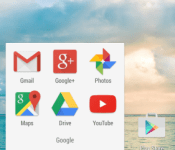
Devices with Jelly Bean and KitKat get Material Design with Google Now Launcher update

The majority of Android devices are not powered by the latest version of the operating system. Instead, it is Jelly Bean and KitKat running the show around the world. Google is doing the best it can to provide the benefits of Lollipop to those without it. For example, the Google Now Launcher has Material Design elements for Jelly Bean and KitKat devices. The elements include new animations (like when opening and closing apps) and a redesigned app launcher button. Also, Google Now itself has been improved with quick access to accounts and settings.
Hit the break for download links.
Come comment on this article: Devices with Jelly Bean and KitKat get Material Design with Google Now Launcher update
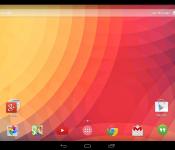
Google Now Launcher update now offers Lollipop design to older devices

Here’s some great news for fans of pure Android, especially those who are afraid of rooting their devices. The Google Now Launcher, made directly by Google, now brings a Lollipop look to every device running at least Android 4.1 Jelly Bean.
It’s completely the same as stock Lollipop with the exception that the left-most home screen is Google Now. Therefore, swiping to the far left allows you to view cards related to your searches, your location, recommended websites, favorite sports teams, stocks, and so forth. You can even use voice commands on this screen.
Android Central notes that the only downside of the launcher is the lack of customization seen on other launchers. However, it adds that the Google Launcher offers high stability, Material Design, and the vanilla Android experience. You can get it in the link below.
FEATURED POSTS


The post Google Now Launcher update now offers Lollipop design to older devices appeared first on AndroidGuys.
Nexus 6 may have inbound call problem for Sprint customers

It has generally been viewed as a positive development that the Nexus 6 is available on all major U.S. carriers and a simple swap of a SIM card is all that is needed for users to switch networks if they are in a position to do so. That doesn’t come without some risk though and Sprint customers seem to be suffering the ill effects at the moment as several Nexus 6 owners are having trouble receiving calls.
The issue has been identified by users for well over a month already, but neither Sprint nor Google has found a solution. The inability to come up with something may be because of the sporadic nature of the problem that does not seem to be connected to location. Some users have indicated the issue does seem to only crop up when connected to Wi-Fi.
When the problem does come up for users, they will find that they do not receive inbound phone calls. To make matters worse, when the phone gets in this state of not accepting calls, it functions like a phone that has been turned off and does not pop up a missed call notification. Unless the caller leaves a voicemail or the Nexus 6 user checks their call history, they may never know they missed a call.
Anyone out there experienced this problem with the Nexus 6 on Sprint not receiving inbound calls?
source: Sprint
via: Android Police
Come comment on this article: Nexus 6 may have inbound call problem for Sprint customers
Add logos, graphics to Google Sheets frozen row in latest update

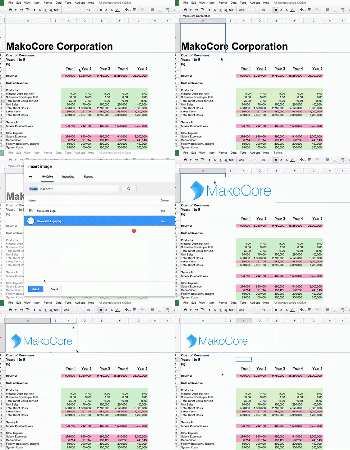
The Google Drive team has added a new feature to their Google Sheets spreadsheet program. Users who setup long spreadsheets often “freeze” the first row in a spreadsheet so it can serve as a header. Then, as they scroll down through a spreadsheet, that first row remains visible.
The update that was released today gives users the ability to embed an image file in that first row so that it will stay visible. This could be especially useful for including something like a logo to a spreadsheet.
The update is currently rolling out to non-Google for Work accounts.s
source: +Google Drive
Come comment on this article: Add logos, graphics to Google Sheets frozen row in latest update
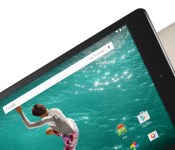
HTC Nexus 9 now offered in Sand color option


Just a quick note for those of you who were considering picking up the HTC Nexus 9. You can now pick the latest Google tablet up in a new color option, Sand.
Head to the Google Play Store today and you’ll find the device offered in the 32GB Wi-Fi configuration. As of right now there’s no LTE option or 16GB storage capacity to choose from.
Powered by Android 5.0 Lollipop, the Nexus 9 boasts a 8.9-inch 2048×1536 display, 2.3GHz dual-core 64-bit NVIDIA Tegra K1 processor, 2GB RAM, and 6700mAh battery. Over on the camera front we find an 8-megapixel rear and 1.6-megapixel front-facing combination.
The post HTC Nexus 9 now offered in Sand color option appeared first on AndroidGuys.
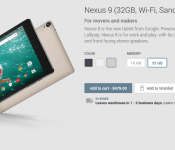
Sand version of Nexus 9 available for first time in Play Store (32GB only)

When the Nexus 9 first landed in the Play Store on November 3, the Sand version was listed as “Coming soon.” It took Google more than two months to make “soon” happen, but now the tan Nexus 9 can finally be yours.
Only the 32GB storage option of the Sand Nexus 9 is available as of right now, with a price tag of $479 and a 1 to 2-day shipping window. This goes for the WiFi-only model, as the LTE-enabled model is still only available in Indigo Black.
The Sand Nexus 9 features a light brown back and black margins, while the front is black, like on all versions. All the differences are skin-deep: inside the device ticks the same Tegra K1 CPU clocked at 2.3GHz, backed by 2GB of RAM and a 6700mAh battery, with a nice 2048×1536 LDC display on the front. Check out review of the HTC-made tablet for more insight.
<!–
–>
<!–
By use of this code snippet, I agree to the Brightcove Publisher T and C
found at http://corp.brightcove.com/legal/terms_publisher.cfm.
–>
There’s no telling when, if ever, Google will release the 16GB Sand model in the Play Store, though considering the lack of expandable storage, going the 32GB route is a sound investment anyway.
Was Google the best of CES 2015 without actually being there?

When January rolls around, thousands of people flock to Las Vegas, Nevada for the Consumer Electronics Show. The trade show allows the press (and the world from afar) to observe what new technology will arrive throughout the year and launch in the future. Even though many companies host their own events for major announcements, CES provides good exposure. It can be a make-or-break time for some while being another platform with the spotlight for others.
There were phones, tablets, televisions, set-top boxes, speakers, and much more all showcased at CES. Something has to power these things, right? Enter Google and more importantly Android. The company did not have a formal presence at this year’s CES; however, devices powered by or connected to Android in some way were seen everywhere. Google might have been the best of CES 2015 and they didn’t have to show up.
Android Devices

Phones and tablets running Android are a lock to appear each year at CES. The flashy names (Samsung, HTC) do not announce flagships or any major devices, but plenty of other companies take full advantage of the massive amount of media coverage. Throughout the week, we saw so many devices that all push something of their own. And that is what Android is all about: variety. Screen sizes, processors, cameras, and software enhancements differences make an Android device unique from any other.

Both high-end and low-end Android phones impressed. The LG G Flex 2 was touted as the first device with the Qualcomm Snapdragon 810 processor. The specifications of the G Flex 2 trump its predecessor and pushes us to think just how mainstream a phone with a curved display can be. There was also ASUS who introduced the ZenFone 2 and ZenFone Zoom to the world. The latter has true 3x optical zoom to capture incredible photographs. Instead of wheeling out a predictable phone, ASUS is gambling. On the low-end and mid-range portion of the market, BLU Products covered consumers of all tastes and budgets with seven new phones. CES 2015 had an Android phone for everyone this year.

Things were a bit more hushed for Android tablets. Still, there was noteworthy hardware to be seen. Polaroid is delivering budget tablets with Android 5.0 Lollipop. You heard that right! Polaroid is already on the Lollipop bandwagon. An extremely thin tablet with a crisp display and Intel’s RealSense technology from Dell impressed. For those awaiting Android to reach a place where productivity is seamless, the Remix tablet is coming. Think of it as the Android equivalent of the Microsoft Surface. Of all the tablets at CES, nothing compared to the massive Fuhu nabi tablets. Android is suitable for sizes big and small.
Android TV

The launch of Android TV has not been particularly smooth. We are six months removed from the platform’s launch at Google I/O 2014 and just one device is on the market. And that one device, the Nexus Player, is available through one retailer which is online. Also, the hardware is a bit underwhelming. All signs have pointed to Android TV facing the same fate as Google TV. Support from hardware manufacturers was announced, but nothing materialized for months. Everything turned around last week in Las Vegas.
A multitude of television manufacturers stepped forward with plans for Android TV in 2015. Sony, Sharp, and Philips and others committed to the platform with their upcoming lineups. Most of them will be 4K Ultra HD televisions. The next step for televisions is met with Google’s vision for Android in the living room. The prices of 4K Ultra HD televisions are starting to fall and that means more consumers will be purchasing them to replace current living room setups. Android TV will be adopted at a pace very similar to 4K Ultra HD. Google TV was introduced with little innovation on both the software and hardware side. Now, the two are being matched perfectly.

Then there is the only set-top box that debuted at the trade show. Razer unveiled the Forge TV micro-console. The Nexus Player is completely blown out of the water by it because the Forge TV is exactly what Google should have released: a set-top box that serves entertainment and gaming content without a hitch. The specifications are leaps and bounds better than the Nexus Player. Furthermore, the Forge TV is able to stream PC-level gaming. All of this is packed into a device that costs just $99, the same price as the inferior Nexus Player.
Android Auto

Another area that Google did not have Android supplanted in prior to I/O 2014 was the car. The platform for automobiles was also launched in June with an impressive amount of partners. Considering how much planning is involved in the automobile industry, it was highly unlikely that Android Auto would gain any traction in 2014. Now is the time for Google to step on the gas pedal and get Android Auto moving.
Volkswagen announced that upcoming cars in 2015 would support Android Auto (and Apple’s CarPlay). The first vehicle to have Android Auto support from the company is the Volkswagen Golf, a more affordable option. The Golf is one of Volkswagen’s top-selling models and that means access to Android Auto is way easier than, say, a vehicle from Mercedes-Benz. Volkswagen is a valuable partner for Google because it allows a larger group of consumers to drive with their software.

The real stars for Android Auto at CES 2015 were the aftermarket head units from Parrot, Pioneer, and Kenwood. These products are what will jump-start the platform this year because of the low cost. Consumers will be able to purchase a head unit with Android Auto to install themselves for far less than it would be to purchase a new vehicle. Shopping for a new vehicle is completely different than shopping for a head unit.
Google Cast for Audio

Google Cast, the technology that is the backbone for Chromecast, has expanded to a new range of equipment. Cast for Audio enables music streaming for speakers, sound bars, televisions, and set-top boxes. Google revealed Cast for Audio a few hours before compatible hardware arrived from LG, Sony, and Denon. Google and its usual partners are together once again and this time the target is Sonos. Almost all of the hardware compatible with Cast for Audio has a Sonos counterpart. The difference is that Cast for Audio extends to entire televisions and set-top boxes rather than strictly audio equipment.
Who do you think had the best CES 2015? Let us know in the comments. Click here to see everything that was part of CES 2015.
Come comment on this article: Was Google the best of CES 2015 without actually being there?

