



Google will sell wireless service through Sprint’s network
 Just yesterday rumors started swirling about Google finally getting the mobile network market by partnering with either Sprint or T-Mobile. Less than 24 hours later, it looks like Google has closed a deal with Sprint and will soon begin offering a wireless service to compete with the other major carriers.
According to an insider, Masayoshi Son, president of Sprint’s parent company Softbank, was the key player in getting talks going between the two companies. The deal will function like most other MNVO deals, with Google paying Sprint for capacity, then Google will sell the service to customers.
There’s no word on whether or not Google will finalize something with T-Mobile, but earlier reports made it seem like a deal with both carriers was very likely.
Are you excited about a Sprint powered, Google managed MNVO?
source: Business Week
Come comment on this article: Google will sell wireless service through Sprint’s network
Sprint has reportedly struck a deal with Google for their upcoming mobile service offerings
The other day the web was a flutter with talks of Google talking with T-Mobile and Sprint to start offering up their own cell service. Google can’t just go out and build a million towers, buy a bunch of spectrum and have their own coverage after all. What they would need to do is piggy […]
The post Sprint has reportedly struck a deal with Google for their upcoming mobile service offerings appeared first on AndroidSPIN.

Chrome for Android updated with minor adjustments, more Material Design

The Chrome for Android application, available in the Play Store, is being updated to version 40. The update is not an overhaul by any means but it does make some appealing changes with even more Material Design sprinkled throughout. Tapping on a URL will cue a box that contains the option to copy it. Before, users had to manual cut/copy the URL like any other text. On tablets, long-pressing the close button on a tab provides a button to close all tabs. The most welcome addition, though, is how fixed headers work when zooming. Things are less likely to get messy and crowded with everything staying in its place.
As expected, Google is rolling out the update slowly. You can download the update for yourself by hitting the download link below.
Source: OMG! Chrome! [APK Download Link]
Come comment on this article: Chrome for Android updated with minor adjustments, more Material Design
Can Google disrupt the wireless industry?

Yesterday a report surfaced from The Information claiming that the long-rumored Google wireless service is nearly upon us under the name Project Nova, piggybacking off of Sprint and T-Mobile’s networks as an MVNO. We have to wonder, what exactly does Google hope to accomplish by entering into this space? Obviously the biggest goal could be disrupting the cellular industry, but in what ways would Google be able to accomplish this?
While we have no way of knowing for sure what Google plans, we can certainly look at the limited evidence around us and speculate a little. With that in mind, let’s take a look at what a Google-ran carrier might look like and how it could potentially change the game.
Google Wireless: the technology behind it
So how might Google’s service differ from traditional carrier services and other MVNOs? That’s a good question.
While initial reports haven’t given us much to go on, yesterday Android Police reported that this isn’t the first time they’ve heard of Project Nova. Reportedly they received a tip last year that they hesitated to report on due to a lack of further information. Based on this tip, Nova could be a data-only service that uses data for everything including calls. Furthermore it would reportedly offer unlimited data, though it would push calls and other operations over to Wi-Fi whenever possible

The original AP tip also claimed that Google Voice would serve as the backbone of Nova’s data plans, though that was before GV features started integrating into Hangouts. In a nutshell, that means Google Wireless (or whatever they call the final product) could give you a data-only plan and a voice number that would work through Hangouts. The end-product would be an experience that acts a lot like a traditional carrier and yet relies on cellular data to make all the magic happen.
Google’s wireless service could offer unlimited data, though it would push calls and other operations over to Wi-Fi whenever possible.
If this sounds familiar, that’s because the model described is very similar to Republic Wireless, with the biggest change being the reliance on Google Hangouts for calls. This is Google though, and that means there has to be more to their service. After all, Google wouldn’t step into this space if they didn’t have a bigger ambition that goes beyond what we’ve already seen from competitors.
So what other kind of technologies might Google bring to the table, other than simply relying on a data-only MVNO model? According to the Wall Street Journal, Google has been lobbying the FCC to free up vast amounts of low-quality wireless spectrum. This type of spectrum can’t transport wireless signals across long distances, but Google could use the signals across smaller ranges (like specific cities) as a way to improve wireless networks. As Google said during a recent letter to the FCC, these frequencies could be used for “the next generation of unlicensed broadband services” or “entirely new technologies and innovations”.
Using a network of Google Fiber driven Wi-Fi and new technologies that potentially utilize higher-frequency spectrum, Google could provide a faster phone service that reverts to using Sprint and T-Mobile networks when folks are away from publicly available Wi-Fi networks.
What the plans might look like, where they might be offered
There’s quite a few ways that Google could go about this. First, it could offer its services for free as part of a Google Fiber subscription, making the use of Fiber-backed public and private networks free for their wireless service. Second, they could make it dirt cheap and maybe even somehow ad advertising to augment costs, though we have a feeling consumers wouldn’t care for this ad-driven approach too much.
We also have to wonder if their MVNO would be prepaid, postpaid or come in more than one flavor. Given the “open nature” of Google (in most things), we’d say that they likely won’t subsidize their devices too heavily, if at all, and so a no-contract model is probably more likely. Regardless, at the very least we can expect pricing to be more aggressive than most other carriers out there.
As for availability? I personally have the feeling that the rollout will be limited, especially if the service is tied into special technology that goes beyond a typical MVNO setup. Obviously this is speculation, but we shouldn’t be too surprised if Google targets the same cities that currently offer Google Fiber — though it would be amazing if they end up having a wider launch of the service that goes beyond a few metro areas.
The phones

Here’s an interesting question: what phones would Google support? Would they allow you to bring any compatible GSM (for T-Mo) or compatible CDMA (for Sprint) device? Would they offer their own products? It seems like a safe bet that the Nexus 6 and Nexus 9 Wi-Fi would be made available, but that’s a pretty limited selection. That means Google either needs to embrace the BYOD model, create new GPe devices, or open up its service to OEM-skinned products from Motorola, Samsung, HTC and others.
We also have to wonder how the network would work, considering it is using both a CDMA-based and a GSM-based carrier. Would customers choose either a Sprint-based plan or a T-mobile-based plan? It is also possible that Google could use both networks simultaneously, though that would mean relying on LTE only (as legacy frequencies like 3G would add extra headaches) and ensuring all phones that are compatible with the service play nicely with all necessary frequencies.
Possible killer weapons

Quicker updates
There are many times when unlocked or global devices start receiving updates significantly quicker than carriers, with AT&T and Verizon being two of the worst offenders when it comes to update timeliness. While it seems obvious that Nexus device on Google Wireless would get extremely quick updates, what if Google did the same with OEM-skinned devices that were compatible with its network?
A US network that offered updates nearly as quickly as unlocked devices? If Google could actually pull this off, that would be amazing. That said, I’ll admit I’m not sure if the fact that Sprint and T-Mobile are providing the cellular network would get in the way of this or not. Still, I suspect that quicker updates would be just one of many weapons in Google’s arsenal.
Being more open, and near-bloat free
Another way that Google could stand out is by simply being more open, embracing the idea of custom ROMs, modding and keeping carrier bloatware to a minimum. If Google is simply utilizing services already tied into Android (such as Hangouts), Google’s service could be the most “pure” bloat free experience on the market.
Think of Nova as the “Nexus” of carriers
The Nexus program is designed to be a reference platform, not just for developers and modders, but for OEMs as well. The idea is that a Nexus device is showing what a Google-driven experience can and should look like, armed out of the box with the newest version of Android. The hope is that OEMs follow their example with their own OEM-skinned offerings.
I sincerely doubt that Google is getting involved with the wireless industry in order to just make money. This is just another way — alongside Project Loon and many others — to get more folks online and connected to their services. It also will hopefully serve as a shining example for carriers on how to make a consumer-friendly service that breaks conventions.
While T-Mobile is already doing its fair share to shake up the wireless industry, more innovative players in this space certainly can’t hurt any. Whether I personally think that Google can disrupt this industry? While they certainly have the means, I don’t think it will happen anytime soon — at least given the slow rollout we’ve seen with Google Fiber so far. What do you think, would you like to see Google get involved in the wireless game or are they best left sitting this one out? How to do you think Google might change up the wireless game?
Report: Google to become MVNO on backs of Sprint and T-Mobile
Google has been working on a solution for mobile service for a while. We haven’t necessarily received any official confirmation, but it has been in reports and rumors for a while. Now, it seems we may be closer than ever to that becoming a reality.
The Information has a report that Nick Fox, a Google executive, is leading what’s called “Project Nova”, which will see Google buying wholesale access to service from T-Mobile and Sprint to provide to consumers. This would make it an MVNO.
Google is always looking for ways to push companies to think for the consumer and push to be better. Just look at Google Fiber, which has done exactly that in the cities it has been released. It will be interesting to see how Google does this as an MVNO and not an actual carrier.
I personally like the idea of Google providing wireless plans, and would be willing to try it out. Would you give it a shot?
The post Report: Google to become MVNO on backs of Sprint and T-Mobile appeared first on AndroidGuys.

Google Play edition devices are no longer available

Never got around to purchasing a Google Play edition device? Then it is likely safe to say you never will. Slowly but surely, we have seen Google Play edition devices vanish online. A warning was never issued by Google and the company has proceeded to pull the devices from the Play Store. Most recently, the Samsung Galaxy S 4 Google Play edition was removed after months of being out of stock. Then, today, the HTC One (M8) Google Play edition was shown the door. It left the Google Play edition section with nothing to show; therefore, the initiative that pushed a stock Android experience on flagship devices is presumably gone.
Have you ever purchased a Google Play edition device? Let us know in the comments.
Source: Google Play
Come comment on this article: Google Play edition devices are no longer available

Google adds screen reader support to Docs, Sheets and Slides apps

Google’s Docs, Sheets and Slides apps aren’t easy to use on a phone’s small screen at all, but this set of updates could make things just a bit more convenient for both iOS and Android users. Documents now come with real-time spell check, spreadsheets are now able to hide rows and columns, and presentations can lump similar shapes together. Even better, they all now work with Android TalkBack and iOS VoiceOver — screen readers that will make the apps friendlier to the visually impaired — though those who only need just a bit of help reading on a small screen can use the magnification tool instead. Finally, if you’re using an iPhone or an iPad, you can start using your fingerprint to unlock the apps if you want to make sure no nosy workmate can get into your files. The updates are now rolling out for both mobile platforms and are now available on Google Play and iTunes.
[image credit: shutterstock]


Filed under: Misc, Mobile, Google
Via: Google Drive, Google Play, iTunes (Docs), iTunes (Sheets), iTunes (Slides)
Source: Google Docs Blog

Google Files new Polaroid-ish Patent
 If you weren’t born yesterday, you probably remember when Polaroids were all the rage. The ability to take a photo and have it develop right before your eyes was a luxury in the days before smartphones, digital cloud storage, and nearly constant internet access. However, Google apparently thinks that this ability is once again necessary. The filing of the Polaroid-reminiscent camera patent has caused many in the tech community to scratch their heads and turn a confused face.
While it;s important to keep in mind that a patent doesn’t necessarily mean there is an upcoming product, it will be interesting to wait and see what the tech giant will do with its new patent. Interesting features on the camera include the ability to print double sided photos, print a photo whenever you want instead of immediately after capture, and print a postcard layout with prepaid postage stamps.
Google has never been one to back down from a challenge, so keep your eyes peeled to see what becomes of its latest patent. Do you think instant print cameras are past their prime and a foolish business idea? OR does Google have a master plan in mind? Leave a comment below and let us know what you think!
Source: Quartz
Via: Android Headlines
Come comment on this article: Google Files new Polaroid-ish Patent
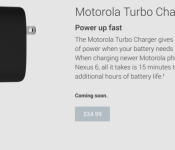
Google lists the Motorola Turbo Charger as “coming soon” in the Play Store

Devices like the Nexus 6, Motorola DROID Turbo, and HTC One (M8) are capable of enhanced charging with Qualcomm Quick Charge 2.0 technology. The special chargers, when paired with supported devices, powers them much quicker than ordinary chargers. Both Motorola and HTC have released their own Quick Charge 2.0 chargers, but availability has been somewhat limited. The Motorola Turbo Charger will soon be available in the Play Store. When? No one is sure. It is a good sign, however, that its status reads “coming soon.” The price listed is $34.99.
In the meantime, you can purchase the Turbo Charger directly from Motorola.
Source: Google Play
Come comment on this article: Google lists the Motorola Turbo Charger as “coming soon” in the Play Store

Google spends more on lobbying than Comcast, AT&T, Verizon, Facebook, and Apple

Google might be buying up a lot of tech companies, but they are also spending a considerable amount of money on lobbying efforts in Washington. According to Consumer Watchdog, Google spent a record $16.83 million to influence regulators in 2014. That’s up from $14.06 million in 2013.
Google bested Comcast, which spent $16.80 million in 2014. They even went ahead of Verizon ($11.22 million) and AT&T ($14.56 million). Apple and Facebook combined didn’t even spend as much as Google, $4.11 and $9.34 million respectively.
I guess it isn’t a surprise that Google tops the list since they have their hand in so many different things. The real question is if Google was able to effectively sway decision makers?
Full Press Release
Google Spends Record $16.83 Million On 2014 Lobbying, Topping 15 Tech And Communications Companies; Facebook, Amazon, Apple Also Post Records, says Consumer Watchdog
SANTA MONICA, Calif., Jan. 21, 2015 /PRNewswire-USNewswire/ — Google spent a record $16.83 million on lobbying in its efforts to influence federal regulators and lawmakers in 2014, just ahead of Comcast’s reported $16.80 million, according to records filed with the Clerk of the House and analyzed today by Consumer Watchdog.
Consumer Watchdog, a nonpartisan nonprofit public interest group, monitors the lobbying disclosure reports of 15 tech and communications companies. Facebook, Apple and Amazon also set corporate records for the amount they each spent. The 15 companies spent a total of $116.62 million on lobbying in 2014, a 3 percent decrease from a total of $120.28 million in 2013. Six of the 15 companies increased their 2014 spending, while the rest cut back from 2013 levels
“It’s important to understand just how much money these companies are throwing around in Washington to buy the policies they want,” said John M. Simpson, Consumer Watchdog’s Privacy Project Director. “Policymaking is now all about big bucks, not big ideas.”
Here is a link to the Clerk of the House’s Lobbying Disclosure database: http://disclosures.house.gov/ld/ldsearch.aspx
Google spent $16.83 million on lobbying in 2014 compared with $14.06 million in 2013, a 20 percent increase. Google’s fourth quarter lobbying expenditure was $3.78 million, a decrease of 5 percent from $3.98 million, in 2013.
Microsoft, Google’s archrival, which used to regularly outspend the Internet giant, spent roughly half of what Google spent. Microsoft reported spending $8.33 million, a decrease of 20 percent from $10.49 million spent on 2013 lobbying. Fourth quarter lobbing expenses were $2.25 million compared to a $2.77 million, a 19 percent decrease from 2013.
Facebook, which has substantially increased its Washington presence over the last three years, posted another company record in its effort to influence policymakers. Spending soared 45 percent to $9.34 million from $6.43 million in 2013. Fourth quarter spending was$1.99 million compared to $1.48 million, an increase of 39 percent.
Amazon also posted a company record its disclosure forms show. It reported lobbying expenditures of $4.74 million, a 37 percent increase from $3.46 million in 2013. Fourth quarter spending was $1.67 million vs. $960,000, an increase of 74 percent.
Apple, too, is increasing its Washington activities. It spent $4.11 million in 2014, a record and a 22 percent increase from $3.37 millionspent in 2013. Fourth quarter spending was $1.19 million vs. $990,000 a 20 percent increase.
Here are the 2014 lobbying amounts for five other tech firms:
- Cisco spent $2.35 million in 2014, a 25 percent decrease from $3.12 million in 2013. Fourth quarter spending was $310,000 vs.$890,000 a decrease of 65 percent.
- IBM spent $4.95 million in 2014 a 30 percent decrease from $7.06 million in 2013. Fourth quarter spending was $1.15 million vs.$1.90 million, a decrease of 39 percent.
- Intel spent $3.80 million in 2014, a 13 percent decrease from $4.39 million in 2013. Fourth quarter spending was $980,000 vs.$1.45 million vs., a decrease of 32 percent.
- Oracle spent $5.83 million a decrease of 3 percent from $5.99 million in 2013. Fourth quarter spending was $1.66 million vs.$1.60 million, an increase of 4 percent.
- Yahoo spent $2.94 million in 2014, an increase of 6 percent from $2.78 million in 2013. Fourth quarter spending was $740,000 vs.$720,000, an increase of 3 percent.
Two of three telecommunications companies decreased their spending on lobbying, while one increased expenditures in 2014:
- AT&T spent $14.56 million, a 9 percent decrease from $15.94 million in 2012. Fourth quarter spending was $3.06 million vs. $3.64 million, a decrease of 16 percent.
- Sprint spent $2.99 million, a 9 percent increase of from $2.75 million in 2013. Fourth quarter spending was $772,658 vs.$716,887, an increase of 8 percent.
- Verizon spent $11.22 million, a decrease of 17 percent from $13.44 million in 2013. Fourth quarter spending was $2.97 million vs.$3.46 million, a decrease of 14 percent.
Here are 2014 lobbying expenditures for two cable companies:
- Comcast spent $16.8 million in 2014, a 10 percent decrease from $18.71 million in 2013. Fourth quarter spending was $5.03 million vs. $4.78 million, a 5 percent increase.
- Time Warner Cable spent $7.83 million in 2014, a 6 percent decrease from $8.29 million in 2013. Fourth quarter spending was$2.2 million vs. $2.49 million, a decrease of 12 percent.
Come comment on this article: Google spends more on lobbying than Comcast, AT&T, Verizon, Facebook, and Apple

