



Avegant Glyph home theater headset isn’t competing with Oculus Rift (hands-on)

We’ve spent gobs of time with variations of Oculus VR’s Rift headset — the original duct-tape prototype, the first dev kit and even an updated HD version. We’ve spoken to creator Palmer Luckey several times, and company reps have graced Engadget stages at both CES 2013 and last March’s first-ever Expand event in San Francisco.
Avegant’s Glyph, however? We’ve only just begun. The home theater headset just got a name, and the first prototype looked an awful lot like what you’d see underneath a Terminator cyborg’s smooth visage. As Oculus did before, the scrappy eight-person team at Avegant is taking its impressive proof-of-concept to Kickstarter in hopes of funding a beta unit: $500 is the base level for a Glyph, and the project is set to go live on January 22nd. And this sentence — right here! — is where we’re gonna stop speaking about the Glyph as if it’s competing with the Oculus Rift. As Avegant’s CEO Ed Tang told us late last week: “We’re not trying to compete with Oculus.”
There’s good reason for that. For starters, the Glyph is really, really different from the Rift. Like, dramatically different. Yes, they’re both video headsets. Yes, they both offer some form of interactivity. What each is trying to achieve, however, is starkly different. The Rift aims for deep immersion — it cuts off your field of view, encompassing your entire spectrum of vision — whereas the Glyph operates more like a set of sunglasses. You can play games on it, but it’s really more suited for movie watching (say, on a plane). Both the alpha model we tried late last week (“hot off the production line!”) and the beta model that’ll ship to Kickstarter backers have a relatively small 45-degree field of view, allowing for a partially obstructed perspective of the world while using the Glyph. It’s this conceit that makes all the difference between the two.
As such, if you’re looking for the immersive virtual reality experience that the Rift offers, stop looking at the Glyph. If you’re looking for a $500 way to buy your own, very personal home/mobile theater (that’s still in beta), the Glyph is spot-on. As previously reported, the Glyph’s image is extremely crisp. Similarly impressive, it can do 3D without any glasses: it projects the image directly onto your retinas rather than using a screen. The effect, however, is more than a little underwhelming. Sure, the image is nice, but it’s surrounded by a massive dead space that feels wasted. Moreover, we spent three to four minutes adjusting the interpupillary distance (IPD) — the space between your eyes — just to make it work. That’s three to four minutes longer than it should take to make a $500 visual entertainment device function.

Another major differentiator from the Rift? Glyph has a fancy pair of headphones built in. If you want to be all the way crazy, you can wear the device like a standard set of (very large) headphones. Normally, though, it just serves as a means to make video viewing more comfortable. It’s a smart addition, but adds yet another layer of adjustment: Not only are you adjusting the IPD, but also how tight the whole apparatus is on your head. The alpha model we tried had a headstrap, though it isn’t planned for the beta. We’re also told that the beta model will be considerably lighter — as it stands, the Glyph rests somewhat uncomfortably on noses.
So, who is the Glyph for? Not just gamers, that’s for sure. A single MHL/HDMI wire will attach the Glyph to virtually anything — we even tried some mobile gaming with a Lightning adapter on an iPhone 5. An expected three-hour battery life, however, applies some serious limitations to viewing on the go. As best we can tell, like Google Glass’ Explorer Edition and Oculus’ Rift dev kit, the Glyph beta unit is meant for early adopters who are willing to put up with a very promising wearable that isn’t ready for retail just yet. Oh, and developers. But not for your parents (or even you, probably) just yet.
Filed under: Gaming, Home Entertainment, Peripherals, Wearables
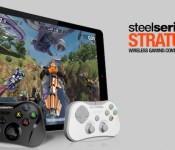
SteelSeries launches the Stratus, the first wireless iOS 7 gamepad

With its new gaming protocols in iOS 7, Apple opened the door for gamepads that make use of the iPhone’s Lightning connector to bring assortment of inputs to iOS titles. Recognizing that not all iOS gamers own an iPhone, accessory maker SteelSeries has unveiled its new Stratus controller, becoming the first wireless gamepad to support Apple’s latest iOS platform in the process. Unlike Logitech’s PowerShell and PowerA’s MOGA Ace Power, the Stratus connects to an iPad, iPhone and the iPod touch via Bluetooth 2.1, putting four pressure sensitive face buttons, four shoulder buttons, dual analog sticks and a 4-way D-pad in a design that reminds us a little of Sega’s Genesis/Mega Drive gamepad, at least in black. While you won’t be able to attach your iOS device to the Stratus and play on the move, it does mean you can set it aside and play against up to three other players on the big screen via AirPlay. Without that additional clutter, the Stratus comes in significantly lighter than rival controllers, giving you around 10 hours playtime on a full (USB) charge. SteelSeries has already made the Stratus available for pre-order on its website for $99.99 / €99.99, you can find the link in the source below.
Filed under: Gaming, Handhelds, Mobile
Via: SteelSeries Press
Source: SteelSeries Status
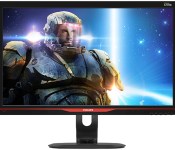
Philips’ 27-inch monitor with NVIDIA’s G-Sync tempts gamers with silky-smooth visuals

When NVIDIA unveiled its G-Sync tech that alleviates lag, screen tearing, and stuttering, it counted Philips among the companies that would make monitors with its secret sauce. Now that CES has rolled around, Philips has finally revealed a panel that uses the graphic titan’s technology. The panel (catchily dubbed 272G5DYEB) measures up at 27 inches, carries a resolution of 1,920 x 1,080, a 144Hz refresh rate, 1,000:1 contrast ratio and displays up to 16.7 million colors. If you’re fixing to connect the screen to your PC via HDMI, you’re out of luck as it only sports a DisplayPort. Enjoying the buttery visuals will drain your pockets of $649 when the monitor arrives this spring. Of course, if you can’t wait till then, a modified ASUS VG248QE is already available with G-Sync from a handful of boutique PC outfits.

Dolby Vision imaging finally comes home this fall with Netflix and Xbox Video as partners

Dolby’s TV image-enhancement tech has been in development for a long time, and today the company is finally ready to show you when and where you’ll find it. What we saw in December has been graced with the Vision name, and the outfit has promised we’ll see TVs with it baked in this fall. What’s more, Sharp and TCL have compatible hardware on display in their respective CES booths this week, and Amazon, Netflix, VUDU and Xbox Video are stepping up as content providers. Hit the Dolby link below for more information, and be sure to check back later this week for our latest impressions.
Filed under: Gaming, Home Entertainment, HD

Nintendo forced to pay a share of every 3DS sale to another company

While Nintendo’s Wii U console sales may continue to frustrate, its handheld gaming business offers hope of a better future. But even as its 3DS and 3DS XL consoles continue to outsell their rivals, Nintendo will have to come to terms with sharing a percentage of each sale with another company. In December, the company was told it must pay 1.82 percent of the wholesale price of each 3DS sold after it was found guilty of infringing on patented camera technology owned by Tomita Technologies. It means that Nintendo could pay up to $3 for each unit, for as long as it continues to sell the console. Given it sold 2 million 3DS and 3DS XLs last quarter, putting the current lifetime total at 35 million, demand for the handhelds is still strong. Nintendo’s already paid Tomita a $15 million damages award, but it faces the prospect of sending Tomita smaller payments well into the future.
Via: Kotaku
Source: Law 360

NVIDIA certifies PCs and routers that can stream games to its Shield handheld

If you’ve ever tried to stream a game from a PC (or PS4) to a mobile device over WiFi, then you’ll know the bandwidth requirements can be quite fussy. Attempt to remote play at 1080p and 60 frames per second, as NVIDIA promises with its Shield handheld and recently upgraded GameStream service, and things start to get seriously pinnikity. So, to help you pick the right hardware to go with your Shield (which is now going for $250 at Amazon, by the way), NVIDIA has started a certification program to label PCs and routers that are GameStream-ready. Expect to see the green logo on pre-built machines from the likes of Digital Storm and Maingear that have the necessary GeForce GTX graphical guts, as well as a number of dual-band and wireless-AC routers from ASUS, Buffalo, D-Link and Netgear. (You’ll find a full and current list of certified products over at the source link). Compatible routers will also support streaming from the cloud, via NVIDIA’s alternative GRID service, although of course you’ll also need a steady 10Mbps broadband connection before you even think about trying that.
Filed under: Desktops, Gaming, Handhelds, Mobile, NVIDIA
Via: IGN
Source: NVIDIA GameStream-ready products

NVIDIA K1 chip adds Unreal Engine 4 support

The Unreal Engine’s latest iteration, Unreal Engine 4, is adding support for NVIDIA’s latest Tegra chip, the K1. Epic Games’ ubiquitous engine powered much of last-generation games with Unreal Engine 3, and Epic’s promising even more with the next generation. NVIDIA CEO Jen-Hsun Huang announced as much tonight during the company’s CES 2014 press conference, and he made sure to note the much shorter gap between Unreal Engine running on next-gen consoles/PC and mobile devices.
With Unreal Engine 3, Infinity Blade was the first mobile game running on Epic’s game tech — demonstrated on-stage during an Apple keynote for a new iPad. Unreal Engine 4, however, scales both up and down right out of the gate, apparently. “We can take absolutely anything that runs on PC or high-end consoles and run it on Tegra…I didn’t think that we’d be at this level on mobile for another three to four years,” Epic Games head Tim Sweeney said of the news. Color us unsurprised — we expect to see Unreal Engine 4 running on anything that plays games in the coming years.
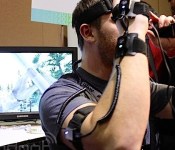
PrioVR full-body mocap suit promises accurate motion tracking in VR gaming

Sure, Kinect’s done a bang-up job of bringing full-body motion tracking closer to the mainstream, but it hasn’t exactly fulfilled the dreams of futuristic gaming that Hollywood (and our imaginations) promised. PrioVR, a motion-tracking suit meant for virtual reality games, aims to bring us closer to that future with accurate full-body motion-capture abilities without a camera array in the mix.
The demo on hand today was pretty impressive: A rep was decked out in the upper-body suit, complete with Wii nunchuks, playing a first-person shooter. Sensors on his chest, back, head, arms and hands translated his movements to the screen with little latency, showing up on the display in a fraction of a second. We did notice an ever-so-slight choppiness — which could have more to do with the game engine than the hardware — but how much it affects gameplay remains to be seen. Though only an upper-body rig was being shown off, a full-body getup promises to capture everything from walking to kicking.

YEI Technology, the company behind PrioVR, originally launched a Kickstarter effort late last year, but after only raising $111,237 of its $225,000 funding goal, the firm’s giving the prototype another go, with a new campaign launching on February 14th. The upper-body suit will reportedly go for about $300, while the full-body version will come in under $400. Obviously, this type of tech opens up a world of possibilities for developers, especially when paired with likes of the Oculus Rift and other head-mounted displays. Expect a few compatible games when the PrioVR makes its way to Kickstarter backers this summer, and a proper hands-on as CES continues.
Sarah Silbert contributed to this report.
Filed under: Gaming
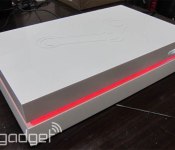
Here are Valve’s 12 Steam Machines partners (so far)

Valve’s Steam Machines initiative is supported by a first-party box that 300 beta users have right now, but 2014 is all about third-party Steam Machines taking that reference box and running with it. Thus far, the only third-party we know of that’s making a Steam Machine is iBuyPower (pictured above) — today, that all changes. Alienware, Falcon Northwest, iBuyPower, CyberPowerPC, Origin PC, Gigabyte, Materiel.net, Webhallen, Alternate, Next, Zotac and Scan Computers are among the first companies signed on to support Valve’s initiative, Engadget learned this afternoon.
The entire lineup will be on display this week at CES 2014, and we’ll have many more details in the coming days. Beyond the dozen companies above, it’s totally possible that there are other third-parties signed on for Steam Machines — we’ll have to wait and see when Valve unveils everything at its press conference tomorrow afternoon.

Eyes on with Tobii’s gaming eye-tracking engine and SteelSeries prototype hardware

Tobii’s getting serious about bringing eye tracking to gamers the world over. Days ago, the company announced a partnership with SteelSeries to build a new sensor bar and its EyeX engine meant to bring eye tracking to more games in 2014. Today at CES, we got to see a non-functioning prototype of that SteelSeries hardware (seen in our gallery below) and test out EyeX playing Deus Ex. As a bit of background, the EyeX engine was released a month ago, and using Tobii’s SDK and APIs to implement it, devs can combine gaze controls with regular mouse, keyboard and touchpad inputs to provide new gaming user experiences.
Our demo was a bit rough, given that the game was running at a startlingly low frame rate for some reason, and the device hadn’t been calibrated to our eyeballs due to time constraints. Still, we could see the potential for the technology, as it allows for faster in-game navigation. For example, the EyeX middleware allows for developers to overlay quick menus on top of the game screen at a touch of a button, and you make your selection by merely looking at the icon you want. Additionally, the control for aiming down the sights simply required closing one eye, while squatting or looking around corners was accomplished by moving our head up and down or side to side. In practice, the menu selection was the smoothest and most accurate implementation, while the character movements were far less reliable — they worked in about two out of three attempts. Of course, you don’t have to take our word for it, you can see for yourself in the video after the break.

