


Using the PlayStation 4’s virtual reality headset, Project Morpheus (update: now with video!)

The cat’s out of the bag and … uh, on our head? Okay, we can do better than that, but what we’re trying to say is that we just used Sony’s new Playstation 4 virtual reality headset: Project Morpheus. You already know the specs and all that good stuff, we’re here to tell you what it’s like using the still-in-prototype-form virtual reality headset for the PlayStation 4. Good news: it’s pretty great! Surprise!
Join us below for a closer look.
Project Morpheus, right now, is a little uncomfortable. In so many words, it feels like a prototype still. As a demo man fit the headset on my generously-sized noggin, he tightened a variety of different adjustments: one that tightened the whole unit on my head, another that brought the display portion forward toward my eyes. When you initially put it on, there’s a gap between where you’re looking and below — certainly not a great way to create immersion. Thankfully, that gap closed easily in the two different demos we tried (“The Deep” and “The Castle” — both of which were more tech demo than game).
I’d love to say it was a sweat-free experience; between gesticulating with PlayStation Move controllers as hands and being surrounded by hundreds of GDC attendees waiting for their chance to try Morpheus, I was relatively moist by the time I’d cut up the dummy model in The Castle with a virtual sword. While uncomfortable, I can get over that — the issue is that it makes the optics fog up and that’s no good at all. Part of the unit’s design is based around keeping players cool, so you should expect a better experience as Morpheus goes from prototype to reality.

So, games! What’s it like using Morpheus to play games? It’s pretty neat! Well, that’s to say, “It’s a lot like playing games in the Oculus Rift headset, especially the newer versions of the Rift.” In The Deep, I took a trip to the bottom of the ocean in a metal cage; when I bent down, my in-game knees bent (as tracked by the PlayStation Camera). When I looked up, my perspective turned skyward and the lamp mounted to my virtual head followed (the lighting was perhaps the most impressive part, with cage bars occluding properly and all).
In The Castle, I picked up two PlayStation Move controllers to act as hands, which enabled me to bend over, pick up a sword and take a dummy down a few notches. If I moved back a few steps, my in-game avatar moved back a few steps. One major change in Morpheus compared with other VR headsets is full-body tracking, which does legitimately add to the immersion effect.

It’s not all virtual reality rainbows and dreams, of course. There are still some pretty major issues to overcome in Project Morpheus. Vision blur, for instance, is a much bigger problem on Morpheus than on Crystal Cove/Rift DK2. The screen resolution is also clearly not as high as DK2, making everything a bit muddier, visually speaking. Right now, well ahead of launch (Sony’s not even talking about what the final product will be just yet, nonetheless giving it a launch window), Project Morpheus is both extremely promising and clearly not ready for primetime. But it’s close!
To put it frankly, we’re extremely excited to see what the next few years means for the entire medium of VR, not to mention the efforts of major players like Sony, Valve and Oculus. Morpheus is the second major entry in the field, and, well, that’s really thrilling! In case it weren’t already clear, this is the week that virtual reality officially goes big.

Epic Games’ Unreal Engine 4 now available by subscription for $19, headed to OS X and more

Unreal Engine 3 set the standard for games last generation, powering breakout franchises like Gears of War and Mass Effect. We don’t know if Unreal Engine 4 will have the same impact, but today’s move by Epic Games to massively democratize this game engine is certainly a step in the right direction. Today, Unreal Engine 4 is going subscription: For $19/month you get, “access to everything, including the Unreal Editor in ready-to-run form, and the engine’s complete C++ source code hosted on GitHub for collaborative development.” That’s according to Epic Games head Tim Sweeney, who spoke at a GDC event this morning. Any game published commercially must also pay 5 percent of gross profit to Epic (which could get lucrative very quickly for Epic). It’s a move aimed directly at the evolving world of contemporary game development, where indie hit-makers like Jonathan Blow take the stage at Sony’s PlayStation 4 unveiling in place of triple-A studios. We were shown a simple Flappy Bird clone for iOS, for instance, as an example of the flexibility of UE4 (the demon lord seen above is an example of the other end of the engine).
Beyond the subscription service and full access to the source code (which is a big move unto itself), Unreal Engine 4 is getting OS X support. There’s also evidence in the source code that Epic’s working on Oculus Rift, Linux, Steam Machines and HTML5 support. But we already kinda knew all that, right? So we asked Tim Sweeney for a deeper dive into today’s news and what it means for Epic Games as both a game engine maker and a game studio. Head below for the full video!

Pretty soon you’ll be able to rip video from the PlayStation 4

During the lead up to the PlayStation 4′s launch, Sony promised that it would enable gamers to shut off HDCP (High-bandwidth Digital Content Protection) post-launch and allow unrestricted video capture over HDMI. That day is almost here, as the company’s just announced its intention to release two new system updates mostly focused on the console’s sharing functionality.
Though Sony hasn’t set a time frame for either of these two planned updates, the first should arrive in the “upcoming weeks” and will add in that previously mentioned HDCP-off option, as well as video editing tools so gamers can chop up and tweak gameplay footage captured via the Share button. In addition to this, the PS4 will also gain an option to save recorded clips and screenshots to an external USB drive, thus clearing up your system’s limited storage space and letting you preserve your gaming conquests. Sony apparently plans to bundle additional features and fixes into this update, but for now it’s saying that specifics on just what that entails will come at a later date. Who knows, maybe it’ll also usher in VR support for Project Morpheus. Though that’s probably us wishing too hard and jumping the gun a bit.
But that’s not all for tweaks to the PS4′s popular Share feature set. When the second planned update hits, gamers will not only get a chance to archive broadcasted Twitch footage, they’ll also get a chance to stream and view it in 720p resolution. Again, there’s no concrete mention of when we can expect these updates to roll out, but at least you can take solace in knowing that Sony’s making good on its word.
Source: Sony PlayStation blog
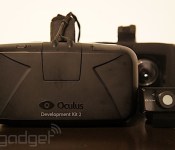
The new Oculus Rift costs $350 and this is what it’s like

If you’re still not paying attention to Oculus VR and the Rift headset — the folks at the forefront of virtual reality’s recent rebirth — what are you doing? Okay, we’ll forgive you. It’s still just a development kit after all, and even the latest prototype (“Crystal Cove”) is far from the expected final product. Today though, you’ve got one less excuse to stay in the dark: The second Oculus Rift development kit is available for pre-order; it costs $350; and it’s really, really impressive. That’s two reallys.
The Oculus Rift has come a long way since we first saw it back in 2012. First there was the HD version, and the next big leap came with the Crystal Cove prototype (which took home our Best of CES 2014 award). The second development kit takes Crystal Cove and adds several bells and whistles, most notably a custom, in-house camera that faces you while playing to track depth. The IR sensors are now hidden below the front plastic, and a duo of ports (USB 2.0 and a one-eighth-inch audio jack) is just above where your left eye would be if it weren’t covered by a VR headset. A power button is on the right side, which is an important change as it also means that the intermediary box between the previous dev kit and the PC powering it is gone. A single wire exits the second Oculus Rift dev kit, which splits to USB for power and HDMI for video. It’s not quite the wireless standalone unit we’re waiting for, but cutting down on the mess of wires sure doesn’t hurt.

So, what’s it like to use it? We’d love to tell you it’s another staggering jump from Crystal Cove, but that’s just not the truth. It’s more polished than Crystal Cove in terms of finish, but the performance leap isn’t dramatic. The few games we tried — updated versions of the Tuscany and Unreal Engine 4 RTS demos were on-hand, as well as a new UE4 game with little sword-fighting characters in a multiplayer scenario — were fun, but the muddy graphics in the former two demos really stood out with the new screen (a low-persistence OLED pushing 1,080 x 960 in each eye).
“DK2,” as Oculus calls it, is simply the next step in the process, and that’s fine. Game developers (and gobs of enthusiasts, ourselves included) get updated hardware for the projects they’re working on and Oculus VR gets another injection of cash on its road to the consumer version.

Here’s the part where we tell you the same thing we’ve been telling you about the consumer version since 2012. Sadly, it still isn’t arriving any time soon. Company founder Palmer Luckey wouldn’t put a date on its release or give its target specs, but he did say it’ll be another great leap over the second development kit. For now, there’s another Oculus Rift dev kit that’s immersive, surreal and industry-changing. Things could be worse, right?
Photos and video: Michael Gorman, Edgar Alvarez and Sean Buckley.

Titanfall delayed again on Xbox 360, now launching April 8th

If you’re an Xbox 360 owner that hoped to get your hands on a copy of Titanfall before the end of the month, we have some bad news: you’re going to need to wait a little longer. EA announced today that for the second time in just over a month, the launch date will be pushed back, this time until April 8th in North America and April 11th in Europe. EA says the delay will help developer Bluepoint Games make things “even better.” The game was originally due to hit stores on March 11th, but was delayed by two weeks to “put the finishing touches” on the current-gen title. What those finishing touches were, we don’t know, but given reports of graphical imperfections on the Xbox One, Bluepoint’s decision to push back the launch to “get the last details right” could be the right one.
Filed under: Gaming, Microsoft
Source: EA News

Microsoft’s Project Spark beta now open to all wannabe game makers (video)

If you haven’t had the chance to make the Flappy Bird or Minecraft clone of your dreams just yet, Microsoft is removing the final barrier to Project Spark’s entry. The game-creation title’s been in open beta for a bit, but now you can download it directly from the Xbox One dashboard — no waiting required. Should you need something to, ahem, spark your creativity, the embedded trailer’s montage of user-creations set to a Linkin Park song might do the trick. If that somehow doesn’t help, Major Nelson will be joining the dev team on its Twitch stream this week, and you can pick his brain for ideas there. Or, maybe just kick back while Xbox’s blogger plays the game (where he’ll presumably make a game) on your game console. It’s all up to you!
Filed under: Gaming, Home Entertainment, HD, Microsoft
Source: Major Nelson
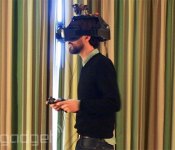
Headset combines virtual and augmented reality with holodeck-like results

Two months ago, Sulon Technologies broke cover with a video showcasing a bulky augmented reality and virtual reality system. Fast forward to today. The chunky backpack and headset combo has been replaced by a much, much smaller second prototype — it’s just a headset with a power cord coming out the back. Oh, and it’s got a name: The Cortex. If you’re a tinkerer, you can pre-order the dev kit version to follow this new prototype — the company claims this more polished hardware will be shipping out in Q4 of 2014. It’ll cost you $500 to get this particular peek into the future, though, so read on to find out what it’s like wandering around with the dev kit’s hacked-together portable predecessor on your melon.
When I first laid eyes on Sulon’s new headset, it was immediately apparent that I’d be demoing a very rough prototype. The eye cups (but not the optics) are ripped straight from an Oculus Rift, and much of the electronics attached to the headset’s straps are wrapped in black gaffer tape. A custom made spacial scanner sits up top and is stuffed with LIDAR, ultrasonic scanners and cameras. that combo’s what maps its surroundings, thereby ensuring proper graphics placement both during augmented reality and virtual reality sessions.
The brain of the spacial scanner is a bit of silicon called a spacial processing unit — it’s dedicated solely to tracking everything the system needs to work, and that info gets beamed to the phone on your face through Bluetooth. And, while the spacial scanner maps the room the Cortex is in, it locates your hands by working with Razer’s Hydra wireless nunchuck controller.
Once Sulon’s software’s interpreted all that info, it can overlay graphics onto your surroundings. Rather than using see-through displays like Meta, Epson or Google Glass, however, the Cortex augments reality in the same way that your smartphone does — by using a camera and overlaying graphics atop the video feed it captures. In fact, the system actually uses an Android smartphone as its display.

The face of the prototype is actually a housing where you slide in a jumbo phone — with a 6-inch, 1080p screen and a Snapdragon 800 — that serves as both the display and the graphical brains of the thing. It’s also got a camera stuck to the front of it. To counterbalance those bits, a power pack is situated around the rear of your skull. The prototype’s version is tethered to an outlet, but company CEO Dhan Balachand assured us that the dev kit will pack a rechargeable battery that’ll provide at least four hours of use.
The weight of the Cortex prototype is noticeable, but it didn’t become uncomfortable during the five minutes we wore it — we expect the dev model to be lighter.
As with the hardware itself, the software still has a ways to go, too. When you first slide the Cortex onto your head, it takes a few seconds to get adjusted as the headset calibrates its optics to suit your eyeballs. After some initial disorientation, we were looking at our empty hotel room and a few digital objects, and then noticed that the video feed was magnifying our view as compared to actual reality. Aside from taking some getting used to, it served to generally keep us aware that we were staring at a phone’s screen instead of the real world.
That said, the shift from augmented to virtual reality is relatively seamless — we stepped into a digital portal and suddenly the hotel room was a covered terrace overlooking a lake and some mountains. Graphical quality is what you’d expect when a mobile chip’s providing the grunt: about as good as a PS2. And during our demo, there was significant flicker and chop to the animation. We were told that the system also works with PCs, in which case the graphics are much smoother. We didn’t get to see such a setup.
Walking around a physical and digital space simultaneously was definitely an interesting experience while being tethered to a power outlet. But, we had helpful Sulon employees keeping the cord out of our way, and the headset itself has a warning system that beeps when you are reaching a physical boundary in the real world.
I played a zombie shooting game, using the Razer Hydra to blast the undead as I ported from digital room to digital room (all the same size, of course), and found myself sitting still and turning in one place instead of traipsing around blasting walkers. While the digital world was mapped very close to the real one, I couldn’t shake the feeling that I was blindfolded, and so moved around with trepidation. Perhaps with more practice, I’d feel more comfortable. But, I feel safe saying that for the tech to catch on with the public, it’ll have to be much more immersive. More accurately placed, smoother graphics might have provided me more confidence.
Bottom line? The hardware we wore was a hacked together prototype, but warts and all, still managed to deliver cool and somewhat immersive VR experience. It’s still not wireless… yet, and we’d really like to see it with the new, faster spacial scanner that the company tells us will be in the dev kit — as Balachand tells us it’ll solve many of our graphical gripes. Still, what we saw is far from the holodeck enjoyed by the crew of the starship Enterprise, but there’s potential in the Cortex. We’ll be looking forward to finding out if it can fulfill it.
Filed under: Gaming, Peripherals, Wearables, HD

Sony’s bringing Hulu Plus and Redbox to the PlayStation Vita

Assuming you like to do more than just play games on your PlayStation Vita, the latest batch of media-centric apps available on Sony’s handheld may be of interest. Crunchyroll, NHL GameCenter LIVE and Qello Concerts are now live on the PlayStation Store, catering for those with a taste for anime, sport and music. Sony also revealed that Hulu Plus and Redbox Instant apps will come to the Vita on March 25th, with fitness app Gaiam TV following later this spring. It’s a nice boost for gamers who remain welded to their Vita, but the wide availability of smartphone and tablet apps means Sony is continually playing catchup.
Filed under: Gaming, Internet, HD, Sony
Source: PlayStation Blog
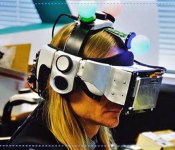
Sony’s early VR headset prototypes looked pretty silly

Head-mounted display, movement sensors…. done. Sony Computer Entertainment’s Shuhei Yoshida says that the company’s been working on its Project Morpheus VR hardware for over three years and it’s fair to say it’s come a long way: the early model above features three Move controller modules, attached in what could be described as the Mickey Mouse formation. It’s somehow cute, but also hilarious.The luminous pearl-finish headset revealed on stage is apparently still nowhere near complete, although SCE appear to have taken on board some of the design cues of Sony’s existing head-mounted display series. There’s more pictures after the break, with Yoshida himself channelling some Star Gladiator vibes with two different prototypes.

Filed under: Gaming, Home Entertainment, Wearables, HD, Sony
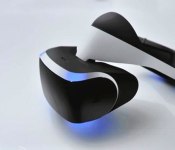
Live from PlayStation’s ‘Driving the Future of Innovation’ panel (the VR one)

What is the “Future of Innovation”? Sony’s gonna tell us tonight, but we’re pretty sure we can tell you what it is right now: bacon-scented alarm clocks. Oh, right, the future of innovation is also the rumored virtual reality headset from Sony’s PlayStation team. At least we’re pretty sure that’s the case, both based on the rumor mill and our own cabal of sources on the ground here at GDC 2014. We’ll certainly find out soon enough, as the event kicks off shortly. Stick around, as we’re starting shortly.


