


Gadget Rewind 2005: Sony PlayStation Portable (PSP)
It’s our 10th birthday, and to celebrate we’ll be revisiting some of the key devices of the last decade. So please be kind, rewind.

Engadget was lucky enough to get ahold of one before the end of 2004, but the Sony PlayStation Portable (PSP) was officially launched in the US in March 2005. This made picking a portable a difficult decision for impatient consumers who were wavering between the Nintendo DS and the PSP. The DS had already arrived by late 2004 and details about the Sony release were still a bit fuzzy. So, you decided to wait and snag the PSP, and according to the 2004 Engadget Awards, both editors and readers agree that you made the right decision. It offered several options including external storage, a 1.3-megapixel camera add-on and the ability to handle an array of image, audio and even video formats. The PSP also had a high-resolution 480 x 272 LCD and content looked great … at least as long as the battery held out. The PSP had a rechargeable 1800mAh battery, but all the bells and whistles led to rapid depletion if you used it as a truly portable device.
All those extras packed into the PSP ran the price up well past the competition. The Nintendo DS retailed at around $150, while Sony slapped a $250 price tag onto the PSP. You did have the whole PlayStation franchise behind it, though, with games like Twisted Metal, Wipeout, Metal Gear and plenty more. Although the PSP had a lot going for it, battery life and device size left room for improvement and that’s just what Sony did over the next few years. By 2007, the PSP had shed some weight and arrived as the Slim & Lite (PSP-2000) version. After numerous iterations, the PlayStation Vita arrived in 2012, still looking a bit like the original PSP — and still taxing the battery like the IRS — but rocking a stunning 960 x 544 OLED display.
Did you own a Sony PSP? Add it to your Engadget profile as a device you had (or still have) and join the discussion to reminisce or share photos of your device with other like-minded gadget fans.

Assassin’s Creed: Unity brings a French flair to stealth action on PC, PS4 and Xbox One

We hope you’re making good progress on Assassin’s Creed: Black Flag, because there’s already a sequel on the way. Ubisoft has unveiled Assassin’s Creed: Unity, a follow-up that takes the stealthy game series to Paris during the French Revolution. Clearly, you can expect guillotines to play an important role. You’ll get a tiny hint of the experience in the teaser video below. However, it’s worth noting that the trailer only shows Unity coming to PCs, the PS4 and the Xbox One — there’s no mention of the Wii U or previous-generation systems. We’ve reached out to Ubisoft to check on platform support, but there’s a good chance that the developer is focusing all its attention on higher-end hardware this time around.
Via: Joystiq
Source: Ubisoft (YouTube)

GDC’s alternative arcade: a gallery of crazy, homemade game controllers

The idea of the gamepad is so entrenched in our mind, it’s easy to forget that there are other ways to play video games. No, we’re not talking about the PC gamer’s keyboard and mouse, or even the traditional arcade stick — but custom, purpose built controllers made to augment a specific experience. At GDC 2014, we found an interactive gallery full of them. The event, Alt.Ctrl.GDC serves as a showcase for indie game experiences that aren’t fully accessible without specialized hardware, but to us, it was simply an alternative arcade of creativity.

The wooden control board for Analog Defender looks more like a missile control console than video game, but it had our attention right away. The complicated array of arcade buttons, protected toggles and switches control a complex Space Invaders clone, tasking players with managing power, weapon modes and special attacks by frantically mashing buttons and changing analog input plugs. The learning curve is steep, but the novelty of the controller makes it an easy climb — the experience is fresh, despite the game’s nostalgic familiarity.

Not every controller in the showcase was custom built from wood, switches and spare wire: Rakete, a collaborative moon lander game, cannibalized old guitar pedals to give four players their own rocket accelerators. The game forces four pilots — each controlling only one thruster — to work together to keep their craft aloft.

Some of the hardware we saw was familiar, too. Please Don’t, Spacedog uses a MIDI controller to explore the body-displacement effect of the Oculus rift — challenging players to use a complex controller without being able to physically see their hands. It’s also probably the world’s only canine-astronaut simulator.

Of course, you don’t need an Oculus Rift to create a virtual reality. The designers behind Roflpillar used a sleepingbag, some pulleys and a sensory isolation tent to create a two-player caterpillar simulator. Frankly, it’s pretty intuitive: wiggle to move. It’s also hilarious.

Ever thought you’d play a video game without a screen? Now you can — but you’ll need some help. Bonus Look is a game that splits the functions of a computer between two players, giving one player the screen and arrow keys and the other almost everything else. The “pilot” controls the player character’s actions, but can’t get more than a few steps without the help of the blind “wizard.” The screen-less second player also has access to a cryptic ASCII map, burned into a sheet of wood. It’s an absolutely bizarre twist on cooperative gameplay, but figuring it out is half the fun.

Speaking of games without screens, Choosatron was easily one of our favorite games in the exhibit. This “deluxe adventure matrix” is pretty simple under the surface: four buttons, a thermal printer and an Arduino board — but it was enough to turn choose-own-adventure fiction into a passable game. Plus, players get to keep their freshly printed epic for posterity, and we’re suckers for souvenirs.

Alternative controller types don’t always mean alternative games, either. Canabalt 100p offers the same endless running experience we all know and love — it just adds a few dozen extra runners. The game uses a standard MIDI keyboard as a control device, assigning each piano key to a specific avatar. Just how many characters you can play as depends on the size of the piano, so sadly, our demo fell short of the promised 100.
Alt.Ctrl.GDC’s exhibit of quirky controllers isn’t likely to rock the industry, but its perspective on gaming is refreshing. By discarding the standards we’ve grown accustomed to, it creates an opportunity explore the idea of what electronic gaming is. We often think about the visual aspect of the experience — but how we experience the game is just as important as how the game looks. Sometimes, the controller makes (or breaks) the game.
Filed under: Gaming

Titanfall on PCs will soon support 4K and NVIDIA’s latest graphics tricks

Many gamers already argue that the PC version of Titanfall is the best-looking of the bunch. Pretty soon, though, it won’t even be a contest. Respawn plans to update its robotic shooter to handle both 4K displays as well as a host of technology from NVIDIA’s GameWorks program, including full support for multiple GeForce cards, improved antialiasing and more realistic shadow effects. The upgrades aren’t all that surprising. Some modern video hardware is powerful enough for 4K gaming, and developers have already used GameWorks to spruce up flagship titles like Assassin’s Creed 4 and Call of Duty: Ghosts. Still, the visual improvements are bound to make a big impact — Titanfall is one of the most important games of the year, and a good excuse to pick up a new gaming rig.
Filed under: Gaming, Software, NVIDIA
Source: NVIDIA (1), (2)

Oink helps parents monitor and control their kid’s in-app purchases

A 13-year-old with access to his parent’s iTunes account can potentially rack up a sizable bill in an afternoon of Candy Crush — a tab mom might potentially refuse to pay because she didn’t authorize the purchase. Payments company Oink has created a solution that lets kids buy what they want, but still stay within mom and dad’s budget. With the service, parents can tie a credit card to the account and set limits on exactly where funds in the account can be spent, as well as how much money can be used in a single purchase.
Oink works similar to PayPal in that purchases can be made online using just a username and password. A child could be given a certain amount of money to spend on their favorite game each month, or can be given an allowance that can only be used at a few specific retailers. Purchases can also be restricted by rating (to prevent the purchase of mature games), and can be disabled quickly if payment info falls into the wrong hands or a parent wants to temporarily prevent a child from spending. The service is available now in a number of online retailers and popular games such as Habbo Hotel, and the company is currently in negotiations to expand to even more (a process that requires a developer to add just nine lines of code, so in theory we could see more compatible sites right away).
At GDC this week the company also told us it plans to release a physical card sometime this summer. The card would work anywhere Discover cards are accepted, and could be used to buy everything from dinner out with friends to a taxi ride home afterwards. Just like the online product, parents would be able to control spending limits and locations. Every purchase is also tracked online and broken down in an easy-to-read pie chart, so kids can learn a bit about budgeting while they’re out buying that new pair of shades at the mall.
Filed under: Cellphones, Gaming, Wireless, Mobile
Source: Oink

Xbox One’s ‘Titanfall’ bundle gets a price cut to $450 at Walmart and Best Buy

The PS4 may have commanded an early lead over the Xbox One, partly thanks to a $100 price difference, but Microsoft is quickly narrowing the gap. Now, the company might just seal the deal with a discounted Xbox One-Titanfall bundle: both Walmart and Best Buy have cut the price to $450. The move is an aggressive one on Walmart and Best Buy’s part: Microsoft only recently started selling the Titanfall bundle for $500 a week and a half ago. Now, just 10 days later, it’s received a $50 discount. For those keeping track, that puts the Xbox One within spitting distance ($50) of the PlayStation 4, which doesn’t even come with a game in the box. Subtract Titanfall‘s $60 value from the cost, and Microsoft at last has the cheaper console. So, which of you is buying?
Filed under: Gaming, Microsoft
Via: New York Times, Joystiq

Peter Molyneux wants more from VR than what’s available

“I just want to make a world which I can be a god in,” jokes developer Peter Molyneux (Fable, Curiosity) in a San Francisco hotel suite. “Imagine being able to make and construct a world under your own rules.” He’s speaking with us at GDC 2014, painting a picture of what he would do with access to a perfect virtual reality interface. Despite his history of building deity simulators, he doesn’t have any plans for building the ultimate virtual god game — today’s virtual reality leaves him wanting.
“The problem is that, as a designer, I’m like a greedy child. I just want more.” That’s not to say he doesn’t recognize how far virtual reality has come in recent years. Dragging on an electronic cigarette, Molyneux recalls using awkward “virtual reality” headsets in 1980s arcades. “It was a very different kind of VR,” he says. “The Oculus Rift and the Sony stuff is a great step forward, but I want more. Really, what VR is, is immersion. I want my eyes to be immersed, my ears to be immersed … I want to touch things in the world and I want to be able to see my hands.” The technology to create the perfect Matrix-like playground he envisions simply isn’t available yet — not that it’s stopped him from building god simulators.
Molyneux’s current project, Godus, hails from more humble hardware, but he still thinks there’s room for innovation. “If you look at the number of things we can use to entertain people in today’s world, it’s just amazing. There’s all this tablet stuff, but I don’t think yet there’s been a game that really defines tablets for me, defines touch. There’s been some good games, but there’s not been great games.” Moreover, he feels that the technology in our smartphones and tablets is underutilized — navigation apps can track your speed and location to curate traffic data, yet few games make use of geolocation technologies.

“We in the gaming industry have not used that yet,” the creator bemoans. “We’ve got so many things we can exploit and use and squeeze the goodness out of. We’re kind of like children when they go to Disneyland; we don’t know which way to turn. You’ve got to narrow it down and focus on one thing.” Picking technologies isn’t easy, either. “If I wasn’t doing this,” he said, pointing to a test build of Godus, “I’d be seriously looking at VR.”
What he is doing with Godus seems to have changed how he thinks about development. “It’s been a fantastic, wonderful, scary and frightening experience.” Molyneux may be a seasoned game designer, but Godus is his first foray into the world of crowdfunded gaming — putting unfinished builds of the title in the hands of Kickstarter backers (through rewards) and Steam early-access buyers. “What’s been amazing is to be able to look at the way people play. We’ve been able to see the mistakes we’ve made with the game a year before releasing it. The problem has been that people who pledged on Kickstarter, I think, expect it to be a completely finished game, and of course it’s not.” The early-access build is missing most of the game’s content, he says. “It’s like playing Call of Duty without guns!” Even so, Molyneux feels that the advantages outweigh the frustrations. “I wouldn’t ever develop a game again without involving a community like the Kickstarter community.”

Before we left, we couldn’t help asking Molyneux if his opinion had changed about next-gen consoles. “I still don’t think that they’re a big enough step up from the last generation,” the designer explains, echoing his own sentiments from E3 2013. “I mean, between the Xbox 360 and the Xbox One and the PlayStation 3 and PlayStation 4, this has happened,” he says, picking up his iPad. “And this has changed the world.”
Even so, Molyneux says that if he was still working with traditional consoles, he’d be pretty excited about having extra memory to play with — but he still thinks it’s not enough. “It’s just another black box that sits under my TV. We’re surrounded by new tech that’s changing our lives; why should game consoles just take iterative steps?” For Molyneux, it’s about innovation, and the new next-gen simply isn’t innovative enough. “It seems to be the fad to put Nintendo down a bit, but at least with the Wii U they gave us something which we hadn’t had before,” he concluded. “Okay, it didn’t feel right, but they were pushing themselves a little bit.”
Filed under: Gaming

Exploring virtual reality on PlayStation 4 with Shuhei Yoshida and Richard Marks (video)

It was 2010 when Sony engineers first explored virtual reality concepts. The idea of a VR headset sprang from another project at the company: PlayStation Move, a wand-like motion controller for the PlayStation 3. Company engineers attached the controller to head-mounted displays, enabling a form of homemade VR via motion and depth tracking. Sony Computer Entertainment Worldwide Studios head Shuhei Yoshida was asked to try these early prototypes, one which put the player into the role of Kratos in God of War 3 and the other a mod of Half-Life 2 where you could lift up and look at your own gun. “That was a totally compelling experience, so I became a believer,” Yoshida told us in an interview this week, post-Project Morpheus announcement. “It was a ‘wow’ moment!”
So, what’s Project Morpheus? It’s the somewhat silly code name (from the Greek God of Dreams) for the virtual reality headset planned for the PlayStation 4, and Sony unveiled it this week during the 2014 Game Developers Conference in San Francisco. Yoshida himself announced Morpheus, flanked by R&D engineers Richard Marks and Anton Mikhailov who dug into the technical chops behind the prototype headset. The trio chose GDC for an important reason: this is where they can send a rallying cry to game developers. Marks made their call to action clear when he finished his portion of the presentation by saying that this moment, right now, is the beginning of a new field of gaming. “This is the Wild West,” he said. And he’s right. There are no VR standards (though efforts are being made), no VR game “tropes” yet. The folks making VR games are at the forefront of an unexplored genre, and that’s thrilling.
Morpheus is as close to the quality of Oculus VR’s latest Rift prototype as anything out there, though it lags behind a bit in a few key areas. Specifically, vision blur, field of view and image quality aren’t as refined as the Rift’s latest dev kit (read our full hands-on here). Nor is Morpheus up to Sony’s standards for the consumer version. Marks acknowledged as much in our interview (seen above), and he also spoke to the hurdles ahead for VR as a medium going mainstream.
As ever, with VR it’s about making a product that’ll convince people. But what about that whole “putting electronics on your head” issue? That “encumbrance” factor is a concern, Marks admitted — one that Sony’s trying to minimize with the design of the headset, but only so much can be done with existing technology that keeps it within a reasonable consumer price range.
Whereas Oculus has put a firm price on its Dev Kit 2, Sony’s not talking cost for this first iteration of Morpheus, and that same silence extends to its particular specs, and eventual consumer release. The prototypes/development kits at GDC are the base level of workable hardware for developers to start developing games. Yoshida’s hoping we’ll see some of the fruits of those developers’ labor by E3 this June — Morpheus dev kits head out to game developers next month, and the only way to get one currently is to get in touch with Sony directly (Yoshida suggested tweeting at Adam Boyes and Shahid Kamal Ahmad).

Morpheus will inevitably evolve towards a final consumer version. It’s just not coming this year — and that’s the closest thing to a release window we’ve got right now. But we expect Project Morpheus won’t remain so mysterious for too long.
castAR’s vision of immersive gaming gets closer to final production

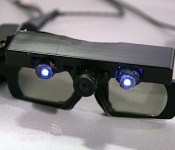
Five months ago, Technical Illusions gained over a million dollars in funding thanks to a highly successful Kickstarter campaign for castAR, a projected augmented reality project that company founders Jeri Ellsworth and Rick Johnson brought over from Valve when they were laid off almost two years ago. Ever since the campaign’s success, the company has been ramping up prototyping on a rapid scale so that the final unit can be sent off for mass production. Along the way, the company has grown from two employees to 11, and Ellsworth has since moved from Portland to Seattle to be with the team (dragging her collection of 80-plus pinball machines along with her). Ellsworth has also just hired the services of a Japanese company (she won’t name which) to provide her with improved optics and thinner circuitry, which she admits is better than the homemade solutions she and her partners have cobbled together so far. This all means, sadly, that castAR is still very much in progress, which is why even though Technical Illusions is here at GDC 2014, we were unable to look at the final castAR hardware. We were, however, able to take a look at castAR’s latest prototype that has never before been seen outside of Technical Illusion’s office until this week.
The hardware is, without a doubt, leaps and bounds ahead of what we saw last year. As a reminder, here’s the way castAR works: a pair of active shutter glasses with tiny projectors casts 3D images onto a retroreflective surface which are then returned to your eyes. At the same time, a camera module in the eyewear scans for infrared LEDs on the surface to track the location and movement of your head. The initial builds for the castAR glasses were very rough around the edges, but understandably so — they were initial builds, right? The latest iteration, however, is far cleaner and smoother in appearance. The circuitry and guts of the headset are now relegated to the right temple, leaving just the projectors and the camera perched above the glasses, which lessens the weight above the nose bridge. Further, the camera part has a much lower profile and doesn’t jut out as much as before. That along with the projectors are also now housed in a simple black plastic block. It doesn’t seem like much, but it’s a lot tidier than previous versions that exposed visible wiring. Ellsworth says they plan to attach a thinner cable to the glasses as well, again to reduce the headset’s overall weight. In the end, she hopes the final unit will weigh less than a 100 grams each.
What’s perhaps more interesting than the design however, are the new tiny projectors embedded in the glasses. The projectors, located above each eye, now have full 720p HD resolution. Not only that, but according to Ellsworth, they also project more light along with richer, more uniform colors. In our brief hands-on with the castAR prototype, we can certainly tell the difference between it and the older standard-definition model. Images were visibly brighter and sharper, and we could lean down toward the display and make out finer details than before. We tried our hand at a beta zombie game that Technical Illusions developed in-house to demonstrate the glasses, and while gameplay was a little unrefined, we could see that the graphics seemed crisper than the other demos in the room. Also, each projector has a 65 degree field of view, while the camera for head tracking has a 125 degree field of view, though Ellsworth promises us that the final version will have a 145 degree view instead. This means that you could cover a much wider surface area with castAR’s retroreflective material for an even larger game environment.

As we were finding out about castAR’s progress, we also took the opportunity to ask Ellsworth and her team about their involvement in the Immersive Technology Alliance (ITA), a virtual reality collective that launched last week. As a founding member of the alliance, Technical Illusions sees the ITA as an advocacy group for virtual and augmented reality and the benefits immersive technology brings. Brian Bruning, who heads up Technical Illusions’ marketing and business development, says both VR and AR have uses far outside gaming, and can be used in training, education and medical imaging. One of ITA’s main duties would be educating the public and developers about those different avenues. Additionally, Bruning said that as VR and AR are still so new, that the various outfits in the organization can take the opportunity to learn tips and tricks from each other. Technical Illusions, as one of the rare firms doing projected AR in addition to VR, is well-positioned to both teach and learn in those areas.
Speaking about projected AR in particular, Ellsworth says, “Projected AR is very graphical and visual, but it’s not just staring at the screen.” One of the benefits of AR as opposed to VR is that you can simply lift your head and still interact with the world. “This comes into play especially with the social aspect of games,” she says, pointing out that part of the fun of playing a video game with pals is being able to see your friends reactions. “It’s a fresh spin on games,” says Ellsworth. “A new driving force.” Seeing as castAR managed to get 3,863 backers on Kickstarter, it certainly seems some people think so. The first developer and Kickstarter prototype units will be available this summer, while the rest of Kickstarter and the first commercial units should ship by Q4.
Filed under: Gaming
OUYA removes free-to-try requirement, lets devs choose whether to include demo content

OUYA will soon let developers choose whether or not to include free content. Since the platform’s launch, customers have been able to try out any game before making a purchase, but some devs have been pushing back, requesting that OUYA allow them to make that call on their own. While free content certainly has its advantages, game makers have outlined several reasons why a free-to-try model may not be practical. Creating demo content costs money, of course, and in some cases, it’s difficult to fit a selection of free gameplay within an existing storyline. It’s not entirely clear when the policy change will take effect, so if you’ve been taking advantage of OUYA demo content, enjoy it while it lasts.
Filed under: Gaming
Source: OUYA

