


Joystiq weekly wrap-up: Fire-breathing lizards, big bad wolves and giant robots

Welcome to the first edition of the Joystiq Weekly Wrap-up, where we present some of the best stories and biggest news from our beloved sister-publication. After the break you’ll find, among other things, Pokémon, the Big Bad Wolf and the final word on Titanfall’s ongoing multiplayer examination. Our brothers and sisters in arms are on the ground in Boston this weekend for PAX East too, and you can find all of that coverage right here. Pour a frosty beverage and join us for the week’s gaming news, won’t you?
News
Arguably the biggest news this week came from Nintendo’s Super Smash Bros-themed Nintendo Direct broadcast. The franchise hits the 3DS this summer and the Wii U this fall with two online modes (For Fun and For Glory) and a unique spin on series-staple Adventure mode, Smash Run. Perhaps the biggest news, though, is the addition of all around bad-ass Charizard to the game’s roster.
One of the more intriguing games shown at Microsoft’s E3 press event last year was indie-puzzler Below. It’s being developed by Capybara Games (Super Brothers Swords and Sworcery EP) and news hit this week that if you don’t feel like shelling out $500 for an Xbox One — it was previously announced as a platform-exclusive — that the game is coming to Steam, too.

In Borderlands: The Pre-Sequel you’ll travel to the moon when it releases this fall for PS3, PC and Xbox 360. The last-gen title takes place between the first two games, and you’ll be fighting for antagonist Handsome Jack this time around.
If you’ve beaten Bastion countless times while waiting for developer Supergiant Games’ follow-up Transistor to hit, it’s almost time to let The Kid rest. The action-RPG releases on the PS4 and PC for $20 on May 20th.
Reviews
This week Joystiq reviewed Xbox One exclusive Kinect Sports Rivals and episode three of Telltale Games’ The Wolf Among Us. Critic Jessica Condit lamented Rivals is another instance of Kinect’s crippled functionality.
The Xbox One Kinect is more responsive than its predecessor, but it still doesn’t seem ready for this level of gameplay. My set-up meets the requirements – a clear, open floor and seven feet of playable space from Kinect to the front of my couch. Still, Kinect had trouble deciphering who was playing if anything moved in the background or just off to the sides, and it tracked motions inconsistently.
Joystiq‘s managing editor Susan Arendt was much more positive in her look at Biggby Wolf’s latest chapter. Although The Crooked Mile narratively occupies the middle of Telltale’s Fables yarn, that shouldn’t be held against it she says.
Taken by itself, it’s unsatisfying and half-missing, but of course it’s not meant to be taken by itself. It’s the centerpiece of a larger whole, the lock that will let everything eventually make sense.
Original stories
Road-trip season will be here before you know it, but with the price of gas still pretty high, getting out and exploring the open road can be an expensive proposition. If you’d still like to see some of the US though, Ubisoft’s The Crew will let you do just that, virtually. The constantly-connected racer lets you and three buddies drive from San Francisco to Salt Lake City and other cities (including Detroit), completing challenges and collecting cars. Joystiq‘s video preview gives an overview of the game’s look and feel.
As part of its ongoing look at crowdfunded game development, Joystiq notes that the month of March continued the space’s continued slump. What’s more, March was the second-worst month of pledges in the prior 10 (when Joystiq started the series).
PC gamers are a proud people: they tend to invest heavily in their rigs and expect the best possible experience from their games as a result. For them, playing a console game that’s been ported can be a crap shoot in terms of performance. With the brutally difficult Dark Souls 2, however, that isn’t the case. The PC version is prettier than its PS3 and Xbox 360 counterparts, and is the best version of the game that’s available.

In the wake of games like Battlefield 4 and its still-rocky performance, Joystiq has started an ongoing look at how a game’s multiplayer fares in the first month after launch. With Titanfall, the outlet says that despite a few brief outages, the experience remains solid, dubbing the game’s state of service “good.”
That’s it! Be sure to check back next Sunday for another recap, or if you’re impatient, click over to Joystiq and catch the news as it happens.
[Image credit: Miguel Angel Garrido / Flickr]
Filed under: Gaming, HD, Sony, Microsoft, Nintendo
Source: Joystiq

IRL: A rant about Nintendo’s Virtual Console service

Before you send in your angry emails, comments and tweets that decry me as a hatchet-wielding antichrist, let’s begin by saying that I’m not a gamer. I do play games, but I have no specific allegiance to a console or manufacturer — I simply go where the fun is. My console history, for editorial balance, includes the VIC 20, Commodore 64, NES, Mega Drive (Genesis), PlayStation, PlayStation 2, Xbox 360 and the Wii. That means that I’m about as much of a dilettante as you can be, and there’s no bias or malice in the following. Just disappointment.

My wife, you see, isn’t a fan of technology. And yet, despite never joining in games, she holds a soft spot for the Super NES. She takes on (and beats) all-comers on Super Mario Kart, but her favorite game, and the one that she’s probably devoted the most time to, is Tetris Attack. For those not in the know, it’s a reskinned version of the Japanese puzzle game Panel De Pon, which was later reskinned as Pokémon Puzzle League and, later, Puzzle League for the DS. Anyway, my wife’s friend recently came over, and we dug out the SNES so the two of them could while away the time. Unfortunately, the console is now 22 years old, and both controllers are now nearly unusable. “Never mind,” said I, dusting off our unused Wii. After all, I’d heard plenty about the Virtual Console service that promised nearly every SNES game had been added to the digital store, and it wouldn’t take long before they could play the game with the Wiimotes doubling as controllers.
This is where things start to fall apart. Nintendo, for some capricious reason, has declined to release Tetris Attack for the Virtual Console. I say for some “capricious reason,” but it’s because Henk Rogers, CEO of the Tetris Company, is annoyed that the game carries his beloved branding. Heartbroken, we decided that as a sop (and to get the evening’s frivolities going), we’d buy Pokémon Puzzle League, despite how annoying Pokémon is for anyone who isn’t a Pokémon fan.
Before you can buy the game (or click on the entry in the store), the console requests you buy Nintendo Store credits. So, after another five minutes of trying to put credit card information onto the system (which isn’t the easiest in the world, I assure you), we’re finally in a position to purchase the game. Except it’s at this point, when you click through, that Nintendo decides to tell you that you can’t use this game without purchasing the Nintendo Classic controller. Which wasn’t going to be possible at 8 p.m. on a Saturday.
What’s the moral of the story? There are two, I guess. Firstly, don’t be the sort of self-absorbed ass who just presumes a company would make logical decisions instead of doing the research. That level of self-absorption could also manifest itself in the decision to write 700 words on the subject and attempt to pretend this isn’t merely the most first-world of first-world problems. I’m happy to accept the charge, and my hubris will linger forever in the £7 that sit on my Wii, unused for time immemorial.
The second, of course, is that for the sort of novice consumer looking to buy a product from Nintendo, the company doesn’t make things easy. After all, it could have shown me before I added my cash that I didn’t have the necessary accessory. It could have also simply rebranded the title as Yoshi’s Puzzle League, since a short trawl of the internet shows there’s more than one aggrieved, self-absorbed Brit wanting to see this game on the Virtual Console. I don’t expect a company to bend over backward to cater to my every need, but I do wonder why Nintendo couldn’t have made this process easier.

Sid Meier’s latest Civilization game reaches for the stars

If you were worried that legendary game developer Sid Meier wouldn’t get his chance to make a new Alpha Centauri, it’s time to put those fears to bed. Civilization: Beyond Earth is coming this fall, and, as the name suggests, it takes the venerable PC strategy series to the stars. As Rock, Paper, Shotgun tells it, publisher Electronic Arts still holds the rights to the Alpha Centauri name (which was a Civ spin-off to start), so this is developer Firaxis’ effort at a sequel, sans the actual title. The trailer below doesn’t show any game-play, but it paints a simultaneously somber and epic picture of just why humanity has to leave Earth. Joystiq and PC Gamer have meaty features and interviews with info from the dev team, so if you’re jonesing for more details on the game’s randomly-generated alien planets, be sure to check ‘em out.
Filed under: Gaming, Home Entertainment, HD
Via: Rock, Paper, Shotgun
Source: PC Gamer (1)

Daily Roundup: Galaxy S5 review, Sony’s Shuhei Yoshida on VR and more!

You might say the day is never really done in consumer technology news. Your workday, however, hopefully draws to a close at some point. This is the Daily Roundup on Engadget, a quick peek back at the top headlines for the past 24 hours — all handpicked by the editors here at the site. Click on through the break, and enjoy.

Samsung Galaxy S5 review: a solid improvement, but don’t rush to upgrade
Samsung’s latest handset, the Galaxy S5, has a slightly larger screen and squared edges, but nontheless recognizable as part of the Galaxy family. Packing a heart rate monitor, fingerprint scanner and extensively revamped TouchWiz UI, it’s a solid upgrade from the GS4. But is it worth an early upgrade?

An oral history of the last 20 years of gaming, as told by PlayStation’s Shuhei Yoshida
Since the beginning, Shuhei Yoshida’s been an integral part of Sony’s PlayStation arm. From initiating franchises like Crash Bandicoot and Uncharted, to daily interacting with thousands of customers on Twitter, Yoshida helped build the foundation of the modern gaming industry.

Sony’s Shuhei Yoshida loves that Facebook bought Oculus, says it helps validate PlayStation’s efforts
Most of us were surprised (maybe even appalled) once we learned that Facebook bought Oculus VR for $2 billion. Shuhei Yoshida, head of Sony Computer Entertainment’s Worldwide Studios, however, was thoroughly excited.

Amazon phone reportedly coming in September with glasses-free 3D
According to the Wall Street Journal, Amazon’s planning to release its own smartphone this coming September. What’s more, the handset’s reported to have four cameras with retina-tracking tech, making it possible to project 3D images without needing glasses.
You also might like:
Filed under: Misc

Blizzard’s Warcraft card game is getting an undead single-player expansion

Were you hoping for a single-player campaign in Blizzard’s Warcraft–themed card game, Hearthstone? Well, you’re getting one. The outfit’s announced Curse of Naxxramas at PAX East, and, in addition to fresh challenges and more than an entire deck’s worth of shiny cards, there’s a new Adventure mode en route for solo players. As Joystiq has noticed, Naxxramas also features a new game-board based on Warcraft‘s floating necropolis of the same name. The first area, subtly named Arachnid Quarter (gee, wonder what’s lurking in there?), is free for everyone and will roll out simultaneously across iPad, Mac and PC sometime later this year. If you want to complete the expansion’s other successive areas as they release, you’ll have to buy-in either with in-game gold or your hard-earned meat-space ducats. Still not sure what the hype is about? Well, the game doesn’t cost a thing, so there really isn’t much risk in giving it a shot for yourself. It’d probably be a good idea to start practicing ahead of Naxxramas’ ambiguous release date, anyhow.
Via: Joystiq
Source: Battle.net
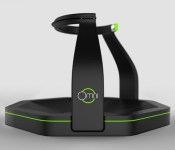
Virtuix Omni treadmill will get gamers off the couch in July

If you pre-ordered the Virtuix Omni virtual-reality treadmill, it’s time to start rearranging the living room furniture. Early backers will be able to strap on their Oculus Rift and start shooting in the virtual battlefield of their choice come July. If you haven’t ordered the enormous $500 gaming accessory yet, you won’t have to wait that much longer to start running in place – orders taken today are expected to ship in September. And with Facebook’s acquisition of Oculus, maybe we’ll be walking through our friends’ Hawaiian vacation photos by winter.
Filed under: Gaming
Via: Joystiq

An oral history of the last 20 years of gaming, as told by PlayStation’s Shuhei Yoshida

The three weeks out of every month that Shuhei Yoshida’s in Japan, he has the same routine every day. He wakes up, opens a tablet, and gets back to work on PlayStation consumer feedback via his favorite interaction tool: Twitter. The man who heads Sony’s PlayStation group is incredibly, perhaps detrimentally, accessible on social media. It’s not his job, but a role he’s taken on. “It’s my personal time, but since lots of people tweet to me, I’m doing this almost official customer service,” he says.
After 20-plus years working on PlayStation, Yoshida’s beyond overqualified for customer service. He’s been with Sony’s PlayStation arm from its creation, and helped shepherd franchises from idea to mainstream norms: Gran Turismo, Crash Bandicoot, Uncharted. The list goes on.
Yoshida spoke with PlayStation 4 lead architect (and other game industry legend) Mark Cerny last evening in California, where he detailed his storied history in the game industry.
Before we get to that, though, it’s important to establish that Yoshida is an incredibly prolific gamer. He owns two of every game console. Why? So he can play Japanese and US games alike. He also says that he’s been banned from Nintendo’s MiiVerse social network. Twice. “The first time was because I had my Twitter account in my profile and that’s against the rules,” he says. “The second time is because I wrote, ‘I love PS.’ You’re not supposed to promote a commercial product in MiiVerse, so they correctly interpreted ‘PS’ as ‘PlayStation,’” he says with a laugh.

Life Before Sony
Prior to joining Sony, Yoshida flirted with studying physics and the work of Einstein, but his dad quickly shot that down, pushing him to a more practical major. So in college he studied economics and business — when he actually went, that is. He says that in Japan, business students don’t really attend class, and that the four or five students who would, took notes and shared them with everyone who wasn’t there. He spent six months working in Australia at the time, and when he got back to Japan he had all the answers to the tests waiting for him. “In my senior year in Japan, I didn’t go to any classes at all.”
Immediately after graduating, Yoshida joined Sony. In hindsight, his reasoning is a little selfish, though. Because his dad more or less forced him to switch majors, he wanted to get out of the country. “I wanted to run away from home as soon as possible because of that,” he says, half-joking. “When I say this, it might sound incredible… but I was thinking, ‘maybe Sony will make games in the future and when they do, I’m going to join that group.’”
Sony being an international company helped Yoshida make his decision, too. The firm sent him to study at UCLA for two years, and only then did he finally start learning about business principals like statistics and microeconomics. Since he was getting a paycheck, Yoshida had the resources to spend time traveling around the Western states and even Europe during summer break, when other students were typically working.
After graduating, he traveled back to Sony HQ in Japan where he spent nine months working with the PC group on a project that was ultimately cancelled. He bounced over to the corporate strategy group after that. It was here that he met then-Sony chairman Ken Kutaragi and work on the PlayStation began.
The formation of Sony Computer Entertainment
Sony Computer Entertainment, Yoshida says, started in Japan as a joint venture between Sony’s hardware division and its music wing. In the team’s early days, it approached signing and curating development teams much like it would a band — something that Parappa the Rapper mastermind (and J-pop singer) Masaya Matsuura loved. The scrappy PlayStation team had a lot to learn from the game industry, Yoshida admits, but it wanted to create something new at the same time.
“We believed that a game could become entertainment for everyone,” he says — not just kids. “The reason the company was named Sony Computer Entertainment instead of Sony Game Company or something like that is because we believed that games could be bigger than they were.”
Four years later, SCE had all of Japan’s major publishers signed on to make games for the platform. Yoshida explains that the big thing for the market was getting the Final Fantasy and Dragon Quest franchises on PlayStation, but after he’d achieved that goal he lost interest a bit. “What’s next? We got all the support from the industry, where do we go?” he asks. It was then that he moved from business development to a producer role on the product side.
The Birth of Crash Bandicoot
If it wasn’t for Nintendo, Crash Bandicoot might have been too difficult to play. Yoshida says that one of the benefits of being new on the scene was that Japanese publishers were keen to pass wisdom Sony’s way. The Mario-house “really helped others” by using test feedback generated from consumers play-testing in-development games. “As soon as I moved into game production, I was the heaviest user of the (testing) group,” he says.
Up to that point, Cerny says, his Crash Bandicoot team was making a game for seasoned gamers like themselves and it was too difficult for the average consumer or kid. “You (Yoshida) were not familiar with games, so you thought you had to do testing,” Cerny says. “We were familiar, so we thought we didn’t have to, ironically.”
Cerny taking his input seriously and using Yoshida’s testing more made Yoshida “so happy,” he says. One of his associate producers would count every player-death and send it to Cerny, who’d then realize where a checkpoint should be added. “We started to think about difficulty. Are our games something consumers play?” Cerny asks. “The idea was you had to find real consumers, study their real behaviors and report back in.”
Working with “The Father of PlayStation”

Yoshida spent 10 years working under Ken Kutaragi, and he admits that without him that PlayStation wouldn’t have happened. Humbly, Yoshida says that without Kutaragi, he wouldn’t have a job, either. “I have nothing but respect for what he has done for me,” he says. At dinner once, Kutaragi turned to him and said that he knew Yoshida didn’t necessarily like him, but he knew that Yoshida liked working for him because he could do exciting work as a result. “I said ‘yes, exactly.’“
Working with Kutaragi was incredibly difficult, Yoshida says, because he could do an immediate 180 in terms of what he wanted. On the engineering team, trying to predict where he might alter direction was “a very difficult job,” Yoshida says. “Every week his direction and instructions could change.”
Also tough was that he struggled to give compliments to coworkers. “I was complimented by Ken twice!” says Yoshida. “When I say this to my colleagues, they say ‘twice? That’s a lot!” Those flow much more freely from Yoshida. “For me, giving a complement is free, it’s like a smile from McDonald’s,” he says. “But still, we all love Ken.”
Working with Kutaragi was incredibly difficult, Yoshida says, because he could do an immediate 180 in terms of what he wanted.
After Kutaragi’s sudden departure in 2006, Yoshida felt threatened by internal conversations at Sony that questioned the need for its worldwide studio team’s existence. After consulting then-chairman Akira Sato, he pitched Kutaragi’s successor Kaz Hirai on leading Sony Worldwide Studios. A few years later, work began on the PS Vita and PS4 — with direct involvement from Yoshida’s army of developers.
Enough digital ink’s been spilled about the partnership between developers and the new PlayStation hardware team, though. What’s notable in this story is that Worldwide Studios went from teetering on the brink of extinction to becoming the backbone of Sony Computer Entertainment in a few short years.
Sean Buckley and Ben Gilbert contributed to this post; Image Credit: AP Photo/Kevork Djansezian.
Filed under: Gaming, Home Entertainment, Software, HD, Sony

Xbox One Titanfall bundle now costs £349, the same as a PS4 in the UK

Next-gen console price wars have officially hit the UK, and they’re getting serious. Going one better than their US counterparts, British retailers have slashed the cost of the Xbox One Titanfall edition by £50, with both Amazon and Asda currently offering the bundle for £349. For those keeping track, that means you’ll get an Xbox One and its most popular game for the same price as a standard PlayStation 4. Microsoft originally charged £429 at launch, but dropped its recommended retail price to £399 around three months later. The PS4 may still have an slight lead over its rival in terms of sales, but with recent price reductions and the appearance of weaponised mechs, Microsoft will hope it can begin to reverse that trend.
Filed under: Gaming, Microsoft
Via: Joystiq

Sony’s Shuhei Yoshida loves that Facebook bought Oculus, says it helps validate PlayStation’s efforts

“I woke up that morning and saw the announcement,” Shuhei Yoshida tells us, remembering the day Facebook acquired Oculus VR. “And I was like, yeah!” Yoshida laughs and thrusts his arms in the air like an excited child. “For me, it was a validation for VR.” As head of Sony Computer Entertainment’s Worldwide Studios, virtual reality (and Sony’s Project Morpheus) has become important to Yoshida. He wants to see it, as a medium, to succeed.
“We meant to validate Oculus by announcing Morpheus, and the Oculus guys knew what we were working on. I think they were waiting for us to make the announcement, so it would be Sony and Oculus together,” he explains backstage at the Computer History Museum in Mountain View, CA. “…but now Oculus being acquired by Facebook is helping to validate our efforts.” It’s big-picture thinking. Yoshida already liked the idea of Sony and Oculus calling attention to each other’s efforts, but adding the Facebook name to the mix broadens the duo’s exposure. “More people will know about VR!”
Oculus being acquired by Facebook is helping to validate our efforts.
Zuckerberg’s vision for the purchase intrigues him too. “Mark said be believes VR can be the next platform after mobile,” Yoshida said. “That’s big thinking, and kind of excites our thinking.” Sony’s team has already been exploring uses for VR outside of traditional gaming, he explains, but nothing as broad as Zuckerberg’s statements. “We’ve thought of doing virtual travel or something, but talking about a new platform? What does that mean?” Yoshida says it’s given him something to think about.

Of course, a broader platform for VR means the technology will see more use — and that technology still has several usability hurdles to conquer. “VR of the past, including our own prototype, has been very difficult to use in terms of getting headaches and becoming nauseated,” he said. “Those early prototypes had larger latency and the positional tracking may not have worked as well. I feel really sorry for people developing VR stuff! They have to test it! With the kit we have now, what we demonstrated at GDC, I think its the first time we can really provide developers with something and say, you can use ours, and you’ll be alright.”
Sony’s been talking to medical professionals about overcoming simulation sickness, Yoshida explains, and wants hardware to be comfortable and usable without adjustment. “The Oculus DK1 has lots of adjustments available, but the Morpheus just works, the optics design. We’ll continue to improve it.” Eventually, the company wants to create guidelines for how old users should be, and how long they should use it for, but it’s not quite there yet. Even Yoshida admits he hasn’t spent extended periods of time in virtual reality, usually keeping his sessions at under ten minutes.
The Oculus DK1 has lots of adjustments available, but the Morpheus just works
Yoshida’s plan for building those guidelines relies heavily on collaboration. “We need to share knowledge,” he explained. “We can’t just make the hardware, it’s the game applications that need to be designed well. We need time for developers to experiment and find the killer application, and at the same time we need to learn how VR applications should be designed.” Providing the Morpheus dev kit to developers, Yoshida says, is the first step.

Razer delays Nabu wearable launch to avoid Fitbit-like skin complaints

Razer’s Nabu wearable won’t launch until late May or early June, according to various developers who’ve received an email regarding the delay. The “smart band,” which took home our People’s Choice Award at CES this year, was originally supposed to be available by the end of March. According to said email, Razer’s in council with “medical professionals” and running “stringent tests to ensure Nabu is fully certified hypoallergenic” before it reaches consumers. This is obviously a reaction to Fitbit’s recent problems with its Force fitness tracker, which had to be recalled after thousands of reports of rashes and other skin troubles by its users. Whether Razer’s just trying to make the best product possible or simply wants to avoid a PR disaster is irrelevant, we guess, as long as wrists are safe. It begs the question, though: shouldn’t such tests have been factored into wearable development as part of reasonable due diligence, rather than just an afterthought?
[Thanks, irawrr!]
Filed under: Gaming, Wearables
Source: @udezekene (Twitter), Sonicspin2

