


Microsoft’s Project Spark game creator comes to Xbox One and PC

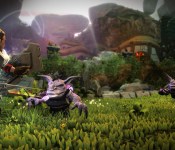
If you enjoy the creative part of building games but not so much the coding, Microsoft’s Project Spark is now available for Xbox One and PC (Windows 8.1 only). That marks the end of a six month beta period that saw over a million testers create 70,000 game levels, according to Microsoft. As a reminder, Spark lets you build games with relative ease by using onscreen tools to add monsters, geography, game dynamics and logic. You can also use a Kinect HD on either platform to capture your own movements and facial expressions for game characters. Download it now for Windows 8.1 and Xbox One for free, or as Microsoft helpfully suggested, buy a starter disk with content for $39.99. Otherwise, fresh content has to be earned during gameplay or by purchasing tokens.
Filed under: Gaming, Microsoft
Source: Xbox
.CPlase_panel display:none;

Video game-inspired remote labs could prevent scientific fraud

Scientific error doesn’t always come from botched equations or faulty theories but bad behavior, too — sometimes scientists crack under pressure and contaminate their results by crafting fraudulent, retrospective hypotheses or cherry-picking data to verify a bias. It’s a constant problem within the scientific community, but researchers from Carnegie Mellon and Stanford Universities may have stumbled upon an unconventional solution: video games. Specifically, EteRNA, an educational game that teaches players to design RNA molecules online.
Although EteRNA is presented as an RNA matching game, it actually teaches players the rules of RNA and has them construct molecule designs that can later be tested in a real lab. Underneath the game, however, the system is highly resistant to most forms of scientific fraud. “We registered more than 150,000 participants who contributed in excess of 2 million human-hours to EteRNA,” explains Adrien Treuille, assistant professor of computer science and robotics at Carnegie Mellon. “That means there were a lot of eyes, a lot of people looking over each other’s shoulders as hypotheses were developed and experimental results evaluated. Everything is out in the open.”
When viewed as an online lab, the game is so transparent that it makes fraud extraordinarily difficult. It also allows parties that weren’t involved in creating a theory to test it, removing the temptation of the team to manipulate results to validate their own work. The team admits that setting up online labs is potentially expensive, but it’s within the reach of most major research facilities.
[Image credit: Getty]
Source: PhysOrg
.CPlase_panel display:none;

RomoCart turns your living room into a video game

Looking for something new to do with your iPhone-powered Romo robot? Well, you could always use it to turn your living room into a race track. Ken Kawamoto and Tomoaki Akitomi have paired the remote controlled phone-charger with a pico projector and an RGB depth sensor to turn their living room into an augmented reality video game — a two-car racer inspired by Mario Kart. RemoCart, as it’s called, isn’t a particularly fast paced racer (the Romo is pretty slow), but it has all the hallmarks of the classic Nintendo game: cars, a race track and special items and weapons that can turn the tide mid-race.
Despite taking its name from the Kickstarter-sourced robot, RomoCart’s magic is mostly handled by its projector and depth camera. Not only does the RGBD camera keep track of the player’s Remos, it also maps out solid objects in the play area. This data is used to automatically create a race track on the floor’s open space. The projector also animates items on the play field, which can interrupt player control of the Remo to create the effect of being “hit” with a weapon. It’s a neat project, but right now it’s also unavailable — but the team promises to release the source code as soon as it can “find the time.”
Source: Kawalabo
.CPlase_panel display:none;

Nintendo’s 3DS software finally gets a new look with custom themes

You can replace your Nintendo 3DS’ outer hull anytime you want (provided you’re willing to buy a new system), but that system menu has always been that same void of transparent white space. Not anymore. The handheld’s latest update (much like the PS Vita’s from last week) gifts the 3DS with five basic color themes in red, blue, yellow, pink and black. Looking for something more complex? You’ll have to pay for it — the new theme shop sells character and pattern-based themes for $0.99-$1.99 a piece, including one that harkens back to Nintendo’s origins selling Hanafuda cards. Oh, and if you want to show off your redesigned 3DS, Nintendo’s thought of that too: pressing up / down while holding the Y button now takes a screenshot of the 3DS upper and lower screens, respectively.
Wahoo! Add a little Mario style to your #3DS Home Menu by downloading his theme in the Theme Shop. pic.twitter.com/3N8y5VsOSa
– Nintendo of America (@NintendoAmerica) October 7, 2014
Source: Nintendo Support
.CPlase_panel display:none;

Exploring modern Paris to find the roots of Assassin’s Creed Unity

The French Revolution! The only part of history class you didn’t sleep through, thanks to the drama, intrigue and of course, Reign of Terror. Paris circa 1790 is undoubtedly the star of Unity, Ubisoft’s next Assassin’s Creed chapter. Sure, the game looks damn nice and brings new gameplay elements like four-player “Brotherhood” co-op missions, murder mysteries, heists and so on. But Ubisoft did extensive research on the period to bring historically accurate details of iconic spots like the catacombs, Notre Dame Cathedral and even the Bastille, which was destroyed over 300 years ago. To show how far it went, the French game company gave us an inside look on the art direction, level design and more, topping it off with a tour of the centerpiece — Paris. To see if it succeeded, read on.
Unlike past Assassin’s Creed (AC) chapters, Ubisoft told me that it aimed for real-world scale to enhance detail in the core section of the game. About a quarter of the buildings are playable, with about a fifth of those containing mission content. In other words, there’s a lot of space to just wander around revolutionary Paris and skip busywork mission tasks, if that’s your thing.

Given the open-world ambitions, Unity‘s designers made its version of Paris a compelling place to hang out. They aimed for historically accurate housing styles, interiors designs, textures and atmospheric elements like smoke and mist. At the same time, the team didn’t want to get bogged down in minutiae and took artistic license when needed to add drama and style.
Another new aspect of the game is seamless interior transitions. Rather than an awkward loading “ellipse” between indoor, underground and outdoor scenes, Unity players will be able to directly enter and exit buildings with little to no break in play. The idea is to encourage exploration while making missions move along briskly. In addition, you can look into and out of windows for another dose of realism.

During the Paris tour, Ubisoft stopped and compared gameplay video on a tablet to real life monuments. Many of the 3D landmarks are dramatically similar to the real deal, with the added touch of grit and atmosphere from 1790s Paris. For instance, Notre Dame (top image) is a drop-dead match to its real life doppleganger. But Ubisoft’s historians learned that the Cathedral was used for stocking arms and livestock during the revolution — so the interior is loaded with weaponry and cows.

History buffs might also appreciate Unity‘s take on the Bastille, the building that sparked the revolution when it was destroyed by an angry crowd in 1789. All that’s left now are a few bricks at the Bastille metro and a monument at Place de la Bastille (above, right). However, the designers took advantage of numerous plans on the historical record to generate a highly believable version of the ominous, hulking fortress (at left).

Other highlights include the Louvre, Hotel de Ville (city hall), le Marais district and Place de la Concorde — the spot where King Louis XVI was guillotined. All those sites look like the were faithfully executed, which begs the question: what if you don’t even want to bother with the gameplay? We could see folks whiling hours away just ducking into all the buildings or taking a tour of one of the three different underground levels. It might be a nice break from the violence, anyway — and art direction aside, the game looks like it has the bloodshed part part of the revolution, in spades. For (many) more pics, check out the gallery above, or the Unity gameplay video below.
Filed under: Gaming
.CPlase_panel display:none;

Plex brings it media streaming magic to Xbox

Plex has more than its share of fans thanks to its powerful and versatile streaming media capabilities. If you’ve got a video file (regardless of how you obtained it) there’s a good chance Plex can play it. And play it anywhere — on your Roku, on your tablet, you smartphone, and now on your Xbox. Starting tomorrow Plex Pass subscribers will be able to pull up their Plex library on their Xbox One. And soon enough Xbox 360 compatibility will be added as well. If you’re not a subscriber you’ll be able to buy the Xbox apps for a one time fee (how much remains to be seen, but probably around $4.99) after the preview period ends. This is also the first time that Plex has been available on a game console, at least as a native app. You could pull in video to your Xbox over DLNA, but this is much easier and cleaner. And yes, you can control your library with voice controls or gestures thanks to Kinect support.
Filed under: Gaming, Home Entertainment, Software, HD
Source: Plex
.CPlase_panel display:none;

The first ‘Smash Bros.’ in six years is available now, and you should play it

There is a new Smash Bros. game, and it’s available as of last Friday. You know when the last game, Super Smash Bros. Brawl, was released? In 2008! Six years ago! So today is a pretty exciting day, at least for me. Hi, I’m Ben Gilbert, and I’ve been playing Smash Bros. with far too much sincerity for 15+ years. The new Smash Bros. for 3DS, however? I’ve only been playing that for about two weeks. The reviews are out! Our sister site Joystiq is pretty into it. I am also way into it, and I want to tell you why.
Look, we don’t do this — whatever “this” is — at Engadget very often (ever?). In leading our game coverage, I’ve intentionally skipped previews, reviews and other standards of game coverage; our sister site Joystiq does a great job with that, and only so many of you want to know about the minutia of every video game. I’m making an exception for Smash Bros., mostly for selfish reasons: I desperately want to talk about the best game Nintendo’s released this year.
WHAT IS IT?
Don’t know what Smash Bros. is? Here’s the launch trailer for Super Smash Bros. for 3DS:
Smash Bros. is a Nintendo-made fighting game starring everyone’s favorite game characters. The cast ranges from Mario to Mega Man, and even includes recent cult classics like Xenoblade‘s Shulk. The latest game has “over 40″ characters in total: the rest of the experience is tailored around supporting and extending the nostalgia conjured by those dozens of characters.
If nothing else, Smash Bros. is a trip down gaming history’s memory lane. No other game allows you to pit Sonic the Hedgehog against Pac-Man, on a stage based on Pikmin, while deploying Pokémon balls as weapons. You know how mash-up artists take hit songs and turn them into something new? Smash Bros. is that, but with video games, and it’s made by the company that created most of those games.
Rather than mashing up the gameplay systems from those various games, though, Smash Bros. takes the characters, their characteristics, and some of their game worlds, and brings them into a 2D, four-player fighting game. Players take those characters into one of many game-themed arenas and fight until time or lives run out.
Here’s where things get a little weird: rather than a life meter, Smash Bros. relies on a percentage meter. The higher your percentage, the more likely your character is to be knocked out of the ring. If your character is knocked out of the ring, you either lose a point or a life. Here’s a video that helps to explain:
Like much of Nintendo’s best work, Smash Bros. is blessedly simple: there is one set of moves that applies to every character in the game. The challenge isn’t in memorizing move lists, but in applying one set of basic controls across a vast swath of variables: which character you’re fighting, the items on-screen, and how much more your character can take before being knocked out (among many other things). It is simple to understand, challenging to master.
MORE THAN WARM MEMORIES
Smash Bros. for 3DS is the richest addition to the franchise’s history in over 10 years. It’s a game focused intently on catering to both casual Mario fans and tattooed Nintendo hyper-loyalists. One mode allows you to quite literally fight your way through gaming history, era by era. You start by battling Mario and Donkey Kong, and end up facing off with Wii Fit‘s demo trainer. Yes, really. It’s a game where you’re just as likely to see Brain Training‘s Dr. Kawashima referenced as you are to see Super Mario Bros.‘s iconic goombas.

Beyond the initial hook of nostalgia, enthralling as it is, lies a game of immense complexity. Smash Bros. is a game of variables, and knowledge of those variables makes a huge difference in how you play the game.
If you’re new to the series, the bare bones variables are all you need to know: which buttons do what actions. It’s entirely possible to have a great time playing Smash Bros. with a base level knowledge about its many, many systems.
Perhaps you play as Starfox‘s Fox McCloud, and you enjoy firing lasers at your friends as they engage in hand-to-hand combat. Plenty of fun to be had there! But maybe a Pokémon ball lands next to you — one of the random items that drops mid-battle — and you decide to pick it up. You throw it in the general direction of your friends, and a massive Snorlax erupts, sending your friends sky high and netting you two knockouts. Now you know a new variable!

Smash Bros.’s greatest asset — beyond the all-star cast and rich library of worlds to draw from — is its fighting system. It’s no surprise that in tournaments Smash Bros. is played with all items turned off, primarily in an arena known as “Final Destination”: a flat plane. That’s because, though there are only two action buttons and jump, each character is highly nuanced in battle. More than simply replicate reminiscent actions from their respective games, each fighter has a wide variety of moves that are tuned to precision.
Yes, Mega Man has his traditional blaster and Link carries the Master Sword, but it’s what you do with those weapons that makes playing Smash Bros. so fun. For instance, learning which moves have “priority” over your foes is just one of dozens of systems underlying the games’ combat. “Priority” is knowing that your strike is going to beat out your opponent’s strike — if you nail the timing, that is — and it’s that stuff that hooks longtime players like myself.
FRESH CLASSICS

Smash Bros. on 3DS is a game you should play. There! I said it! Did you grow up with video games? Then you should play it. Don’t like fighting games? That’s okay! It’s still a ton of fun, and there’s plenty of stuff to do that isn’t fighting.
Simply put, Smash Bros. on 3DS is the best game Nintendo’s released this year (and that’s saying a lot considering how good Mario Kart 8 is!). It’s the best Smash Bros. game since the last best entry, Super Smash Bros. Melee.
No, it’s not the full console game we’re all waiting for on Wii U (where is that, Nintendo?). And yes, your hands do occasionally get cramped from playing a fighting game on a handheld console (even the 3DS XL). And yeah, the online still isn’t where it should be (nowhere near as good as Mario Kart 8, anyway). Despite all that, Smash Bros. for 3DS is a fresh addition to the franchise, an excellent game, and an easy suggestion to both newcomers and longtime fans. It is the full console Smash Bros. we’ve all been waiting for, only it’s available on your 3DS right now.
Filed under: Gaming, Handhelds, Software, HD, Nintendo
.CPlase_panel display:none;

The new Unreal Engine will bring eerily realistic skin to your games

It hasn’t been hard to produce realistic-looking skin in computer-generated movies, but it’s much harder to do that in the context of a game running live on your console or PC. That trip to the uncanny valley is going to be much easier in the near future, though, thanks to the impending arrival of Unreal Engine 4.5. The gaming framework adds subsurface light scattering effects that give digital skin a more natural look. Instead of the harsh visuals you normally get (see the pale, excessively-shadowed face at left), you’ll see softer, decidedly fleshier surfaces (middle and right). The scattering should also help out with leaves, candle wax and other materials that are rarely drawn well in your favorite action games.
That’s not the only party trick. A new raytracing technique should produce soft, reasonably authentic long shadows in sunsets. Mobile games can finally handle dynamic shadows, too, so a character carrying a lantern may look that much more ominous. Developers will have to implement the new Unreal Engine in their projects before you can see the upgrades first-hand, but it shouldn’t be too long before you’re playing shooters and other titles that feel much more true to life.
Source: Unreal Engine
.CPlase_panel display:none;

Microsoft’s RoomAlive turns your den into a video game level

Remember IllumiRoom? It’s the Microsoft Research project that pairs an Xbox Kinect with a projector to extend your TV onto a wall, with immersive (and hallucinogenic) effects. Redmond has just revealed that IllumiRoom 2.0 is now called RoomAlive and is a huge leap over what it was last year. The new system projects content throughout your entire room that you can interact with (or shoot), as shown in the insane video below. Instead of a single Kinect and projector, it uses multiple “procams” consisting of off-the-shelf projectors, Kinects and a smaller computer to control them. Microsoft claims that it’s completely auto-calibrating and self-locating, enabling it to calculate the entire 3D geometry of your room in minutes.
Once installed, RoomAlive can track multiple players and weapons, letting them hit or blow up creatures, whack-a-mole style. It can also project textures and cyber-critters onto your walls and furniture, transforming your den into a holodeck or a factory, for example. Another demo brought to mind the 3D game in the movie Her, with the players controlling a character that tries to avoid being killed by “robots” emerging from your walls and floor. Finally, there’s a game that requires you to physically dodge booby traps, with any failure resulting in a bloody wound projected virtually onto your body.

It looks amazing, but we were also excited by Illumiroom’s potential, and it’s still far from becoming an actual product you can buy. In any case, not too many folks could afford to rig up a room with multiple projectors and Kinects the way Microsoft did. Still, like Oculus, it’s not hard to see huge potential in the research. And unlike the Rift, it could one day transform games into something that actually gets you off the couch.
[Image credits: Microsoft Research]
Filed under: Gaming, Microsoft
Source: Microsoft
.CPlase_panel display:none;

Fanatec has a solution for using its pricey Xbox 360 racing wheels on the One
 One of the biggest hassles of upgrading to a new gaming console is that by and large almost all of the accessories and peripherals you bought for the previous one are incompatible. High-end racing-wheel outfit Fanatec isn’t going to leave Xbox gamers high and dry, though. The outfit’s recently announced that it’ll soon release a “Fanatec wheel base” that allows you to plug in its existing lines of pricey Xbox 360 racing wheels, shifters and pedal sets into it and use them with Microsoft’s newest gaming system. The outfit’s also apparently closed a licensing deal with Redmond to bring new racing gear to the Xbox One as well. Considering the newly released Forza Horizon 2 and the upcoming The Crew and Project Cars, this should all be good news to virtual gearheads. Here’s to hoping a company steps up and does something similar for PlayStation 4 owners soon, too.
Filed under: Gaming, Home Entertainment, Peripherals, HD
Source: Fanatec (Facebook)
.CPlase_panel display:none;

