


Inside Seattle’s invitation-only VR summit

Tech aficionados have been flocking to Seattle’s Living Computer Museum for the past few years to get up close and personal with relics from computer technology’s past. For one night earlier this month, though, I got a chance to peek at its possible future. Nearly two dozen exhibitors filled the museum’s first floor for SEA VR, an invite-only event meant to highlight some of the field’s biggest names and showcase the VR community.
Envelop VR played host for the evening, in part, to introduce itself. The new company is looking to both develop its own VR software and help other companies come to grips with what CEO Bob Berry called the next great wave of computing. In gathering some of the VR community’s brightest stars to the Pacific Northwest, the hope, he said, is to establish the Seattle area as a VR hub.
“Seattle is a hotbed of video game development,” Berry said. “It’s going to be a hotbed of VR development.”
Berry moved to Japan in 1998 to study VR as part of his Ph.D. work. After getting a good look at what passed for “state of the art” in the VR world of the late ’90s, he quickly realized virtual reality just wasn’t ready yet. It was only in the last year or so, he said, that various technologies started combining to make VR feasible — headlined, of course, by Oculus’ work. The next major step, he added, is developing and refining software that takes advantage of those hardware advancements.
 Attendees check out Oculus VR’s DK2 headset.
But words can only convey so much. As Berry notes, with virtual reality: Seeing is believing. And there was plenty to at SEA VR. Oculus was there showcasing its Development Kit 2 (DK2) headsets, but its gear wasn’t confined to the company’s demo area.
Atomic VR’s holodeck-style setup featured an older DK1 headset and a camera array to track users in one corner of the museum. A pair of PlayStation Move controllers became virtual lightsabers “energy swords” in a battle with a floating droid. After employees helped me put on the headset, equipment-filled backpack and headphones, I set about exploring the demo’s virtual arena.
The lag between my movements and those shown onscreen was noticeable, but hardly a distraction. After a few seconds, I was successfully blocking incoming laser blasts with my swords and dodging slow-moving missiles. The full-body tracking kept up admirably and I never felt disoriented — a significant plus considering the limited area I could explore.
“VR’s going to impact various industries; not just entertainment.”
Still, the relatively low-resolution screens and the buzz of the show floor prevented me from reaching the level of “presence” that VR developers strive to attain. Atomic VR mentioned that it hopes to increase realism when it switches to Oculus’ more advanced DK2 kit — including the use of haptic feedback in the vest and possibly the floor to provide a more immersive simulation.
The game-like applications are obvious, but the company envisions similar setups in showrooms at retailers like Home Depot, where customers can preview home remodels and landscaping projects before breaking out the hammers and shovels.
“VR’s going to impact various industries; not just entertainment,” Berry said. One look at the show floor was enough to prove that statement. While there were plenty of examples of VR as a gaming tool, there were exhibitors using it in other settings, too.
 Leap Motion showed off its finger-tracking tech.
Retailer Nordstrom showcased its Virtual Customer Experience Center, created by the company’s Innovation Labs. The software complements a real-world Customer Experience Center housed in a renovated warehouse not far from the Living Computer Museum. The Innovation Lab’s virtual version lets designers use tools like Unity and 3ds Max to create and try out new floor layouts, store designs and other physical structures before committing to actually building anything.
Elsewhere on the show floor, DeepStream VR demonstrated its work in pain research and using 3D and VR to aid in patient rehabilitation.
“The virtual world is a motivator,” DeepStream VR CEO and founder Howard Rose said. The company has been exploring different methods of incorporating virtual reality into therapy, including combining a treadmill-walking regimen with a projected screen so patients can go on a “walking meditation” through a computer-generated trail.
The company also showed off its DeepStream 3D Viewer, a shroud that attaches to a laptop screen, a Retina display MacBook Pro in this case, to provide panoramic 3D movies and environments. The viewer splits the screen into a pair of 2,600 x 900 images — one for each eye. Users can adjust the eyepieces as they would for a pair of binoculars and a nearby Leap Motion controller is used to interact with the world. In one example, I used my left hand to gather fireflies to fill a lantern. Rose said using an attachment to a laptop screen (and, later, tablets) can sometimes make more sense than the headset approach Oculus and others are taking.
 DeepStream VR’s 3D Viewer attached to a Retina display MacBook Pro.
When it comes to patients struggling with constant pain, he said, “Helmets don’t work very well.” Indeed, placing my face up to the 3D Viewer’s eyepieces and manipulating objects with a Leap Motion controller was a great deal easier than strapping on a headset and grasping physical input devices.
A quick scan across the show floor makes it clear there’s no single way to approach VR. While Oculus’ gear was certainly prevalent at various booths, Kinect sensors, GoPro cameras, PS Moves and Leap Motion Controllers spread throughout the area indicate that developers are still very much in the exploration and experimentation phase.
And while some companies are working to create fantastical environments filled with spaceships and lightsabers, others are figuring out ways to showcase parts of the real world. In one corner of the show floor, Jaunt offered up a multi-scene demo of its real-world VR capture tech. Its approach includes a multi-camera setup to record 3D video in all directions. After putting on the headset and over-ear headphones, I started out with a scene from a skate/bike park, as a bike-riding enthusiast whizzed around me. I could turn my head in practically any direction to keep track of him, while positional audio accurately clued me in to where he was.
“The VR community needs to collaborate … No company, not even (Oculus) can do it alone.”
A later scene of the Golden Gate Bridge demonstrated the powerful effect accurate audio can have in VR. Wind noise was present throughout the area, but I had no trouble pinpointing a ship’s horn blaring on the far right. I turned my head completely away from the vessel and, sure enough, the horn sounded like it was coming from behind me. Clearly, high-resolution displays aren’t the only requirement for convincing VR presence.

One thing was readily apparent at SEA VR and it didn’t require a headset or fancy camera setup. It was a sense of community. From booth to booth, company representatives chatted with one another, happily trying out competitors’ gear and sharing notes. I got the sense that many of the attendees are motivated more by the fun of experimentation and discovery than they are by the thrill of ruthless competition.
To Rose, it reminds him of the early stages of the internet, “when it was fun and exciting.” Seeing companies explore VR from different angles and coming up with new solutions, he said, is part of what he loves about the virtual reality community right now. After numerous false starts over the past few decades, it’s this cooperative, diverse approach, he said, that will be key if VR is truly going to be the next big thing.
“The VR community needs to collaborate,” Rose said. “No company, not even (Oculus) can do it alone.”
Filed under: Gaming, Peripherals

Recommended Reading: Palmer Luckey and the homemade VR headset
Recommended Reading highlights the best long-form writing on technology and more in print and on the web. Some weeks, you’ll also find short reviews of books that we think are worth your time. We hope you enjoy the read.

How Palmer Luckey Created the Oculus Rift
by Taylor Clark,
Smithsonian Magazine
If you’ve yet to read up on the origins of the Oculus Rift, there’s no time like the present. Smithsonian Magazine details the headset’s origins, giving its creator, Palmer Luckey, an American Ingenuity Award this week. The piece offers a look into the gaming gadget’s brief history, including the first meeting between Luckey and Brendan Iribe, Nate Mitchell and Michael Antonov back in 2012.
|
The Future of the Culture Wars is Here, and it’s Gamergate Not sure what this whole Gamergate thing is all about? Here’s a good place to start. Kyle Wagner’s piece covers what you need to know and what it means for the future of internet culture. Pocket!function(d,i)if(!d.getElementById(i))var j=d.createElement(“script”);j.id=i;j.src=”https://widgets.getpocket.com/v1/j/btn.js?v=1″;var w=d.getElementById(i);d.body.appendChild(j);(document,”pocket-btn-js”); |
Endangered Tree Snails Keep Hawaii Public Radio Off the Air There have been lots of reasons for radio stations going off the air, but in Hawaii, the mating habits of endangered tree snails certainly make for an interesting situation. And of course, the whole thing makes for a perfect broadcasting metaphor. Pocket!function(d,i)if(!d.getElementById(i))var j=d.createElement(“script”);j.id=i;j.src=”https://widgets.getpocket.com/v1/j/btn.js?v=1″;var w=d.getElementById(i);d.body.appendChild(j);(document,”pocket-btn-js”); |
|
Outernet Aims to Provide Data to the Net Unconnected One company is looking to provide a truckload of reading materials and time-sensitive news bulletins to everyone around the globe — even those with no connectivity. How will it accomplish the task? A system of satellites and solar-powered compact receivers for mobile phones. Pocket!function(d,i)if(!d.getElementById(i))var j=d.createElement(“script”);j.id=i;j.src=”https://widgets.getpocket.com/v1/j/btn.js?v=1″;var w=d.getElementById(i);d.body.appendChild(j);(document,”pocket-btn-js”); |
Tesla’s Autopilot isn’t Special (But it’s Still Cool) At last week’s event, Tesla detailed its autopilot tech that’ll come with its vehicles. While the system is quite awesome, The Verge’s Chris Ziegler explains that it’s far from revolutionary. “The stereotypical vision of a car of the future tooling around your neighborhood with a driver comfortably asleep at the wheel (or missing altogether) isn’t any closer to reality than it was before,” he says. Pocket!function(d,i)if(!d.getElementById(i))var j=d.createElement(“script”);j.id=i;j.src=”https://widgets.getpocket.com/v1/j/btn.js?v=1″;var w=d.getElementById(i);d.body.appendChild(j);(document,”pocket-btn-js”); |
[Photo credit: Larry French/Getty Images]
Filed under: Misc

Playdate: We’re livestreaming ‘The Evil Within’ on PS4!

Welcome, ladygeeks and gentlenerds, to the new era of gaming. The one where you get to watch, and comment, as other people livestream gameplay from new-gen consoles. Because games! They’re fun!
Are you ready for a few scares? We hope so because we’re going to be streaming The Evil Within today. If you aren’t familiar with Shinji Mikami’s name, you’ve almost assuredly played his games — Mikami is the mastermind behind the Resident Evil franchise, and, specifically, he was the director on perhaps its best moment, Resident Evil 4. Since then he’s been doing a little of this and some of that, but nothing quite horror related. That changes with The Evil Within, the first effort from his Tango Gameworks studio. How’d it turn out? Check back at starting at 7 p.m. Eastern / 4 p.m. Pacific as we go in blind on PlayStation 4. Since you folks liked our Alien: Isolation stream as much as you did, instead of getting a head start we’re going to be playing from the very beginning and have no idea what to expect. Surely there’ll be a few shrieks involved. Have you even looked at the screenshot above?
[For the record, I’m playing The Evil Within on a PlayStation 4, using a retail copy (download) provided by Bethesda. I’m streaming the game over wired internet using the PlayStation 4 Twitch app. All that to say, “This game will likely look prettier and run more smoothly on your home equipment. Streaming conditions vary!”]
Filed under: Gaming, Home Entertainment, HD
Source: Twitch

‘Halo: The Master Chief Collection’ needs 20GB day-one patch

When the long-awaited Halo: The Master Chief Collection gets released next month, the first thing players will have to do is download what’s estimated to be a 20GB update, according to developer 343 Industries. The day-one patch, which is required to unlock multiplayer features, isn’t particularly shocking when you consider that this a 4-in-1 title — still, that’s asking for a lot of hard drive space from users. “Our philosophy has been to give Halo fans the best possible experience and not compromise the quality or features of the collection,” Dan Ayoub, Halo External Development’s studio head, wrote in a blog post. “The result is that Halo: The Master Chief Collection will take up almost all of the usable space of a single Blu-ray (45 GB).” In addition, Ayoub let it be known that Spartan Ops, a co-op mode for Halo 4, won’t be coming to The Master Chief Collection until December, which will likely disappoint a few fans of the franchise. But, most importantly, how do you feel? Let us know in the comments section.
Filed under: Gaming, Home Entertainment, HD, Microsoft
Via: Eurogamer
Source: Xbox
castAR bets big on its augmented reality hardware with move to Silicon Valley

Jeri Ellsworth is moving.
Though she was born in Georgia, the former Valve engineer and all-around hardware guru was raised in Oregon and has always called the Pacific Northwest her home. Even during the seven or so years when she would travel regularly to Silicon Valley as a computer chip consultant, her base of operations never deviated. Now, however, it will. Technical Illusions, the company that she founded with fellow former Valve co-worker Rick Johnson to create a projected augmented reality system called castAR, is uprooting from Seattle and moving to Mountain View, California. And she — along with the rest of the company’s 10 or so employees — is following suit.
No, the company wasn’t bought out by Google or anything like that. It is, however, about to take the next steps in growing castAR, which has raised over $1 million on Kickstarter and is currently ramping up efforts to meet production demands. And in order to do that, it needs more people. Specifically, it needs more hardware people.
“The idea for moving down here is to raise more money and to get more hardware engineers,” said David Henkel-Wallace, Technical Illusion’s newly appointed CEO. Henkel-Wallace is based in California, and has been helping Ellsworth and her crew raise capital for the past few months. “Seattle is great for software folks; not so much hardware.”
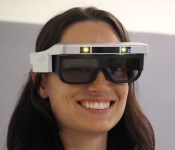
Henkel-Wallace introduced himself to me in the company’s new makeshift headquarters, tucked inside a rented office suite in downtown Mountain View. The space is small and a touch claustrophobic, with narrow hallways, stark empty walls and harsh fluorescent lighting. The only employees on-hand to greet me were Henkel-Wallace, a couple of engineers and Christina Engel, Technical Illusion’s communications manager, who’s pictured in the photo above. The office, Henkel-Wallace told me, is temporary. They’re still looking for a more permanent solution, but they wanted a space to interview applicants, talk to investors and, of course, demonstrate castAR.

Which also happens to be the reason I was there in the first place. The team had finally finished building the first few castAR units that it hopes to ship out to its early Kickstarter backers, and I was there to see how it looked. Before I get into that, however, here’s a brief recap on how castAR works. It consists of a pair of active shutter glasses that are equipped with a couple of tiny projectors and a camera module perched above the frame. When hooked up to a computer, the projectors cast 3D images onto a retroreflective surface, while the camera module scans for infrared LEDs to track the location and movement of your head. Unlike pure VR systems like the Oculus Rift, castAR touts augmented reality — the fact that you can play 3D games and still look at the people and things around you — as its strength. We should note here that castAR also comes with an optional clip-on attachment that can transform the glasses into a VR headset if you so desire.
While it’s not quite close to production-quality just yet, the early developer glasses Henkel-Wallace showed me are far and away cleaner and more refined compared to the units I saw seven months ago at GDC 2014. The projectors, camera modules and surrounding circuitry are now encased in a slim plastic enclosure that wraps around the top and sides of the frames, with none of the hot glue and exposed wires that plagued the earlier prototypes. Among the reasons for the streamlined look are new projectors, which have been custom-designed for castAR by a Japanese company that specializes in optics. “They’re very similar to low-power pico projectors,” said Henkel-Wallace.
“Before, I was building the projectors myself, and putting my fingers all over the lenses, so it was so blurry,” explained Ellsworth, who joined us over Skype. She was still in the process of making the rest of the hundred or so pre-ordered glasses, and won’t make the trip down south until that’s squared away. “I’m not an optical engineer, so we hired a company to build and design the optics for us. Now they’re so much better.”

And they certainly were. From just a brief hands-on with the new hardware, I could tell the images were brighter and crisper. I saw a demo of a fantasy chess game, and I could make out the cracks on the armor of one of the pieces. The clearest example for the sharper resolution was in a new Marble Madness-type game that Johnson and his team designed using the Unity engine. With a resolution of 2,560 by 720, the text for the scores looked nice and sharp, and as the ball rolled around collecting coins, I could easily make out the number of points hovering above it. A retroreflective surface blanketed almost the entire table as well as a couple of the walls in the room, and since it acted as the game’s “display,” the game terrain was much wider than I anticipated. I found it fascinating that I could look around objects by just walking around the table. Henkel-Wallace mentioned a potential for a holodeck application by blanketing a room with that retroreflective material, and I could certainly see a use case for that.
Early Kickstarter backers will get a copy of the new glasses, a set of retroreflective material, the aforementioned marble game (named mARbles) and an SDK that developers can use to make their own apps and games.
The glasses are also overall much lighter, weighing in at around 135 grams, which Ellsworth hopes to reduce to about 80 grams in the final production. Indeed, the team accidentally made their plastic enclosures much bigger than the internal components — they didn’t know the new projectors and cameras would be so much smaller — so slimming down the glasses won’t be a problem.

And that’s not all. Backers who also chipped in for peripherals like wands will get them as soon as they’re available. The wands, just like the glasses, need a camera to find their way around, and the team is still iterating the design on it. “We’re not happy with the buttons just yet,” said Henkel-Wallace. “We’re trying to put in a more traditional one with a joystick and a button.” He added that since it’s augmented reality, the wand can be anything you like, say a sword or a gun. If you pair that with retroreflective clothing, Henkel-Wallace said that could lead to all kinds of interesting gameplay. “Imagine slicing someone with a virtual sword and seeing their ‘guts’ spill out, or maybe shooting someone in a game of laser tag.” Ellsworth and Johnson also mentioned they’ll be sending out RFID mats so that you could play tabletop games like Dungeons & Dragons with “living” character pieces that can do things like breathe fire or swing an axe.
Henkel-Wallace added that castAR is not just for gaming either. Indeed, one of the reasons the team committed to moving down to Mountain View is that they see its potential far beyond the video game realm. He said that someone from the movie industry has approached him about doing that aforementioned holodeck application, for example, and you could also use it for CAD drawings or work presentations. “One of my objectives is to get rid of this thing,” he said, while tapping on the whiteboard behind him. “We can have a three-dimensional experience for projects and presentations.”
http://www.engadget.com/embed-5min/?sid=577&playList=518170689
As for future plans, well, Henkel-Wallace eventually wants a retail space for castAR. “We want people to come and get demos, buy glasses if they want to,” he said. “I think we’re going to sell a lot of these.”
“I’m so excited making the move down there, although it’s going to be a tremendous amount of work,” said Ellsworth. The biggest logistical problem? Moving down her collection of 80-plus pinball machines. “I’m trying to encourage David to do a big fundraising round so that we can put most of my machines in the office,” she said jokingly. “We’ll have a pinball parlor.”
“An augmented reality pinball parlor,” Henkel-Wallace added, laughing. “That’s what we’ll have.”
Filed under: Gaming

Local multiplayer is coming to Android games

Ever wish that you could just whip out your Android device and harass a passer-by to play games with you? It’s the sort of thing that Nintendo DS users, for example, have been using thanks to that company’s StreetPass feature, but, until now, hasn’t been available on Google’s smartphones. Now, however, the company has an added an update to its games infrastructure that enables “ambient, real-time” games with more than one user – so long that the game relies upon Google’s home-grown multiplayer backend. Still, maybe don’t sprint into the street and start challenging people to a dual, because they might get the wrong idea.
Filed under: Cellphones, Gaming, Mobile, Google
Source: Android Developers (G+)
Galaxy Note 4 owners get three months free of OnLive gaming

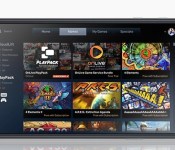
Ahead of the Galaxy Note 4’s release in the US tomorrow, Samsung has a last-minute incentive for potential buyers as well as those who have already pre-ordered. The company just announced a new partnership deal with OnLive, which gives owners of its fresh, big-screen handset three months of free gaming through the streaming platform. Samsung’s promotion is part of the Galaxy Gifts Package, a collection of free software from its own app store, and will give users access to titles from OnLive’s PlayPack bundle, such as Batman: Arkham City, Darksiders, Rogue Legacy and many more. The OnLive service is typically $9.95 per month — so not only do you save some cash, but also have the chance to try it without any attachments. Once you have your Note 4, the OnLive app can be downloaded from the Galaxy Apps shop.
Filed under: Cellphones, Gaming, Internet, Mobile, Samsung
Source: Samsung Galaxy Apps

PS4 2.0: MP3s, themes and better dashboard organization

We’re creeping up to the PlayStation 4’s one year anniversary and the system is finally getting its 2.0 firmware update. Even better, there are a bunch of surprises; let’s dive in. First up we have the expected: SharePlay which lets you virtually pass the controller for help, YouTube exports and themes. A post PlayStation Blog notes that in addition to those, a USB music player, the ability to change colors of the PS4 dashboard (if custom themes aren’t your thing), as well as improvements to streaming are en route. There’s content organization, voice commands and, last but not least, a new backup feature that lets you archive all your settings, media and data to a USB device coming too. Like the Xbox One patch that hit this week, this adds a whole slew of features that ideally would have been available when the system launched last year. Join us after the jump for a breakdown, yeah?
PS4 System Software 2.00 new features: http://t.co/sjlyHsde67 USB Music Player, broadcasting enhancements, more pic.twitter.com/ZwFbiJRKlN
– PlayStation (@PlayStation) October 16, 2014
Sony came under some fire from fans when it was announced that the only way to listen to music on the PS4 was with a Music Unlimited subscription. That changes with this patch, though, and soon you’ll be able to plug in a USB device full of MP3, MP4, MP4A and 3GP files and listen to your heart’s content. The PS Blog says that music can’t be copied to the system’s hard drive, nor can it be used in conjunction with Music Unlimited. When we’ll see CD support is anyone’s guess, however.
We’re betting that custom playlists won’t be available in-game either. Not happy with the theme pictured below? Well, you can opt for a handful of solid colors for the system UI like those at the bottom of this post.

The patch also addresses a major gripe many have had with the system since launch: decluttering the system dashboard. Now the dashboard will only show the 15 most-used games and apps, with the rest going into the Library, which also is getting some new sorting options. What’s more, lets say you’ve been stocking up on the pretty great, free releases each month that are a part of your PS Plus subscription but you’re running out of storage on your console. Well, from the PlayStation Store you’ll be able to add them to your Library without downloading — perfect for grabbing stuff before it’s no longer free and saving for later, or once you install a bigger hard drive.
Speaking of which, the 2.0 patch also adds the ability to back your system data, media and settings to a USB device. This should make transferring all the stuff you’ve accumulated over the past year to a roomier HDD a while lot faster and much more convenient if you’re living under a data cap. There’s a ton more than that, though! For the rest of the patch notes be sure to hit the PS Blog — sadly, however, it’s missing a release date.

Filed under: Gaming, Home Entertainment, HD, Sony
Source: PlayStation Blog

Xbox One update makes multitasking easier and everyone more secure

We knew that the October update coming to the Xbox One would make it act more like the 360, but Redmond has packed a few other features into it too. In addition to double-tapping the Guide button to call up your friends list and achievements, this patch adds what amounts to two-factor authentication for your account (something new for Xbox-only Microsoft logins), according to Xbox Live’s Larry “Major Nelson” Hyrb. A select few markets are getting access to a tweaked Live TV setup option too, which will automatically detect the set-top box plugged into the One’s HDMI-In port (sounds like HDMI-CEC to us). You can hide any games that are cluttering up the “ready to install” portion of your collection now as well. Handy! The 249MB update is rolling out starting today, and you should be able to force the download from the system’s settings menu.

Filed under: Gaming, Home Entertainment, HD, Microsoft
Source: Major Nelson, Xbox Support

Playdate: We’re livestreaming ‘Bayonetta 2’ on Wii U!

Nintendo’s big exclusive game for its Wii U home console is Bayonetta 2. It was Nintendo’s big coup announcement ahead of the Wii U’s launch. Bayonetta‘s notable not just for being good — the first game is critically-acclaimed — but also for being made by a developer other than Nintendo. And hey, it’s October, so that means games are being released into the wild. Among them is Platinum Games’ Bayonetta 2, featuring the stylishly appointed, combat-ready Rapunzel-alike you see above. The series is known for its over-the-top, goofy-yet-calculated style, and we’re gonna put the latest one through its paces in a stream for you just below starting at 4PM ET.
http://www.twitch.tv/engadget/embedWatch live video from Engadget on www.twitch.tv
http://www.twitch.tv/engadget/chat?popout=

