



Playdate: We’re livestreaming ‘Halo: The Master Chief Collection’ on Xbox One! (update: game over!)

You’d think that ten years after Halo 2 launched, Master Chief saying, “I need a weapon” would have less of an impact. I thought that, anyway, and I was wrong. Like, super, super wrong. In Halo: The Master Chief Collection, Microsoft’s Halo studio (343 Industries) has made a decade-old game shockingly relevant once again. Halo 2 “Anniversary” (as it’s known) is gorgeous, it sounds dramatically better, and the cutscenes are completely re-made by the CGI masters at Blur Studio. But let’s not kid ourselves — unless you’re a hardcore Halo dork (like me), you’re here for the wealth of online multiplayer, right? Follow us below for a stream of both Master Chief Collection‘s campaigns and all that multiplayer.
[For the record, I’m playing Halo: The Master Chief Collection on an Xbox One, using a retail copy (disc) provided by Microsoft. I’m streaming the game over wired internet using Open Broadcaster Software and an Elgato Game Capture HD. All that to say, “This game will likely look prettier and run more smoothly on your home equipment. Streaming conditions vary!”]
#fivemin-widget-blogsmith-image-16998display:none; .cke_show_borders #fivemin-widget-blogsmith-image-16998, #postcontentcontainer #fivemin-widget-blogsmith-image-16998width:630px;display:block;
 trydocument.getElementById(“fivemin-widget-blogsmith-image-16998″).style.display=”none”;catch(e)

Facebook thought about featuring games in Messenger

Love it or hate it, you have to use Facebook Messenger if you’re to chat privately with your friends on the social network. As we know it, the application features a minimalist design and very straight-to-the-point functionality. That’s all great, of course — but, for better or worse, it could have been so much different. TechCrunch reports that Facebook quietly flirted with the idea of featuring games in the Messenger app, going as far as quietly testing this out and, eventually, deciding against it. Instead, Facebook’s EMEA Director of Platform Partnerships, Julien Codorniou, says the company opted for other ways to cash-in on the site’s gaming ecosystem, like letting developers take full advantage of its mobile advertising platform. More specifically, through app install ads.
Was it a good decision? We’ll never know. But what do you think?
Filed under: Gaming, Internet, Software, Mobile, Facebook
Source: TechCrunch
Making music in a Kinect-powered sandbox (video)

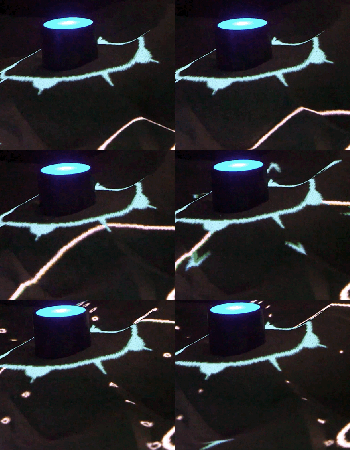
Tucked away under a tent at Expand 2014 was perhaps the coolest exhibition on the show floor: Sand Noise Device, a literal interactive sandbox experience. No, this isn’t a new Grand Theft Auto; it’s powered by hacked gaming tech, though, including an Xbox 360 Kinect sensor and a PlayStation Eye camera. Watching it in action immediately brought memories of Xbox 360 classic Geometry Wars to mind, actually. A ring radiates out from a center origin point, and when it hits the glowing, multi-colored pucks (that are tracked for position by the PS Eye), a series of particles start shooting outward.
From there, they bounce around a 4 x 3-foot sand table with physics-based reactions to changes in the substrate’s elevation and topography. Translation? The particles can get stuck in a depression you create — gaining speed as they reach the bottom — or follow a path left by raking a set of shallow grooves into the sand. You can even “catch” one in your palm and hold it there. Oh, and every movement produces sound too.
“It’s a generative music system, so you program a bunch of rules, feed it data and it creates music based on that data,” Jay Van Dyke, one of the project’s creators from The Green Cat Collective, told us. When the center origin wave hits the pucks, and the quasi-spaceships make their way outward (depending on how high or low the sand physically is), that’s how loud or quiet the sound will be (respectively). “The Kinect is basically the way we read the topography of the sand,” Van Dyke said. “It returns every frame of how people have manipulated the sand to us, and that becomes our environment.”
That environment, according to Van Dyke, could be pretty big and humans could even be a physical part in it, standing in a pile of sand on the floor. That’d have made a mess at the Javits Center, though, so the team opted instead for a wobbly table that was rated to hold some 300 pounds of the pre-glass grains. And even with that precaution, by late Saturday afternoon the cement floor in and around the tent was already fairly gritty.
The idea stems from the frustrations of wanting to play an instrument but not exactly knowing how, Van Dyke said. He mentioned that someone might come along a piano and tap a few keys here and there, but the immediate sense of gratification (one of the reasons games like Rock Band and Guitar Hero were so popular) just isn’t there. Many want a quick fix in a fleeting moment, not the years of training it takes to traditionally make music.

“You can play around with it and learn how it works in a couple of minutes and have a really good time,” Van Dyke said.
Judging by the amount of Expand attendees that crowded around the sand table at any moment throughout the weekend, it’s safe to say Van Dyke and his team were pretty successful.
Filed under: Gaming, Peripherals, Microsoft
Source: Sand Noise Device

Homemade ‘Castlevania’ board game looks beautiful and fun to play

If you style yourself as a fan of Castlevania, you have nothing on Reddit user XsimonbelmontX. He’s created a board version of Nintendo’s classic NES game that looks like a hoot thanks to well-thought-out gameplay and stunning craftsmanship. It features 11 characters with upgradeable weapons, 100 items like special armor and over 100 monster cards. The board layout pays homage to the original version of Castlevania, with players battling together through five levels in order to resurrect (and then re-murder) Dracula himself.

XsimonbelmontX crafted the game using off-the-shelf gameplay items and an inkjet printer, though the board itself (above) was professionally made. Castlevania fans on Reddit are clamoring for their own (with one saying he’d pay up to $80), though it seems pretty unlikely that publisher Konami would ever share the copyright. You can see a large gallery of the cards, dice, board and case right here.
[Image credits: XsimonbelmontX]
Filed under: Gaming
Via: Kotaku

The Apple years while Steve Jobs was away

As one of the founders of Apple Computer Inc., Steve Jobs became synonymous with the brand. But his relationship with the company wasn’t always so hallowed and harmonious. After internal disputes with Apple’s board of directors in 1985, Jobs left the company to pursue other projects, including NeXT Inc. and Pixar. Although he’d piloted the Apple brand from the start, the company carried on without him until his return in 1997 during which time he rebooted the company and turned out “world-changing” products. Join us in the gallery below as we look at some of the hardware that Apple made while Jobs was away.

Xbox One update arrives with customization and Twitter tie-ins

Have you been eager to customize your Xbox One profile, or share your gaming escapades on Twitter? Now’s your chance. Microsoft has started rolling out its promised November update for its latest console, and it includes a ton of updates that let you both personalize your system and keep tabs on tweets. You can now customize your background with colors or achievement images, and post a bio that includes your location. If you’re a social sort, you can also tweet your favorite game videos and follow the Twitter buzz surrounding live TV shows. You can finally snap Internet Explorer to a smaller view, too. Fire up your system if you’ve been waiting weeks for any of these perks.
Filed under: Gaming, Home Entertainment, HD, Microsoft
Source: Major Nelson

‘Far Cry 4’ isn’t on Steam anymore because EA wants to sell it directly

What happened not too long ago with Electronic Arts and its Origin platform appears to be happening with Ubisoft too. As Kotaku has noticed, Ubisoft’s trio of tentpole releases for this fall — Assassin’s Creed Unity, Far Cry 4 and The Crew — are no longer available on Valve’s game store, seemingly disappearing overnight. Curiously, older entries in each respective franchise are still available (and reasonably priced) on Gabe Newell’s one-stop PC-gaming shop. Even weirder yet? VG247 has spotted that ACU and FC4 are now listed on Origin. No, it doesn’t make a lot of sense especially considering Ubisoft has its own digital storefront. We’ve pinged the outfit’s PR team for details about what’s up and will update this post should we hear back.
Filed under: Gaming, Home Entertainment, HD
Via: VG247

Blizzard’s next game is ‘Overwatch,’ an online superhero shooter

Blizzard is breaking out of its role-playing and strategy niches in a big, big way. The game developer has just unveiled Overwatch, a superhero-focused, team-based multiplayer shooter. Details of how it works are scarce, but it’s definitely more lighthearted than the likes of Diablo. Think of it as a cross between Team Fortress 2 and The Incredibles, with an added emphasis on high-tech weaponry. Blizzard isn’t talking release dates or platforms, but a release is “nearer than you think.” BlizzCon attendees will try an early version of Overwatch, and a beta test is due in 2015 — unlike Titan, there’s a good chance you’ll get to play this yourself. Itching for just a little more? Peep the BlizzCon trailer after the break!
Via: Massively
Source: BlizzCon

You can Remote Play PS4 games on your Xperia Z2 devices now, too

We’re going to say that Sony’s relationship with the PS Vita is a little bit, well, complicated. Why? Because one of the biggest reasons to even own one these days, Remote Play, is now available in more places. Specifically, the Xperia Z2 smartphone and its similarly-named tablet cousin. That’s right, you no longer need to own the catch-up king’s portable gaming system or Z3 device to play PlayStation 4 games while you’re away from your console and TV. Given that it uses the console’s DualShock 4 controller rather than the slightly cramped confines of the Vita, depending on the size of your hands it could be a better experience, too. Sony says that the Xperia line is the only place you’ll get full Remote Play functionality, but folks on the XDA Developers forums are already working to get around that bit of exclusivity so it’s available on all capable Android gizmos. Are you a new Vita (or Z3) owner feeling a bit slighted now? Let us know in the comments.
Filed under: Cellphones, Gaming, Home Entertainment, Tablets, HD, Mobile, Sony
Source: Sony Mobile, XDA Developers
Five questions about VR beyond gaming with three people making it happen

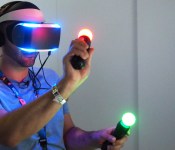
Looking at Facebook, Sony and Samsung, you might think the future of virtual reality is all entertainment and social interaction. While video games and movie watching are both primary components of the recent virtual reality wave, there’s much more to the field. Matterport, a company focused on 3D-mapping tech, and BeAnotherLab, the group behind interactive art installation “The Machine to be Another” — are each pushing forward virtual reality, and neither are focused directly on game-like interactive immersion. The medium of virtual reality is young, but it is already varied. So, what does the future hold? We asked five questions surrounding that subject to three people who are shaping that future: the panelists for our “Back to Reality: VR Beyond Gaming” panel at Expand 2014 (which starts tomorrow!). Head below for their answers!
Where is virtual reality today?
BeAnotherLab’s Marte Roel: It’s a very exciting time; while research and development in VR has been ongoing since the initial boom of the ’80s and ’90s, it has not been focused on consumer markets since that time. What has breathed new life into the field of VR, and caused a renewal of public interest, is the radical shift in the ecosystem of technological development. Previously, the tools and knowledge were the sole domain of large corporations and research institutions, but now you have a lot of very creative individuals and groups working outside of this system; with alternative funding like crowdfunding, rapid prototyping tools, easier access to cheap manufacturing and open knowledge contributing to accelerated development and adoption of technologies.
This tension between large corporations and the maker ecosystem has injected a tremendous amount of energy into the field, which has, as of yet, not coalesced into a mass market. We see a lot of the same VR concepts that existed more than 20 years ago, but this technology does not exist without context; instead it works to co-create context. As such, we face an important question: Do we want to continue building over what is provided by our current socioeconomic and techno-cultural context? We see the high-energy and fluid state of VR as an opportunity to work toward creating a more human-centered context, which addresses some of the shortcomings of the previous VR boom and information technology in general.
Matterport Co-founder/Chief Strategy Officer Matt Bell: It’s where the web was in 1994 or social media in 2003. People agree that it’s going to change the world, but they’re working out how and when the various markets and use cases are going to go big.
Linden Labs CEO Ebbe Altberg: It depends on what you mean by “virtual reality” — I’d argue that term means something beyond just the head-mounted displays and other hardware that are often associated with it. An important aspect of virtual reality is the level of immersion and impact it can have on a person. Part of what qualifies an experience as virtual reality is that it impacts you in the same way as if it had really happened in the physical world — your brain fails to distinguish the difference between the virtual and the real.
Virtual reality is still in its infancy, still niche, but we’re nearing a massive inflection point. Not only is the hardware, software, networking, etc. all improving, but people are also increasingly comfortable with digital experiences, from communicating to shopping, playing, learning, creating and more. The combination of technical and cultural advancements [is] leading us toward a point where a huge number of people will be able to experience virtual realities.
What is the greatest challenge that the medium of virtual reality must overcome in the next five years?
Roel: There are three different domains in which we may find fundamental challenges: social, research and design. In terms of the social aspect, which is perhaps the most important, we have to talk about what will fit within the bounds of our current context; there are many technologies that may affect our conception of what constitutes a “virtual experience” — from transcranial magnetic stimulation to psychoactive drugs — but these are not commonly bound within our current social context. On the other hand, there are many virtual experiences, or virtual tools that are used and becoming much more accepted. Look at Tinder for example; 10 years ago, it was not as accepted to go on dates using online tools as mediators for real experiences. Whatever future applications become widespread in the near future, they will emerge from their bounding to our current context and there is where energy and creativity must be applied.
As far as recent and near-future research is concerned, we believe that research in multimodal perception is fundamental for our understanding of how to build robust virtual experiences, and perhaps even novel perceptual experiences. Under the conception of perception as a sensorimotor faculty, if we are able to manipulate sensorimotor contingencies, we might be able to construct new forms of perception.
Lastly, the central challenge of design is how to integrate all this in a user-friendly, perhaps portable, and inexpensive product that at the same time is meaningful in a variety of different social and cultural contexts.
Bell: Making VR mainstream will require getting people to adopt a technology that’s very fundamental to how they look and how they act in public. This is often difficult; Bluetooth headsets have been successfully accepted into the mainstream, but Google Glass has not. The rest of the 3D ecosystem needs to mature. For example, 3D input devices are needed to make the UI work well, since you can’t easily use a mouse and keyboard in VR. Fortunately there are options under development, such as Sixense, Leap Motion and Nimble Sense.
Altberg: Ease of use remains the greatest challenge. In order to truly reach the mainstream, virtual reality experiences will have to be easy, natural and comfortable to create, interact with and consume.
What is your vision for the future of VR?
Roel: Our vision of the future is perhaps similar to others on the panel; i.e., pervasive across different industries, accessible to everyone, integrated into [the] fabric of social interaction, collective virtual spaces and experiences becoming as culturally meaningful as real reality, etc. But for us, this cultural and technological shift toward the virtual, in which social interaction is happening more and more at distance and its cohesion is mediated through centralized information systems, is not something we see as inevitably utopian or even optimal. In simple terms, it doesn’t matter how you look at it; you still have your face in a box, and we are concerned about what that means for human culture. As a result, our approach is somewhat in reaction to this anticipated future, where we attempt to address broad social issues and interaction paradigms in a critical manner and co-opt existing technologies to shift the focus back toward the human.
Bell: This is such a broad category that it’s hard to answer. (e.g., “What is the future of the internet?”) I expect broad interest, not just gamers. We’re showing Matterport’s VR models of houses to people in real estate, traditionally a very tech-phobic industry, but they’re very interested in it. There’s something fundamentally valuable when you put on a VR headset and it gives you a sense of place.
Altberg: As things advance, VR experiences will get much richer, more interactive and more natural — they’ll get closer and closer to “reality” with both the interfaces and the emotional impact of the experiences.
One key for the future of VR is that it won’t be just a consumer experience. Today, many VR experiences are more like 3D movies, or games, but directed and passive experiences are only part of what VR will be. In the future, one way VR will move closer to reality is in the types of experiences one can have that go beyond being a consumer — you’ll be able to create things, connect and interact with other people, share and trade, work, learn and more.
What is VR’s “killer app”? Gaming? Media consumption? Virtual travel? Something else?
Roel: Framing the potential of VR as necessitating a “killer app” holds back the industry, which already suffers from being narrowly concerned with monetizing applications and marketing them within established structures. What we have before us is a much broader cultural shift in how humans interact with and through virtual, remote and informational spaces due primarily to the affordances of new interfaces, which are becoming multimodal and immersive. We are, of course, at the beginning of this shift, and have been since the ’80s in terms of VR, but one of the key aspects is that this is a complex process of co-evolution of technology and our own human perception of reality. The “killer app” for VR will be something a lot more dynamic that is bound by our cultural conception of reality and capable of having a wide impact on the behavior of humanity, not a single-use-case scenario.
Bell: There’s a wide range of apps that I believe will be successful, but I expect social virtual worlds, in all their flavors, to be a significant fraction of this. This will include real places, digitally constructed places and everything in between. There’s a lot of potential for social gatherings in these virtual worlds for whatever purpose, whether it’s a game, a business meeting, shopping, a training session or casual social interaction. Social media brought increased interactivity and personal relevance at a cost of media richness and immersion, but VR will let the immersion side catch up.
Altberg: This is a tough question — it’s a bit like asking, “What’s the killer app for the internet?” I’d say the killer app for the internet is communication, and the key for VR is creating a context within which to communicate that makes the experience like a real one.
With virtual worlds, the experience can be as impactful as real life, but the context for those experiences can far surpass real life. You have complete control over the virtual world — you have the freedom to be whoever you want (including someone else), and create anything you can imagine, with other people — and so the experiences you can have in VR can go beyond the bounds of reality. In the future, we will create, play, work, travel, learn, teach, heal, socialize and find love in VR experiences.
What is your company or project doing to make VR a consumer product?
Roel: The ambition driving our project is to develop technologies which facilitate empathy and social good. While other companies are focusing on existing industry-wide technological or market challenges, we are taking a leap in developing and designing for future applications which we believe will become pervasive.
We do this through a distributed research and development network where we can explore niche applications in various fields through partnerships with key players, such as MIT and [the] United Nations, while simultaneously interconnecting these developments with the broader open-source community. Concretely, we work developing tools for conflict resolution, human-centered design, interactive art and storytelling experiences as well as scientific research in cognitive science, embodiment, pain perception, phobias, body dysmorphia and neurorehabiliation.
Central to our methodology is developing technology through a process of co-creation. We are passionate about working in collaboration with members of the public in many different cultural contexts and testing these prototypes “in the field.” We believe this contributes to a much richer and deeper understanding of the user experience of the people who will ultimately benefit from these technologies.
Bell: Matterport makes it easy to bring real-world spaces into VR. 3D content is very difficult to create from scratch, but we’ve used our computer-vision expertise to build the 3D equivalent of the camera. With Matterport, the public can use the Oculus Rift and Gear VR to explore real-world sites. This could be for tourism (e.g., museums, historical sites, famous places), virtual shopping, looking at places to rent or buy, etc. It also lets you view transformations to real-world spaces, such as remodels or furniture purchases.
Altberg: Linden Lab is currently building a next-generation platform that will allow people to create their own virtual experiences that will be accessible with VR hardware, as well as via other devices. It will be in the spirit of Second Life and will empower people to create their own places and easily invite others into them for shared virtual experiences. This ambitious project will make it so that not only can anyone easily enjoy immersive virtual experiences, [but] they can also create their own.

