


WSJ: Time Warner’s latest suitor is AT&T
AT&T’s next step to telecom dominance? Buying Time Warner, it seems. Before the next episode of Westworld airs, theoretically, AT&T could own HBO, CNN, Hulu, DC Entertainment and Warner Bros. Pictures among others, according to The Wall Street Journal. Over the past few years pretty much any multibillion dollar corporation has flirted with the idea of buying Time Warner. Apple and Fox have both been heavily rumored, for example. And considering that Time Warner turned down $80 billion from the latter, it gives us an idea that the asking price is going to be northward of that.
Consolidation in the media landscape (oh hi, Verizon) is increasingly commonplace as companies look to bolster their bottom line with bigger customer numbers over individual profits. After all, that cable subscription’s going to get a lot cheaper when people start cutting the cord en masse in order to try winning you back. Just look at the price of monthly landline service as a parallel.
But last year’s $49 billion acquisition of DirecTV has left the coffers a bit dry, and its last investors report stated that the company only had about $5 billion in free cash. If the deal goes through, it’s going to leave the company pretty deep in the red. Or AT&T manage to raise the GDP of a small somehow just to afford the purchase price. But hey, corporations are good with math, right? The beancounters will make this work. Somehow.
Via: CNBC
Source: Wall Street Journal
AT&T in ‘Advanced Talks’ to Acquire CNN and HBO Parent Company Time Warner
AT&T is in “advanced talks” to acquire media company Time Warner, and a deal could be finalized as early as this weekend, according to The Wall Street Journal.
Bloomberg on Thursday said senior executives at AT&T and Time Warner met in recent weeks to discuss a possible merger, but it said the talks were informal at that stage.
The talks toward what likely would be a cash-and-stock deal have come together quickly, are fluid, and still could fall through, according the people familiar with the matter. An agreement also could be delayed, they said.
Time Warner CEO Jeffrey Bewkes has previously told investors he would entertain a sale of the media company, but only if it feels the price is right. In 2014, Bewkes and his board reportedly turned down an $85-a-share offer from 21st Century Fox, which valued Time Warner at more than $75 billion.
AT&T, looking to add more content and original programming, would gain a number of valuable assets from Time Warner, including CNN, HBO, TBS, TNT, NBA basketball, Cartoon Network and the Warner Bros. film and TV studio. Popular series airing on those networks include, among others, Game of Thrones and Silicon Valley.
New York Post sources said Apple was a possible suitor to purchase Time Warner earlier this year, which Financial Times later said was an idea proposed by Apple’s services chief Eddy Cue. The discussions reportedly never progressed beyond the preliminary stage, however, and did not involve Apple CEO Tim Cook or Bewkes.
An acquisition would have provided Apple with content for its much-rumored streaming TV service, which it has reportedly placed on hold due to difficulties in negotiating deals. It was reported the Netflix-like service would have offered a skinny bundle of channels, including ABC, CBS, and FOX, as part of a monthly subscription.
An AT&T-Time Warner acquisition would likely be closely examined by federal regulators.
Tags: AT&T, Time Warner
Discuss this article in our forums
AT&T Insurance to Cover Cracked iPhone Screens Starting November 15
Insurance plans offered on a monthly basis from AT&T will soon cover cracked screens, according to recently updated information on AT&T’s website (via AndroidPolice). Starting on November 15, AT&T customers who have an iPhone 6, 6s, 6 Plus, 6s Plus, or SE and an eligible insurance plan will be able to pay $89 to have a broken screen repaired.
A limited number of Android phones are also eligible for screen repairs, but notably missing is Apple’s most recent iPhone 7 and iPhone 7 Plus devices, perhaps due to repair costs or the availability of parts. AT&T warns that repairs may use new or refurbished parts and could include non-original manufacturer parts.
The new cracked screen repair option is available to customers who have Mobile Insurance, Mobile Protection Pack, Mobile Protection Pack for Business and Multi-Device Protection Pack service. According to AT&T, same-day screen repairs will be available in most cases and are done by Asurion-certified technicians. All repairs include a 12-month warranty.
This will give you the opportunity to get your screen repaired as soon as the same day. You can file a claim in the morning and, if approved, schedule an Asurion-certified technician to repair your cracked screen as soon as the same afternoon, subject to appointment availability.
AT&T’s screen repair program comes shortly after AT&T raised its device replacement costs across the board on September 1. The program is launching in 15 markets on November 15, including San Diego, San Francisco, Pittsburgh, Orlando, Los Angeles, and Boston. It will expand to 29 additional markets on December 1.
Mobile insurance from AT&T is available for $7.99 per month and covers damage, loss, theft, and out-of-warranty malfunctions. The $89 screen repair option will be a welcome change for many iPhone owners with AT&T insurance, as replacement iPhones (iPhone 5 and later) are priced at $225 and up [PDF].
Tag: AT&T
Discuss this article in our forums
AT&T’s insurance plan will soon repair busted phone screens
If you have insurance on your phone and smash the ever-loving tar out of the screen, you normally have to file a claim, pay a deductible and wait for a replacement device. Bleh. AT&T and its insurance provider Asurion, however, are trying something a little different. As of November 15, people paying to insure their phones can shell out $89 to — schedule permitting — have a technician repair that display that very day.
Same-day repairs definitely aren’t guaranteed, but the plan could work well for people who can’t go without their phones or don’t have the time for the traditional trade-in process. You stand to save a little money, too: the usual deductible for a high-end smartphone fluctuates between $150 and $225 depending on what it is, so just under $90 doesn’t sound like a bad deal for potentially speedy service.
There are a couple caveats you should know about, though — for one, the new plan only applies to certain smartphones. If you have an iPhone 6, 6 Plus, 6s, 6s Plus or SE, you’re in luck. Ditto if you own Samsung’s Galaxy Note 4, Galaxy S5 or Galaxy S6. You might notice some very popular omissions from that list, namely the most recent iPhone and Galaxy S devices, but that’s probably because the requisite parts are more pricey or tougher to come by. Beyond that, the screen replacement plan is only set to launch in 14 markets come November 15; you can check out the full list (plus markets launching down the road) below.

Via: AndroidPolice
Source: AT&T
Bloomberg: AT&T considering a halt on Galaxy Note 7 sales
Reports that a Galaxy Note 7 issued as a replacement caught fire on an airplane may be too much for at least one carrier. Bloomberg cites a single unnamed source claiming that AT&T is “considering” stopping sales of the troubled phone based on that incident. Although AT&T (along with Sprint, T-Mobile and Verizon) have already issued statements indicating that customers can return or exchange their replacement phones, this would go a step further. The rumored deadline for the decision is Friday, which would put pressure on Samsung to figure out what’s going here.
Source: Bloomberg
AT&T, Sprint will exchange replacement Note 7s after airplane incident (updated)
A replacement Samsung Galaxy Note 7 started smoking and burned through the carpet on board a Southwest flight this week. Following the incident, one US carrier is allowing owners to exchange those replacement devices even though the Consumer Product Safety Commission (CPSC) hasn’t issued a formal warning or recall yet. Sprint confirmed to Engadget it will allow customers to return their replacement Note 7 for another device at its retail stores “during the investigation window.” The carrier says that it’s working with Samsung “to better understand the most recent concerns” with the handset.
Here’s Sprint’s full statement on the matter:
“Sprint is working collaboratively with Samsung to better understand the most recent concerns regarding replacement Samsung Galaxy Note 7 smartphones. The U.S. Consumer Product Safety Commission is also investigating the Note 7 replacement device. At this time, CPSC has not specifically said if customers should or should not use the replacement model. If a Sprint customer with a replacement Note 7 has any concerns regarding their device, we will exchange it for any other device at any Sprint retail store during the investigation window. We will provide additional information when the investigation has concluded.”
So, what if you’re on T-Mobile, AT&T or Verizon? Well, Recode reports T-Mobile will accept returns so long as they fall within its normal 14-day “remorse” policy. The carrier began offering replacement Note 7s to customers on September 21st, so if you got one that day, the return window has already closed. T-Mobile began selling the phone to new customers this week, so they still have time to take it back. We’ve asked the carrier for more info on the return process and we’ll let you know when/if its responds.
AT&T confirmed to Engadget that it will also allow customers to exchange replacement Galaxy Note 7s for another phone. We also reached out to Verizon on the matter and haven’t heard back. When or if we do, we’ll update this post with more information. Both carriers have 14-day return policies similar to T-Mobile, but again, if you picked up a replacement on the 21st, that exchange period has already run out.
Update: This post has been updated to reflect AT&T confirmed that it too would offer exchanges.
Via: 9to5 Google
Source: Recode
DirecTV Now streaming rumored to supplant satellite by 2020
AT&T is planning to release a DirecTV-branded streaming video service later this year, but according to Bloomberg, it also expects for that to become its primary video platform soon. Earlier this week, its CEO Randall Stephenson confirmed the DirecTV Now launch is still on track for 2016, calling it an exclusively over the top product, with no truck roll, no set-top box or anything else. The report claims that at launch it will be limited to two simultaneous streams, with pricing similar to the $40 – $55 per month PlayStation Vue service.
Randall Stephenson (transcription via Seeking Alpha)
Sure. An MVPD like product. So I think 100 premium channels in a purely over-the-top platform with a completely different cost structure. I mean, this is a very unique cost structure and a very unique platform. We have built this from the ground up. We spent the last year plus developing this platform. And it starts with how does the customer subscribe to the service?
They download an app on their smartphone, their smart TV or their tablet, they subscribe purely digitally, they select their content digitally, they interact with us digitally, the billing is purely an online billing arrangement. This is a very, very low cost customer acquisition product. It is a very low cost to install product meaning the customer has just done it once they downloaded the app. There are no set-top boxes, they are no truck rolls involved in this.
So we are kind of re-platformed all of the cost for this product, and it’s a very, I mean, nominal incremental cost to provision this. So to your point, we had to acquire content rights, and being the largest scale TV provider in the U.S. gave us a lot of opportunity to get a best-in-class cost structure around this content. We’ve been very aggressive about this over the last year.
And we’ve been doing what I would consider some win-win arrangements with the content providers. The content providers, I believe are [indiscernible] referred to it that he is happy with the arrangement we struck. And so you put the different cost structure, kind of a unique position content cost together. And we can’t put together a product that is — I’m going to call it thinner, not thin margins, but thinner than what we’re accustom to. But I’m always willing to take thinner margins, when there is low capital intensity in the product.
So we think we’re going to be able to meet a price point, that’s very, very aggressive in the marketplace. And keep in mind, it’s a product that is integrated with our wireless service. And it’s also integrated with our broadband our home broadband service.
And so to the extent, that is driving additional penetration or further penetration, wireless or driving churn down in wireless, the lifetime value of a customer with this kind of product is actually quite attractive and very positive. So that’s why we’re so excited about it.
While Vue and Sling TV are natural competition, other providers like Comcast and Time Warner Cable have launched small tests in offering internet video. If AT&T pushes to replace its satellite TV acquisition and U-verse TV service with a purely over-the-top streaming service, it could be the first major provider to go that route. The projected window is within three to five years, so one way or another, by 2020 you can probably expect easier access to NFL Sunday Ticket.
Source: Bloomberg
AT&T to Target Cord Cutters With Late 2016 Launch of ‘DirecTV Now’ Streaming Video Service
AT&T CEO Randall Stephenson today confirmed that the company is planning to launch an online streaming video service, called DirecTV Now, sometime in the fourth quarter of 2016 (via CNET). Featuring “very, very aggressive price points,” the service is said to include more than 100 premium channels and will come in app form on smartphones, tablets, and set-top boxes, although the specifics of the launch were kept to a minimum.
Stephenson remarked on the company’s ability to introduce the service at a low price point, due to the fact that DirecTV Now won’t require customer visits and installation, and “all of the ordering, customer service and billing is done digitally, reducing the need for more traditional tech support.” The streaming service will also provide the option between one and two streams per household, with customers able to increase simultaneous streaming by paying a little more each month.
Cord cutters have seen an explosion of options when it comes to streaming video, including services like Hulu, Netflix and HBO Go. But cobbling these services together is costly and complicated, which is why many consumers still stick with the easier package deal of a cable subscription.
AT&T believes it can offer something more attractive. The company plans to initially go after the 20 million households with no pay TV subscription, Stephenson said. When asked if DirecTV Now could threaten its traditional DirecTV business, Stephenson acknowledged some risk. But “that’s a good sign,” he said.
“If you don’t see them threatening your legacy products, 99 percent of the time they don’t go anywhere,” he said. “It means you found something the market really wants.”
Users will also be able to bundle DirecTV Now into the company’s broadband and mobile services, and all of the various aspects of AT&T’s offerings will work in the same ecosystem, so customers who stream DirecTV Now on their smartphone won’t get hit with data overcharges.
AT&T has struck deals with Disney and HBO for its new streaming platform, but Stephenson noted that a few “holdouts” still remain, preventing DirecTV Now from a more immediate launch. Still, the CEO said the content deals process is around 90 percent done. By the time customers begin signing up for the service after its late-2016 launch, Stephenson thinks that “in 2017, this will be a big driver of video for us.”
The amount of video streaming apps and services has been growing steadily over the past few years, and new companies consistently announce their presence in the space. This year, Hulu confirmed an upcoming live cable TV service, and premium channels like HBO, Showtime, and Starz each have their own content specific, monthly subscription services that range between $9 and $15. Apple was even attempting to get a similar $30-$40 web-based TV package launched last year, but failed deals with networks caused the company to put its plans on hold.
Tags: AT&T, DirecTV
Discuss this article in our forums
AT&T’s Project AirGig could be a wireless alternative to fiber
Bringing gigabit internet to rural areas is usually an expensive proposition — but soon, it might not be. AT&T Labs today announced Project AirGig, a new wireless internet delivery system that carriers high speed internet service over power-lines without actually tapping into the physical wired infrastructure. More specifically, AT&T plans to mount hundreds of tiny radio stations atop telephone poles to bring high-speed internet to customers without laying down new cable.
The project is still in its experimental phase, but AT&T says it’s bursting with potential. AirGig’s relay stations may sit on top of telephone poles, but it doesn’t actually need to tap into the pole’s power source — it doesn’t send signals over the lines either, opting instead to regenerate millimeter wave signals from station to station. Because the stations are designed with to use affordable plastic antennas and make use of existing infrastructure, it offers a potential way to bring high-speed connections to new areas without laying down new cable. Not only does that save a ton of money, it also means the new system could be deployed faster.
AT&T is careful to note that AirGig is purely experimental right now, and its first field trials won’t even start until next year. Even so, lab tests have been encouraging, and the company is confident that the system could be used to bring next generation internet to rural communities and developing countries.
Source: AT&T
The best places to buy and sell a used iPhone
By Jackie Dove
With a new iPhone arriving soon, many people will look to sell their old iPhone for some quick cash. But which places offer the best return and the smoothest process? To find out, Tom’s Guide tested seven services that buy and sell used iPhones.
To find out where you can expect the best return on your dollar, we bought an iPhone from each reseller service and then turned around and re-sold that phone to same service where it came from. We also rated each service on their convenience, ease of use and responsiveness to come up with our rankings.
The key takeaways from our testing:
- Glyde and Swappa top our rankings of the best places to buy and sell a used phone.
- Walmart and Best Buy finished at the bottom.
- We resold our iPhones for an average of 52 percent of what we had paid for them.
- We got the highest rate of return from marketplace services that connect smartphone buyers with sellers; the worst return came from big-box retailers.
How we tested
To best measure how much return you can expect from iPhone resellers, we selected services that both buy and sell used iPhones, evaluating seven. In addition to Glyde and Swappa, we also looked at Amazon, Best Buy, GameStop, Gazelle and Walmart. We bought a used iPhone from each service, and then — without activating or using our newly purchased phone — sold the same model back to the seller where we purchased it.
From most resellers, we bought a 16GB iPhone 6. We purchased a 16GB iPhone 6 Plus from Amazon and GameStop due to availability issues, though we stuck with iPhones released in 2014 to get comparable quotes from resellers. Also, due to availability, some of the iPhones we purchased were tied to specific carriers, which we’ve noted below. In our experience, unlocked phones not tied to any one carrier generally fetch higher prices (though AT&T and Verizon phones have a high resale value, too).
MORE: The Best iOS Apps You’re Not Using
As you might expect, there’s a gap between what resellers will charge you for an iPhone and what they’re willing to pay out when you try selling that same phone back. Just like with cars that depreciate the moment you drive them off the lot, that iPhone you’re hoping to unload will never recoup its value. In our testing, resellers make their money by buying low and selling high.
When ranking these seven services, in addition to measuring how much we got back when reselling an iPhone, we also took the entire process into account. Were the instructions easy to follow? How quickly did it take to get a quote on our iPhone? Did the reseller offer cash or store credit? And how promptly did we receive that cash or credit after completing the sale?
Glyde: Our top pick
What we bought: Space Gray iPhone 6 (AT&T)
What we paid: $359.50
What we got back: $265.60
Rate of return: 74 percent
Cash or credit: Cash and bitcoin
Pros: Best rate of return; Clear explanation of policies with explicit breakdown of fees; Option to wait for a better price; Can verify your identity via PayPal; Flexible payment options
Cons: You’re not required to post a verification photo, a step that can help weed out scammers.

Glyde offers a straightforward, colorful and easy-to-navigate website where you can find an assortment of second-hand iPhones as well as Android models from Samsung, HTC, LG and others. To sell my iPhone 6, all I needed to do was select the website’s Sell tab and type in the phone’s model number, carrier, color and condition. Several questions from Glyde covered details about physical appearance and scratches, personalization, and whether I had included accessories like a power adapter and cable.
Note that prices can change, often from day to day. After trying a dry run, I went back to Glyde to re-enter information about the phone I was trying to sell, and the market price had dropped to $316 from $326.
The market price is what the buyer is going to pay, not the amount I would pocket. Glyde charges a 15-percent transaction fee, while a kit with packaging to ship off your phone will cost you $3. Glyde was the most transparent service when it came to spelling out fees. I wound up collecting $265.60. (That amount would have been $274.10 if I had stuck with the quote from my dry run.) That’s still the highest percentage of return from any vendor we tested, as we got back 74 percent of what we paid for the iPhone.
MORE: Upgrading to the iPhone 7? Read This Before You Do
While I was disappointed with the price drop over two days, I decided to take my profit immediately and hit the List for Sale button. From there, you type in information about the phone, enter your email and Glyde account password, and verify your identity with your credit card or PayPal account. Click the button, and your item is listed. You can post your listing on Facebook, Twitter and Google + right from Glyde’s page.
Two days after I listed my phone for sale, a buyer bit and then reneged within an hour; Glyde notified me via email about both events. The next day, another person offered to buy, which I quickly confirmed. A packing box arrived in the mail, with a prepaid label; all I had to do was drop the package into the nearest mailbox. Three days after the buyer receives and accepts the phone, Glyde posts the money into your account. From there, you can transfer the cash to your bank account, opt for Bitcoin payment or have a check mailed to you for a $2 fee.
Swappa: Runner-Up
What we bought: Space Gray iPhone 6 (Verizon)
What we paid: $465
What we got back: $325
Rate of return: 70 percent
Cash or credit: Cash
Pros: Posted items are approved quickly by Swappa; Ability to adjust listing; Solid rate of return; Added protection via PayPal purchases
Cons: Time-consuming process required for shooting photos of your phone; Agreeing to an immediate trade will lower your rate of return; Mandatory $10 PayPal transaction fee.

Swappa — as in “you wanna swappa?” — is an electronics website that features a fun interface for selling several dozen brands of phones, including Android devices as well as the iPhone. Just type in the specific search term to find the model you want to sell, and if it appears, you get an immediate idea of how much cash you’ll get.
My Verizon-tied iPhone cost $465, and from the site’s initial offer, I would have pocketed up to $307 in cash, which came to 66 percent of the total I paid for the device. Swappa also gave me the choice of selling my phone for from $340 to $559 if I wanted to wait for a better deal. I opted for a better return — and to take the deal, I had to register, either through Facebook or Google+ or via email and password.
It took longer to get my listing up on Swappa than it did with other sites. The process requires you to shoot a verification photo of the phone and its accessories using a specific, rather low-tech approach. You have to set up your shots with the site’s verification number handwritten on a piece of paper next to the phone, and then powerup the phone you’re reselling, so the screen is lit when you take your picture. You repeat the process with any included accessories. The idea is to prevent scams, and Swappa at least offers ample instruction on how to take your picture.
MORE: The Best iPhone 7 Carrier Deals
After I took the photos, Swappa took 15 minutes to verify and approve my entry. From there, it’s a matter of waiting for someone to buy your phone. If you’ve tried to get a higher price, you can revise your listing to Swappa’s lower price, which I did after waiting three days. The phone sold only after I settled on a new price: $335, which netted me $325 once I took into account a mandatory PayPal transaction fee.
That PayPal fee is the only cost — there’s no fee to sell on Swappa — and using PayPal to handle transactions felt safer than having to punch in credit card information. Swappa reviews and approves all listings before buyers can see them. Swappy promptly answered my questions about my listing when I sent queries via email and posted them to Swappa’s Facebook page. When my phone sold, I was notified that money had been deposited in my PayPal account, after which I had two days to mail out the phone.
As an extra added layer of protection, anyone who sells a stolen phone, or one with a damaged screen or water damage violates Swappa’s terms of use, giving buyers recourse through PayPal.
Gazelle
What we bought: Space Gray iPhone 6 (Verizon)
What we paid: $406
What we got back: $210
Rate of return: 52 percent
Cash or credit: Both
Pros: Quick and easy resale process; Multiple options for getting paid for your device; Inspection processensures quality selection of phones on sale.
Cons: Middle-of-the-road payment for trade-ins, compared to other resellers.

Gazelle has an attractive site that makes it easy to get started with your sale: The company trades in iPhones and Samsung Galaxy models as well as Android devices from HTC, Nokia, LG and others that cover the four major carriers.
If you take Gazelle’s offer on your phone, you have a choice of payment via Amazon gift card (which adds an extra 5 percent to your total), PayPal, charitable donation or standard check delivered within 10 days of Gazelle verifying the phone’s condition. Customers buy your phone from Gazelle, not you directly, and the company inspects the device before selling it as certified pre-owned to guarantee the condition. To ensure buyers are satisfied, there is a 30-day return policy.
After you enter your email address and a minimum amount of information about the phone’s brand, capacity and physical condition, you do not have to wait for a buyer — just accept the Gazelle offer, box up the phone and choose how you want to be paid.
As a reseller, Gazelle will appeal most if you want to unload your phone quickly and would like some options for how you’ll be reimbursed. We got back only half of the value of the iPhone we had bought, though.
Amazon
What we bought: Space Gray iPhone 6 Plus (unlocked)
What we paid: $549.99
What we got back: $265
Rate of return: 48 percent
Cash or credit: Amazon gift card
Pros: Process is clearly explained; Trade-in offer is immediate; Amazon offers free mailing label for sending in your phone.
Cons: Prices paid are fairly low; You’re restricted to store credit; Trade-in links can be hard to find.

To sell your old smartphone on Amazon’s massive website — which appears to sell a huge variety of almost every brand imaginable — requires an eagle eye and some clicking around to find the right path. In the end, typing the exact item into Amazon’s search box, clicking on a result and finding the trade-in link on the page was the quickest way to get an estimate.
For an iPhone 6 Plus that we bought for $549.99 from the e-commerce giant, Amazon offered $265 in trade — less than half of what we paid. While your phone’s appearance and condition may be acceptable to you, Amazon reserves the right to inspect the device and asks straightaway if you will accept a lower price or if you want the phone sent back if your price and Amazon’s don’t match. After my phone passed inspection, Amazon deposited the proceeds of my gift card directly into my account.
The company’s trade-in program offers an Amazon gift card in exchange for your used phone. If you don’t mind registering as an Amazon seller — which involves entering credit card and tax info — you can sell your phone on Amazon’s individual seller marketplace. But that’s a lot of hoops to jump through for a one-time sale, especially when the gift card can be used to buy any of the hundreds of thousands of things Amazon sells on its site.
GameStop
What we bought: Space Gray iPhone 6 Plus (AT&T)
What we paid: $459.99
What we got back: $240
Rate of return: 52 percent
Cash or credit: Both
Pros: Choice between cash or store credit; Simple process; In-store staff were helpful and professional during our testing.
Cons: Middling return on the value of our phone; Requires a visit to a brick-and-mortar store to complete your sale.
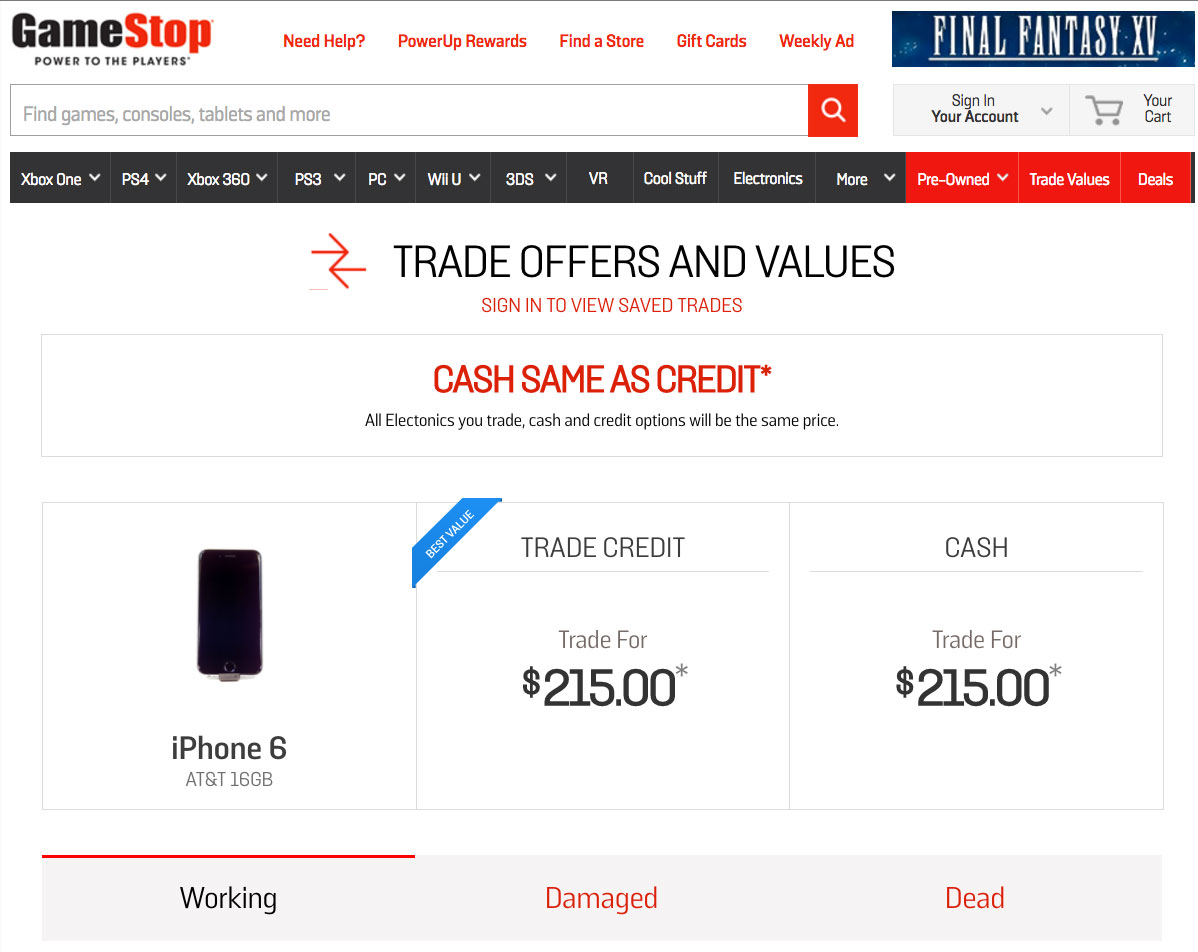
GameStop takes a different approach than other resellers because of its focus on games. While some resellers offer a mix of cash and credit, GameStop customers may be more inclined to trade in their phones for store credit in games, VR headsets and gaming systems, in addition to the refurbished iPhones and Samsung Galaxy models available on the GameStop site. The transaction is straightforward except for one thing: The final turnover of your phone for cash or gift cards must be done in person.
The website offers a list of the phone types GameStop accepts for trade. A working iPhone 6 Plus that has no missing parts, cracks or dents will trade or get cash totaling $240. That’s a little more than 52 percent of the $459.99 we had paid GameStop for the same phone the previous month. A damaged phone will trade for $95, while a dead phone gets $25.
My trade-in experience took just 15 minutes, as the pleasant and efficient clerk behind the counter tested the phone and looked up records. I walked out with a $240 gift card.
GameStop lets you search for stores within a 15-mile radius of your zip code. If there’s no retail outlet near you, you’ll want to turn to a different reseller.
Walmart
What we bought: Space Gray iPhone 6 (Straight Talk)
What we paid: $369
What we got back: $125
Rate of return: 34 percent
Cash or credit: Credit
Pros: Simple transaction requiring little information; Free shipping label supplied.
Cons: Very low return on resales; Limited to in-store credit.

You’ll find plenty of phones available for sale at Walmart, including contract, unlocked and refurbished phones available for the major carriers as well as the retailer’s in-house Straight Talk network. What you won’t find is the option to get cash back for your phone. It’s store credit and no negotiating.
It’s easy enough to go through the process, using the Gadgets for Gift Cards link. The used iPhone 6 we bought from Walmart netted a $125 offer, 34 percent of what we paid, which was the lowest return from any reseller. Interestingly, the phone was tied to Straight Talk. Had we tried selling back an unlocked phone or one tied to AT&T or Verizon, Walmart would have given us $160 in credit.
Once you approve Walmart’s appraisal, just log in to your account or create a new account with your email and mailing address. Walmart offers a printed label that you can use to pack up your phone and send it in. After that, just wait for your gift card to arrive via email, which it did within three days of receiving my phone.
Best Buy
What we bought: Space Gray iPhone 6 (AT&T)
What we paid: $599.99
What we got back: $208
Rate of return: 35 percent
Cash or credit: Gift Card
Pros: Trade-in process is simple, if you have no questions; Trade-ins at the store are handled efficiently by friendly staff.
Cons: Long wait times for answering questions on Best Buy’s 800-number; Low rate of return.

Best Buy has a busy website that features a vast variety of iPhones and flavors of Android phones for sale. But it’s still fairly easy to find the place to trade in your older iPhone. If you do, be prepared to accept payment in credit. Like Walmart and Amazon, Best Buy doesn’t deal in cash for phone trade-ins.
We paid $599.99 for an iPhone 6 that arrived in a sealed box (for an iPhone 6s oddly) but with no earbuds included, the only used phone we bought that was missing an item. That didn’t affect my trade-in price; when I turned in my iPhone for resale, the Best Buy clerk said I didn’t need to include accessories. But Best Buy’s offer was the second-lowest return from any reseller: just a $208 gift card, or 35 percent of what we paid for the iPhone.
MORE: Best Cellphone Plans for Your Money
Getting a quote from Best Buy’s website is simple enough. All I had to do was list the phone’s color, carrier and condition to get a trade-in value that I could redeem in person or by mail. Getting answers to questions proved more difficult. I called Best Buy’s toll-free number to ask about the missing earbuds and an issue with the phone’s IMEI number, and waited 20 minutes and through three transfers before I was told it would be a better idea to do my trade-in at a store. That took a much more efficient 15 minutes.
Other options
You don’t necessarily need to go through a reseller or e-commerce marketplace to unload your aging iPhone. Certainly, Craigslist offers the opportunity to find a willing buyer, and depending on your negotiating skills, you may be able to get a bigger return than you would from a reseller who’s going to offer you a set price.

That said, handling a sale on your own can be a hassle, and there’s always the risk of running into scammers. A reseller or reputable marketplace removes a lot of the headaches and potential risks.
If you’re planning on using the money you get from trading in your phone to finance the purchase of a new phone and you’re committed to a specific wireless carrier, you may want to see what that carrier will offer you for your old phone. Verizon offered us the best quote on an iPhone 6, with a $265 trade-in value. AT&T quoted us a price of $200 for a 16GB iPhone 6, while T-Mobile and Sprint offered $191 and $159, respectively. Those quotes assume a phone is in excellent condition, and the amounts can vary based on which carrier your old phone is tied to. You receive the trade-in value in the form of credit or a gift card.
Where to buy a used phone
Our testing of reseller services focused primarily on selling a used iPhone, because that’s where you’re likely to experience the greatest amount of variance, from the money you get back for your phone to the simplicity of the resale process. In contrast, shopping for a used iPhone from these sites is a pretty similar experience, though there are a few differences worth noting.

In terms of selection, you’ll generally find each service offers a wide degree of smartphone models and capacities. In our search for a used iPhone 6, we found that models tied to AT&T and Verizon were plentiful while T-Mobile and Sprint devices were in shorter supply. Amazon, Glyde and Swappa offered the widest range of phones in terms of carriers and capacities.
Used iPhone shoppers will find the best range of prices at Swappa, though lower-priced phones are likely to have been well-used. Glyde, Gazelle, GameStop and Amazon also offer attractive pricing on used phones depending on what model you’re looking for.
We found it easiest to shop for a used iPhone at Glyde and Swappa, which conveniently group iPhone models together, allowing you to drill down to the version you want. Despite its wide selection, Amazon offers very cluttered search results; type in iPhone 6, and you’re just as likely to get entries for the 6s, 6s Plus and 6 Plus as you are for the model you want. Walmart and Best Buy feature helpful filters for removing superfluous search results.
We should note that we ran into one quirk when buying our phones from Glyde and GameStop, though that’s likely a result of how we ordered our iPhones. Because we bought our phones through our corporate office and shipped them to an editor at another location, both Glyde and GameStop flagged our initial purchases, requiring us to set up a PayPal account to complete the deals. Most shoppers won’t run into that problem, though it could flare up if you’re buying a used phone as a gift for someone who has a different address than yours.
More from Tom’s Guide:
- Walmart, Best Buy Offer Worst iPhone Trade-in Deals
- The Best and Worst iPhone Trade-In Deals
- iPhone 7 vs iPhone 7 Plus: What Should You Buy?
- Why You Shouldn’t Get the iPhone 7
- iPhone 7 Camera Tech: Can Apple Be the Best Again?
 AIVAnet