


Teardown of New Mac Pro Reveals Surprising Amount of Accessibility, Circular Daugtherboard
iFixit has performed another one of its traditional high-quality teardowns on the new 2013 Mac Pro, revealing a host of very powerful components and a design that allows the computer to be surprisingly accessible and repairable.

The new Mac Pro includes a rear lock switch that allows the device’s cylindrical casing to be removed with ease, allowing the user to easily access and replace components such as memory modules, SSD drives, and more. A teardown performed by Other World Computing (OWC) earlier this week also revealed that the Mac Pro includes a removable CPU, which may be useful to users who want to upgrade their machines in the future. Non-proprietary Torx screws are also found throughout some parts of the machine as well, which makes for easier repair.

Another internal to note in the Mac Pro is its power supply, which appears to be located in between the I/O panel and the logic board. The power supply itself appears to be rated at 450 Watts, and relies solely on Apple’s highly touted single fan cooling system in the Mac Pro to keep a low temperature. This, in unison with the triangular heat sink that cools the graphics card and GPU, allows the Mac Pro to idle at a quiet 12 dBA.

Furthermore, the logic board, dual graphics cards, and I/O port board found on the machine appear to connect to a single daughterboard, or interconnect board, found at the base of the machine. However, unlike the other parts of the computer, the daughterboard appears to use a tight cable routing system and various new proprietary connectors.
As is tradition for iFixit’s teardowns, the company has assigned a repairability score to the 2013 Mac Pro based on the accessibility of the various components. While iFixit disliked the inability to add additional internal storage and the tight cable routing system in some places, the new Mac Pro’s repairability scored a high 8 out of 10, with the firm crediting the computer for having non-proprietary Torx screws, an easily accessible case, and a user replaceable CPU.
     |

The year in reviews: 2013’s best and worst gadgets scored and scrutinized

Fun fact: Engadget reviewed 176 products in 2013, and that’s not even counting the umpteen times we got hands-on with stuff at tradeshows and press events.
In general, we try to review just the top-tier gadgets, but even then, some of it ends up being forgettable. (Can you name-check everything we tested from memory? We can’t.) So, as the year draws to a close, we’re taking a look back at the last 12 months of reviews, and this time, we’re including only the products you’d have no trouble remembering. Across every category, we’ve noted the flagships everyone coveted — along with the duds that could’ve been so much better. Oh, and you might notice that we included some numbered scores throughout. That’s right; Engadget is bringing back numerical ratings, and they’ll follow the same format as the critic score gdgt has already been using for years. Which is to say, each rating takes into account various criteria for a given product category — things like battery life and portability. Wanna see how your favorite gadgets did? Meet us after the break for a walk down memory lane.
E-Readers
Amazon Kindle Paperwhite (2013)

Engadget Score: 93
The “all-new” Paperwhite doesn’t really offer anything all that different from last year’s edition, but an improved frontlight and some software tweaks have made an already great reading experience even better. Unless Goodreads is a must-have app for you, it’s a tempting, but largely unnecessary upgrade if you already own last year’s version.
Kobo Aura HD

Engadget Score: 83
The Aura HD is packed with features specifically aimed at the power reader, including best-in-class specs like a 6.8-inch display with blisteringly sharp text and a robust 4GB of internal storage space. Unfortunately, its niche status is further cemented by a high price and a hard-to-hold form factor that escapes easily from those with sweaty hands.
Barnes & Noble Nook GlowLight

Engadget Score: 73
Barnes & Noble giveth and taketh away with the Nook GlowLight. Sure, it’s the best Nook so far, with a better display, improved frontlight and a lighter form factor. But, all those improvements come at the cost of features like the microSD slot, physical page turn buttons and the contoured back, which all served to distinguish the line from its competition.
Gaming
Sony PlayStation 4

Engadget Score: 83
It doesn’t look like a PC, but underneath the PlayStation 4′s sleek black exterior is a powerhouse that rivals gaming PCs, with a user-friendly interface, a great controller and the ability to share your gameplay at the touch of a button. The next generation of consoles might just be getting started, but it’s one hell of a start with the PS4 at the head of the pack.
Microsoft Xbox One

Engadget Score: 81
The Xbox One may not be the prettiest belle at the next-generation ball, but with the wonders of Kinect voice control, robust media features and the ease of switching between games and apps at the drop of a hat, it certainly is vying to be the center of attention. It just needs a few more exclusives to get consumers to look past that $500 price tag.
OUYA console

Engadget Score: 66
The initial backer editions of the OUYA shipped with a flawed controller and access to a limited games selection. But even after the retail release, the OUYA’s still a system best left to hackers and developers, as it’s likely to leave most gamers disappointed by its average smartphone-level internals and rehashed games library.
NVIDIA Shield

Engadget Score: 83
The NVIDIA Shield wants to be the Swiss Army knife of hand-held game consoles, and it largely succeeds as a product — but not as a handheld. Its size and weight mean you won’t be carrying it around much, but the larger screen, great battery life and the ability to stream PC games to the Shield mean you’ll still get a lot of use out of it.
Home Entertainment
Google Chromecast

Engadget Score: 84
The Chromecast might not be as fully featured as competitors like Roku or Apple TV, but you know what? It doesn’t matter. This palm-sized dongle is easy to set up and turns any modern set into a smart TV, all for the low, low price of $35. Its app selection is still experiencing some growing pains, but even now, you’re still getting more than your money’s worth.
Roku 3

Engadget Score: 89
The newest Roku doesn’t have analog AV support like its predecessors, but it does offer incredible ease of use and a wide selection of channels, all for a nice price of $99. Even users of older Roku boxes should look into the Roku 3, whose upgraded CPU and improved UI help future-proof against new, more demanding apps.
Laptops and Hybrids
Microsoft Surface Pro 2

Engadget Score: 77
The Surface Pro 2 retains its predecessor’s durable body, but it’s equipped with a Haswell processor, boasts faster performance and has longer battery life. Microsoft has yet to find the perfect balance for a hybrid device, though — its weight and thickness make it a better notebook than a tablet, so you may want to look elsewhere for an everyday slate.
Apple MacBook Pro with Retina display

Engadget Score: 90
With a starting price that’s $400 less than the 2012 model, the new MacBook Pro with Retina display is a much better deal. In addition to its speedier SSD and better graphics, its epic battery life and thinner, lighter body might make you reconsider if you’ve been in the market for the slightly wispier MacBook Air.
Google Chromebook Pixel

Engadget Score: 79
Google infused the Chromebook Pixel with sophisticated looks and high-end specs, including a 2,560 x 1,700 touchscreen display and LTE connectivity. Even so, its $1,299 price tag might not be worth it unless you’re always connected to the web — hard to do with its poor battery life — and plan on storing huge files in the cloud.
Smartphones
MOTOROLA MOTO X

Engadget Score: 88
The Moto X doesn’t have the specs to compete with heavyweights like the Galaxy S 4 and the HTC One, especially at the same price. But, with user-friendly enhancements to the UI and the magic of customization with Moto Maker — now available for all major carriers — this truly is a phone for the people.
Apple iPhone 5s

Engadget Score: 92
Apple continues to improve on the iPhone line with the 5s, and while the phone maintains the same body as its predecessor, it packs in enough upgrades to appeal to hardcore and casual users of iOS alike. However, even with future-proofing measures like 64-bit support and the M7 coprocessor on board, only the most forward-looking Android power users will find incentive to switch.
HTC One

Engadget Score: 92
The HTC One is a top-shelf smartphone, boasting a unibody aluminum shell, a gorgeous display and a fast Snapdragon 600 processor that runs buttery smooth. The Sense 5 UI didn’t thrill us, but a solid battery and excellent call quality, among other things, made this one of the best phones to buy this year.
Samsung Galaxy S 4

Engadget Score: 88
With a familiar chassis and some impractical features, Samsung’s newest flagship isn’t exactly turning heads. Market-topping specs and minimal learning curve make this worth considering if you’re due for an upgrade from an older Samsung device, but anyone looking for something fresh would be better served by the more polished HTC One.
LG G2

Engadget Score: 87
With its bright 5.2-inch screen and phenomenal battery life, the G2 is a great phone for taking photos, watching videos or just general everyday, all-day usage. That is, if you can get used to its other standout feature — all three of its buttons are on the back, better to make room for the gorgeous screen, but not so friendly to those who like to hold their handset in a death grip.
LG Nexus 5

Engadget Score: 86
Not only is the Nexus 5 gifted with a great 1080p display and a fast quad-core processor, but it also heralds the release of a leaner and meaner iteration of Android, 4.4 KitKat. Take all that and offer it to consumers at an outstanding off-contract price of $349, and the Nexus 5 not only succeeds, but also puts rival handsets on notice to deliver more bang for your buck.
Samsung Galaxy Note 3

Engadget Score: 87
Those with small hands still need not apply, but for the third iteration of the Galaxy Note, Samsung has packed in a robust processor, a solid battery and even more useful S Pen features. The display has also gotten bigger and better, though those who want to watch videos on this thing shouldn’t depend on the built-in speakers.
BlackBerry Z30

Engadget Score: 62
The Z30 was supposed to be the phone that would make BlackBerry relevant again. And while the comfortable hold and large screen will more than please the BlackBerry faithful, an average battery, poor call quality and crash-prone software mean few, if any, will be making the switch from Android or iOS anytime soon.
LG G Flex

Engadget Score: 83
The G Flex’s top-to-bottom curve means it’s very comfortable next to your head, but not so much in your pocket. That curve comes with a chassis designed to be pretty durable, with a flexible body and screen, and a self-healing back that resists scratches. Does it work? Somewhat. Is it worth the $900 price tag? Not really.
Tablets
Google Nexus 7

Engadget Score: 90
The price may be (slightly) higher on our returning favorite tablet, but the Nexus 7 is still an obscene value. That this year’s model got a noticeable boost everywhere it counts and sells for significantly less than a comparable iPad mini is nothing short of impressive — even though Apple’s tablets still have more apps designed for bigger screens.
Amazon Kindle Fire HDX

Engadget Score: 85
The Kindle Fire HDX may be the most compelling case yet for Amazon’s tablet ecosystem. Advanced users might scoff at the device’s somewhat limited capabilities, but the display’s gorgeous color accuracy could make Bezos’ Prime directive an easy sell for just about everyone else.
Apple iPad mini

Engadget Score: 92
The iPad mini is an inexpensive way to join Apple’s tablet family, but it remains more costly than its similarly sized competition. Besides the striking Retina display, what makes the minuscule iPad so attractive this year is it’s essentially a shrunken-down version of its powerful bigger sibling. Very few sacrifices were made to accommodate the smaller stature — something the competition can’t quite claim.
Apple iPad Air

Engadget Score: 92
Tablets went mainstream thanks to the original iPad, but thanks to economies of scale and Moore’s Law, the competition’s become rather fierce — maybe unexpectedly, from Cupertino itself. The iPad Air is the best Apple tablet we’ve reviewed, but it could be hard to justify when the iPad mini now offers nearly the same experience — Retina display, similar styling, A7 64-bit processor — for less.
Microsoft Surface 2

Engadget Score: 78
If the Surface 2 existed in a world where only hardware mattered, its brawny battery and rock-solid construction might put it at the head of the tablet pack. In reality, though, Microsoft’s slate is hamstrung by the shortcomings of its OS, Windows RT, and its inability to run traditional desktop apps.
Galaxy Tab 3 10.1

Engadget Score: 65
We’re not entirely sure what Samsung’s game is with the Galaxy Tab 3 10.1. It hasn’t changed much in terms of specs from the GTab 2, packs a subpar display and severely lacks in features and power compared to the company’s line of Galaxy smartphones. Most damning? The $300 asking price.
Wearables
Samsung Galaxy Gear

Engadget Score: 65
It’s hard to justify paying $300 for the Galaxy Gear when it feels like an incomplete product and is only compatible with a handful of Samsung devices. Still, it stands out as one of the most feature-rich smartwatches we’ve tried, and as the company issues software patches and the app catalog grows, it could become better in time.
Google Glass

Engadget Score: Not Yet Scored
We’ve yet to see a consumer-facing Google Glass, but suffice to say the current version’s more of a research project — definitely not worth its $1,500 price tag for most folks. Mountain View still has to polish its features, address privacy concerns and entice developers before it hits the market. Until then, current Explorers will just have to deal with lots of confused stares when they wear it outside.
Sony SmartWatch 2

Engadget Score: 71
Unlike the Galaxy Gear, you can tell time on Sony’s SmartWatch 2 without having to interact with the screen, and it even costs $100 less. Unfortunately, few will be able to stand its buggy software and limited app selection. But, hey, at least it’s compatible with most handsets running Android 4.0 or higher.
Pebble

Engadget Score: 80
Pebble doesn’t have as many features as other smartwatches: It can only read texts, skip music tracks and tell time. Unlike its competitors, though, it costs a more reasonable $150 and offers both great battery life and an e-ink display that’s easy to read in daylight. As an added bonus, it also works with both Android and iOS devices.
Mariella Moon, Timothy J. Seppala, Kris Naudus and Dana Wollman contributed to this feature.
Filed under: Cellphones, Gaming, Laptops, Tablets, Wearables, HD, Mobile, Apple, Samsung, Sony, Microsoft, HTC, Google, Amazon, LG, NVIDIA
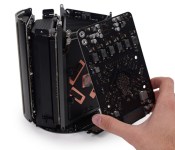
Mac Pro teardown reveals simple repair process and upgradeable CPU

The new Mac Pro’s highly customized design may look like it’s a pain to fix, but don’t be fooled — it’s friendlier than you think. An iFixit teardown of the workstation has revealed that it’s easy to take apart, and that several components can be replaced without going through Apple. It’s also more upgradeable than you’d expect. iFixit has confirmed OWC’s discovery that the Xeon processor is replaceable, saving buyers over $1,000 if they splurge on a 12-core chip. Other findings? The PCI Express-based SSD looks very familiar, and the entire system is very power efficient; despite the high-end CPU and dual graphics cards, the Mac Pro only needs a 450W power supply. No one will mistake Apple’s machine for an easily expandable gaming rig, but it’s clearly built with serviceability in mind.
Source: iFixit
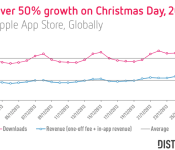
App Store Downloads and Revenue Surpasses 50% Growth on Christmas Day 2013 [iOS Blog]
According to a new report from App Store analytics firm Distimo (via The Next Web), Apple’s App Store once again experienced a great spike in interest on Christmas day, with revenue increasing by 56 percent and the number of total downloads rising by 53 percent.
The firm tied the increase in downloads and revenue to interest from Western countries on Christmas day, and also credits developers such as Rovio Entertainment and ZeptoLab strategically releasing their titles just before Christmas to maximize product interest and profit potential.

Main contributors to this year’s Christmas spike were Western countries. For example: download volume in the United Kingdom increased by 161 percent on Christmas day. In addition, revenues in United States almost doubled with a plus of 97 percent in the Apple App Store. In the large Asian app markets like Japan and Korea this trend was hardly visible.
However, while the figures show strong App Store numbers on Christmas day this year, the report also notes that the percentages in 2013 are lower compared to the past two years. On Christmas day 2011, Distimo stated that there was a threefold growth in download volume compared to an average day in December, which was followed by near double download growth a year later.
Other notable Christmas 2013 findings from the firm include data showing that the increase in paid downloads was greater than that of free downloads, and that the growth of revenue from in-app purchases was less than that of the growth in revenue from apps charging a one-time fee.
| |
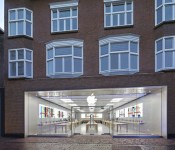
Recently Opened Dutch Apple Store in Haarlem Hit by Smash-and-Grab Robbers [Mac Blog]
The recently opened Apple Retail Store located in the Netherlandic city of Haarlem was the site of a smash-and-grab robbery last night, reports Dutch news website NU.nl [Google Translate].
People living in the area of the store claimed to hear a loud bang in the middle of the night, which likely represented the sound of a car hitting the front of the Apple Store. The car used to ram the Apple Store was reportedly left behind as the thieves allegedly used two scooters to escape the crime scene.

Dutch Police are actively investigating the crime scene as the store remains closed to the public, but also states that only a small amount of merchandise was stolen. Employees at the retail location will also not be permitted to identify what was stolen until police complete their analysis of the crime scene.
With Apple gadgets fetching a high price on the secondary market, thefts of individual devices in muggings are common. However, organized robberies on Apple Retail Stores are mostly uncommon.
The Haarlem Apple Store opened on December 7 and is located roughly 20km from Apple’s existing Amsterdam store. The incident also follows another smash-and-grab robbery committed at an Apple Retail Store located in Kurfürstendamm, Berlin in which thieves crashed an Opel Corsa supermini automobile into the store and proceeded to steal display iPhones, iPads, and computers before fleeing in two Audis. 
| |

2008 NSA program to hack and remote control iPhones detailed (video)

Part of security expert Jacob Appelbaum’s Chaos Communications Congress presentation exposed NSA methods to hack systems via WiFi from long range, but we’ll also point out another segment focusing on the Apple iPhone (embedded after the break, beginning at 44:30). Along with German news mag Der Spiegel, he mentioned a program called DROPOUTJEEP which developed malware to install on iPhones that can remotely access files on the devices including email, voicemails and SMS, or perform geolocation, hot mic, camera capture and more.
While the documents dated to 2008, around the introduction of the iPhone, Appelbaum quoted the NSA QUANTUMTHEORY “toolbox” which claimed a 100 percent success rate at implanting this spyware. At the time, loading the tool required physical access to a phone but the team was already working on something it could load remotely. Details on more recently developed attacks don’t seem to be part of the package, but another Der Spiegel report back in September mentioned an example of a target captured on camera via his iPhone as in 2012. Does this news have you looking for a way around prying eyes? Good luck, since other revelations have shown programs targeting Android devices as well as Blackberry’s email servers and phones.
Here is a link to a video of my #NSA and #GCHQ focused #ccc #30c3 talk: To Protect And Infect, Part 2: https://t.co/ox5Ht3LwTP
– Jacob Appelbaum (@ioerror) December 30, 2013
Filed under: Cellphones, Software, Mobile, Apple
Via: Forbes, The Daily Dot
Source: Albert Veli (YouTube), Der Spiegel
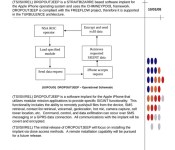
NSA Was Able to Capture Live Data From Compromised iPhones in 2008, Including Live Camera, GPS, and More
The U.S. National Security Agency could retrieve a vast array of data from compromised iPhones according to an NSA document from 2008 leaked by German magazine Der Spiegel and security researcher Jacob Applebaum. (via Forbes)
According to the report, the NSA could install special software onto iPhones as part of a program called DROPOUTJEEP, that provides significant access to user data and other relevant information.
DROPOUTJEEP is a software implant for the Apple iPhone that utilizes modular mission applications to provide specific SIGINT functionality. This functionality includes the ability to remotely push/pull files from the device. SMS retrieval, contact list retrieval, voicemail, geolocation, hot mic, camera capture, cell tower location, etc. Command, control and data exfiltration can occur over SMS messaging or a GPRS data connection. All communications with the implant will be covert and encrypted

The NSA in 2008 claimed a 100 percent success rate in installing the software on phones it had physical access to, and it’s possible that the spy agency has improved its software so it can be installed remotely or via some sort of social engineering, something that was specifically mentioned in the documents. It’s also possible that Apple has closed the security holes the NSA was using, making it more difficult to compromise iOS devices in this manner.
A separate report says that American spy agencies have intercepted shipping packages — something the NSA calls method interdiction — containing new electronic devices destined for specific targets, installed special spy software on those devices, and then sent them on their way. One report calls the shipping disruptions some of the “most productive operations” conducted by the NSA.
Applebaum said in a talk at the Chaos Communication Congress this weekend that he does not believe that Apple assisted the NSA in its spying efforts, but that the NSA has targeted and cracked a number of different smartphones including those running the Android and BlackBerry operating systems.
Earlier in December, Apple CEO Tim Cook and more than a dozen other tech executives met with President Obama to discuss NSA surveillance tactics, following an open letter that Apple and seven other technology companies sent to the President and Congress asking the Government to reform its surveillance tactics.
Note: Due to the political nature of the discussion regarding this topic, the comment thread is located in our Politics, Religion, Social Issues forum. All MacRumors forum members and site visitors are welcome to read and follow the thread, but posting is limited to forum members with at least 100 posts.
| |
Apple’s App Store Usage Numbers Peg iOS 7 Adoption at 78% [iOS Blog]
After three-and-a-half months on the market, iOS 7 is installed on some 78 percent of devices connecting to the App Store, according to the latest numbers posted on Apple’s App Store support page for developers.
The company puts iOS 6 adoption at 18 percent, and older OS versions at 4 percent. The data from Apple is likely the most accurate adoption data we will see and is the most relevant for developers as its taken directly from the App Store.
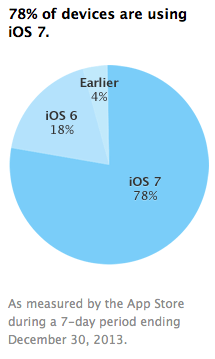
Earlier in December, Apple reported iOS 7 adoption at 74 percent.
| |

Fitbit App Update Adds ‘MobileTrack’ With M7 Coprocessor Support [iOS Blog]
 Fitbit, the fitness company behind the Fitbit line of wearable activity tracking devices, today updated its Fitbit iPhone app with a new “MobileTrack” feature, which is designed to offer iPhone 5s users standard Fitbit activity tracking without the need for one of the company’s fitness bands.
To track movement and activity, the revamped Fitbit app uses Apple’s “M7” motion coprocessor. First introduced with the iPhone 5s, the M7 chip accompanies Apple’s standard A7 processor and captures motion data from the phone’s compass, accelerometer, and gyroscope, facilitating the continued capture of movement without significant battery drain.
With MobileTrack, the Fitbit app is able to track steps, distance traveled, and calories burned. Fitbit’s physical offerings, including its newest Fitbit Force band, track those standard metrics along with active minutes, sleep, and stairs climbed.
Along with MobileTrack, the newly updated Fitbit app also includes redesigned alarm settings, custom water goals, and several other design enhancements.
– The Fitbit app now features MobileTrack which offers basic Fitbit activity tracking directly using your iPhone 5s.
– Redesigned Silent Alarms settings. Set, switch, edit, and remove alarms faster than ever.
– Set your own custom water goal.
– Redesigned profile editor.
– Redesigned tracker settings.
– Redesigned sign-up and sign-in.
– Tap on people in Friend Finder to see their profile.
– Swipe on friends on your leaderboard to Cheer, Taunt, or Message.
– Tap on tabs to auto-scroll to the top.
Earlier this year, Fitbit competitor Nike introduced a similar app, called Nike+ Move, which is also designed to track physical activity. Several other apps have also been engineered to use the M7 coprocessor for measuring movement.
Fitbit can be downloaded from the App Store for free. [Direct Link]
| |
Chromebooks overtake Android tablets and Macs in US business sales

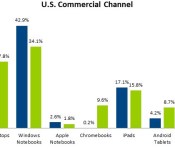
Chrome OS is at last gaining some momentum — among US businesses and schools, anyway. The NPD Group reports that Chromebooks represented 9.6 percent of all computing devices sold through American commercial channels in 2013, or enough to surpass the market share of Android tablets, Windows tablets and MacBooks. Google’s rise put the squeeze on traditional computers, which dropped from 77.8 percent of the commercial space to 63.7 percent this year. NPD researchers don’t believe that the PC is going away, but they note that the most successful companies diversified their gadget lineups. Samsung’s combo of Android and Chromebooks helped it jump to 10 percent share of commercial sales in 2013, while PC-focused builders like HP took a bruising; it’s clear that one-trick ponies won’t thrive in the workplace for much longer.

Filed under: Laptops, Tablets, Mobile, Apple, Samsung, Microsoft, Google
Via: Electronista
Source: NPD Group


