


Early ‘iWatch’ Production Seeing Poor Yields Due to Issues with Body Finish Treatments?
While Apple’s long-rumored “iWatch” may be one of the products to look for in 2014, several rumors have suggested that the device is unlikely to launch until the latter half of the year as the company works to address technical challenges.
A new report from DigiTimes claims that one of those issues involves surface finish treatments for the body of the device, with both Apple and Qualcomm searching for ways to improve the look of chassis parts made using metal injection molding (MIM) methods.
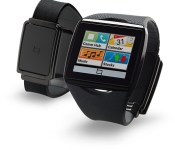
Several wearable devices such as Apple’s iWatch and Qualcomm’s Toq are reportedly seeing less than 50% yield rates due to difficulties applying surface treatments on their metal injection molded (MIM) chassis, according to sources from the upstream supply chain. […]
MIM-made components used to be used inside products, but as the components are now becoming part of the external design, surface treatments have become an important process for the look of products.
 Qualcomm’s Toq smart watch
Metal injection molding may sound very similar to what Apple is trying to achieve with Liquidmetal alloys, but there are distinct differences between the technologies, with MIM involving powdered metals that are combined with binder materials and placed into molds before being heated to very high temperatures to solidify while Liquidmetal alloys are heated to a molten state before being formed using molds and allowed to cool.
Liquidmetal Technologies argues that its alloys and processes offer significant advantages over MIM, including greater precision in molding shapes while offering higher strength, hardness, elasticity, and corrosion resistance than with typical metals. But while MIM is an established production process, Liquidmetal technology remains under development and its inventors have indicated that it will still be several years before it it can be used to produce major parts for Apple’s products.
     |
Switched On: The 2013 Switchies, Part Two
Each week Ross Rubin contributes Switched On, a column about consumer technology.

The last Switched On introduced the 2013 Switchie Awards for TV, PC and gaming products. This time, we’ll take a look at the mobile and wearable devices that made their mark in 2013.
The “Great Slate” Award for Best New Large Tablet (nine inches or larger) goes to the iPad Air. As competitors add all manner of keyboards and other accoutrements to differentiate their slates, Apple embraced the minimalism for which it is known with the iPad Air. Is it a content-creation tool? For certain kinds of content, yes. But the Air refines the essence of a pure tablet experience. Honorable Mention goes to the budget-friendly, kickstand-equipped Lenovo Yoga Tablet 10; Lenovo also snagged an Honorable Mention in the convertibles category with the Yoga 11 last year.
The “Great Slate, Smaller Plate” Award for Best New Small Tablet (8.9 inches or smaller) goes to the Amazon Kindle Fire HDX. Amazon paved the way in budget tablets, but the Kindle Fire line always matched its excellent content offerings with solid, if uninspired hardware. That has changed with the Kindle Fire HDX, which brings the online store’s strongest content package inside a speedy shell matched with a useful cover stand in the Origami case. Like the Kindle Fire HDX, the iPad mini, an Honorable Mention winner, emerged from the larger iPad’s shadow. This year, the iPad mini went from being the poorer, smaller version of its larger sibling to a powerful, if pricey, equal that trades screen size for portability.
The “Make the Call” Award for Best New Smartphone goes to the HTC One. While its features and hardware may no longer be state of the art, the One’s exquisite design turned enough heads that Google saw demand to make a pure Google version of it. Honorable Mentions go to the Moto X and LG G2 for, among other things, their clever use of sensors, and the Nokia Lumia 1520 for offering the strongest imaging experience in a 6-inch (or greater) device.
The “Make the Big Call” Award for Best New Large Smartphone (six-plus inches) goes to the Sony Xperia Z Ultra. This grip-busting, 6.4-inch, water-resistant giant among giants includes a scratchproof display and great imaging. Honorable Mention goes to the Nokia Lumia 1520 for refining the strong imaging capabilities of the Lumia 1020 in a large phone.
The “Fun on the Run” Award for Best New Mobile Product goes to the NVIDIA Shield. Enabling consumption of both souped-up Android and PC games (with some serious caveats), the Shield presents a new spin on hand-held gaming on the go or at home.
The “Ready to Pair” Award for Best New Wearables goes to the Fitbit Force. Fitbit has encountered growing competition in both the waist clip and wristband spaces. The Fitbit Force improves upon the earlier Fitbit Flex by adding a small OLED with engaging animations. Honorable Mention for this prize goes to the Pebble smartwatch, which should become more useful in 2014 due to the availability of more apps.
The “Seeing is Believing” Award for Best New Display goes to the Garmin HUD. As car navigation shifts away from dedicated devices, Garmin is catering to smartphones — at least those running its navigation apps — with one of the first heads-up displays available for less than $120. That’s a small price to pay for less clutter and a taste of the future.
The “By Any Other Name” Award for Best Pun in a Product Name goes to Porkfolio. Crowdsourced (but not crowdfunded) product-development company Quirky partnered with GE to release devices ranging from a remotely controllable version of its signature snaking Power Pivot power strip to a dubious connected egg-age tracker for your refrigerator. Somewhere between the two was an app-connected piggy bank, dubbed Porkfolio, that counts coins and alerts you when it’s jostled. Unlike the traditional piggy bank, the porcine coin container is posed lying on its back with its stomach up — a supine (or perhaps “pork-upine”) orientation.
Ross Rubin is principal analyst at Reticle Research, a research and advisory firm focusing on consumer technology adoption. He shares commentary at Techspressive and on Twitter at @rossrubin.
Filed under: Cellphones, Misc, Gaming, Tablets, Wearables, Apple, HTC, Amazon
‘Lucky Bags’ Go on Sale at Japanese Apple Stores, Big-Ticket Items Included
Apple Stores across Japan have today begun selling different configurations of the Fukubukro, or “lucky bag”, giving customers the chance to purchase a random assortment of products sold at a steep discount, reports Japanese blog Mac Otakara [Google Translate].
This year’s lucky bags, which sell for 36,000 yen, or $345, come in four different configurations with certain items appearing in every bag, including a t-shirt commemorating the event, an Incase City Collection Compact Backpack in a special red color, and a Mophie Juice Pack PowerStation Mini with a design to match the grab bag.
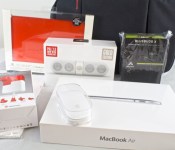
 MacBook Air Lucky Bag (Source: App Bank, Google Translate)
Different items between the bundles however differ greatly, with one configuration of the bag offering a 11-inch MacBook Air with a Power Support Air Jacket, an Apple Magic Mouse, and a Beats by Dre Pill Bluetooth speaker, and another variant of the bag offering a Wi-Fi only iPad Air with Smart Cover, Nike+ FuelBand SE, Phillips Hue Starter Kit, and Square Reader.
 iPad Nano Lucky Bag (Source: App Bank, Google Translate)
The other two versions of the lucky bags are highlighted by the inclusion of either a non-Retina iPad Mini or 7th generation iPad nano, with items such as the Jaybirds BlueBuds X Bluetooth headphones, the IZON View remote camera, and Logitech’s Ultimate Ears Mobile Boombox appearing among other items as well.
 iPad mini Lucky Bag (Source: Mac Otakara)
Apple’s grab bags are sold as is, and returns are not accepted unless a product is found to be defective. Still, the bags have been quick sellers on previous occasions, with many people lining up the night before to get their hands on a bag.
As with past years, Apple’s Lucky Bag promotion is limited to Japanese customers, though other countries, like China, may see the same traditional Apple Store sales during the new year.
| |
Switched On: The 2013 Switchies, Part One
Each week Ross Rubin contributes Switched On, a column about consumer technology.

It’s that special time of year between holiday sales and the pre-CES hype cycle that presents an opportunity to consider some of the most innovative devices of the year. Switched On is proud to present the 2013 Saluting Wares Improving Technology’s Contribution to Humanity awards, also known as The Switchies.
This installment marks the eighth annual Switchies, which are decided based on a rigorous examination of the opinion of me, and do not reflect the opinion of Engadget or its editors. For that latter honor, nominees will need to win an Engadget Award. Now, then, let’s stroll past the red carpet and tear open those envelopes.
This column will focus on TV, PC and gaming products while the next installment will focus on mobile and wearable devices.
The “Big Screen Scene” Award for Best New Video Device goes to the Google Chromecast. Taking an app-by-app approach, Google’s cheap stream-redirecting HDMI dongle took everyone by pleasant surprise with its small size and ease of use. It also helped Google show the power of bridging the assets of Android and Chrome and built momentum in a frustrating race for the living room. It’s now rapidly adding new content sources.
Honorable Mention for Best New Video Device goes to the Xbox One. Microsoft’s latest home console is not only a powerful game system, but also a living room experience that incorporates many leading-edge technologies, including speech control, gesture control, video chat and an expanding array of over-the-top entertainment. Honorable Mention also goes to the TiVo Roamio Pro, the latest generation of the venerable CableCARD DVR that can support up to six tuners and offers improved streaming and offload to mobile devices.
The “Play’s the Thing” Award for Best New Gaming Device goes to Sony’s PlayStation 4. By casting off much of the corporate baggage of the PlayStation 3, like in-house chips, 3D and expensive novel optical formats, Sony finds itself in the enviable sweet spot of offering top-notch performance without occupying the top end of the market. Sony’s simpler development proposition should also help enable a stronger flow of game titles coming into 2014.
The “Convertible Bonds” Award for Best New Hybrid Computing Device goes to Microsoft’s Surface Pro 2. Still a study in contrasts, the second generation of Microsoft’s Intel-based tablet combines high performance and dramatically improved battery life, but you’ll be spending most of your time in desktop mode to tap its potential. Honorable Mention goes to Nokia’s cellular-equipped, outdoor-optimized, Windows RT-based Lumia 2520 and HP’s Android-based Slatebook x2 “2-in-1″ detachable.
The “Guess We Just Click” Award for Best New Input Peripheral goes to the Leap Motion controller. While we continue to see many companies focus on bringing down the cost of gesture control at the expense of a rich experience, Leap Motion presented a new 10-inch paradigm that won it a partnership with HP. Leap Motion wrests this award from Microsoft, which won it for the past three years.
The “Critical Bits” Award for Best New OS goes to OS X Mavericks. In a year where Apple, Microsoft and Google all unveiled new versions of their operating systems for tablets, Mavericks was left virtually unchallenged to pursue improvements for the desktop paradigm and Apple delivered with better battery life through superior memory management and its best multiple-monitor support yet.
Ross Rubin is principal analyst at Reticle Research, a research and advisory firm focusing on consumer technology adoption. He shares commentary at Techspressive and on Twitter at @rossrubin.
Filed under: Gaming, Home Entertainment, Peripherals, Software, Apple, Sony, Microsoft, Google
Mac Pro/OS X 4K Display Compatibility ‘Like the Wild West’, Some 4K Monitors Unsupported
In its lengthy review of the new Mac Pro, AnandTech discovered that the Mac Pro’s current support for 4K monitors leaves something to be desired. The reviewer connected the Sharp 32″ 4K display that Apple currently offers on the Apple Online Store, expecting that OS X work the same way on that panel as Apple’s current Retina MacBook Pro models do.
On those machines, Apple renders the screen at full resolution but then renders text, menu and UI elements at 4x their normal resolution so they are the appropriate physical size for the user. It also offers multiple options to scale UI elements up or down as the user prefers. Instead, using the Sharp panel with the Mac Pro makes text and other on-screen elements — aside from photos and video — very small and difficult to read.
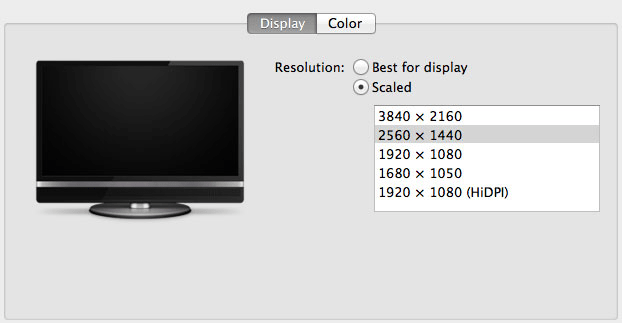
I was fully expecting all of this to be available on the Mac Pro when connected to a 32” 4K display. By default, there’s only a single supported scaled resolution: 2560 x 1440. Unfortunately it doesn’t look like Apple is running the same supersampling routines when you pick this resolution, instead you get a 2560 x 1440 desktop scaled up to 3840 x 2160 (rather than a 5120 x 2880 screen scaled down). The result is a bit of a blurry mess.
You can use tools like SwitchResX (or Quartz Debug or the necessary Terminal command) to enable a 1080p HiDPI mode, but then you end up with insanely low point density of around 68 PPI. Unfortunately it doesn’t appear to be possible to define your own HiDPI modes in OS X, you have to rely on those that Apple officially supports. I tried creating a 5120 x 2880 (2560 x 1440 HiDPI) mode but I couldn’t get it working under Mavericks. I’m not sure if I was limited by the OS or if Sharp’s EDID-specified max resolution of 3840 x 2160 prevented OS X from accepting what I was trying to do.
AnandTech also tried the new Dell UltraSharp 24 Ultra HD display but found that the display is not properly supported by the Mac Pro.
The reviewer calls OS X’s 4K display support “a bit like the wild west at this point”, though he anticipates Apple will fix things with both software updates and its own displays in the future — but urges early adopters to be aware of what they’re getting into.
I am disappointed that Apple didn’t enable any HiDPI modes on the 32” Sharp display. While I found 3840 x 2160 a great resolution for video work, for everything else it made on-screen menus and text a bit too small. I would love to see a 2560 x 1440 HiDPI option (rendering offscreen at 5120 x 2880 and but scaling down to 3840 x 2160 for display) but it looks like I may have to wait for Apple’s own display before I get something like that.
It’s been two years since Apple has updated its standalone display lineup, and the company is expected to come out with new models sooner rather than later. However, there are no concrete rumors suggesting when such an update might happen.
| |

Daily Roundup: NSA iPhone malware, Mac Pro teardown, this year in reviews and more!

You might say the day is never really done in consumer technology news. Your workday, however, hopefully draws to a close at some point. This is the Daily Roundup on Engadget, a quick peek back at the top headlines for the past 24 hours — all handpicked by the editors here at the site. Click on through the break, and enjoy.

The year in reviews
We reviewed more than 170 products in 2013, but rather than leave you to sift through them yourself, we’ve compiled our most memorable reviews into one simple package. Click on through for more details.

Leaked NSA iPhone Hack
Leaked documents dating from 2008 reveal an NSA program called DROPOUTJEEP, which developed iPhone malware that can remotely access files on the devices. Follow the link for the video and more information.

Mac Pro teardown
Apple products aren’t exactly known for their serviceability, but according to iFixit’s latest teardown, repairing the new Mac Pro is a surprisingly straightforward affair. Click through for details on the repairability score.

Google Glass available to All Access subscribers
Are you a Google Play Music All Access subscriber? If so, you now have the option to purchase your own Google Glass headset. Click the link for more information.
Entry-Level Mac Pro Offers Comparable Pricing Versus OEM PCs, DIY Systems More Affordable
Anandtech today published its comprehensive review of the Mac Pro, including a price comparison between the Mac Pro and similar systems from competitors HP and Lenovo.
When comparing the entry-level 3.7GHz quad-core Mac Pro with dual AMD FirePro D300s to both the similarly specced HP Z420 and the Lenovo ThinkStation S30, Anandtech found the Mac Pro to be competitively priced at $3248 (priced with AppleCare) vs. $4490 for the HP and $4373 for the Lenovo.
While there are some important distinctions between the computers, such as the fact that the HP system only offers a single FirePro W7000 and supports more displays, the pricing experiment suggests that Apple’s pricing is in line with other Ivy Bridge EP systems.
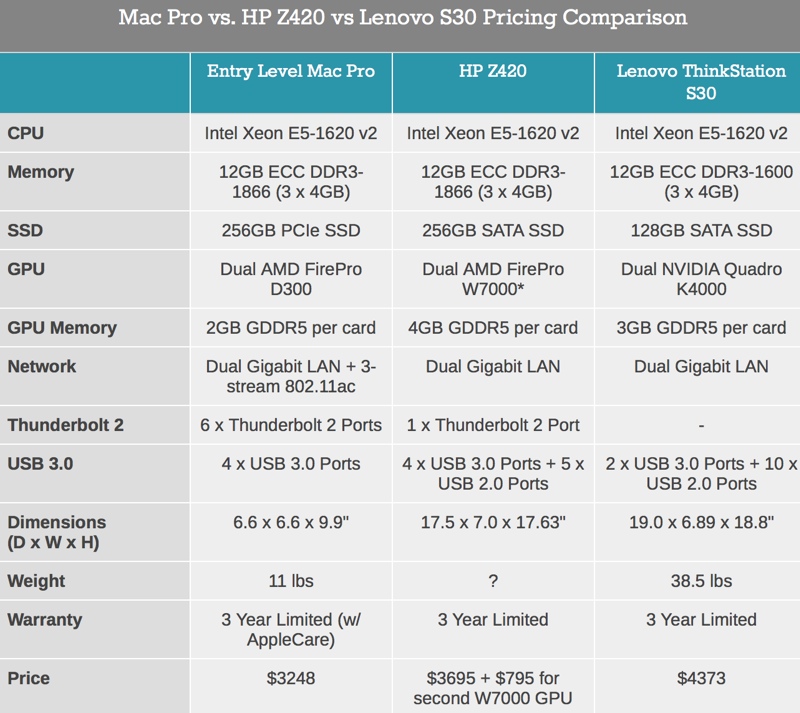
As I learned last time, there are typically some hefty discounts associated with workstation orders so take this pricing with a grain of salt. I also had to fudge the HP numbers a bit as I can only get a single FirePro W7000 in the Z420 configuration – I just doubled the W7000 adder in order to simulate what a theoretical dual GPU version would cost. There are other imbalances between the comparison (HP supports more displays, Apple features more Thunderbolt 2 ports, FirePro W7000 features ECC GDDR5, etc…), but the point here is to see if Apple’s pricing is out of touch with reality. It’s not.
While Apple’s pricing is competitive with similar PCs from HP and Lenovo, AnandTech found that building a comparative PC from individual parts was far less expensive, at least for lower-end systems. Pricing out an option with an Ivy Bridge E Core i7 PC with 12GB of RAM, two FirePro W7000 GPUs, and a fast SATA SSD came to $2730, a good bit less than the approximately $3499 a similar lower-end Mac Pro would cost from Apple.
AnandTech did not price out a higher-end DIY system, but earlier this month, FutureLooks attempted to build a PC equal to the top-of-the-line 12-core Mac Pro with 64GB of RAM, 1TB of flash storage, and Dual AMD FirePro D700 GPUs. Using similar parts (several Mac Pro parts – like the FirePro GPUs – were built exclusively for Apple) a PC equivalent to the high-end Mac Pro was actually priced at $11,530.54, far above Apple’s asking price of $9,599 for its professional workstation.
AnandTech‘s full review, which includes benchmarks comparing the Mac Pro to previous Mac Pros and other offerings from Apple as well as comments on 4K displays, is well worth reading.
| |

Apple claims it ‘has never worked with the NSA’ to create backdoors in any of its products

While it may feel we’re more at the stage where we’re counting the parts of our digital lives that the NSA can’t access, the revelation yesterday that the agency had relatively deep access to iPhones was still a shock to many. Apple included, it seems, prompting it to issue a statement to AllThingsD denying any involvement in the NSA’s program, explaining it has never worked or cooperated with the NSA to create a backdoor on any of its products — though it does comply with official requests. The same statement goes on to claim that it will work to close any vulnerabilities in its software, no matter who it might be that is exploiting them. Apple is far from the first large tech company to have it’s products and services targeted by the NSA, and we suspect it’s only a matter of time before even more come to light. You can read the complete statement passed the break.
Apple has never worked with the NSA to create a backdoor in any of our products, including iPhone. Additionally, we have been unaware of this alleged NSA program targeting our products. We care deeply about our customers’ privacy and security. Our team is continuously working to make our products even more secure, and we make it easy for customers to keep their software up to date with the latest advancements. Whenever we hear about attempts to undermine Apple’s industry-leading security, we thoroughly investigate and take appropriate steps to protect our customers. We will continue to use our resources to stay ahead of malicious hackers and defend our customers from security attacks, regardless of who’s behind them.
Filed under: Cellphones, Mobile
Source: AllThingsD

Apple Denies Knowledge of NSA’s iPhone Spying Program
 Yesterday, it was reported that the National Security Agency was able to capture live data from compromised iPhones including live camera, GPS, cell tower location and more.
Apple has now issued a statement denying that it ever cooperated with the NSA, according to AllThingsD.
Apple has never worked with the NSA to create a backdoor in any of our products, including iPhone. Additionally, we have been unaware of this alleged NSA program targeting our products. We care deeply about our customers’ privacy and security. Our team is continuously working to make our products even more secure, and we make it easy for customers to keep their software up to date with the latest advancements. Whenever we hear about attempts to undermine Apple’s industry-leading security, we thoroughly investigate and take appropriate steps to protect our customers. We will continue to use our resources to stay ahead of malicious hackers and defend our customers from security attacks, regardless of who’s behind them.
According to yesterday’s report, the NSA could install special software onto iPhones as part of a program called DROPOUTJEEP, that provides significant access to user data and other relevant information. The leaked documents describing the program were from 2008, so it is unknown how effective the NSA’s current iPhone efforts are.
| |

External Compliance Monitor: Apple is Blocking Interviews, Disrupting E-Book Antitrust Investigation
 Michael Bromwich, the external compliance monitor assigned to Apple as a result of its e-book antitrust case, has filed papers in a U.S. District Court accusing the company of being uncooperative and obstructive in his investigation, reports The Wall Street Journal.
The lawyer stated that Apple characterized his team’s activities as a “roving investigation“ with no worthwhile purpose, even going on to say that individuals within the company purposely blocked him from interviewing top-level officials and senior executives.
On Monday, Mr. Bromwich said he routinely met with top management at the three organizations he previously monitored and had “never before had a request for a meeting or interview in a monitoring assignment rejected or even deferred.”
“This is far less access than I have ever received during a comparable period of time in the three other monitorships I have conducted,” Mr. Bromwich said.
According to the emails filed by Mr. Bromwich, his relationship with Apple was rocky from the start. After Mr. Bromwich sent Kyle Andeer, Apple’s director of competition law, an email detailing his rates and the contours of his oversight, the wide gaps between the two party’s expectations came into focus.
The news follows a formal complaint filed by Apple last month over Bromwich’s handling of the case, stating that the lawyer charged exorbitant fees that the company was unhappy with. Following two weeks of work, Bromwich sent Apple an invoice of $138,432, which the company described as “unprecedented in its experience.” Apple also spoke out against Bromwich’s requests for interviews with high level officials, stating that the lawyer was overstepping his bounds.
In July, Apple was found guilty of of conspiring with five publishers to raise the retail price of e-books, following a lawsuit brought by the United States Department of Justice. As a result of its punishment, Apple was ordered to hire an external compliance monitor to ensure that the company complies with all antitrust requirements in the future.
Apple also continues to deny that it engaged in price fixing and filed a notice in October to appeal the case, with the company likely to submit its formal arguments in early 2014.
| |

