


Apple to Announce Q1 2014 Earnings on January 27
Apple updated its investor relations page today to note that it will announce its earnings for the first fiscal quarter (fourth calendar quarter) of 2014 on Monday, January 27. The earnings release typically occurs just after 4:30 PM Eastern Time following the close of regular stock trading, and the conference call is scheduled to follow at 5:00 PM Eastern / 2:00 PM Pacific.

MacRumors will provide running coverage of the earnings release and conference call.
The release will provide a look into initial iPad Air and Retina iPad mini sales during their first quarter of availability as well as iPhone 5s and 5c sales throughout the holiday. Apple reported a record number of iPhone/iPad sales during fiscal 2013, at 150 million iPhones and 71 million iPads.
In its fiscal fourth-quarter earnings call, Apple guided expected revenue of $55–58 billion and gross margin between 36.5 and 37.5 percent. If the company meets even the low end of that guidance, it will count as the strongest quarter for Apple in history.
     |
CES 2014: Sen.se Announces Wi-Fi-Enabled ‘Mother’ Monitoring System [iOS Blog]
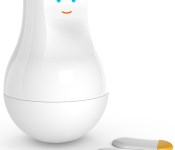
A new company called Sen.se has debuted an electronic device called “Mother,” which is designed to serve as a hub for a series of Motion Cookie tracking devices. Cookies are multipurpose portable sensors able to track a variety of information, including movement and temperature.

As with your real mother, Mother cares about you and loves you. Yet this Mother is programmable. You decide what aspects of your life you want her to handle and she tunes to your current needs. Unlike other devices that specialize in only one area, this Mother knows how to help you in many areas of your daily life: fitness, health, security, well-being and comfort. You decide how she can help simplify your life, ultimately helping you live better, healthier and happier.
Cookies, which interact with Mother, can be stuck on any object and will capture and analyze movements and factors like ambient temperature or closeness to the Mother base station. A Cookie can be placed on any object to measure its whereabouts and its movements. For example, if a Cookie is placed on a dog’s collar, it can track when the dog moves too far away from the base station.
Motion Cookies are the first essential members of the ever growing Mother family.
Small and slick, they can be affixed to almost anything. They have the power to detect and understand the movements of objects and people.
Cookies are endlessly reusable and can be placed on a wide array of objects. They are reprogrammable and are able to handle new functionality at any time. Cookies have a one year battery life and a 10 day memory before needing to resync data with the Mother. 24 cookies can be controlled by a single Mother.

Cookies can send alerts to phones, and Cookies near the Mother will upload collected data to the Internet. A number of apps are designed to work with the system, and Sen.se details several different possible use cases for Cookies and Mother, including fitness tracking, monitoring for intruders, tracking temperature, monitoring medications, and tracking sleep.
Sen.se is comprised of team members that were previously behind a Wi-Fi connected rabbit called Nabaztag, which was a programmable and customizable smart object that could connect to the Internet and display information like weather forecasts and email notifications.
Mother is expected to begin shipping in the spring of 2014 and is priced at $222 for a Mother base unit and four tracking Cookies. Pre-orders will begin in February and additional cookies will be sold in sets of four for $99.
| |
Samsung Introduces 12.2″ Galaxy Tablets Ahead of Rumored iPad Pro Introduction
Some analysts expect Apple to introduce a larger “iPad Pro” later this fall, but Samsung has beaten them to the punch. The Korean firm today announced a pair of 12.2″ Galaxy tablets running Android.

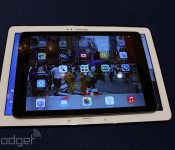
Engadget got a hands on with the 12.1-inch Galaxy NotePro, noting that it “simply isn’t designed for optimal portability” and that it is awkward to hold for long periods of time. Weighing in at 1.66 lbs with a 2560×1600 pixel display at 247 ppi, the device is significantly larger than the iPad Air.
First, let’s discuss the key specs. With a larger Note comes an even larger 9,500mAh battery, an 8MP rear camera paired with a 2MP front camera, “super clear” WQXGA LCD panel, IR support, dual-band WiFi 802.11 a/b/g/n/ac MIMO, USB 3.0 and Bluetooth 4.0. The LTE model promises support for 800/900/1800/2100/2600+850, while you’ll get quad-band HSPA+ (with a max of 21Mbps).
The Note Pro 12.2 runs Android 4.4 KitKat, but the user experience is drastically different than any Note we’ve played with before. Instead of being graced with a standard Android/TouchWiz home screen panel when pressing the home hardware button, you get whisked away to a new interface lovingly called Magazine UX. This experience consists of three separate customizeable screen panels: one for your office/workspace, another for personal use and a last one that handles your social networks and media.
The Verge also has a hands-on video with the new tablets:
There are two 12.2-inch variants — the GalaxyNotePro which includes Samsung’s S Pen functionality, and the Galaxy TabPro which does not — though both include custom Samsung software and firmware. It will come in LTE, 3G and Wi-Fi-only variants and is expected to launch later this quarter. Pricing is not yet available.
Along with the 12.2-inch devices, Samsung introduced several other new Galaxy TabPro tablets, in 10.1- and 8.4-inch variations.
| |
CES 2014: Holi Smart Lamp Coming to U.S. in March [iOS Blog]
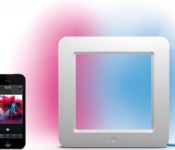
Holi yesterday announced that its iPhone and iPad-Controlled smart lamp will be coming to the United States in the near future. Currently, the square 18-LED mood light is available in Europe.
At just over an inch thick and approximately 7.8-inches wide, the Holi light sports a minimalist design that is meant to fit into any room. Much like the Light Strip and the Bloom from Philips’ Hue line of lights, the Holi is designed to be an accent light. With over 500 lumens, it produces more light than a standard 40W bulb. Comparatively, the Philips Hue bulbs come in at 600 lumens, while the Bloom has a 120-lumen bulb.
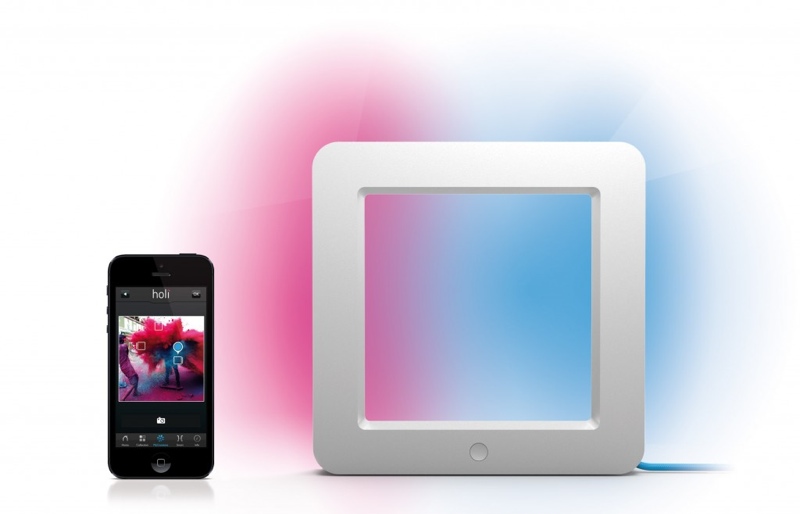
Users can utilize the Holi app to create various lighting effects, which can be shared with the entire Holi community. Holi is able to sync with music, changing color with tempo, and it also serves as an alarm clock with a built-in dawn simulator.
Holi is able to simulate millions of different colors, and it is also able to combine colors with its individual LED bulbs. Similar light offerings, like the Philips Bloom, are limited to a single color. The Holi app can be used to create lighting scenes from photographs, and it includes pre-programmed effects like rotating colors. Three Holi lamps can be synced and controlled from a single iPhone.
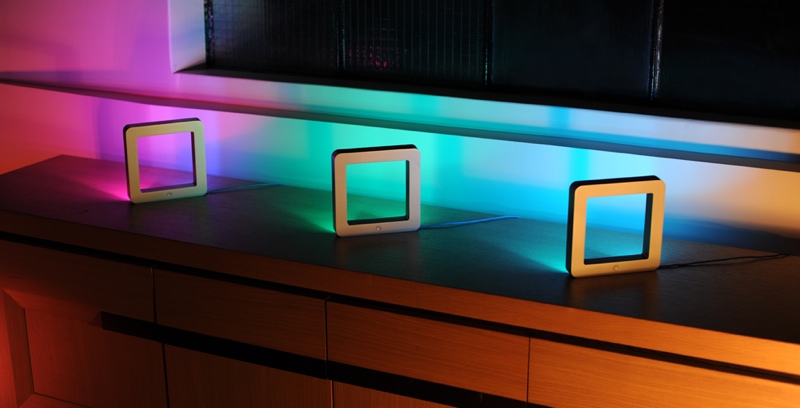
Though U.S. pricing has not yet been released, the lamp retails for €199 in Europe and will likely cost around $200 in the U.S. It is expected to be available beginning in March.
| |
Apple to Announce Q1 2014 Earnings on January 27
Apple updated its investor relations page today to note that it will announce its earnings for the first fiscal quarter (fourth calendar quarter) of 2014 on Monday, January 27. The earnings release typically occurs just after 4:30 PM Eastern Time following the close of regular stock trading, and the conference call is scheduled to follow at 5:00 PM Eastern / 2:00 PM Pacific.
MacRumors will provide running coverage of the earnings release and conference call.
The release will provide a look into initial iPad Air and Retina iPad mini sales during their first quarter of availability as well as iPhone 5s and 5c sales throughout the holiday. Apple reported a record number of iPhone/iPad sales during fiscal 2013, at 150 million iPhones and 71 million iPads.
In its fiscal fourth-quarter earnings call, Apple guided expected revenue of $55–58 billion and gross margin between 36.5 and 37.5 percent. If the company meets even the low end of that guidance, it will count as the strongest quarter for Apple in history.
| |

Apple’s U.S. Smartphone Usage Share Continues to Climb
ComScore today released the results of its monthly rolling survey of U.S. mobile phone users for the September-November 2013 period, showing that Apple’s U.S. smartphone market share has increased 0.5 percentage points for a total share of 41.2 percent. Though Apple’s share continues to grow, it still lags behind Android’s total share of 51.9 percent.
When measuring usage by handset manufacturer, Apple continued to come in first place by a wide margin, with Samsung coming in second at 26 percent and Motorola, LG, and HTC bringing up the rear with just over 6 percent share each.

152.5 million people in the U.S. owned smartphones (63.8 percent mobile market penetration) during the three months ending in November, up 3 percent since August. Apple ranked as the top OEM with 41.2 percent of U.S. smartphone subscribers (up 0.5 percentage points from August). Samsung ranked second with 26 percent market share (up 1.7 percentage points), followed by Motorola with 6.7 percent, LG with 6.5 percent and HTC with 6.4 percent.
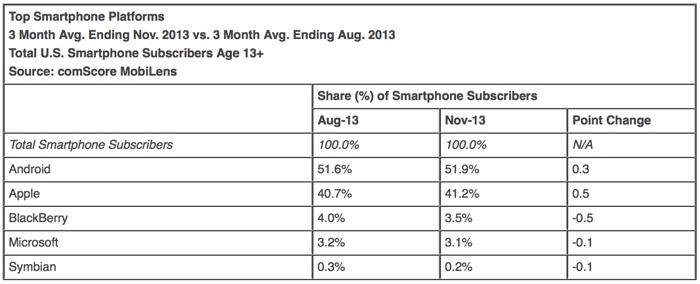
Collectively, Apple and Google control 93.1 percent of the U.S. smartphone market, with BlackBerry, Microsoft, and Symbian losing share during the November period.
ComScore’s data tracks installed user base rather than new handset sales, which means it is more reflective of real-world usage but slower to respond to shifting market trends than some other studies.
| |

How Angela Ahrendts’ Burberry Experience Could Drive the Future of Apple Retail
Later this year, Burberry CEO Angela Ahrendts will move to Apple as a new senior vice president in charge of Apple’s retail and online sales efforts. Before Apple announced her hiring in October, Fast Company spoke extensively with Ahrendts across several non-Apple related interviews. However, since the announcement, she has unsurprisingly declined any interview requests.
In a wide-ranging profile, Fast Company looks at Ahrendts’ job history and work style, the troubles Apple Retail has seen in the past few years, and how her experiences at Burberry could shape Apple Retail’s growth going forward.

Ahrendts’ is not a tech-savvy geek, but she has a vision for how to speak for customers. In an interview with Vishal Sikka, a development executive at SAP, Fast Co. discovered that she exhibits some Steve Jobs-esque tendencies:
She saw a wealth of information… what did customers respond to? What did they like or dislike? What did they share on social media? She thought there must be a way to collect and share such data with the whole Burberry team, as well as combine all six of Burberry’s consumer-intel databases into one salesperson-friendly interface. “She wanted to merge the digital experience with the in-store experience,” Sikka says. She did not know how to do that herself; she freely acknowledges that she is no digital native nor is she fluent in the language of coders and engineers, but she is very good at asking for help. “She is not a geek. She is not technical,” Sikka says. “But she has a vision for things she wants to see, and she has a profound understanding of what technology can do for people.”
Beyond that, Ahrendts put extensive amounts of technology into the sales experience at Burberry. She created a back-end system that allows every Burberry salesperson, across 330 stores, to access all the data that the company has collected on individual customers, including data as detailed as whether customers prefer to browse merchandise with assistance or to be left alone.
The company uses RFID tags extensively, allowing customers to bring a piece of merchandise to a mirror and a video will appear with a model wearing the coat. She also oversaw the creation of a website where users can upload photographs of themselves wearing Burberry attire, allowing users to share their looks and potential buyers to imagine themselves in Burberry garb.
Finally, Ahrendts appears to take a page out of Ron Johnson’s communicative playbook. Johnson was famous for the videos he recorded to be played to all Apple Retail employees at quarterly staff meetings, and Ahrendts currently does weekly videos for Burberry’s 11,000 employees.
At Burberry, she communicates constantly with her 11,000 employees, sending emails to thank them for a particular contribution and frequently jetting to offices and stores around the world (she tries always to be home by Friday night to be with her husband and her kids, who are 18, 17, and 13). She is adamant that significant news be shared first with staff, so that they never learn about their own company by reading the papers. She does a weekly video update–soon, perhaps, Apple staff will joke about how perfect Ahrendts’s hair is, just as they did with Johnson. Her main message is usually “thank you.” Sometimes that’s an epilogue to an all-hands call to action: “I will sit there on the webcast and say, ‘Okay, guys, we’re nearing the end of the quarter and it’s really tight, but I know we’re gonna make it because there’s 11,000 of you out there,’ ” she says. “‘Could you do me a favor? Just one extra call to a customer? ‘Cause if you do that, we’ll win.’”
Angela Ahrendts will join Apple this spring and will continue in her role as Burberry CEO until then. In his email to Apple employees announcing the hire, Tim Cook said Ahrendts’ shares Apple’s values and “focus on innovation” and that she “embraces our view that our most important resource and our soul is our people”.
Apple Retail has been without a leader since John Browett was fired in October of 2012.
| |
Pebble Announces Next-Generation $249 ‘Pebble Steel’ Smart Watch
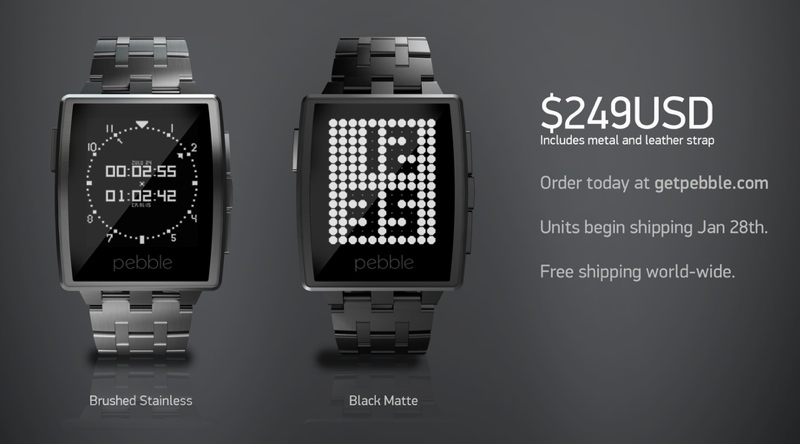
Pebble today announced its next-generation Pebble Smart Watch, the Pebble Steel, which features a stainless steel body with a leather or steel band and a face covered with the ultra durable and scratch resistant Gorilla Glass used in Apple’s own products.
Along with a new metal or leather band, a deviation from the plastic band of the first-generation Pebble, the Pebble Steel features smaller side and top bezels for a slimmer, lighter profile. The Pebble Steel weighs 45 grams, two grams less than the original Pebble.
According to Pebble CEO Eric Migicovsky, who spoke to CNET, the Pebble Steel is designed to be a more formal version of the original Pebble.
CEO Eric Migicovsky describes Steel as a more formal version of Pebble: “I’m going out for dinner, I’m wearing a suit, I’ve got a position that doesn’t allow me to wear a plastic watch on my wrist. How do I benefit from a smartwatch? How do I get notifications and run all the apps that Pebble offers without having to put something that I don’t prefer on my wrist. We took that as an industrial design problem. It wasn’t really a software problem…We just had to build an aesthetically different Pebble.”
The band is available in both brushed stainless steel and a matte black steel, along with black leather. Pebble Steel lasts for up to a week on a single charge and includes an LED indicator that displays battery life. Like the original Pebble, it is waterproof.
Along with the Steel, Pebble has announced that its app store will be available to users later in January. The company is also partnering with new companies to introduce a playback control app for Pandora, ESPN sports stats and box scores, and a car stats monitoring app from Mercedes.
Pebble Steel will begin shipping on January 28 for $249, a $100 premium over the existing Pebble watch. Pre-orders can be placed today on the Pebble website.
| |

Pebble introduces the Steel, an all-metal smartwatch with an elegant look (video)

To say 2013 was a good year for Pebble is a huge understatement. The company started out at last year’s CES showing off functional versions of its iconic smartwatch — you know, the one that generated over $10 million on Kickstarter in a matter of weeks — and it ended the year by announcing it had pushed more than 300,000 units and was planning to launch a dedicated app store. But while the watch has a healthy ecosystem, loyal following and a sporty look, the Pebble isn’t exactly the kind of device you slap on your wrist for wine-tastings or galas at the local art gallery. For those types of events, you’ll need a premium-looking smartwatch, but good luck finding one; you’ll probably just opt for your traditional Rolex or other fancy piece of wrist jewelry over anything else on the market.
Fortunately Pebble didn’t come to CES empty-handed this year. CEO Eric Migicovsky announced the Pebble Steel at the company’s press conference this morning, which takes the original Pebble watch and encapsulates it in an all-stainless steel, CNC-machined body. If you like the idea of the Pebble, but don’t think it radiates enough elegance or class, the $250 Steel may be more up your alley. The new device will be available alongside its predecessor on January 28th, but you can pre-order it beginning today.
So what did we think about Pebble’s new look? In a nutshell, we like it (although the jury’s still out on the name itself). Keep reading below to get our full take on the new watch, and enjoy the image gallery and hands-on video first.
Before we go any further, let’s make an important clarification. The Pebble Steel isn’t replacing the original version, which will continue to be available for $150 through several different channels. Fortunately, it isn’t creating fragmentation within the Pebble lineup either; aside from a few minor hardware changes (such as a new charger, Gorilla Glass, an anti-fingerprint coating and an LED notification light, which is used to indicate the watch is charging), the Steel adds very little extra functionality. Many of the other specs remain the same: the e-paper display, waterproof design, user interface and battery are identical.
Indeed, the most striking changes to the Steel are all cosmetic, all of which are welcome improvements that give the Pebble a much more mature appearance. The stainless steel body is surrounded by a small, black racing stripe near the top, which doubles as an external antenna; without it, the Bluetooth signal would be consistently obstructed by the watch’s metal chassis. Each Steel will come with two wristbands — leather (below) and metal (above) — but this time, standard bands aren’t going to be compatible. Pebble plans to release the design specs in a 3D-printable format, in case third-party manufacturers want to come up with a wider variety of options.

You can also choose between two available colors: Brushed Stainless and Black Matte. While both models feature the same build material and quality, the black unit’s casing is coated with a Physical Vapor Deposition (PVD) finish that helps make the body more scratch-resistant and slightly more durable.
We’ve always been fond of the original Pebble’s look, but there is definitely something to be said about the fact that the Steel is simply more stylish, not to mention easier to use. It still feels just as comfortable to wear and even the buttons offer a more enjoyable experience; we didn’t feel like we had to push as hard on the Steel’s buttons to navigate around the UI, which is a huge win for the watch’s industrial design.
Earlier we mentioned that the Steel unfortunately doesn’t use the same charger as the original version. Since the new watch is shaped quite a bit differently than its predecessor, the team had to make some adjustments. Fortunately, the result is at least a good one: In theory, since the contacts actually have a little bit more surface area, it charges the Steel faster. Also, don’t worry about having to buy a new one — as you might expect, it’ll come with one in the box.
On the firmware side, the Steel will come with Pebble OS 2.0 built-in, and you’ll be able to take advantage of the company’s new App Store. CEO Eric Migicovsky tells us that more than 6,000 developers have already submitted apps, so the Steel should have a pretty healthy selection of games, watchfaces and other apps when it launches. This list of apps includes ESPN, Pandora, GoPro, Yelp, Foursquare and Mercedes.
Pebble Steel. January 28th. Tell your friends.

AT&T Introduces ‘Sponsored Data’ to Allow Businesses to Cover Cost of Mobile Data Downloads
 AT&T today announced a new Sponsored Data program to allow its customers to download content or apps over cellular data, with businesses picking up the cost of the data — that is, downloads won’t affect the users’ monthly wireless data plan allotment.
The system, which works similarly to toll-free 800-numbers, was originally rumored nearly two years ago.
According to AT&T, the service will allow companies to sponsor data use across a number of industries including healthcare, retail, media and entertainment, and financial services, and giving a number of possible use cases in its press release announcing the program:
– Encouraging customers to try a new smartphone or tablet app.
– Promoting movie trailers or games.
– Providing patient healthcare support via wellness videos.
– Encouraging customers to browse mobile shopping sites.
– Allowing businesses with ‘Bring Your Own Device’ policies to pay for the data employees use for specific business-related apps and services.
– Enhancing customer loyalty programs by providing sponsored data access to products and services.
For users, the program will be nearly invisible, with post-paid customers receiving automatic access to Sponsored Data when on AT&T’s domestic wireless network. Prepaid customers will not be able to use the Sponsored Data program.
U.S. cellular carriers have been in something of a marketing war in recent months, particularly between T-Mobile and AT&T. Recently, AT&T began a new promotion to offer up to $450 in credits to customers that switch to it from T-Mobile.
The new sponsored data program, if widely adopted, could reduce user concerns over data usage, particularly after AT&T has moved aggressively to wean customers off of its unlimited data plans.
| |

